Wolfram Student Podcast S1.5 Ep 3: Using Graph Rewriting to Study Discrete Lattice Systems
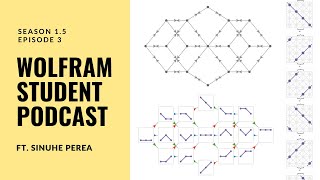
Sinuhe, a physics PhD student at King's College London heading to Max Planck, uses Wolfram Language to study topological properties of discrete lattice systems through graph rewriting. His project finds that certain field configurations on lattices get frozen in place by topology, creating isolated states that can't reach each other through single-step moves. He uses Manipulate to visualize how these systems behave on different surfaces like tori and Klein bottles.
Questions this video answers
June 28, 2023
Manipulate
Gracias
King's College London (PhD in physics)
Chapters
Hello, everyone, and welcome to a special episode of the Wolfram Student Podcast. I'm Sam and I'm your host. Today, this is the Wolfram Student Podcast, where every fortnight we dive into a new innovative project done by high schoolers using the Wolfram language. For this episode, let's welcome Sinohe, who'll be discussing his project on topological invariance in discrete lattice via graph rewriting. Hello, Sinuhe.
Hello there. Nice to have this opportunity to talk about the Guelphra language.
Yeah, it's great to meet you. So why don't you start off, tell us a little bit about yourself.
Absolutely. Well, I did my undergrad in mathematics. I did physics back in Spain. Now I joined in London, the King's College London, for doing my PhD in physics. And soon I will join the Max Patty Institute for Colloidal Interface to try to discover more about the boundaries between physics and biology.
Well, that sounds really cool. I guess congratulations on being a doctorate student. Sounds really amazing. Can you give us a little bit of insight into your history with Wolfram?
Absolutely. The first time I heard from Wolfram was in an outreach event back in Oviedo, that's sitting in Spain, where I take my undergrad. And I discovered that all the things that we did in the blackboard could be very easily translated into very nice function, manipulate function from Wolfram. And I really started to understand that despite the numerical process that we can do with Matlab, Python or other languages, Wolfram could help us for the theoretical people to understand the equation and try to see which were the really deep consequences of that. Since then, I started to get involved with the Wolfram project, and I think I joined the summer project of last year, and then I joined the physics projects about understanding the rewriting rules. And since then I became an ambassador from Wolfram. So more or less that's my relation with the Wolfram.
Yeah. No, that's really cool. I like what you said about using Wolfram to kind of model more theoretical things, because I think, like, the graphs and the visualizations that are available in Wolfram are very useful to seeing things in, like, a different light. So I totally agree with that. And then just like a fun little function question that we like to ask everyone. What's your favorite Wolfram function?
Well, I'm afraid for me, in the theoretical point of view is the manipulate, because you can play around with all the equation that normally looks like very nasty equivalent things with this equal symbol in the middle. And with manipulation, you can really play around and see what's Happening with this relationship. So for me, I'm afraid it will be manipulated. Definitely.
Yeah, that's a new answer. We've never heard manipulate before. A lot of people generally go with table. But yeah, manipulates are also very powerful.
I think maybe with one, with just one parameter could be equivalent and as you can see in the table growing the different. The unique parameter. But when you try to play around with different parameters, manipulate is starting to show enough its power.
Yes. Yeah. So getting into your project, you know, topological invariance in discrete lattice via graph rewriting sounds really cool and also very complicated. Can you give us a quick summary?
So the idea is we try to understand objects that happen in other contexts, like in magnetism, biology or in economics. We try to build up which are the main building parts from these things. And for that unfortunately we need to use mathematics. In this part we are going to try to talk about a discrete lattice that basically for us will be just a grid of different points. And the idea is we play around with different configuration system that for us will be just generalization of of our function. We are going to see that indeed this is quite a naive approach because we are taking many assumptions, but even that in that case we're going to get really cool conclusion that could be applied, for example to scale. And that's the reason the nickname for this project was Gracias, which means thank you in Spanish. Because we are playing around with graphs, cycles that will happen when we talk about the toroidal expansion. And then finally we get some physical insights about the scadiums.
That's a really cool name. I like it. Gracias, if I said that right.
Absolutely correct.
Great. So why don't you get into your project?
Absolutely. So let's try to set up which are our goals. That is, we wanted to understand why Skymions are so popular thing in physics, in acoustics or in geology. The idea is we started trying to discover what's the important part of it. And for that we need to use some kind of a new theory that it was emerging in the 80s, that it was a mesoscopic theory that basically we can explain like the sum of the theme. It's more than overall things we can have even we have some ingredients. We can create a magnificent receipt that could have different taste that they wanted that we expect in the beginning. Things like Skymios are a very good example of this. And for us, Ischemios it will be just some kind of particle that could be treated as a particle, although indeed it's not a Real true object, but we can push it and we can move it like a particle. And it happens in different systems. When we have a defect, when our space has some particular scenes, we have a singularity. And we know that in physical space, infinite and zeros are very tricky things and maybe didn't exist in normal configuration. So we need to have a smooth transition. So when we have our singularity and we wanted to wrap around this singularity, we need to do it in a smooth way. And that's where schemers happen. So there is. We have a problem we need to condense it with using some mathematical artifacts. And the way that nature evolved to wrap these errors, these defects are. For example, in this case there was firstly create in the context of particle physics, in the context of non sigma models, which are a bit a part of our topic. But then it was discovered that it could be applied to many, many other situations. We are going to talk about defects that happen in our system. And this is another very sophisticated word, that it's topologically protected. That means that even we set that system, when we app. Apply some perturbation, the system will stay. We can think very easily about that. For example, when we have some hole in our. In our cloth, although we try to move and compress or stretch our cloth, we are always get this hole. These things that are. These topological effects will can exist in many other situations, from acoustics to a magnetic system. So as we see that it happened in many, many particular situation, let's try to see which is the origin for that. And for that we are literally trying to explit our space. And therefore we are trying to obtain a discrete space in which we can go in different jumps time to time. You can call it, if you are daring enough, a quantum version of our problem. But indeed it's bigger, it's on a scale that is even smaller like that. We are going to the mathematical. The mathematical configuration that could cause this kind of defense. So for that we are going to develop some mathematical model. And then at the end we are going to discover that some context that happen in other fields we can understand with these very simple ideas. And for that I wanted to mention another extra thing that indeed this thing that we are going to try to build, build from scratch right now is something that in principle we don't know exactly which is the scale that it will have. So maybe we are doing a very small number of points, or maybe they are too much. That is something that we saw that it was a problem in the world in the Warframe project. And ideally searching which is the amount of this of this object will be a very interesting part. So for that let's try to think of something, a grid of points that we just have in a square lattice, for example. And for that, the object that we are going to study, it's mathematically stock is described as PI by one. But for us we can understand it like a high brush in which we have a two dimension that is going like up and down top in our hybrid, or left or right in our hybras. And when we place a single hair on this structure, we can see that we have some configuration. So basically with this idea, let's try to move on a bit. And the idea of trying to do this thing is because in this microscopic system we have some properties that initially they don't appear, but when we have many of them combining together, we can earn different extra properties. That's for example, what we happen when we try to scatter a structure that is chiral in the sense of its place in a way if it's different from each mirror image in this kind of situation. Although in principle we don't have properties about misostructure in the context of properties that relation with light, with sound or with other waves, when we have this kind of configuration, some of these properties are inherent and therefore we can have new behavior for the same objects. That's something that it was exploited recently trying to see in the context of scattering of point like dipoles in magnetokedal structures. And we discovered that even we don't have any magnetic, even we only have some magnetic behavior in our points. If we set up the points in a certain particular way via geometry, we can obtain chirality in a freeway. This is one example of the application of this theory. But we are going to go more into detail about this fiber. So let's go now a bit more. So the idea is for that we are going to use a model that is schema geometry that it was developed from the Wolfram language. And then let's try to see what can we do with it. So basically our ingredients for this thing will be something that is called fiber geometries, that basically it's like this thing that we mentioned before about high brush, that it's corresponding to fiber pandas, but in a more generic way. Let's try to see some examples. Imagine that our hybrid didn't have any dimension up and bottom, and we only have left and right. So we can have this kind of structures in which we just have left or right position and they are discrete. Like for example, this struct has only 4 points and nevertheless this one has 5. If we starting to have that the end part starting to touch with the initial part. We can have this kind of cyclic things that it's some mathematical idea that the end is the same as the beginning when we started to create also some dimension. In the other dimension we can have some kind of triangular cubic or a square lattice. These things that are the square lattice in which basically we just have a direction that is going left to right and a direction that is going up to bottom that we call tribal bundles will be the basic object we discuss in our project. And indeed it will be the ones that will emerge this extremio lattice. There is some extra point here because this is the original case. But imagine that we apply these SQL properties. In this case we can join this right hand side with this left hand side and therefore we have a wrapping in one direction. We can do the same between the top part and the bottom part, which will give us some cylinder. But we can do both things at the same time. And therefore we obtain what mathematically called a torus, which for our understanding is just a dot. If you have played ever play a spacing battery, you can discover that it's basically this structure of this kind that when you go to the corner on the right, you immediately appear on the left hand side. And if you're starting to play around with this kind of configuration, you can start to obtain non trivial topological object like this famous Mobius string or the clean button. But I'm afraid that will be polite. So now let's talk about more about.
Yeah, for sure, the Mobius strip thing. So essentially is that like a, I guess a quiver is what you said. Is it like a quiver representation of kind of the connections between points in a Mobius strip, like if it was laid flat. So like, I don't know.
Yes, let's try to see. Let's try to see exactly how it works. The idea is, imagine that we have this bundle that for the moment is not connected, but we try to connect this thing with this other part, right? We can do it joining this with this point, this with this point and this with this point. And therefore we are going to have some kind of cylinder without the. The upper and bottom part, right? But we can do also we can join this point with this other point and this point, we see other point and this point with other point. And therefore we obtain the Mobius state. That is basically what we get here. We just get this bundle in which we connect this point with this other point, which point with this other point, and this point with this other point. These are the label.
Oh, okay. That's really cool. Thank you.
So the idea is, when we have this structure, we can see that different properties will depend of the different geometries that we have. It will be not the same. We play around with the bundle, with the Mobius strip, or with the clean bottle. That is when we also try to glue these other two structures. These are topological objects that are a projected plane and many other names that are sophisticated. But bear in mind that the novelty of these cubic geometries is that they are finite in the sense from getting to this point to this point. We need to do a jump for that. There is no points in between all these things. Nevertheless, bear in mind that when we have a large amount of these points, we can more or less have some continuous idea. But the novelty of this is that we are going to deal with things that are discrete that we can color just point by point. So with that we can try to move a little bit more. So these are our original things that are our bundles. And let's go to the field configuration that we mentioned that before. So if this is our high brush, this field configuration will be just placing a hair from our head into this place. And you can see that, for example, in this case will be corresponding to putting the hair in this position. And here we just need to have some specific rules. We need to this behave as a function in the sense of we cannot have this thing happening two times. Maybe when we think about in the real space, it's not quite a good idea, because we can have vertical hair, but we need to discover that this is indeed in a continuous thing. But here we're trying to do discrete approximation, so we cannot allow that thing. And we have another extra property that is what we call a smooth or continuity in this discrete space. That basically means that we cannot jump for any position to the next position in an arbitrary way. We can do it with only jumping one position up, one position down, or just staying in the same position. That's a way of describing continuity these discrete bundles. And ideally for us, we are just going to play with functions that are smooth in the sense continues in this discrete fiber geometries. And it's a completely new topic. What happens when we have more elastic fiber bundles in which we allow jumping from here to this point. So this is our basic ingredients. And now we know which is our grid. That basically is these fiber bundles. We Know what these are? These field configuration that they are basically some function, but living instead of a continuous environment, a discrete environment. And then we can move on on trying to see what's exactly going on with these things. That is, how can we talk about graph theory when we talk about these things? Actually it's because we can go from different states from others. The idea is we have some particular configuration of our system and then we can evolve moving one of these points with the rules that we have previously mentioned that will be correspond to our rules that we can only do movements that are smooth in the sense of when we go from this position to this position, we see that we just move the central point, but one step to the top part. Or when we are this position, we can go back to the previous position, moving this point to the bottom part and going into this thing. So for a specific fiber bundle, trying to see which are all the different allowed states that this fiber bundle can have, we can create a different graph and two in which each edge will correspond to a different state. And we can see that two positions are connected. They are linking with an arrow. That's in the graph theory that we can link with an arrow between them. If we can transform one into the other. Just doing one step. So for each structure that we have, we can transform this. We can obtain a different configuration. What's the funny part over here that we can try to see which is the structure of this kind of graph. And for graph we just need to talk about edges and vertices. And let's try to see what happens when we try to classify different kinds of of hyper patterns. So for that let's try to move on. And it is. Let's try to starting with some easy cases. We call it linear coagulus because we just go from left to right and to bottom to top. There is no connection between the left and the right or the bottom to the top. Now for that we can do even a more simplistic case. We can talk only when we have in the first dimension only two possibilities. And maybe the image is not clear for this initial part, but later we are going to discover why we call it linear rubber part. So the idea is when we have only two possibilities, it's equivalent to having just two states. And we have in the second dimension n cases is that we can go upper and upper. If we use another representation for representing which is the height of our structure. Using a color brand, we can label this as the first atom, this as the second atom. And with the color we can represent will be the height of this configuration. The funny part here is that for respecting that we have a smooth configuration. For example, if our color code is red, blue, green, we can never have red close to green, because that means that the jump in one single step will be two. Two steps in the in the vertical direction. So that won't be allowed. So when we try to create which is the structure we obtain with this kind of fiber bundles, we discover that indeed it's a rubber band. Because you can think about a rubber band stamping from the bottom part. And we can just move each of the each of these edges of this particle. And we can try to go and moving them step by step till we obtain both position and at the top. Maybe when we see in the cycle version, it will be understand better. But this is the the idea that we wanted to emphasize. But now we can do the other way around. Let's imagine that instead of having just two atoms, we have any number of atoms. But we can only have two steps. Bin in the bottom and bin on the top. Therefore, we only have red or blue lines that will correspond at what we call the tesseract binary machine. That for us we can just understand as a binary number. Because if you link the 0 value with the color red and the 1 value with the color blue, you can see that we can represent numbers with that. It's called binary machine. But we can, because we can sum quantities with this fiber. And when we plot it, we discover that actually the shape that this graph has, it's a cube of dimension N. Mean N the number of the different atoms that we have. For example, if we do it with just two atoms, we are going to obtain a square. If we do it with three atoms, we are going to obtain a cube. And with four atoms we obtain a tesseract. And in general we can obtain more hypercubes. That's another example that we found. Another question that we have is what happened when we mix these two things together. When we have any dimensional number of atoms and any dimensional number of of position state of different heights. And when we obtain exactly the square version, in which we have the same number of atoms of position and the same number of heights, we obtain what we can call it the chess key, because actually it represents the movement of a queen of a king in a chess board, that it's represented by the number of of chess board with size equivalent to the number of the atoms. For example, that will be the movements of a chess scheme in a three by three bore. If we try to characterize this graph, it's quite interesting because it's already mentioned which is the number of different positions that you will have that is corresponding to the edges of this graph. And it's one of the online encyclopedia intersequences. But we discovered that the number of arrows that we can have that corresponding to the edges, it wasn't yet discovered. So we included in the OAS, in the online encyclopedia of intersequency, which is the number of arrows of edges that we have when we have this kind of configuration. And that was quite a nice application of one of our studies because we started only with something that a mathematical object that only depends of mathematics and maybe some topology, because we talk about continuity and then we obtain which are the different movements of a king in a chessboard. And furthermore, if we instead of talking about continuous function, we talk about elastic function, we can simulate which is the movement of a knight or of a bishop or even the queen or a chessboard. So this is a very nice connection that we found while we were understanding this kind of elements. And now we can move on a bit more. And we can see what happened when we starting to left, when we are starting to link left and right and upper and bow and bottom. So that's exactly what we talked before about a rubber band. And let's try to see, we can see more clearly now. So basically here we have a rubber band and then we try to move it upwards or downwards. When we have the previous case in which both things were linear, we don't have the connection, therefore we cannot close the rubber band. But now we can see clearly how this elastic band could be moved from a bottom position to upper position. Yes, by smoothly moving the edges of this configuration. It's funny because indeed we cannot do a transition from this part to this part, because that's exactly the part of the elastic rubber band. So that was a nice connection. And when we started to having basically part in the corresponding part for the, for the fiber, for the rubber band, we got in the other dimension, in the second dimension, we can have it what we call the snake band. It's basically a bundle that could be understand as a snake trying to climb from a tree. Because now the cycling is in this direction and we don't have a closing between left and right and we have the closing between bottom and top. And that will be like a tree and a snake trying to climb on it. As you can see, these names are quite, quite friendly because the mathematics behind them, it's not so friendly. So it's Nice to have some duplicative and reaching more engaging types. That's till this point we have seen that all these positions are quite simple, because we can always connect all the position that we have in our graph. That it's equivalent that our graph it only have one connected component. That means that we can go from each point of the graph to any other point of the graph. But when we started to join left and right and bottom to top to form the torella thing, we're starting to see that now there is states that cannot be reached, that we cannot smoothly transform one state into the other for all the cases. And let's try to see that that. So there was also some kind of configuration of how these different these bundles behave when we increase the size of our dimension. But I'm afraid it will be a bit off topic on this thing. But. Okay, so now we can try to see which is the toroidal case. And then it's quite interesting because now we discovered that when we allow to join left and right from bottom to top, there is some components that cannot be moved. They are frozen and we cannot evolve them to obtain other things. And when we see this in in the configuration, we see that when we have a smaller number of. Of. Of different position, we only have one component. This is the graph that we had before, but in a more nice display. But when we starting to increase the dimension of these components, we're starting to see that there are isolated points that cannot be linked to the requirements. Start to think this more deeply. We mentioned that these are smooth things. So when we perturbate this state, maybe we can go here, we perturbate further, maybe we can go here. But we can transform all this position. If we do some perturbation, we apply some change. But when we are here even we apply any perturbation at all, we cannot move because this point, this state is not connected to any other point. So we can call these states topological protective. Because there is no neighbors that we can connect to. And therefore this thing will correspond to defects in real system. For example, when we have a chain of atoms and at certain point we break the binding between two atoms, this configuration that will be broken cannot be evolved to the original thing. More interestingly, when we started to jump even to higher dimensions, these are the configurations that for example, are frozen because we cannot evolve to any part at all. We're starting to see that we have have more isolated points, more topological effects. But when we started to have even more situation, we started to see that, well, these frozen state are not yet frozen, because they can evolve to other configuration, but they are still closed in their components. So we can have some topologically protected defect that can evolve in different states, but we cannot jump to the other configuration. Let's try to think about physics in this case. Imagine that this thing is something that it has all the configuration that are in the minimum configuration, in the minimum energy configuration. And this thing will be states that are higher energetically and therefore not normally allowed in the nature. But as we cannot connect this with this one, this will be local minima of our configuration. We can think about that when we try to climb into a mountain and we go to the first peak, that is not the highest peak of our mountain, but we are still on a local minima and we see that we can move, try to escape from that point with for example, throwing a ball. But when we see that this ball again falls into this peak, so we starting to see that we can discover physical ideas just talking about mathematics, a very small mathematical object. Let's try to see more. These are for example, different components that you can see that we can in these different things, we can jump from this position to this position, but still we cannot jump from one part over here to this other part here. And that's the topological protective that we mentioned before. And now the question is, well, we can do increase this thing and maybe we can call this thing the trivial case. Maybe we can call this thing case one, maybe we can call this thing case two. And indeed there are mathematical objects that can characterize this thing. And they are the invariant topological that they are integral quantities that could characterize this configuration. We can call it what it's called in the literature, winding number, because this is a way of wrapping a defect going in the positive direction, in clockwise direction. And maybe this will be the anti clockwise direction. So the funny part here is without applying any extra condition, we obtain some nice condition of our system that we didn't expect at the beginning, but it emerged that's the part of the mesoscopic strike. Okay, so how it's the connection with this physics that we started to mention before, which is the connection with the experiments. So indeed it's quite simple to identify. Let's try to see what happens when we have this configuration, this field configuration in our fiber bundle and this other one. And basically, if we can think on a physical system that can identify it's in the context of matrix, but it could be understand even more clearly. Let's call this state that it's pointing towards them, having our Hands going down. And let's call this state going the hands up. So the question is, how can we go for hands down to hands up? We can do in two different ways. And actually these are the two different configuration. We can do it just rotating our hands, starting from the bottom and rotating for example clockwise or anti clockwise. And that will correspond to do this thing. And I bet you to try to do this at home because you will see that it's quite straightforward because basically just protecting your hand from from bottom to top. Or you can do it other way. You can start from the bottom position and you can start to raise your hand towards the top part. So the idea is even these are quite naive ideas. This correspond to some well known concepts in magnetism that are called domain walls. That basically domains in physics are corresponding to many atoms that have the same property. And a domain wall is exactly the world that separates two domains with different values. In the context of magnetism, it will be things going with the spin. That is this thing that electrons and atoms can spin up or spin down. So a domain wall is just the way that we can connect a domain that has hands down and hands up. And we can try to evolve from one to the other doing this configuration that is rotating. And in the literature it's called blocked domain wall. Or we can do it just by raising our hands. That is what is called the nail domain one. Another question is. Well, we have assimilated ideas from magnetism. When we apply these fiber bundles. How can we obtain the schemes that nevertheless skimming is just rotating these elements into a cylindrical coordinate. Let me try to show this image. So we have this domain wall and we started to rotate in this direction. And what we obtained this structure overall, it's a scenario because we have a problem that it's starting here. Because here we can see that we're starting with something that is hands up here in the boundaries. We have something that it's hands down and how the system tried to evolve to this configuration to this configuration. It's what we call escape. So we saw that when we try to evolve from this thing to this thing via different ways, we can identify as different field configuration from our fiber band. Furthermore, we discovered that there is even another next kind of skillmium because we can talk about nil skimmers when we try to do it in this way. We can have block skimmings when we try to do it in that way. And a new way of schemas that we can call quiver scheme. It's when we try to do the looping from going from here up to down in this direction, because you can see here that all the arrows are pointing in the same time. But when we try to do it in this direction, in the ASIM multi direction, we can discover a new kind of of skill news. So the idea is with that from mathematics, we have discovered a nice connection in the field of physics in which we can see that with this very small structure that are corresponding to the fiber bundles, we can understand which is the scheme. Furthermore, this is something that it was previously discussed in the Toulouse claimant relationship. But here we have developed these ideas from scratch just using mathematical arguments. And that's basically what I discovered with this project, that the limit when we have enough technology to understand physics is actually mathematics. We can use mathematics for understanding other things like physics, biology or economics.
Okay, right. Anyway, I think that was super cool. Not sure I understood 100% of that, but I've hopefully gotten the main ideas. I like the sentiment that like technology at its limit applied to physics is just pure math. Not the biggest fan of physics. I'm a much more more focused on like peer math. But I like the concept. I think it's very interesting. Okay, your project was super cool. Again, not certain I understood all of it, but I like learning about this whole concept. And you explained it really well. I guess like now that you've used Wolfram language for a while and for like really advanced projects like this, what are your kind of thoughts about it? Do you prefer it more to other coding languages? What do you think is the power of its capabilities?
So there is. I honestly think that the powerful thing of Mathematica is just trying to join things from the real world and extract information in a natural language through programming. But indeed, and from exactly the opposite way, I'm happy to see that theory could be understand very well and could see visualized with Mathematica. So I think the most powerful feature of Mathematica, it's so broad, it could be useful to understanding applied concepts and we can very easily extract information from real world with this natural language, but could also be useful for more theoretical application in which we wanted to see mathematical results.
Yeah, very true. I remember like a few projects I've done, I've used it both on like as an application side and also just to visualize the theory behind things. So I think that is, it's very versatile in that sense. And then I guess, is there any future work you want to do with Wolfram? Maybe like the continuation of this project or maybe an entirely different project, I'm.
Afraid it will be considered entirely different. Right. But in the end it's quite connected. We have seen that basically when we allow more technology to the, to the physics, we can start it to join mathematics and therefore we can use mathematics to learn more things about physics or other other disciplines. And ideally that's what I'm trying to do with. If we have electromagnetics, if we allow some numbers to be instead of real numbers that are are the ones that we know from school, we allow them to be imaginary or complex numbers. We can see that even in the first time. This makes no sense mathematically, physically speaking, mathematically speaking, they are quite useful. And when we get back to the physics, we discover that it's quite useful and how this related to skymius because we can use skymios as a way of communicating information with us. And that's done when we allow the things to be instant of real numbers, complex numbers. So my next project hopefully is try to use these ideas of mesoscopic ideas to try to control the light in the nanoscale. Trying to build computers that are made with light instead of electrons.
Yeah, no, that sounds really cool. I'm interested in seeing it when you, when you publish it.
Me also true.
Well, thank you so much for coming on and speaking with us today and sharing your very interesting project. Have a good day.
The pleasure was all mine. See you around.
Thanks for listening to this episode of the Wolfram Student Podcast. We hope you learned something new and took away insights from today's discussion. If you want to be featured in a future episode, fill out the form@tinyurl.com WSP S2 interests and be sure to tune back in one month's time to hear our next episode. Once again, thanks for listening to this episode of GoogleFarm Student Podcast.
More from Guy


Cheryl Strauss Einhorn | The Human Edge: Smarter Decisions in the Age of AI | Talks at Google



Rachel Glennerster | Innovation and the Center for Global Development | Talks at Google

Rebecca Winthrop | Rethinking the Purpose of Education in the Age of AI | Talks at Google

Dr. Robert Wachter | A Giant Leap: How AI Is Transforming Healthcare... | Talks at Google



