Wolfram Student Podcast S2 Ep 1: Recreating the Beresheet Lunar Crash
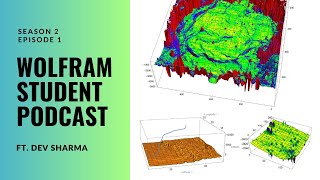
Dave Sharma recreated the 2019 Beresheet lunar crash using image analysis and telemetry data. He found the crater's elliptical shape suggests a low-angle impact, and calculations show the lander had enough fuel (76 kg) to land safely if thrusters hadn't failed. He also mapped optimal landing zones on the Moon.
Questions this video answers
2019
Approximately 76 kg (Dave also referenced ~70 kg in places)
MorphologicalComponents
The rocket equation
2023 (he was a rising senior at the time)
Chapters
Hello, everyone, and welcome to episode one of season two of the Wolfram Student Podcast. I'm Sam. And I'm Rashank and we're your hosts.
This is the Wolfram Student Podcast, where every fortnight we dive into a new innovative project done by high schoolers using the Wolfram language.
For this episode, let's welcome Dave. We'll be discussing his Wolfram project on recreating the Beresheet lunar crash. Hi, Dave.
Hi.
Kind of. So if you could just get us started with, you know, your name, your grade, where you're from.
So my name is Dave Sharma. When I attended the Wolfram Summer Research program in, like, a few months ago in 2023. And I was a rising senior at the time, so I live in India. And when I came to the program, I went up to Stephen Wolfram. I told him I wanted to do something related kind of to math, but in a slightly more fun real world context. And he gave me this project on recreating a lunar crash, and that's what I spent my two weeks there on.
Sounds pretty cool. Yeah, definitely takes a bunch of courage to tell Stephen Wolfram directly what project you want. So I guess prior to, like, the program in 2023, have you had, like, any prior experience with Wolfram? Have you done a previous program?
I think in about March or April, I heard about the Wolfram student program, and I realized I didn't want to be lazy and do nothing with my summer. So I wanted to apply for it because I'd heard things about the Wolfram language, but I'd never really interacted with it before. So I got to learning the language. Just kind of breaking that barrier. That initial, like, barrier was about, like a one week time, and then I kind of got the hang of it. And then obviously the first few days of the program just helped me kind of solidify that knowledge of the language.
Yeah, yeah, for sure. And that's. The Wolfram language is definitely a different paradigm from, you know, a lot of other. Yeah. Languages we're used to. So. But I'm glad you were able to get the hang of it really quickly. So, I mean, I'm sure you've used all sorts of cool functions in this project, but is there one that stands out to you? Anything you would call your favorite Wolfram function?
Okay, so my favorite Wolfram function by far would be something called morphological components. I don't know if you've used that.
Yes, I've used that.
Morphological components.
Yes. So for my own project at the.
Summer camp, the way, like, I was using it, and the way you use it is you take an image and you take some kind of, like, bitmap of that, whatever. And I was using images of craters. And if you've ever seen a photo of, like, the lunar surface, like a picture of the Moon, there are lots of, like, cracks and stuff like that. But you need to get the crater to stand out. So morphological components detects with some kind of threshold. I have no idea how it works. It detects clusters or components of pixels and just finds. It turns a random image into these components that you can use to analyze different things.
Yeah, it's a really cool function. It was very helpful for my own project, too, but, yeah, I'm glad you liked it.
Cool. So now that we know, like, a little bit about you, do you want to take us into your project? It was like a summary and then dive right in.
Okay, yeah, 100%. So my whole project that Steven kind of gave to me was about recreating this very specific lunar crash. So in 2019, there was a lunar lander, the Beresheet lunar lander, that was supposed to land at this, if you've heard of it, the Sea of Serenity Crater. But in kind of the last three or four minutes, it experienced some failures and it crashed. Now, the most interesting part is not that the lunar crash happened, but kind of what. At least to me, the most interesting part is what happened afterwards. So the Beresheet lunar crash had a whole treasure hunt surrounding it related to finding the exact location where it landed and finding out whether some important payload was inside. So my whole project was an attempt to kind of further that, I guess, treasure hunt that started in 2019.
Cool. So sounds like a really cool project. And it's unfortunate what happened to that lander, but so based on your description, it sounds like they were trying to do something like the Pioneer spacecraft or, you know, the Pioneer plaque, but for. For the moon, right?
Yeah, 100%. 100%.
So, yeah, let's get into it then.
So when I kind of started with it, I had quite a bit to work with, but I wanted to take a slightly more unique approach. So kind of the attempts that had been made before were surrounding image analysis. If I can just go into that. So there were images published of photographs taken by NASA of the site and what crater had been formed. So Stephen Wolfram himself published this paper where he just went into great depths of the Wolfram Image Analysis Repository, and he just figured out all of these things just from looking at these two images. So if you See them right here. They're available on, like, the public NASA pages. So just from these, like, few images of the crater, he went all out, which is figuring out different aspects of the size of the crater, how it was formed, the structure of it all from image analysis. So that had kind of been explored. And what I wanted to do is I wanted to look at more physics, angle of it. So the angle of approach, if I could say for me, was to look not only at the images themselves, but of some data that I could find about the data that was sent back by the lunar lander. So if I was to break down my project, I did some image. I tried to first recreate the impact crater by looking at the energies, and then I tried to look at the actual energy used by the fuel. And then finally, I was looking at plotting the path of the lunar lander. So those kind of three key features were how I structured my analysis, and I kind of structured my attempt at this, analyzing this lunar crash.
Cool. Okay, that sounds like a very reasonable approach.
Okay, so I'm just going to restart that part. So the first kind of idea I had for working through this was to look at the crater and try to recreate it. So, key thing that you need to understand, and this is something I had no idea about previously, is in geology, I guess, when craters are formed on the Moon, the only real, really big thing that matters is the angle at which they impact and the amount of energy with which they impact. So most of the time, there's going to be some kind of explosion of energy just when it hits the surface, and that tends to create these circular craters. But the Beresheet impact was kind of unique in that sense, that it had an elliptical crater. And that elliptical crater I kind of found and analyzed by this morphological components library. So after I was able to kind of find out that it was an elliptical structure, I went into the data. So I found the bear sheet telemetry data. So telemetry data would be the data that the lunar lander kept sending back while it was kind of in orbit. So from the telemetry data, obviously, it told me the velocities at different points, it told me the altitudes at different points, and I knew the mass of the lunar lander. So from all of that, I was able to get the kind of the kinetic energies, how much fuel was left in it, the potential energies. And after all that kind of fun stuff, I found this paper online which talked about how to estimate impact craters on the surface of the Moon. So this was kind Of a game changer for me. So it was a paper. Yeah.
This is really interesting. I just wanted to, you know, ask. I hope you don't mind. Just wanted to ask, you know, you told me that most of the craters on the Moon are circular, whereas this one was elliptical. Does that have something to do with the shape of the lander or what's that about? And then, you know, based on that is what. Did this equation still apply to any object? Or was this model based off of, you know, the usual impacts that you see on the Moon and not, like, artificial objects? Just curious, right?
No. Okay. That's probably the single best question you could ask because that was the entire focus of this first kind of investigation that I pulled. It was, why is this one elliptical? While as most other creators. Have you ever seen a photo of the lunar surface? You know, most of these are going to be circular. Why was this one elliptical? And the answer came down to the impact angle. So I believe. I'm not entirely sure about this metric, but if a lander impacts at above 12 degrees relative to the lunar surface, it'll always have this circular kind of landing spot, this circular crater. But if it's at a low enough angle, it'll drag across the surface and create this elliptical crater. And that's what I wanted to show. So. Got it.
That's really interesting.
So it was trying to do this almost flyby type landing. It was going at a very low angle, and when it crashed, it formed this elliptical type crater. So at this point in kind of my investigation, I ran through the telemetry data, and I was just plugging things into this equation that I'd found online. And what I came up with was the ability to recreate, well, how the crater should look like based on my calculations and based on my images. So I got a pretty close representation. If you see it in the Wolfram community post, I got a little red circle, which told me what my calculations predict the crater should look like versus how the crater looked in the actual images. And this was probably the biggest kind of first breakthrough I'd been able to get through my project. And I was really happy about it.
Yeah, this looks really, you know, these are really impressive results. So I can definitely see why this was like, you know, you had the aha moment in a project and you're like, yeah, it's starting to make sense now. After, like this flagging in numbers into equations and trying to connect the dots. Yeah, that's great.
So I'm pretty sure you could say this about most Projects going on a bit of a tangent. Most projects that I'd seen, because a lot of the time I spent working on my project was just spent talking to other people about theirs and trying to gather any kind of ideas from that was everyone starts out with this idea that their project's gonna be super fun and interesting, but it's not as much fun as it is just a series of roadblocks that everyone kind of sees themselves faced with. And that's really interesting to me because this project had a lot of roadblocks. And I feel like I developed new ways to overcome those roadblocks just by one trial and error. But as I kind of went through it, I got these kind of newfound intuition for how landers would work on in space. And just. It was an interesting thing to see. It was an interesting thing to see for sure. So probably if I moved on. So once I kind of analyzed the crater itself, I wanted to understand why the lander crashed in the first place. So I looked at the crater, but now I wanted to know how much the. Why the crater itself happened. Why did the Lender crash? And one thing I looked at, and this comes at that there was previously published research, previously published results. One thing that the kind of the company, the arch mission, One thing they published was that at the time of crash, there were. Let me look at this. I believe it was 70 kg of fuel. Okay. Okay. So it has. It had 76 kgs of fuel inside the lander at the time that it hit the ground, hit the surface. So what I wanted to understand is, one, why didn't it use that? And two, if it had used that extra fuel to kind of propel itself, would it have been able to save itself? So, and that took me down this whole rabbit hole of mapping fuel usage. So from the ideas that I had previously about telemetry data, I used the speeds to plot through the kinetic energies, and I used the altitudes that it kind of sent back to get all the gravitation, all the gravitational potential energies. And if you've ever taken a physics class, you would know when an object is falling, all of its kinetic, all of its potential energy goes down, and it transfers to kinetic energy. And that's kind of the perfect state. But if you looked at the graphs that I got out, the lines were anything but straight. There were clear drops, There were clear hikes. And from these drops and hikes, you can see that something must have happened. Something must have happened to switch it up to change the motion of the lander. So what I Was able to do is I was able to look at these graphs, identify the major drops in total energy. That was time when the energy of the motion majorly decreased and there was work being done on it. And based on those drops in energy, I was able to get that at these points, the thrusters were using fuel. How much fuel were they were using? Well, if you do a quick google search of what lander's thruster type they had, they had something called a biopropellant engine. What type of fuel were they using? They were using this fuel that was a ratio of hydrazine and an oxidizer. And based on all of these little values I was able to get from the Internet, I realized that this fuel had a specific efficiency. And to get those kind of energy drops, to get the kind of drops that it required, it had to have dropped about. I found the exact values of how much fuel it had used at different points in time. So how much work was being done, how efficient was the fuel? And I found that at it was using exactly about maybe 1 1/2 to 2 kgs of fuel. And this was surprising to me because, like I told you at the beginning, it had over 70 kg of fuel left on board, and it was only using about 2 kgs to save itself. So there was some major, like, there were clearly some engine failures, clearly some system failures that contributed to that. And what I wanted to know is, could the lander have saved itself if it were to be functioning normally? If it were to analyze the. If it was to use its fuel efficiently, as it would have if there were no system failures, Would it have been able to save itself? And that kind of brought me to, if you've ever seen it, probably the most. Probably the coolest named differential equation in the world. It's called the rocket equation. So I use the rocket equation. And the rocket equation talks about something where if you have a changing mass, like you would in a rocket, how does that velocity change over time? How does it accelerate over time? And from the rocket equation, what I got out of it was that the lunar lander actually had more than enough fuel. It had more than enough time, more than enough fuel for it to get down from its velocity all the way to a very safe landing. And that only told me one thing, that as much as there might have been, there were no problems with the fuel itself. Everything was perfectly planned until at the last moment, system failures were what caused the lunar lander to crash, it not being able to correctly use its thrusters. So this was, again, one of those really cool moments where you go down this rabbit hole of solving these differential equations, of finding these random values for fuel efficiency, looking at these graphs of potential energies over time. And all of that brought me to this point where I realized got a true insight from all those numbers. Kind of through the Wolfram language and plotting all of it down from those numbers, I was able to get this idea that there were actually, it was actually more than possible for it to have saved itself.
Oh, that's, that's a very strong conclusion. You know, I feel like this is something, you know, on the level that the company themselves would do. I mean, these are calculations that they would do in retrospect to just, you know, analyze what they could have done better. And. Yeah, this is amazing, man. I mean, have these results been published before, something similar to these, or like this sort of analysis?
Can you see my screen if I move to a different page? Yeah. So like I was kind of telling you, there's this whole. There was this whole treasure hunt for the Lunar Library, right, that was done by the Arch Mission and Nova Svivak. And in this they kind of have a catalog of all the different kind of researches that were done, all the kind of attempts that were made.
So.
From that I kind of got the idea to look at fuel usage, but as far as I know, there were no in depth analyses of the kind of energetics or how the energy changed over time of the lander, and there were no real calculations about where those drops were. How much fuel was it using? Could it have used all of its fuel?
Yeah, no, these are really great conclusions. And specifically that question of, you know, could the thruster have saved itself? I think that was a really important one to ask. And I'm surprised, you know, you did tell us about the entire hunt that went on, but I'm surprised nobody else thought to take a look at it before. But wow, now you get to contribute to the entire original literature on that.
The last kind of real analysis that I did for looking at the lunar crash and looking at how its path across the surface onto its crash, where I looked at the actual trajectory plots. So if you've ever seen a trajectory plot, and I'll show you some of them in the kind of further down trajectory plots work by plotting different velocities, finding where the lander was at different points in time. So all of this just came down to analyzing that data and looking at it in terms of where it was over time. And then by probably the coolest little repository I found on, in The Wolfram language, I was able to get data about the surface of the moon.
Well, that is without question the most, the most badass data repository I've seen. Just the entire. And this was specifically. So was this like what file format was it? Or was it just part of the repository that Wolfram has?
No. So what I. What I'd initially thought was I was going to have to import these from some random like CSV files I found on the like Internet. But no, all of it was directly built into the Wolfram language. There was, if you ever use like geolocation libraries for stuff on the Earth, all of those functions work for stuff on the moon. Oh, wow.
Okay, that's crazy. So it's inbuilt. That's.
It's inbuilt. Fully inbuilt.
Correct.
So I was able to use all of this GEO elevation data to really answer some questions about its path landing in and how that was affected by the terrain of it. And that was an extremely interesting time. So I kind of looked at what are. What's probably the best way to go about analyzing this. And I found that one thing that if you notice if you look at its trajectory plot across the surface of the moon is it's not straight. It's not a straight path. There were clearly times when the lander was using its thrusters to like we mentioned to no real availability, but it was constantly using them to try to maneuver itself. But at some points it was just freefall. I think the main computer on board just was not able to control the thrusters. And there have been theories about that. They say that the computer itself failed. So that was the analysis I was able to get from this, that if you look at the trajectory plots, you find it's not what you'd expect from a normal falling object. It was an object that at different points in time was attempting to save itself but failing at other points. So that's what I was able to get from that. Right.
Wow, that's such a cool visualization. And yeah, I can definitely see your point. This is not what a dead object falling to the ground would look like. It's definitely trying to change its trajectory and trying to change its path. But yeah, for whatever reason that did not happen. And as you said, they're bother us about that, but this is really cool.
Right. So I guess without the exact blueprints directly from the company itself, it'd be hard to understand what kind of technical failures they had. But at least from this analysis I was able to conclude that There was some kind of system engine failures that prevented it from using its fuel correctly. And that was the kind of end of my analysis. And one thing I did by suggestion of one of my TAs. So one of my TAs, Macy, she was, she really helped me through kind of this. She kind of helped me through the entirety of my project. But one of the main things she suggested is if you're going to be talking about a lunar lender, and especially one that crashed, you should be looking at the location where it hit, and you should be looking at whether there were better options for landing locations. So if you talk about any of NASA's landings or any of its previous landings or anything on that, they take a lot of time and effort to analyze landing locations because you want to have the best bet landing location to four year crash. I mean, four year landing. So one thing that I was looking at is, and this was kind of an extension as part of my project was around this Mare Seritates crater. I butchered that spelling. So I call it the Sea of Serenity. It's been the site of successful moon landings in the past. So I wanted to look at if I could analyze what would be a good landing spot. And you realize that a good landing spot for a lunar crater is just how flat that region is. So what I got, and this is the picture of it directly out of elevation data from the Wolfram language, is I got the entire terrain of this crater. And what I wanted to look at was find the flattest regions, find the best regions for a possible future lunar landing. And there was no real good way to do this. So what I did is I brainstormed a little with my mentors, I brainstormed a little with my TAs, and I got this idea for how you should be calculating how smooth an area is. So I looked at these little grid boxes of every point on the lunar surface, and I found the maximum height in that area, the minimum height in that region, and I just found the difference. So a very simple algorithm and that kind of told me how relatively smooth it was at every point. And this, all of this kind of brought me to the favorite visualization I was able to get throughout my entire thing. I was able to plot the entirety of the lunar surface. I think there's a better one. It's actually the COVID page of my lunar, of my paper. You look at the entirety of the lunar crater and you find the points with the most flat regions, the most ideal locations for landing. So if you were to look at the, if you were. If you were to look at the computational essay, you'd find the yellow spots on the graph are the smoothest areas, the green spots are decently smooth, and everything else would be a terrible spot for landing. So this is something, again, I was happy with, to be able to come up with some kind of algorithm. Not one that's probably perfectly optimized, not one that's maybe the best solution, but my attempt at how I would calculate how smooth the region is and my attempt at working through this data to get some sort of conclusions from it. And I went through this and I looked at. I started from. Right. So from my analysis of what areas would be ideal landing locations for maybe some kind of future missions, I found the exact landing locations. So if you see this again, there should be another morphological components function. I found all the best regions here, and I compiled them into these little components. And what I found is these four landing locations at different points in the Moon would be probably, according to my algorithm, the best future landing locations for lunar missions that want to land in this sea of Serenity Crater. And I plotted them at a more micro view and compared them actually against the Bear Sheet Lunar Lander's chosen landing location. And I found that this one mine were a lot better by my own metric. So maybe not the best metric itself, but what I was able to get was I was able to find good landing locations for future missions. And that's one thing I wanted to extend on. That's my contribution to maybe the future of space exploration.
Oh, great. Yeah, this is definitely, you know, a pretty big thing, you know, being able to do an entire analysis on your own and not only identify the source.
Of error, but also talk about what.
Could be done better. This is great.
Yeah, your diagrams looked really amazing. Morphological components really came in. Yeah, Cool. So now that we saw your, like, really cool project, is there any, like, future work you want to do with this one specifically? Or maybe just general future projects you want to do?
So when it comes to future work on this project, I think that I have done what I can with the data I had on hand. So one thing about the Beresheet lunar crash is, and one thing about lunar crashes in general is they don't leave you with a lot of information. So I think my analysis was conducted on 40 or 30 or so data points and just all of this external data I could find. So there's not that much more analysis that at least I'd be willing to conduct on it. But when it comes to Wolfram language in General and future projects. I am extremely hopeful and extremely open to the idea because one thing I realized through this program was the Wolfram language is vast, extremely vast. So everything from linguistics, I think so many projects I saw, to graph theory to image analysis, there are all of these very cool features inbuilt into the language that kind of foster future exploration. So if I was to pick what I'd want to do with it in the future, with some kind of future works, I'd definitely be willing to find some. I'd want to do some projects around analyzing city data. So this one project I had in mind and one thing I'd wanted to do at the program was to look at air pollution data in my city. So I live in Delhi and one of the ideas I had going into this program was to look at how air pollution in Delhi is affected by air pollution in other states, along with winds and wind currents that carry it towards the city or carry it towards other regions. So. And I realized a lot of those functionalities were built into the language and that would be a very cool kind of future project that I want to get into.
Yeah, that sounds really exciting. And yeah, I also live in India and I'm very aware of how bad Daddy's pollution is. So I think that would be, you know, I'd be interested in seeing what results you get there. But yeah, whatever you do in general, just best of luck with everything and all your future projects.
Thank you.
If you ever make something cool, just send it to us and we'd love to have you again and care about whatever.
That'd be great. That would be cool stuff here. Yeah.
Thank you so much for coming onto the podcast and sharing your project with us.
I loved it. Yeah. Thank you.
Thanks for listening to this episode of the Wolfram Student Podcast. We hope you learned something new and took away insights from today's discussion. If you want to be featured in a future episode, fill out the form@tinyorel.com WSP S2 interest and be sure to.
Tune back in two weeks time to hear our next episode. Once again, thanks for listening to this episode of the Wolfram Student Podcast.
More from Guy


Cheryl Strauss Einhorn | The Human Edge: Smarter Decisions in the Age of AI | Talks at Google



Rachel Glennerster | Innovation and the Center for Global Development | Talks at Google

Rebecca Winthrop | Rethinking the Purpose of Education in the Age of AI | Talks at Google

Dr. Robert Wachter | A Giant Leap: How AI Is Transforming Healthcare... | Talks at Google



