Wolfram Student Podcast S2 Ep 7: Studying Mergers of Numerical Multiway Systems
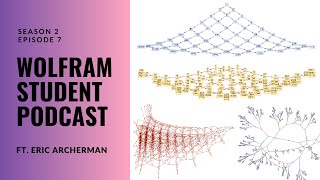
Podcast interview (Wolfram Student Podcast, S2E7) with Eric Archman discussing his summer research on mergers in numerical multiway systems. Eric (a high-school freshman) describes three parts of his project: number-theoretic characterization of mergers for linear functions (e.g., 2x+1 and 3x+1), analysis via causal graphs and prime-factor ‘tokens’, and empirical/observational work (entropy patterns, modular behavior, automata connections). He mentions tools in the Wolfram Language, related prior work, and future conjectures to prove.
Chapters
Hello, everyone, and welcome back to episode seven, season two of the Wolfram Student Podcast. I'm Sam.
And I'm Reshank.
And we're your hosts.
This is the Wolfram Student Podcast where every fortnight we dive into a new innovative project done by high schoolers using the Wolfram language.
For this episode, let's welcome Eric. We'll be discussing his summer research program project on the mergers of numerical multi way systems. Hi, Eric.
Hello.
Yeah, so it's. Yeah, so it's great to have you here. Can you first give us like a quick intro? Know your grade, where you come from?
Yeah, sure. So my name's Eric Archman. I go to the Roxbury Land School in Boston. And yeah, in general I like math, computer science and yeah, it's funny.
That's cool. No worries. Um, so can you give us a little bit of your history with Wolfram?
Yeah, sure. So I actually met Wolfram originally in a math competition. I think he. He lives in Concord, so he just came to speak at a local math competition. And then after that I joined. And then, yeah, and after that I joined his, like, sort of weekly Sunday. He has like these programming things where he just shows cool technology to like, younger kids. And then, yeah, from there I just applied to the summer camp and.
Yeah, yeah, sounds really cool. So you're in 10th, 9th grade now?
Yes, I'm currently a freshman.
Yeah. Nice. Yeah. Congratulations on, you know, getting in to the camp. I hope you had a great time there. Just a question we like to ask everyone. What's your favorite Wolfram function?
Well, I think my farewell function. It's a resource function and it's like just multi way graph because I used it a bunch. But it's. It's really nice. I think I would. I would not be able to make it by myself, but basically you give it like some rules and then it just generates a. A graph for you. So.
Yeah, yeah, that sounds really cool. I know we did a tier list episode on the Wolfram function repository a while back. So. Yeah, that looks. Sounds like a really cool function. Cool. So let's just get into your project. Okay, so before we start, can you first give us like a quick summary about what your project is?
Yeah, sure. So my project, I think it's quite interesting. It's like sort of split into three main parts, I think. Well, first of all, a little background. This is sort of a continuation of some, I think a little project Stephen was working on in 2019 or something like that. And so the. Basically three parts of my Projects. So my project has to do with sort of numbers and then you basically have two functions and you want to see like what combinations of them and like sort of what types of combinations of them will intersect to give you the same value. And the first part was sort of just using sort of like number theoretic like number theory techniques and stuff like that to find these mergers. And then my second part was sort of a more wolfram y sort of thing. It was like looking at the causal graph and then the third one is just sort of more observations and. Yeah.
Yeah, that sounds really cool. I love math too. So seeing how number theory gets used here would be really cool to see. Okay, let's just get right in.
All right, cool. So yeah, it's called the. On the merge of numerical multi way systems. And so first I guess a sort of important thing to explain is like what is a multi way graph? Right. So for if we're dealing with just functions or multi way system, basically you just have like two rules. So for example, if you have like a rule like 2x plus 1 and 3x plus 1, like those are just two functions, right. And then basically there's two options for what you do to an initial starting number. And then each of those options will give two new options. Right. So it's just powers of two. And then occasionally like for 2x + 1 and 3x + 1 the values will intersect and then they actually. The way the. So when they intersect we call that a merger. And then the behavior of the mergers is actually quite non trivial for. Yeah. For example like the 2x + 1 and 3x + 1 and then there's sort of an explanation for that later. Yeah. So let's see. First sort of discreetly characterizing the mergers with like number theory we. The first thing I did was I just.
Just one question before you go on. If you scroll back up to that section on your introduction.
Yeah.
That multi way. Yeah. There were like some few green dots on there. Are those the one. Yes. That image.
Oh yes, yes.
Are those green dots the examples of like a merger between. Yeah, two iterations. Okay.
Okay.
Yeah, really cool.
Okay, so this is sort of the multi way graph for 2x + 1 and 3x + 1. And then as you see the green dots here, that's where they intersect. And usually it looks like it branches out like for the initial conditions I think. Over here. Sorry, over here. But they actually do intersect. And then if we expand that a little bit we get the sort of odd loop, loopy like tree looking like Things. So.
Yeah, looks really cool. Thank you.
Yeah, sure. So our first step was sort of looking at like, where. What things can we use from number theory that will actually like, sort of tell us anything about this? So the, the first sort of result, I guess is. So the first result was that if you have. You can't have a loop of all reds and all blues. So I sort of created this as like an example I didn't take out of the graph. But like. So for example, up here, except for this one, except for this one, there's no loops of all reds and all blues starting from. Oh, no, no, sorry. There's no loops of like all reds and all blue starting from the number one. And then you see this, this starts from number three, I think. So starting from number one, there's no loops of all reds and all blues. And then this. I think you just prove this by just taking the. I mean this is just a sequence and you could just take this mod 8 and then. Yeah. So another one was that sort of like another sort of more empirical result was that if you like the same. If you have the same number of operations on both sides, like up here, if we have. You see, the first merger comes from 3, 2, 1 +1 operations and 2, 3x +1 operations. So there's no up, at least up to the. Up till the 15th iteration, which is around to the power of 15 things, like to the power 15 sort of n cases. There's no intersections where there's the same number of functions on one side and the same number of functions on the other side. And then I actually tried coming up with the proof for that, but I don't think. Or I had a little bit of trouble with that. So that's definitely something for the future which would.
Just one question. How did you, like, I don't know, discover that these existed? Like, I understand that like you found them and then you later tried to come up with a proof, but like, I don't know what step was there that led you to discover these kind of number. Theoretical.
Yeah.
Properties. Yeah.
Yeah. So I think there's sort of brainstorming a little bit. I mean, that seems like sort of writing an essay, which that's definitely not math, like sort of is. But I think I was looking at this graph momentor and then we were sort of like noticing this, like this thing. I think we had just a huge graph and then we're just looking at how it evolved. And then there's actually a bunch of patterns that you can originally see. And Then most of them are sort of just by chance but there's actually some meaning as in these two and then there's another one later and then where's the other one? Okay, so another thing is that because these are sort of linear functions, whenever you have like these two linear functions like we're able to show that these like these sort of loops or these mergers up here like these, like this sort of stuff happens either once or infinitely many times from a single dot here. So because these are linear functions, when you like do like 2x +1 to the function like 2x +1 that always results in a linear function. So it just ends up being two lines on the coordinate plane. And then like since you can have either infinitely many zero or one intersections for two for two lines. Yeah, that's, that's basically why. And then I think, and then I ran the, the picture up till like 25, it took some time but yeah. And then it seems, it seems true that whenever there's an intersection it has to be a sort of unique composition of functions because I didn't see any recurring loops. But I can't, I, I don't have any like proofs for that or anything.
Yeah, no, yeah, I understand what you mean. Like it makes intuitive sense but. Okay, thank you.
Yeah, sure. So let's see. So step two was sort of looking at the causal graph of the multi way system. This was sort of like the part two of my project. So this part is sort of inspired by Jonathan Gorard who originally I was working on this like number theory thing for the first like few days and then I realized like I kind of got stuck a little bit because like I actually tried like sort of some sort of like group theory thing with these. But it like it was quite, it was a quite short lived effort because it didn't really work out. But like I think because they're linear functions they're so they're sort of complex or like they're pretty simple. So there's not that much like stuff about them. But like when, when you like put them together it makes them a little bit more complex which is. Yeah. Which sort of explains, I mean it makes sense why the intersections are sort of non trivial. And the next thing was the causal graph. So basically, basically the causal graph is the graph that emerges from like is the graph of the transformations. So instead of the states which is like the numbers like 1 and then after the function 2x +1 that goes to 3 and then if you do another like if you do 3x +1 to that, that just goes to 10. Instead of having the states like 1, 3 and 10 being displayed, we have, we use the functions like 2x +1 and 3x +1. And so this is an image of over here, this is an image of sort of a letter transformation. So here this transition is like a goes to AB I think this is. And then here A goes to AB again. So this is a sort of states transition graph. But instead of the transitions being like the lines, they're just the states. And yeah, so running this for the, the numerical multi way system looks like this. And then if you do it, if you do it for the, the transition or the, the causal graph, it. It looks like this. So it looks pretty similar, which makes sense because it's transitions. But an interesting thing about this is that if you think of each other each of these transitions because it's the causal graph. What's interesting is that in a transition the prime fact position is not preserved between two states. So for example, if you have a state like five. No, sorry, if you start at let's say. Yeah, so you start from one and then there's a 3x plus one, right? So that goes to four. And then if you have another like 2x plus one that would go to nine. And then if you like. So if you do a 2x plus one or a 3x plus one like that. The prime fact, the prime factorization of the two like the two numbers like the one that you plug in, the one that you get out share no common factors. So for example, like 4 and 9, they share no common factors except for one. So yeah, that's sort of interesting if you think of the prime factorization as the sort of catal. If you think of the prime factorization as sort of like the things that make up the numbers. Because that sort of with integers that's sort of the first thing, right. That you think of like a prime factorization. So because it's not preserved, it makes sense that these intersections are not very trivial. And actually if you look at the prime factorization of the next two, not the two adjacent ones, but the one if you have an input, an output and then ones that result from that output, there's actually some more interesting things between those two. So that explains the complexity a little bit. I mean intuitively it explains the complexity, but I was able to find a way to directly link the two.
So earlier when you said like the complexity of or like the non triviality of the mergers. So that's because of how complex the prime factorizations are for like calculating these mergers.
Yeah. So I can't be sure to like sort of say because of. But it certainly makes sense because, because between transition of two states the, the prime factor decision is completely destroyed. So in a causal graph like generally if we go back to this ABBA to abba for example if you use the letters as tokens, you see the B B and the A are preserved. Right. And that sort of is linked to the simplicity of the graph at least empirically. So if I can zoom in here it's a little bit, it's a little bit pixelated. I think I've mapped these out of resolution but like because it's just age goes to a B. You see like this, this graph has a very sort of simple structure. Right. Because the. Not necessarily because but there's I saw like some relation between like the number of these sort of tokens like the letters that are being preserved each time. And then if you think of the prime factors as sort of the tokens of our multi way system in the causal graph like between two consecutive like causal points there's no like the tokens are completely destroyed and they recreated.
So yeah, yeah, that's really cool. Thank you.
Yeah, sure. And then yeah so this I was sort of establishing a really a relationship between the sort of the amount of tokens that are like preserved and then the complexity of the graph. So for example here you see there less of the tokens are preserved because the rules a little bit more complex and then it results in this more complex but still sort of regular looking graph. And then this is just for string substitution systems. And then later. Yeah, so then for like continue on like the sort of tokens thing like if you just have 2n and 3n that results in like this very uniform looking graph because obviously it makes sense because you're just multiplying by two and three. And then whenever like you have an, like whenever you, you have an LCM they just intersect because 2 times 3 is the same as 3 times 2. But like still this, this sort of preserves the prime factorization of two states. So it makes this sort of more simple thing. Although I can't like sort of be sure to. I mean there's, I feel like there's some relation here but I wasn't able to like prove anything. But there's a lot of evidence to suggest there's a relationship between the two. Yeah. And then also now so since the paths are sort of irregular the next thing like sort of third ish part where I Was just trying to find out more stuff in general about this is like how irregular are these paths? And like what, like how, how can I quantify like how irregular and random they are? So these graphs are sort of the paths that the functions take to the first few mergers. So each move along like each horizontal. So basically for every merger you start at a number and then you go there's just two loops. There's a left hand loop and a right hand loop that because there's two sort of compositions of functions that result in the same number that like start with the same input number and the result in the same output number. So you see the two lines here, one's orange and the one's green. Those are the two sort of function compositions. So every move along the red line is a. Sorry, Every move along the x axis is a 2x plus 1 and then every move along the y axis is a 3x plus 1. And then it results in these sort of zigzag looking graphs. I think my favorite one is this one because it just looks like a staircase a little bit. Yeah. And then.
Looks pretty cool.
Yeah. Like originally I thought that it would be always true that the green line was above the. Above the orange line. And I was like, oh my God, I found something really interesting. But then I realized it was just sort of for smaller numbers.
Yeah, still pretty cool. I like, I like seeing this.
Thanks. And then another thing is if you chart the strings. So for example, if this is like an. If every 2x +1 is an A and then a 3x +1 is a B. I think I use letters R and B just because like red and blue were the colors I use for my graph. But you see, this is actually quite interesting. There's sort of regular dips here. So regular dips in sort of the entropy, which is a measure for how random and how like irregular the paths are. So I think an explanation for this is Steve May actually wrote a little bit about this is if you take this sort of system mod 144, which is like you consider the remainders for the numbers with respect to like 144 as the divisor. So for example, like 145 mod 144 will be one because it leaves a remainder of one after. After being divided by 144. There's sort of these regular dips and then I think they sort of correspond to that graph of 2x + 1 and 3x + 1. Like that multi way graph. We take it mod 144. Because a lot of like sort of thing, a lot of states loop back to the number 31 and then you see like every. So I think starting from 31 and then 100, every 144 things there's a, there's a minor dip. Although I'm not too sure why there's like these sort of bigger dips here, but. Yeah, yeah, go ahead.
No, that just looks pretty cool. I like the results.
Yeah. And then here, and this is like sort of my code and then in sort of appendix. So something else I was working on was you can actually make like a sort of push on automata for this. I designed one like over here using like Thomas decamo Beck's sort of. I used some of the code from his article and, and this, I mean it's pretty interesting. It doesn't really show anything new, but it sort of establishes a connection between this sort of Wolframi like multi way graph and like push down automata from like theoretical computer science and. Yeah, yeah. The way like a sort of a push down automata works is that you have an initial state and there's like transformations to this. So for example, like I think you start with the zero state and then you have these epsilon transitions which just means like they automatically go that way. And then you have a, like I think times two here and then times three here and then you add one and then it just epsilon transitions into these two. And this, this sort of push automata accepts a sort of regular expression of operations. But like the way it works to find the merges is that you have to sort of code it in a way that the merges are already sort of within the push automata. So it doesn't show anything new or it doesn't really reduce the computation time. It's still like to find the mergers you still have to just calculate them beforehand. And yeah.
I think it's really cool that you got to like, you know, just go explore other things beyond your project on multi way systems.
Yeah, thank you. So that's pretty much my project. But yeah, there's pretty much three parts. And then I think my favorite sort of part was. Well, I mean the first few days I like had a lot of progress. And then like after that I was like, oh shoot. Like I'm not, I'm not really like I was so stuck. And then I, I met with Wolfram. I think in the middle of like we had a project check in, I think a weekend or something. And then yeah, I got some more, more sort of directions from that.
Yeah, I think yours was really, was really interesting. I honestly did not know anything about multi way systems, but this looks really amazing, honestly. Probably one of the most impressive projects I've seen from the summer program. Yeah. Do you have any plans for like future work on this or like either continuing this or maybe a different project with Wolfram?
Yeah, definitely. So I think we're continuing this. I made like two or three more conjectures. Yeah. Like in my sort of article thing I made a few more. I mean, I guess we're supposed to call these research papers, but I made like a few more conjectures and I think it would definitely be fun and sort of feel like a sort of conclusion to sort of wrap it up and then prove them. But I think right now like the most like afterwards, I think in like Sunday things, because I still go to them. Like we're talking like Steve and I were talking about a project and it's just like we were talking about the multi, like the, the group. The group theory sort of approach to this. But it's like the same issue with the push down automata is that it doesn't simplify the problem that much. It just. You have to sort of pre encode it into the system and then it's like a very circular sort of reduction.
Yeah, yeah. No, that sounds really cool.
Yeah. Oh yeah. So for the second part of your question, for the like the other stuff I'm doing right now, so I'm doing well, which is pretty fun. It's like the program after this and we're doing some sort of. We're like working on the synchronization of sort of oscillators. So if you have like two pendulums and they're sort of connected in some very small way, like they tend to synchronize. And there's actually a model, it's called the Kuramoto model for that, which sort of characterizes the merges and yeah, we're working on that, which is pretty fun.
Yeah. I'm going to be honest, I don't love physics, but I think that's really cool. I think the Wolfram language is like, it's nice in that how much potential it has for like mathematical modeling. I know I've done a lot of like math modeling kind of projects. Wolfram language. Yeah, I think that's one great thing about it. Okay, thank you so much for coming on and sharing your project. I definitely learned a lot and was very impressed by all that you were able to get done in three weeks.
Thanks.
Yeah, thank you so much and have a great day.
Yeah, sure.
You too. Thanks for listening to this episode of the Wolfram Student Podcast. We hope you learned something new and took away insights from today's discussion. If you want to be featured in a future episode, fill out the form@tinyurl.com WSP S2 interest and be sure to.
Tune back in two weeks time to hear our next episode. Once again, thanks for listening to this episode of the Wolfram Student Podcast.
More from Guy


Cheryl Strauss Einhorn | The Human Edge: Smarter Decisions in the Age of AI | Talks at Google



Rachel Glennerster | Innovation and the Center for Global Development | Talks at Google

Rebecca Winthrop | Rethinking the Purpose of Education in the Age of AI | Talks at Google

Dr. Robert Wachter | A Giant Leap: How AI Is Transforming Healthcare... | Talks at Google



