Breaking the Cycle of Anxiety using Spirituality with Brandon Yuenger | Ep. 71
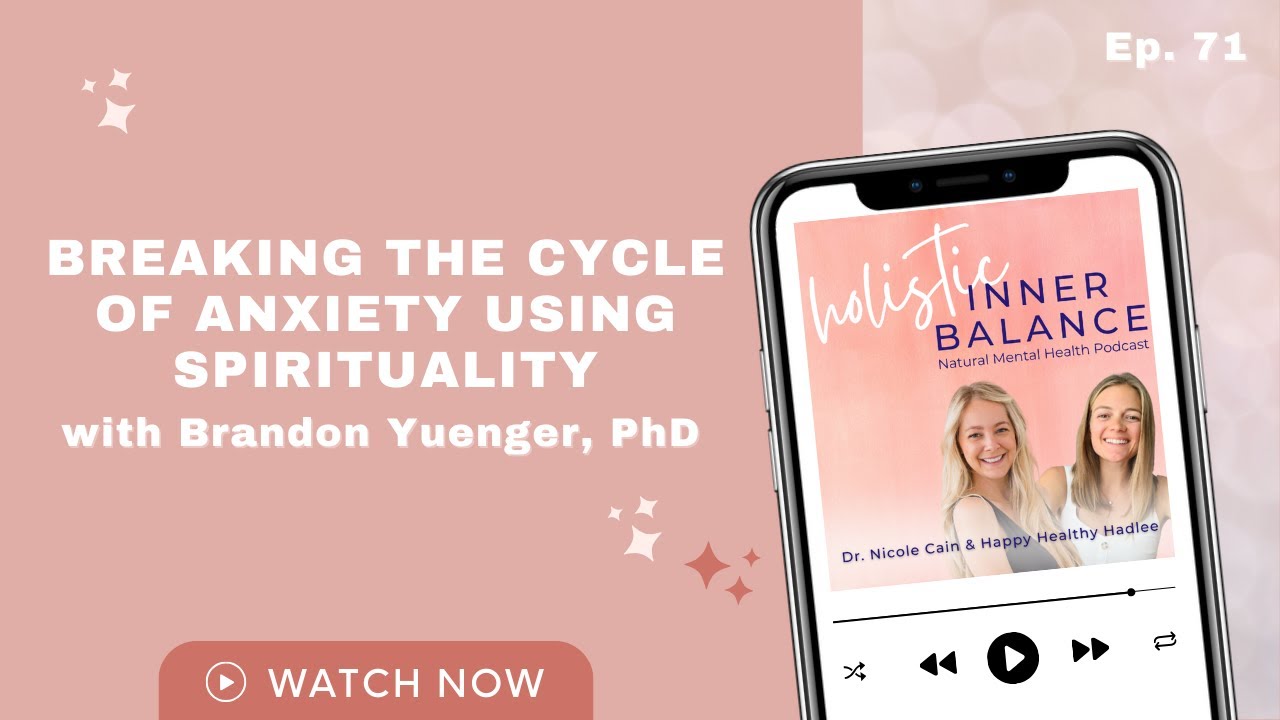
In this episode of the podcast, hosts Nicole and Hadlee Garrison interview Dr. Brandon Yuenger, a Doctor of Physical Therapy with a decade of experience treating chronic pain. Brandon recounts his professional evolution from a strictly biomedical background to incorporating energy‑based modalities such as acupressure, craniosacral therapy, dry needling, and shamanic healing. He describes a pivotal case involving a young woman with severe neurological symptoms, where a simple leg‑pull distraction (long‑axis distraction) and subsequent acupressure led to a dramatic, unexplained recovery, prompting his mentor to introduce him to energy work. Over time Brandon learned to perceive “dense” versus “light” energy in a client’s field, linking these patterns to stored trauma and emotional blocks. The conversation expands to discuss how spirituality, shamanism, and Ayurvedic concepts (the five koshas) can be integrated with conventional physiotherapy to address the root cause of pain, anxiety, and depression. Both hosts stress the importance of self‑empowerment, discernment when selecting healers, and teaching clients tools they can use independently. Brandon shares a practical three‑step meditation technique designed to increase present‑moment awareness, regulate the autonomic nervous system, and facilitate energy flow. He also outlines his current practice (Step Forward Wellness), remote coaching offerings, and a forthcoming research collaboration with a biomedical professor to obtain physiological data on his integrative methods. The episode concludes with reflections on the need for a balanced mind‑body‑spirit approach and encouragement for listeners to explore these practices safely.
Chapters
Hi, we are so excited to be here today. We have an amazing person joining the conversation. In fact, this person is the reason that Hadley and I know each other, and he's an— he's an amazing healer, and he's an amazing human and a great friend. And so So Hadlee and I were like, we'd have to have Brandon in this conversation. And so here you are. We're all here together. And I think this is going to be an incredible conversation. So thank you for coming.
I'm so excited to have you here, Brandon. Let me introduce you before we get started. So Brandon is a doctor of physical therapy with over 10 years of experience treating chronic pain. He's proficient in a wide variety of manual therapies, neurologic reeducation techniques, and energy medicine, including shamanic healing. He's seen firsthand the dramatic transformations that come from tapping into our energetic body and facilitating spiritual healing for people who are considered medical mysteries. His goal is to bridge the gap between science and spirituality to help individuals and communities heal. So that's what we're going to get into today is bridging that gap between, between science and spirituality. I'm so excited. This is something that is very near and dear to my heart, but that I'm not necessarily an expert in. So I'm super Super, super, super excited to be able to learn from you today, Brandon.
Oh, thank you. That's very nice. I don't know. I don't. I feel like I work in this area, but I don't feel like an expert in it at all. Nice about that. Yeah.
Socrates says that right. It's I it's like the process of knowing. It's like in the beginning you know nothing, and then you think you know everything, and then you realize you don't know everything, and maybe you don't know something, and then. You feel like you know nothing again, and then the more that you know, the less you think you know, like that kind of weird process. So the fact that you feel like you don't know may imply that you do know a little bit.
Yeah, especially since you've been doing it for 10 years.
Hopefully I can communicate that, that I know something, so that'll be good. Yeah.
And today we're going to be really leaning into this conversation about spirituality and our mental and emotional well-being, and I'm really excited about that. But what I feel like is really the heart in these kinds of conversations is the person that I get to have, and Hadlee gets to have this conversation with. And it feels like, and maybe it isn't, but it feels like kind of this about-face or this 180 or this big jump to go from like chronic pain and manual therapies and, you know, having this PhD in physical therapy. All the way to where it's very energetic, very emotional, very spiritual, and maybe a little bit less of that like hands-on materialist stuff. So I was wondering if you could just sort of talk about that.
How do we go from the science-y to the, the spiritual stuff?
Yeah, how did you do that? Yeah.
For me, it's a really interesting story, and it's evolution over years. Um, but it really started, you know, going through— I started in engineering school and like biomedical sciences, and then Physical therapy school is very, you know, evidence, evidence, evidence, and all that kind of stuff. So if you don't have double-blind placebo-controlled studies, you know, you don't really have anything, is what we're taught in school anyway. But one of the things that was going on in my life as I was finishing, starting PT school all the way through until I finished up, was that I had, I was having a relationship with a young lady who wasn't really able to find any answers. And so we bounced around, did all this kind of stuff, and eventually she was in front of somebody who became a mentor of mine. And we— so what would happen when she would like pass out, but she wouldn't pass out, and she went through a whole range of diagnoses. But essentially she could try, you could hear her try to vocalize to communicate, and she could tell you everything that was happening, but she couldn't move her body and things like that. And then eventually she started to like convulse and still we had no answers. But one of the things that we had realized one day when I was in— excuse me, when she was in the hospital and she had a headache, and that was like one of the first things that I found I was able to help with, was while mobilizing her neck, we would move one of her vertebrae and like forward anteriorly into her throat, and she would take this big deep breath and her eyes would light up, and then she could move and she could talk again. And so we were like, like, I don't know what this is. Let's bring the doctors in here and maybe this is like something that will be helpful for them. Um, and it wasn't. Uh, so they were like, I don't know what to do with this information. Um, eventually she was told by the head neurologist at the University of Michigan that think happy thoughts. That's the best we can do for somebody like you. And then she finally, she was very much all about the allopathic medicine. And then she, and I kept asking her to go see this This guy who ended up being my mentor, because I'd heard about him and alternative things that he would do. And she finally said yes when she was feeling like hopeless and completely out of luck. And we went and saw him, and she passed out during his evaluation. And I showed him, here's how we wake her up. And then she passed out again a little while later. And what he said— well, I was like, do you want me to wake her up again? He's like, well, if everything her body's telling me is true, this will wake her up. And he grabs her right leg and and just pulls on it. Like in physical therapy, we call it long axis distraction. And she woke right up and I was like, holy shit, I don't know what I'm looking at, but that was amazing. And nobody can figure out, and this is the first time we're seeing you, and you could figure something out, that's amazing. So that was after I graduated and he asked if I had questions and of course I had a ton and I didn't know where to start because it was so far outside of like the way I'd been taught up till that point in my life. But he was like, I don't have a lot of papers to give you. I don't want to, like, for evidence. And I was like, I don't care about that. Like, that was enough evidence. That's all I need to see. And he told me to start practicing, or that he would teach me acupressure. And so that's where I got into it. And then I started working at— with kids with head injuries, and I started working with chronic pain almost immediately. And what I found was that when I would sit there and do acupressure with people, they would get Stronger, their minds would get clear, their pain would go down, so much more so than with a lot— I learned a lot about their osteopathic techniques like high velocity, low amplitude thrust and muscle energy and strain counterstrain, myofascial release, things like that. And those things were so temporary that the people who were the hardest cases would stand up, walk across the room, come back, and their bodies would be in the exact same place as they started. When we did acupressure, they would feel better, their objective measurements would stay the same, and they would feel better for a couple days or something, you know, longer than I could do with manual therapy. So I knew there was something going on, but I didn't know what. And, you know, maybe I have a better idea now, but who knows. So then the next step, I started to learn craniosacral therapy, and I started to find that if I did more craniosacral therapy, I could do less acupressure. And that took a while. That helped me develop my sense of— of energy, like of the person that I'm treating. The more I learned about my own, the more I could identify what was going on with somebody else. And during that time, that was when I started to notice the patterns that would occur within people. I was doing cranial work on like every single person that I would see every day. And I was working 2 jobs, so I was working like 50 hours a week doing cranial, cranial, cranial, cranial, cranial. And what I started to notice was that there was like, I had learned meridians, how energy moves through our body and stuff like that, but I started to notice like our field and how energy would start to move around our field. And it seemed like there was all of this dark energy that would be like in spots around somebody's field or within their body. And as we were doing cranial, it would start to like collect. And at the time it seemed like it started to collect around their heart. And then as the session went on, They— that darkness would like lift up towards the sky and then in would come, uh, I shouldn't say in would come because it would lift up and then the whole space would become bright. And when we got to that point and I had this question, I was like, I don't know, like I couldn't find anybody who could help me answer it. Um, and so up until that point, somebody would give me a book and it would answer my question and it was great. And I was learning a whole bunch of stuff more about like Eastern Eastern medicine. And for that one, nobody could help me until I met Kristen, my fiancée, and her mom was telling me that I should read this book called Shaman, Healer, Sage. And when I read it, it told me— it described exactly what I was experiencing. It would talk about extractions and illuminations, and I was like, that sounds like an extraction and an illumination, what I've been looking at. So for me, it was another thing where it's like, there's not evidence you know, evidence in the paper, the article sense, but there was evidence right before my eyes where this would happen consistently and people would have emotional responses. Like they would have little emotions kind of come up. They'd say, I'm crying, I don't know why I'm crying, or like, I'm crying but I'm not sad, stuff like that. And they would always feel better. So I was like, who cares? People feel better. I don't care about the evidence in the classical sense. Because this is helpful for people. And so I read that book to confirm that I wasn't crazy and to understand like a little bit more that there are cultures in the world that this is normal for them. That's like a normal part of the healing process. And it was just something that I was— I still feel grateful to be able to be a part of, you know, because it's not something that we were ever taught, at least the schools that I went to. We weren't taught that that's anything that exists or has any value. And eventually, this is like the footnote on it, eventually I learned dry needling and I can take— needles are like, have been the best, most helpful tool for me to do the depth of work that sometimes we need to do with people that are really repressed or really have these deep traumas that are stored in their body manifesting as pain. And it allows me to do more of that energy work or that work in their field when I can keep the energy kind of flowing through their body with the needling. Um, so I found that that was like the next step from cranial, was I started to do the needling stuff, and I started to— I would just check their head every now and then to check their rhythm, and I would watch it by the end of like 20, 30 minutes would go back to completely normal, and I wouldn't have to do anything. So I was like, this is an amazing tool. Um, so right now I'm combining the needling with the, the stuff that I learned, energy medicine, and manual therapies and teaching people how to keep it going with, with meditation, mindfulness, body awareness, and movement, depending on what's going on with them. So that's kind of where we're at now.
I have a question. I know Hadlee's like, I have lots of questions. And I have, I have so many questions. So when we— the way that I teach about symptoms is that they're data about the unique way or ways that our body is at a balance, that our mind is out of balance, that our spirit is out of balance. And, and so you're making this observation, this medical mystery case that you started with, is that this woman, she's having these sinkable episodes. So she's passing out, but then she still has some cognizance. She just can't exert any voluntary will over her body. And so then there's a corrective intervention. So he distracts, he pulls on the leg, Applies acupressure. Is that right? He applied an acupressure point or was it just a distraction on the leg?
I mean, he would probably— he thinks very much in acupressure, so he was probably thinking about these points I'm holding on the foot as well as combining it with the distraction. That's my guess.
I'm wondering about when we're thinking about these corrective interventions like craniosacral or pulling on the leg or applying acupressure or dry needling and moving energy, Is how are, how are we examining the root cause of the symptoms with these symptoms? So to try to clarify my question, I'm kind of thinking it as I go. Like, you would do a physical adjustment on somebody, they'd walk away, and then by the time they came back to you, they were back into a state of imbalance. And it's arguably because you weren't treating the root cause, like the body was adapting to something. So then, but there's a difference with the, the new type of work that you're doing. And so I guess what I'm— this long-winded question is, is how is that treating the root cause? Like, what are you doing that's different?
Like, how is the work that I'm doing and described how I learned it, like, what is the root cause? Well, you know, it really depends on— it depends on people. I always kind of preface it, and partially because I'm like, used to living in West Michigan and having people be very like opposed to the ideas that we're talking about. But it also depends on people's perspective because am I going to explain— I'm not necessarily going to explain it to somebody who doesn't believe in what I'm about to say. But for us now, I believe that our spirituality, our energy, our soul is something that is tangible and it's not just where you go to church and then somebody blesses you and your soul is better. We all have this ability. Ability to connect with our spiritual self and our higher self or whatever we want to use or whatever we want to call it. And within that process, there are these parts of us that in my experience show up as like denser and more like denser energy, more like earthly energy that can manifest itself in our— as thought forms or disease processes. And as those things start to be removed from the body, they're usually connected. There's usually something that's connected with some sort of old trauma in our body. And so the way that I look at it is it's a more physical way of moving that density through in a way, like through our body, through our field, and to wherever it needs to go. Sometimes it— sometimes we go up, sometimes it goes down. That's not for me to decide necessarily, but, um, Yeah, it seems like as that energy moves, and it's almost like the energy is more, more of a neutral thing, but then as it moves through our body, we experience what it's been connected to, whether it's a, like, a trauma that we've experienced in our life, or if it's something that's like generational that's been passed down to us. So that's the way that I look at kind of getting to the root. And the person has whatever their personal experience is, and most of the time I just see it as like, oh, here's density, and there's some that are more closely held to our body, um, or within ourself, um, than others. And so we have to dig harder, work more, use more tools, that kind of stuff, to be able to exercise that part of ourselves.
Yeah, I really appreciate that differentiation because I imagine that some people who may listen to this conversation will think, well, I just need new different tools. But I think that the, the reason The why behind why we use a tool is arguably more important than the tool that we use. And it sounds like your why is different, is like you're expressing like, I'm seeing these energetic densities and I'm moving and things are flowing. And so it's different than like, oh, this person has a subluxation here and muscle hypertonicity here. Um, so it feels like a different way of thinking about it, and therefore it impacts what you're actually doing to support restoration of balance.
Yeah, you know, and while you're talking, while you were just describing that, it makes me think of like, what's the other way to say it to people? So that's what something that was being worked on. I was in Western medical, and I mean still am in Western medical setting, um, I guess to a lesser degree now that I'm in private practice, but people aren't going to go for what I just described, you know. But it's, uh, there's a lot that we can start to talk about with, um, our autonomic nervous system and how we've responded. You know, like the idea that everyone has had some amount of trauma in our life. You know, people will often say, not me, you know, everything's been pretty good. But we'll talk about, were you hungry and didn't get fed? Did you need to get held and you didn't get love? All those kinds of things. Those are all traumatic. Literally everybody has experienced that. Nobody's life is perfect. And they can start to shape the way that we view the world and how— and the world being dangerous. And especially when it comes to chronic pain, but I think it works in a lot of other disease states, the same mentality is that once our body is trying to protect ourselves, like, that's ultimately where pain comes from. Because pain is a warning signal, like something's going on here. Pain is information, you know, about something that we need to be looking at. So when somebody can start to understand that there's this thing about their brain, their autonomic nervous system, system that doesn't ever really stop and is always going on behind the scenes, then they can start to be like, that's maybe more of a scientific bridge for them to say, oh, there is more that I can learn about myself. And then through that process is typically where the healing comes.
So good. Yeah, I'm, I'm incredibly curious about the link with trauma and also shamanism, because I know that Peter Levine, who's, you know, one of the great teachers on all of this, talks about shamanism in, in some of his books, you know, thinking about how we actually heal trauma, because we aren't that great at it in Western medicine. And so, so I would love to hear a little bit more about, you know, how that relates for you when you're like working with someone, like working through, um, a trauma? Or do you even think of it as a trauma? Because you mentioned you kind of look at it as like a dense energy. Um, do you— is that kind of like a, like interchangeable term? Or do you think of it as slightly different?
I think of it as that's what I'm working with and seeing, because essentially, um, you know, once when we start getting really far out there about like What's happening during these sessions. Essentially, like, shamanism is to connect with these other realms of existence outside of, like, the linear way that we look at life. And so for me, it's often about just like— I think I've called it like painting by numbers. Like, things show up and look a certain way, and that directs me to a certain tool or technique or something like that. And it's always just like, what does this person need right now? And there's— so most of the time what I'm seeing is I'm working with those dense energies and what shows up as a dense energy for me. And then as those things start to move, typically that person is experiencing that movement as that trauma. That's if we talk about it like it's trapped in our body or something as it starts to move. So I think they could potentially be used interchangeably. It's just more like the person who I'm working with is going to experience it as you know, this memory and this thing that happened. And, you know, oftentimes they're feeling it in their body in a certain way as well. So they're experiencing it somatically and emotionally, um, whereas I'm maybe only experiencing it, uh, as like these subtle movements of energy within their field. Um, you know what I mean? So hopefully that answers your question.
Yeah, totally. Yeah, no, I think that's, um, that's so cool. And for those, you know, for those of you who are listening who are like I don't even, I don't even know what shamanism is. Um, do you want to just like describe that a little bit more for us?
Yeah, you know, it's the word itself is even super loaded. Like just saying, saying like a shamanic healing practitioner or something like that is oftentimes people are— I've had people be like, well, what's the— they want to know like, where did you learn it from? And, and, um, what the group is and all these like very— I don't know, I don't— I guess I don't really know what they're looking for, but it's like a way to decide in their mind, is this person legit or not? Because I'm a white person, you know, and that isn't the culture that I was raised in. But, um, you know, it's one of those things where I guess for my own— for my own self, it's like that's something that showed up in my life, so I just learned more about it. Um, but so shamanism typically, you know, for somebody who doesn't know anything about it, they would be thinking like native cultures and how they heal typically. Or if you think about like tribes in Africa or people that live in the mountains in South America or something like that, how they typically do healing. You know, they're more— it's more of a connection to the spiritual realm and using what the earth gives us to facilitate healing for another person. I think if you Google shaman, it's somebody who connects with the spiritual realm to facilitate healing. That's something that we don't ever think about. It's something that if people are listening and have no idea what it is, it makes a lot of sense because our medical system doesn't believe that that's a part. We don't say that that's a part of you, so we don't look at it. That's why we end up with people— I mean, I think that's why we end up with chronic pain in the first place is because we're not even assessing a system that has a heavy influence on your nervous system, and your nervous system is in charge of everything else. So not a surprise that people wouldn't have any idea what that is. And so the next part I think is tough is like, okay, so we're gonna say that it's somebody who facilitates healing through connection with, into the spiritual realms. That still maybe doesn't mean anything. And I'm not sure, maybe you guys have questions or something where we can go a better direction to help people understand, because right now I'm like, if we're thinking that that doesn't even make any sense, then it's hard to elaborate.
I was sort of thinking about that too and finding a little bit of personal dissonance in the need to go down that fly bottle and analyze it. But then at the same time, then it's just— it's— I found like a lot of those times that there's just not the correct language, or maybe even useful language for it. So it is what it is.
Mm-hmm.
And it isn't what it isn't. And it can be incredibly useful beyond placebo, as in that case that you described. But at the same time, I feel like this almost sense of protectiveness over people, because I feel like there's, there's this intangible sacredness of our spiritual being. And having somebody who has the authority or has been given the authority or the ability or desire to do an intervention or to intercede in that part of a person's being, I feel like you gotta be really careful with that. And so in that sense, it does feel important to define it and protect it. And so, you know, 'cause coming from the naturopathic world, I was encountered— I encountered all sorts of people from all sorts of spectrums, you know, people who identified as witches and people who identified as vitalists and, you know, so like shamans and like we went with Peter Bigfoot into the mountains and ate off of the land and, you know, like— just all sorts of spectrums. And I've seen it be incredibly healing, like in the work that you do. And, you know, we've had mutual patients, and the work that you do is amazing. And I've also seen other people be really incredibly harmed by it. So I guess, how can, how can I, as somebody who's, let's say, have anxiety, I'm listening to this podcast, I'm like, oh wow, I love what Brandon's saying about spirituality, shamanism. And so what do I do? Just like Google somebody who says they're a shaman and then go? Like, what do we do? Like, where's the accountability? Where— how do we do that?
Yeah, that part's hard because I think anybody can say that that's what they do. So for me, and I don't have a good answer, I really don't. All I know is that having a medical background, in my opinion, is super helpful because then at least you have more knowledge of like what's going on in the body and potentially how to refer somebody that maybe needs something beyond a spiritual intervention. Yeah, you know, there's a lot of, a lot of asking around. I don't necessarily have like— I wish there was like a good place, but there's lots of places where you search and they'll say here's the shamans in your area and stuff like that. The best thing that I can come up with right now is For me, if you try something or if you feel called towards a certain provider, that could potentially be a good way to find somebody. And that, you know, even that in itself, saying that calling, you know, how connected are you? Like, is it something where you want so badly for somebody to be your healer that you're gonna say, I was called to them and so they're gonna be my healer? I don't know. I think it's a great question, Nicole, because I really don't know the answer.
Yeah, neither do I. I'm sort of hoping you did. Hadlee, you're our only hope. What do you got?
Yeah, it is hard because— and I've seen this before, where especially in the spiritual world and like the self-help world and stuff, There are teachers and leaders who can use the language of self-help and use the language of spirituality to manipulate, and to make you think that oh, what you're thinking right now is just a self-sabotage, or oh, it's just you know, like a you know. Dark energy, or, you know, some— something that is like, they can kind of convince you of things. And so I would just say, discernment is so important. Um, with any healer or someone that you're working with, I'm a really big fan of bringing, um, self-empowerment into it and, and really empowering our The people that we're working with to be able to make decisions for themselves and not look to other people to make decisions for them, right? So like, you know, in our medical model, it's, it's, we put our— put the authority on another person. And so I'm just, you know, as someone who is a teacher and, you know, who helps people with this stuff. It's— for me, it's all about I'm— I don't have the answers. I'm not going to give anyone any answers. Rather, I'm gonna just ask questions and see what they come to for themselves. That's all I've got. I don't know if that's helpful.
I think that's a good— I mean, for me, that's a really great answer because as I'm sitting here like thinking while you girls are talking, I'm like, well, what would— what What would be the difference from maybe other people that I know to what I do? And I'm teaching people about themselves. So when you're talking about self-empowerment, I think that's a big thing. Maybe you have to do a couple sessions with somebody, but are they looking to be regarded as your healer, or are they trying to help you move on? The example that's coming to mind that I've used a million times because people say, you're a physical therapist, you hate chiropractors, right? And— You know, there's good ones and there's bad ones, just like there's good PTs and bad PTs, and there's good and bad everywhere. Um, but is somebody— is somebody like— if we just go to like pain, just pain in general, if somebody's doing something passively to you, like I'm gonna do an adjustment on you or something like that, if they're not teaching you how to do that for yourself, then, then I'm probably gonna put them in the maybe don't go to them category. But if they're teaching you how to do it yourself and not need them any longer, then that's probably a good person to see. So I think you're— I think you nailed it.
I love that. You two are amazing. And then if, if you aren't so geniusy as Brandon is to have the medical background in addition to all this beautiful soul spiritual training, then work as a team. Are they willing to collaborate with your other providers? I think that's really important to the sacredness of working together. And so, you know, we're talking about the mind, the body, the spirit, and how these can amalgamate together. And, you know, this isn't a new modern idea. In fact, Hadlee is always talking about Ayurveda and how Ayurveda is able to pull in all of these different variables about energetics and spirituality. And it's one of the oldest therapies or oldest philosophies, right? Hadlee, can you tell us a little bit about the spirituality of— I can't even say the word— Ayurveda?
Yes, you got it.
Ayurveda.
Yes.
Brandon, just to give you context, I've been saying it wrong for like 20 years. And then—
You say Ayurveda?
Ayur— I don't even know how I normally say it.
She says, are you Veda?
Are you Veda?
Ayurveda.
I've been saying it wrong for 20 years. And then one day after Hadlee and I've been talking for like, I don't know, a year and a half about it, she finally like told me.
And now I'm just completely—
I don't even know. I don't know my words. Um, VEDA, let's just call it that. That's what I'll call it because of my inability to get it
straight. I love it. Usually I don't correct people because, you know, I have like one podcast with them or whatever, but I was like, all right, we're doing this. Now we're we're doing a podcast together. You gotta know what the word is.
I'll get it one of these days. We'll be on like episode 387, and I'll say Ayurveda, and you'll
be
like, it feels wrong to say it that way. And so tell us about tell us about that.
Yeah, I mean, it's. So my kind of worldview, I guess, is like, the more cultures think of, you know, something as true, you know, and if that can also like relate to what science says is true, like, then we've got truth with a capital T, right? We've got shamanism, we've got Ayurveda, we've got modern science. I'm like, okay, if all of these line up, like, that to me is All right, we've got truth here. And it's really cool because I think lots of different ancient cultures actually have a lot of the same principles as Ayurveda. And the really cool thing is that, you know, it's not like— well, sometimes they were communicating between cultures, and that's really cool and amazing. And sometimes they weren't. And that's also really, really cool and amazing because to me, It's like, okay, if everyone was thinking this, you know, 5,000 years ago, then there's got to be some nugget of truth in that as well. And so, you know, what you're saying, Brandon, that is, you know, it's so aligned with what Ayurveda says, right? Our mind— so health in Ayurveda can be described as, you know, a state of blissful equilibrium. We've talked about that before in our body, mind, soul and senses. And so the soul piece is kind of the piece that we're kind of talking about today, that spirituality piece. And Ayurveda doesn't actually like separate these things, you know, it doesn't. It's not like, okay, we can, we are just going to work on healing the body, or we are just going to work on healing the mind, or we are just going to work on healing The soul, or whatever you want to call it. Like it's it's all integrated. And Ayurveda talks about the the five koshas, which I won't get super into that, but it's the five different bodies, parts of our bodies, which is like the physical body. There's the the breath body or the energy body, and then there's the the mental body, mental and emotional body, the intuitive body, and then the spirit. spiritual body. And all of these things interact with each other. And when we do all of the Ayurvedic practices and everything, they're all able to benefit from that. And so that's kind of what I've been thinking about as you've been talking about all of this stuff, Brandon. Does that resonate with you?
Yeah, I mean, you're making me think about like a whole bunch. There's reading for the last decade to try to understand what's going on. You start to run into the same concepts as what you're describing. And cultures that are identifying the same chakras and stuff like that, like, they're like, here's where they are, and we're naming that— we're naming them similarly, that we're saying that they have these same types of functionality and things like that. And you see all the different, like, associate, like, with layers of our aura too, because as you're doing that, your hands— I don't know if anybody— I don't know if people can see this too, but she's moving her hands away from her body as she's— Right. Each of these different bodies, and that's A lot of different cultures have those exact same things too. So, um, yeah, that's super— it super resonates what you're saying. And so that's like, it's just more part of being a human, uh, rather than like, like a, a specific type of therapy. And I think that that's amazing and so interesting to, to learn, and I'd love to learn as much as possible about that type of stuff.
Traditional naturopathic medicine talks about this too, and we were talking about it before we started recording, and so I was excited to, to bring that into the conversation, is the Threefold Constitution of— I'll call it human.
Mm-hmm.
And it talks about how the vibrant living being is like an instrument being played beautifully and fully in tune, and it has to be in balance in 3 of its parts: the, the mind, the body, and the spirit. And so the mind Is I'm capable, I know how to play, we'll say the flute, I know how to play it, I have the mental aptitude to play it, but if I have a broken flute or my body isn't in health, then I could be as skilled as they come and it still won't make beautiful resonance, right? Similarly with the, um, the emotions, if I'm trying to play a really happy song On the flute, and I know how to play it. I know the notes. My flute is perfectly functional, but I'm just so sad and depressed. The music will reflect that. And so that's our emotions. We have to work with our emotionality. And then the spirit is, or the the physical, the physical body is. We talked about that. I'm getting discombobulated. The physical body is the flute. The emotions are how I feel, and then the spirit is the music that comes out of it. And so just this beautiful tune that's being played is you have to have a good flute, you have to know how to play it, and you have to have the emotional space and all of that. So all of that being said is it sounds like a lot of these traditions are kind of pointing at the importance of all of these variables. And yet it's like you said, Brandon, in certain parts of the country or certain cultures or certain groups of people is It's a little bit of a taboo topic. And so, you know, spirituality is something that I feel like we don't get to talk about as much unless you're in like that, the quote weird circle or the weird group. Um, what do you guys think?
I think that that's true, you know, at least in the culture that we're living in, you know. Um, I feel like other cultures, it's maybe not necessarily as taboo and it's just so normal, but My experience being a white person that was raised with like Christian, around a Christian church and stuff like that, is your spirit is separate. You know, that's something that church will— that's the most you're going to learn about it, you know. And it's not true for everybody, but that's the way it seems to be the most common, is somebody else has authority over that part of you. And they live in a church. And you— I mean, it would probably be a whole nother podcast to start to talk about how the church has been using faith, like weaponizing faith, to be able to have power and stuff like that. So not only are you entrusting somebody else to it, but somebody else who's like part of a system that maybe isn't even looking out for your best interest. Um, so now I forgot what the question was, but obviously that needs to change. Yes. And people need to have— be like, I You know, I am my own spiritual authority, you know, it's not for somebody else. Um, but then, you know, a cult being— our culture being what it is, it's gonna take some like, you know, preschool education stuff. Like, what is this? How can you connect with it? All that kind of stuff.
Yeah, totally. I think, uh, I think that the idea that our spirit and our body is so separate Is that's a really that's a really good point that I I mean I grew up with the in within the Christian tradition as well, and you know there are parts of the Christian tradition that I still love and I still use, and so you know not to knock on knock on it. But I think that it is really interesting how a lot of people think of the physical realm like you know the material realm or whatever as that is bad, that is sin, right? Any like carnal desire or anything is like, that's all, it's all bad. Or, you know, we talk about assigning morality a lot on this podcast. And, you know, I'm, I'm not a huge fan of assigning morality to things. Um, and I think if we can bring in the realm of this, of spirit, spirit and spirituality with our bodies and within our bodies, and we can integrate that. That's where bliss comes from. For me personally, I don't know about you guys, but like, that's when I feel like, yes, like, here's God. Hello. Right. So yeah, that's what I would add.
And like, I'm connected with God in this moment, you know, and that's, and that's, I feel like when you're completely present, that's typically Like you get that, that blissed-out type of feeling, and then you're like, we're connected. That's what people talk about, establishing connection with God or whatever you want to call it, the higher self, soul, you know, like the mind, body, spirit is now coalesced, you know. And that's where— and, and then you feel really good, and you know when you feel
it.
On the flip side, what are signs that you might be dealing with like spirit sick or soul sick or Or it might be time to go and do some work in the world that you're in. And Brandon?
I mean, pain is the number one, you know. I've been dealing with pain for so long, and it's— over the last 10 years, it's just like the epidemic is increasing. We're getting more and more people suffering from chronic pain every year. And I think a big part of that is what we're talking about right now, because we're so disconnected from like who we really are, and we're just kind of like, you know, we gotta do the steps that were predetermined to live life, and that's what it is. And, you know, and along the way we get disease and pain. And but, you know, I think the, the basic stuff is anxiety, depression, pain, you know, especially if you're not getting resolution With a more traditional means within like the way that our system is already set up, then that's always, that's always like start looking elsewhere and into, into more alter— I mean, it shouldn't even say alternative things because nutrition is an alternative, but it kind of is in our system. But yeah, basically you're not getting answers because that's the way everybody's going to start. You know, I don't know what your, your podcast crowd is like, Like, but because maybe they're more, maybe they're more of this mindset, but for somebody who's listening, that's, that's not, and they're just like, medical system is where you go when you're sick. Um, if you're not getting answers, then that's the time to start seeking elsewhere. It's probably the best way to look at it. 'Cause if you're getting answers, then why, they probably, probably people probably aren't looking elsewhere unless they're trying to maximize their health or something like that.
Yeah. Like Hadlee said, bliss.
Yeah. Yeah.
I would like a little bit of that. I feel like that sounds fun. It sounds fantastic.
Be nice. A little daily dose would be fantastic. Yeah.
Yeah, totally. Well, and I've— I have actually done some of this work with Brandon, and it is incredible. I can say this from firsthand experience, like, and now I know how to do some of this stuff with myself, because Brandon is amazing. And he teaches you how to do stuff for yourself. And that's where I find bliss is being able to, you know, get into my body and just feel the spirit and energy kind of moving through my body and just paying attention to that. And that to me is like, that's where bliss is in my life currently. So cool. So even if you're not sick, soul sick, like, this is still great stuff.
If you're sick, it means get moving on this stuff, and ideally you're gonna ride that trajectory And find your own practices and stuff like that. That's what I cross my fingers for, for the people that I'm working with, is like, hopefully that's like the work that we did was what they needed to be able to do it on their own and continue going, not just to be like, oh, symptom-free, which a lot of people, you know, I'm symptom-free, so I'm good to go, and we'll settle into old routines again. Um, but yeah, so I really appreciate first just being— saying such nice things about me. Um, but also that, you know, you're doing That you're, you know, that you're finding that for yourself. I think that's amazing.
Yeah, thank you. And thank you for teaching me.
You're welcome.
So let's teach our audience. Let's make some of this intangible a little bit tangible. So maybe like 3s. 3s are digestible numbers. So are there 3 things that you can think of to help someone start to dial in on their spiritual self to, to do that spiritual healing or start that self-healing?
Yes, we can come up with some stuff. And my, my question is, is this somebody who's currently suffering or somebody who is not suffering but looking to pursue bliss? Or should we try to approach both of those things?
Um, I like the yes and, but if maybe first, because a lot of the individuals who come to this podcast are people who are wanting to become their own mental health expert. So we're coming from a place of either dealing with anxiety or depression or insomnia or bipolar symptoms like that.
Okay. First step is always the work to become more present. You know, lots of times our heads are spinning. So while there's a 3-step thing, I had somebody tell me that they were— they would— I would hear them tell other people, I used to be a meditation You know, but now, now I know how to do it. So we can use the 3 steps of meditation for morons. I started to call it after that person. But the main, the main thing, the main one is meditation. And now how can you do it tangibly, I think, is a great 3-step thing. So what I usually like to start with people, and it's people who have the hardest time connecting to their body. So some people can start in different layers of this, but let's just pretend somebody's a meditation moron and how do we get started? That's what it is. I like to utilize— it's something that I've learned from the mental health world of— it's like the 5 things you see, 4 things you hear, 3 things you smell. I can't remember exactly how it goes, but I'm telling people, we're just gonna be still, and you're gonna be in a place that's like nice and quiet and comfortable and relaxed for you. Because even in that space, your mind might still be going. And so we're just gonna be checking in with our senses and take time and just know like, that's what I see and that's what it is. Because sometimes you can see something, hear something, Smell something, and it's going to trigger you into some sort of response where you're less calm. And in those moments, take note of that, and you maybe you need help from somebody to deal with like what that trigger is. So, but assuming, assuming that none of this stuff is triggering, we're just going to go through each of our senses, you know, even to taste and smell. And we're just kind of monitoring as your mind quiets down. Because that's ultimately— that would be the goal. Like, success— if we're going to call something successful, successful completion would be like, my mind's not thinking, it's not racing so much. Great. And then you're going to pay attention to what your body feels like. And then to get into the body, I usually just start with a belly breath, which is really basic. You know, the only thing I will usually tell people is where your diaphragm is. So if you follow your sternum— your sternum is like your breastbone, it goes down the center line of your body. And then eventually you'll get to the bottom of it where you won't feel it anymore and it'll just be soft. That's where your diaphragm is. And so when you breathe in, your diaphragm should expand. So if you rest your hand in that location I just described, your belly will rise up if you're laying on your back up towards the ceiling. But if you're sitting up, it'll just expand out, you know, towards the wall in front of you or whatever's in front of you. And that's all you're going to pay attention to now, now that your mind is more calm. Breathe in. Inhale. And your belly expands, and breathe out. And then it's gonna sink back down. And that's all you're gonna do. And for, you know, a couple minutes, I wouldn't time it, but we're gonna go from mind is more quiet, breathing with the belly, until the belly— excuse me, until the body is more quiet as well. And you might start to feel things letting go, and maybe your body's starting to shift and you need to move to accommodate for this letting go that's occurring. Okay. And then, like I said, that's going to take a minute, but we're going to fast forward because of what we're doing right now. The next thing that I like to do that I think is amazing, and the only reason, I guess, in my practice that I started adding these other things, is because I couldn't get people to get the effect from this next breathing, and it's my favorite. So let's go for it. All you're going to do is imagine there's a hole in the top of your head. If you're familiar with your chakra system, that's your crown chakra. If you're not, it doesn't matter. Matter. A hole in the very top of your head, like if you, you know, when your parents or somebody says, you know, good posture is imagine that there's a string on the top of your head and it's pulling you up. That very, very peak of your head, crown of your head, there's a hole in that. As you breathe in, you're imagining that the air that you're breathing in is coming in through that hole, and as you exhale, it's moving down through your body and then out your arms and your legs. And then the next breath is just the opposite, and we're going to be breathing in through our arms and legs. That breath is moving up through our body, and then we're exhaling out the top of the head. Next breath, switch directions— in through the hole, out through the body. Next breath, in through the body, out through the hole in the head. And then you're just going to keep going back and forth and back and forth. And me just describing it right now, I start to feel like, hmm, That's good. I'm going to relax and lay down. But it's not necessarily always that easy for people. It takes practice to be able to kind of rewrite these neural pathways and be able to, to get to that place. But that's, that's my 3 steps. And I think that's probably— it's something that anybody can do at any time and it's free. So that's my highest recommendation.
So that's why people aren't talking about it. It's free.
You'd hear a lot more about it if you could monetize it. People are monetizing it, I would imagine. In the self-help. Yeah, yeah,
totally, totally.
But I'd like to give away everything for free, and then if you need me, I'll help you. But like, do it yourself, people. That's what I want.
Yeah,
so start by being more present and notice your senses, notice your body, and then the reverse direction breathing— first down through the vertex and out through the extremities and then reverse in through the extremities and out through the top of the head. That's great.
Something else that I loved that you said was like, as you— so in step number 2, as you settle your body down, uh, it's not about just being perfectly still. I think a lot of times people think that meditation is supposed to look a certain way. It's, you know, you're supposed to be in like cross-legged position, you know, it's like, um, you know, whatever, you know, whatever you think of it as, it might be different based on the person. But often we think of it as trying to be still. And I've actually even heard that in Ayurvedic circles and stuff. It's like, okay, be perfectly still for this 20-minute meditation. And then I get like, My mind is like, I'm not allowed to move. I'm not allowed to move. I'm not allowed to move. And really, our bodies actually do need us to move in order to shift some of that energy out of us. And so fidget, move, do whatever you need to do to feel comfortable because it's for you. The practice is for you. You are not a slave to the practice. So I just loved that you said that, Brandon.
Yeah, it's really important. I'm glad that's being taught to people. You know, I find that the goal is to be able to be perfectly still and attain and be in that blissful state that you're talking about and not have to do anything to, to just feel good. But typically, you have to— your body's not in that, otherwise you'd already be there. And we wouldn't— none of this would matter to a person. So it only makes sense that your mind and your body would both have to adjust, I think.
And trying to do it Forcing yourself to do it isn't actually gonna get you there, right?
No, it's like if somebody's got, um, if somebody's triggered by, you know, just living life and they're gonna try to not act triggered when they're in public, they're not actually gonna get any better. It's just gonna suffer and it's gonna suck. Um, so that's what I feel like that you're describing with now just be still, don't move, even though like you just denying your experience, you know, at that point.
Yeah. And what you deny will amplify.
Yeah, absolutely.
Yeah, totally. Yeah, yeah. Bypassing.
So Brandon, what do you have going on in your practice? How can people get involved with the cool stuff you have going on, work with you, learn more about you? Tell us about all of the ways to connect.
Well, I mean, my website, my practice is Step Forward Wellness. The website is stepforwardwellness.org. Um, on there, there's just a little bit about me, and people can sign up for, if they're in West Michigan, in-person integrative physical therapy or energy medicine. And I'm offering virtual pain coaching, is what I'm calling it, in combination with what I'm calling the nervous system reset, which is essentially helping people walk through what we began today. And I often— and I'll offer like energy work too during that, but to help them be able to get to that calm place where they can feel better. And then the coaching services to help them identify more of like what's going on in their life and the changes that they could make to be able to live, I don't know, more freely, more blissfully, since that's what we're talking about here. So that's, that's my personal practice, and that's like my main focus. But there are— well, one of them I don't think people can get involved with yet, but I'm really super excited about working with— he's a professor at Grand Valley State University, a biomedical professor, and we're going to be doing a study. We're in like the planning, like writing our protocol and stuff like that to get physiologic measurements for the stuff that we're doing. It's basically just going to be me recording what's going on, what I'm doing, and we'll have the client give feedback after. We'll be measuring— we're not 100% sure what equipment we'll have, but measuring a variety of physiologic responses to see what's happening. Because that's been one of my biggest things is people will say, well, you don't have evidence for it, so that's nothing, you know, like we talked about at the beginning of this. So I'm like, let's get some evidence. And I'm really excited to be able to start that process.
That's awesome. So everyone, cool, stay involved, reach out to Brandon. There's Like he said, he's doing remote work. And so if you're feeling stuck, or if you want to feel even better, then he's, he's there. And so anything else y'all want to mention before we finish up today?
Oh, let me just say that he does remote work. And I've actually done some remote stuff with him. And it's just as powerful as the in-person, because I've done both. And so it is amazing. It's energy work. And it, it can be done over Zoom. It is really, really, really cool.
You know, I've actually been finding that the Zoom starts to go out a lot, so I've just been doing phone calls lately.
Wow, that's cool.
Phone calls seem to work just fine.
Yeah, yeah, so cool. Amazing.
I just like got this image of, um, what, what's the— I ain't afraid of no ghosts. What is that? Oh, Ghostbusters. I'm like imagining like it's like everything explodes out.
Yeah.
It was a huge pain in the ass during COVID to do some of this stuff. Uh, and that's where I was like, I'm done with the video stuff because it's just not working.
Yeah. Yeah.
So I don't know, you know, I've had people ask me too, is it just because there's so much going on? I don't know, but it doesn't work. So
Yeah, I don't know why, but I know what to do.
Yeah.
Yeah.
Yeah.
There you go.
Thank you so much for being here, Brandon. We're so grateful for you and the work that you're doing with the mind, the body, and the spirit, and helping people achieve healing and bliss.
Yeah. Thank you for having me. It's nice to see both of you again, and it's been a long time, Hadlee. So it's really good to see you again. Nice to see you both together. I know. I don't think that's ever happened for me.
Yeah, I know, I know. Yeah, really cool. Well, we're gonna need to meet up, the 3 of us. Maybe we'll have to do a triple date with our partners as well sometime soon. Yeah, awesome, awesome.
More from Hadlee
Happy Healthy Habits: Automate Your Habits. Optimize Your Energy. Unlock Your Capacity.
Join us at the Align & Thrive day retreat Sunday 1/11 in San Diego 🩵 Comment ALIGN for the link
Fueling the Future: ESS60, Mitochondria & Mission Longevity with Chris Burres | Ep 156

Dancing Through Life: The Healing Power of Showtunes with Danella Mercati | Ep 155
From Breakdown to Breakthrough: Reinventing Life at Midlife with Wendy Valentine | Ep 154

Your Soul Wants To Be Surprised: The Good Life with Michele Lamoureux | Ep.153
BONUS EPISODE: Fawning: The Trauma Response Hiding in Plain Sight With Dr. Ingrid Clayton | Ep 152
Fall Asleep Faster, Rest Deeper & Wake Up Refreshed Using Sleep Science with Devin Burke | Ep 151

Your Oral Microbiome & Mental Health: The Overlooked Link with Dr. Namrata Patel | Ep 150
Acupuncture & Energy Flow: Unlocking the Body’s Healing Potential with Dr. Felice Chan | Ep. 149