Creating Authentic Connection | Ep. 133
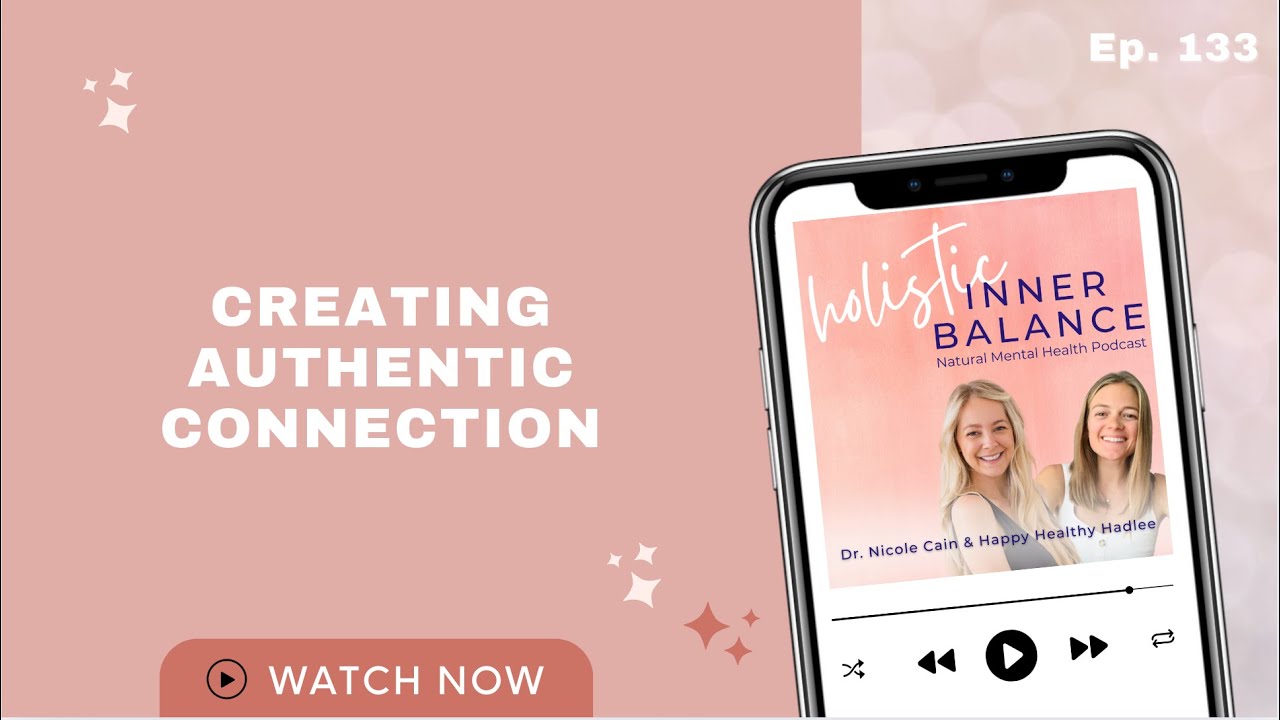
In this Holistic Inner Balance podcast episode, host Dr. Nicole interviews Hadlee Garrison (Happy Healthy with Hadlee) about cultivating authentic, "I‑Thou" connections and "sparkly" conversations, especially during family gatherings and holidays. They explore the psychological distinction between I‑Thou (seeing others as whole human beings) versus I‑It (treating people as objects), emphasizing curiosity, a fresh‑lens mindset, and levity. Practical coaching tools are shared: asking open‑ended questions, sharing personal stories, using conversation/table cards, go‑to prompts (e.g., "What are you currently excited about?"), memory‑making questions, eye‑contact techniques (left‑eye focus), body‑language cues (palms up, uncrossed arms), the ILS method (Invite‑Listen‑Summarize), setting intentions and boundaries before events, and giving sincere, specific appreciation. The dialogue is playful, meta‑conversational, and includes personal anecdotes that illustrate how these practices foster deeper, lighter, and more joyful connections.
Chapters
Hi everybody, welcome to Holistic Inner Balance. I'm Dr. Nicole.
And I'm Hadlee of Happy Healthy with Hadlee.
We're so pumped today to talk about creating authentic connection, sparkly conversations, and new dynamics with your family. And this could be during the holidays, or it could really be relevant for any time of the year when you're getting together with your and friends. And so Hadlee has so much sparkle inside of her that she's going to teach us how to embrace today. And so I'm really pumped to dive in. Are you ready, girl?
I'm so ready. I love this kind of topic because I've just— I mean, my family has been pretty intentional with conversations and different things throughout my life, but I think That connection for me is one of the most important things in life, and it's something that I have learned from my parents. It's something that I've also learned from my husband. He's like the king of connection. He doesn't really do like the small talk thing. He just like gets right into it. It's really awesome. And creating like a sense of community and creating a deeper sense of connection. is I think if we were able to do that, like if everyone was able to do that in the world, we would have a much better, much better world. And so I love talking about this kind of thing during this season. I always talk about it with my clients. And so I'm really excited to share this with you all as well.
Yeah. And what I wanted to differentiate in that conversation about connection is I feel like the— there's a really good word in psychology. It— well, it's 2 words. It's called I-Thou engaging with each other. Are you familiar with that?
Mm-mm.
So, all right, this is so interesting. Um, you've heard of the love languages, right?
Of course, yes.
So oftentimes when we ask somebody, what is your love language, they will often express an unmet need. And what's really interesting about it is I've encountered so many people who are like, well, I feel like extra loved and supported when I get quality time. But then when they get more of that time, they still feel that there's an unmet need there. And so I wrote this whole article about the 6th love language, which—
Ooh.
So interesting, because I think all of the love languages could be honored if people had the 6th love language, which is—
Oh my gosh, I'm so excited for what, what this is. What is the 6th love language?
It's I-Vow connection. And I-Vow connection is when we relate—
Are you saying, are you saying vow with a V or thou, TH? Just so everyone knows.
TH.
Yeah. Okay, cool.
Thou. I-Vow. And so I-Thou is where we connect with another person as a being, as a soul, as a fellow human. We see their humanity, we see their individualism, we see who they really are. It's where we listen with curiosity and understanding, and we are able to kind of read between the lines. Oftentimes people are like, don't listen to what I say, listen to what I mean. And I-Thou is exactly that. And that's in opposition to I-It, which is where we relate to another person as an object. Mm-hmm. Or as an other, as a thing for meeting our needs, as a meat suit holding space In our audience of companions. And so when you're with somebody and you're seeking that real authentic connection, what you want to be looking for is the I-Thou way of existing. Mm-hmm. And then when you're in that frame of mind, you have this foundation upon which you can engage in really thoughtful, transformative, sparkly communication.
Yes, I love it. Okay, so this reminds me of something that I've been talking about also with my clients, which is allowing people to be different than you have labeled them as. And so coming to all of your conversations through a lens of curiosity and discovering who is this person right now, like, who are you? And really like coming to that from that, just like that fresh lens, even Even if you've— I mean, obviously, like family members you've known maybe your whole entire life. And so you think that you have this idea of who they are. And then we hold people in this stagnant place where we're like, well, this is the way this person is. So I know that this is how the interaction is going to go. But when we allow, like when we open that up, when we kind of like widen the aperture of, you know, like kind of go from like more of a bird's eye view, it's like, how could this person be different from how they were before? So because a lot of times when we go back home, we, you know, for the holidays or whenever, we will go back and be like, we're like, oh my gosh, why am I acting like my 12-year-old self? Right? Like, why am I acting like a, like a brat? Or like, why am I acting like super sensitive when I haven't been sensitive in the, you know, for the past, like, however many years? It's because we, we, the people around us, their expectations of us are of what we used to be. And so, and we do that to other people too. So if we really want deep connection, we have to come to it from like a flash of fresh, clean slate of like, oh, like, who are you? And I get to discover who you are rather than having that label on you.
Oh my God, I love this so much. There's so many things that are like flooding into my mind that I want to say in response to what you just expressed. And one of them Is that I love the first part you said is a fresh lens and curiosity. Because one thing that I personally have had conversations with my husband about is if I do or say or feel something that's incongruent, I don't want to be held accountable to always being that.
Yeah.
I want to be able to be looked at with a fresh perspective so that I am able to look at myself with a fresh perspective and grow and change our minds. And you and I have actually talked about this too, about how some people won't even create a podcast because they're afraid of putting something out there that they may not agree with later, that we feel like we don't have the safe space to evolve and change our opinions. People are like, oh, you're wishy-washy, or you're waffling, or see, you didn't really know. Right. As opposed to if we allow ourselves to be fluid human beings that change, And people look at us with that fresh lens and curiosity, as you said, then it creates the space for us to then be curious and to experiment. So I love that, that what you said.
Yes. And so if we come to our holiday situation, whatever your holiday situation is, from that place, from like an intention of, I wonder what I'm going to discover about all of the people around me, then things become really cool. Like, it's like you become this curious, like, investigator, or, you know, you can kind of like, you can kind of like set yourself up in like an archetype of, you know, I love— I was a theater kid, so I love like taking on different, like different characters and stuff. And that can sometimes feel really fun for me. And, and then it creates this sense, this like lightness. So it's not so— because a lot of times we think connection and we think deep connection has to be so serious. But can we bring in some levity, some fun with it? And that's why I call it sparkly conversations rather than just deep conversations. It's like, oh, we can get in deep into something and have it be this light and fun thing as well.
Yeah, it doesn't have to be heavy, and it doesn't have to be like a therapy session.
Yeah, I think sometimes that scares people. It's like, oh my gosh, well, I'm going to have to bare my whole heart and soul. Which is wonderful if you do end up doing that, um, but it doesn't have to necessarily be that to feel really connected to someone.
So to recap where we are so far is to get into that headspace of interacting with and being with others from an I-Thou as opposed to an I-It. And so I-Thou is, is that— I love the curiosity— is Allowing yourself to see them for their humanity, seeing them with curiosity, really being interested in who they are, their thoughts, their feelings, their needs, their memories, their quirks, like all of it. Mm-hmm. And so approaching it from that I-Thou and then having that fresh lens with every single new encounter, and then the levity that can come during conversations doesn't have to be really heavy and serious. And so tell me more.
I love that you said the, you know, being interested. Something that my family always says is like, oh, I really liked having a conversation with so-and-so. They, they were just so like interested and interesting. It's like, that's like the, that's like the quintessential, like my family will love you if you are interested and interesting. So it's like if you're, if you're interested in the conversation, if you're actually interested in the other person, that's that's going to create so much more connection. And I will say that— well, yeah, I will say that like you can totally go in really deep. We've also talked in the past about how healing is like going in deep and then coming into levity and then going back into the deep and then coming back up into sort of that like lightness and, you know, laughter or whatever it might be. And that can also be how you connect with other people, maybe how you heal relationships with other people if there have been like fractures. And that's kind of how we We connect as human beings as well.
So how to convey your interest? And so if we look at just kind of like 101.
Yeah. I mean, the first thing I would say is ask questions. That's like, yeah, as like whatever you, whatever you can do to, to show that you, you want to know more. It's something I've had to work on. I'm not like a huge question asker typically. But conversation— so connection can also happen by you sharing your heart openly too. That's where my superpower comes in. So I'm not as great at asking questions, but I, but I do work on it and then I will share openly. And then usually the response is someone will, will share their heart openly as well. In fact, I've had many people at like different parties and stuff tell me their whole life story and be like, I've never told anyone this, you know? So You don't have to be that open. I can handle it. I'm fine with it. But sometimes if you're a super empath and you don't want that to happen, you don't have to share everything about yourself. But so both the— I love how you said the I-thou because it's both being interested in them but also sharing about yourself. It is equally important.
I love that. And you heard me have an awkward pause because somebody was just outside of my office cackling so loudly, and I didn't know if the mic was picking it up. So I was like, you just—
No, but we should invite them in. They can cackle with us.
They sound interesting. So Hadlee, that was like really good improv. You saw me like awkwardly pause and I was like kind of smirking, and then you were like, I want to answer that question. So you guys, we're really meta real here. We're not editing that out. It's like, I love it. We're having a conversation.
I'm all about the improv. Theater kid background.
You're so good. So how to, how to convey your interest? Asking questions and sharing your heart openly too, so it doesn't feel like an interrogation, but like a reciprocal.
Yes. Sometimes I feel like sometimes that can happen where it feels like I can sense that the other person is feeling like they're being interrogated when I, when someone, when like someone else is asking like a lot of questions and, and people can get uncomfortable. And so, yeah, so definitely sharing, sharing yourself as well is really important within
your comfort zone.
Yes.
And one thing that I've heard and studied a little bit into is the power of looking into someone's left eye as opposed to their right eye. Is when you look into their left eye, that can be like a little bit like— you should experiment with that. Is when you go out and you talk to people, notice what you feel in your body when you look at their right eye versus when you look at their left eye. And the left eye can feel feel a little bit more like that can like up the connection.
Oh, so interesting. So what is it? So how do you feel when you look in their right eye? Is it more intimidating?
I feel like the right eye for me, and I'm curious what people who are listening notice, but for me it feels like a little bit more maybe creative and like a little bit more creative and like maybe a little bit more like passive. Versus when you look at their left eye, we often associate that with more of like, I'm having a conversation and I'm really focusing and I'm really paying attention, like very left-brained activities. So sometimes when I look people in the left eye, I feel like a little more intensity, more connection, which can be so powerful.
Oh, yeah.
Used in the right way. Of course, you don't want to stare them down in their left eye without blinking because again, that's Freaky.
Yeah, don't be weird.
Don't be weird,
but try
it.
Or actually, you can totally be weird. I'm super weird. We'll
be weird with each other, Had, but maybe not with people who are not ready for the weird. Way too weird. Yeah,
yeah. But your weirdness can invite people into their own weirdness, which I find is definitely the case a lot of the time. So you could be weird, just maybe not like, like that kind of weird.
Flavors of weird. Yeah. Yeah. So how to, how to convey interest is asking questions and then reflecting back. In counseling, we talk about— it's called ILS, which stands for invite, listen, and summarize, which is a way to engage somebody. So tell me about your dog. Oh, that's so interesting. So what I hear you saying is that your dog is blah blah blah. Tell me more about that.
Right.
And so then people like, you're using active engagement. And then other things that I wanted to add is, is like body language can be huge. And so if you're crossing your arms over your chest, it can create a nonverbal cue that you're blocking yourself or you're not interested or you're upset. And so maybe relaxing your arms down and having palms up. Palms can feel open, like I have nothing to hide, versus if your palms are down, it can feel like a little bit of a block.
I love that. Yeah. Yeah. That's usually how I'm talking is with my palms up and I'm moving my hands around. Yeah.
Because you're open-hearted. You might not, like, realize or intentionally do that, but it's like a reflection of how you're feeling. And so if you want to cultivate that feeling and convey to people that's what you're feeling is put your palms up.
Yes. Yeah. The cool thing about, like, doing stuff with our physical body is that it goes either way. So if you're feeling that way, a lot of times you'll automatically do However you're feeling. But if you notice that and you do the opposite thing, it can actually make you feel the other way. So if you, if you're feeling closed off but you want to feel open, then doing that kind of thing can make you feel, actually feel more open. It's so cool.
I feel so like connected to you right now, watching you on the Zoom with your palms up.
Talking with my hands.
I'm trying to like zero in on your left eye through the camera, but I don't know if you can tell. Like staring at the picture, the moving picture. So, um, and of course, like, put our phones away. But I really want to— because we're gonna— we could like talk about this for like so many hours, but I don't want to miss out on a chance to hear about the sparkly conversations that you and your family have and like advice for having new and interesting interactions with your loved ones.
Totally. So my family, uh, often we will— well, So sometimes we'll get like, like table cards. That was like a constant on our dining room table actually growing up was just like these little like dinner conversation cards. And so you could totally get one of— get those and bring them to your family gatherings. People, people might like poke some fun at you. They usually— they're not going to be like, that's dumb, we're not doing that, right? Like, I mean, if that's the case, maybe listen to our other Podcast episode about opting out of your family. Yeah. Your family get-togethers. But usually people are going to be like, you know, they might feel a little uncomfortable at first, but then it becomes really— it becomes a really cool connective opportunity. And so then, like, you know, people can go around the table and say their answer to the different cards and stuff. And you don't have to answer everyone. You could— like, the collective people around the table might be like, that's— no, let's not do that one. That one's like not as interesting. Like, we can move on to the next one. We have gotten to a place where, like, my dad and my sister are both, like, question masters. They're so good at asking sparkly questions and getting everyone, like, engaged in them. So we don't even need the table cards anymore. But if I'm there with just, like, my husband, or if I'm there with, like, friends, I will— I usually need the— I usually need the question cards, or I'll just look it up online. I'll just look up, like, you know, connective questions to ask at a dinner party or something like that. And there are billions on the internet that you can pull up, and usually there'll be like 100 questions you can ask to create deeper connection or something like that. So that's the first thing that I would say, because it's, it's so easy. It's just like such an easy way to really get to know people on a deeper level.
I love that. I just Googled it and I have some pulled up and I'm going to print it and I'm going to put it in my, my house because we have people coming over for an office party and I need to feel like I have things to say.
Yes. And something else that you might do is if you don't have like your cards handy, is you can also like have like 1 or 2 questions that are kind of like your go-to, or you can identify like before you go to a party, before you go to an event, what are my go— what's my 1 go-to question that I'm going to ask tonight? So maybe it's like something that my husband and I have kind of done in the past that seems to be a cool one is like, what are you currently excited about in your life? Like right now? Because a lot of times people, if you say like, what are you excited about? People will say something in the future. But we're like, we want to know like what you're really like getting passionate about, like diving into in your life right now. That's, that's really cool. And so we say, what are you currently excited about? And that's been a really fun one. Yeah.
I'm writing it down. This is great.
Yeah. And then there's another one is, you know, for Thanksgiving, we all go around the table and say one thing that we are grateful for within the last year, something that we, you know, really, really loved from the last year. For people's birthdays, we always go around and say, well, a lot of times we say 2 things. One, the first one is One thing that we really love about the person whose birthday it is. And those get really— like, those can be so, so sweet. Like, it's just like, it makes people— I mean, it makes you cry. Like, it's like, I can't believe people thought— like, I can't believe you thought that about me. Like, I didn't know that you ever noticed that about me. We just did that for Todd over Thanksgiving because his birthday is December 2nd. And so— Oh, that's so sweet. We weren't with my family for his birthday, but we were like, let's all like, you know, go around and like celebrate Todd's birthday while we're all together. And so my family, everyone was sharing these different things and you can't do the same one as another person either. So you have to do something different. And they were all sharing all of these little different tiny aspects of Todd that they had never expressed before and that like maybe there were a couple of them that Todd had never heard anyone express about him before. So it was so cool to just— create that deeper connection. And then the other one for the birthdays is like a favorite memory from your whole life or a favorite memory from the past year if you do it every year, which is what we do. And so those are really great ways to create like specific connection with a birthday person as well.
I think those are wonderful. And that is, that is such a cool way to be curious and specific for someone. That first one you said is like, what are you currently excited about in your life? Right now. And then I love expressing your interest and your love and your compassion and caring for another person by pointing out things about them that you see and that you care about. And I think that's really lovely.
Yeah. So we can do this like outside of birthdays too, right? Like I try to always— if I think of something that's positive about another person, I try to always tell them. You, Dr. Cain, are the queen of this. So I have yet to get to your level. But I like— I mean, it's not just like compliments because compliments feel like flattery. Some like that, that word kind of, kind of can sound like flattery where you're like just like heaping on compliments. But really, like, I really appreciate this about you. Or even if you, if you don't feel comfortable saying it in person, maybe you just start by like texting it to someone so that they know and that can create a deeper connection as well. Sometimes people, sometimes people get really surprised when I do this, especially men, because often women will do this with each other. They'll tell things that they appreciate about each other. But sometimes men will be like, oh my gosh, like, you know, people don't compliment men as much, right? A lot of times women will be like, I love your dress, I love this, like, you know, whatever. But that doesn't happen as much for men. So men might be a little bit taken aback at first, but often they really appreciate it because they haven't had that as, as often.
I think that's amazing. Should we have a meta experience here right now?
Ooh, yeah, I'm down.
So a memory-making question that I see on here is, so Hadlee, what is your earliest memory?
Oh my gosh, I love this question. My— I know I have an answer. So my earliest memory is my dad and I playing this game in the basement in like the first house that I lived in. I was maybe 3 and he would— we called it Owl. That was the game. And he would— we would like be in the basement and he would flash a flashlight on the wall and I would just chase the flashlight around like a dog. That's my earliest memory. And now I will say That I don't know if I actually remember it or if I now at this point remember remembering it and like going over it over and over again because that question has come up many, many times in my family.
That is so funny. Like you were chasing the spotlight even when you were 3.
Yes, that makes a lot of sense.
You were so like, you're ready for the shine. You're ready for the spotlight. Little owl.
Oh my gosh, so good. Okay, what's yours?
Uh, playing bingo. It's so—
Oh, so cute.
It's just funny because I like to win.
I like to win.
And with bingo, there's always that hope. You're like, oh, they're gonna roll my number.
Oh my gosh.
Yeah, I remember being— I was, I was 4, and I don't remember anything before 4. That was my first memory. And I was sitting in a classroom, in a kindergarten classroom in North Carolina, We were playing bingo, and I remember the way the room looked, and I have an awareness that we were playing bingo, but I don't remember— maybe you do, as I'm thinking about it. I don't remember the bingo cards.
Wow, that's cool. That's super cool. I love it. So that's a great question.
Yeah, we did it.
One thing I will say, because— and that reminded me of this— is some people, when you do this, will be Like, I don't know, I don't know, I don't know. They'll really get in their own heads. And this happens to Todd.
It happens to Paul.
Yes. So he's like, I don't know the answer. And I'm like, there is no the answer. Just like, come up with something. Like, it doesn't have to be the right thing. It doesn't have to be the correct thing. So if that's you or if that's anyone else in the circle, you could even say beforehand, like, And there's no right answer to any of these questions. Just come up with something. This is just a fun connection experience. It's not like you have to have a favorite color or a favorite animal. Just come up with like one thing, um, and you don't have to be held to that, to that thing for the rest of your life.
I love it. We were at dinner with our colleagues, uh, the other night, and I asked a question. I was like, what if there's a song that could be like the theme song of your life? What would you And Paul's head exploded. He's like, I can't pick. And then I was like, OK, well, then you're Ben Folds, Rocking the Suburbs. And he was like, we don't live in the suburbs. And I was like, we do. And so I was like, this is what happens when you don't pick.
That's hilarious. And Paul knows every song ever. So that would make his brain explode.
Yeah, he could not abide. And then I think he came up with, in rebellion against the one that I picked for him, which is so funny because we always like to joke about how I think we live in the suburbs, but he thinks we live in the city. And so it was like a jab. He ended up picking some David Bowie song. Yeah, we totally live in the suburbs. You can't like walk easily anywhere.
Yeah,
do you? Yeah, it's gonna be a hike. That's suburban lifestyle. We're not rural, but—
Right, right, right. Totally. Oh my gosh.
You live in the city. You're urban.
Oh yeah, I live in the city.
You do?
So fun. Although San Diego is, is an anomaly because it feels very neighborhoody where I am, but like I can walk to everything, so it's really cool. Yeah. But yeah, so, so we've got our, we've got our like conversation, sparkly conversations. I would also say something else that's really helpful to come into, to come like before you walk into a party or before you walk into an event with family members or friends, setting an intention for like what, what it is that you want out of the experience. So maybe it's like, I really want to connect on a deeper level with this specific person, or maybe it's I want to, you know, maybe you're going into a situation where it's like it's been a little rocky, like in the past, maybe with family or whatever. And so this is how I want to show up. This is how I want to actually show up in this situation. And, you know, my intention is to show up in that way, or my intention is to hold this boundary, you know, if that's, if that's the case. And that can also, that can be really, really helpful as well. I would say even if you're holding a boundary, also maybe set an intention that you still have an open heart at the same time, because otherwise we can feel really walled off and that doesn't create connection. But really, yeah, setting an intention beforehand, something that Todd and I do is like, okay, what's your intention? As we're in the car going to an event, we're like, what's your intention for this event? And then we'll share about that.
Oh, you guys are the best couple. I just love it. I love hanging out with you. Paul and I always leave hanging out with you, and we're like, God, they're just the coolest people. They're just so great. Such an anomaly.
You guys are so sweet. Oh my gosh. Well, and you're so good at telling us this. And this is why we feel so connected to you is because you always tell us how it makes you feel. It's just such— so cool.
Yeah. Oh, I sincerely very much care about you and Todd. It's been amazing being in life with you and doing this podcast with you and working together. I'm very sincerely grateful for that.
Oh my gosh, I received that, and I'm so grateful for you. Like, literally, this podcast, I was just telling, um, someone that it's like one of my favorite parts of my life. Just being able to do this with you. And so, uh, so stay tuned everyone because we're gonna try to do some more, uh, some more in-person things in the future too.
Yeah, would you guys come if we had an in-person podcast?
Let us know, let us know if we did some in-person events if you would be down to come hang out with us.
Yeah, please leave us a comment. We actually read them. Tell us where you want us to show up. We were thinking Phoenix, San Diego, and LA. Like, those places are super easy, but But we know we have people all around the country, all around the world actually. So like, where do you want us to go?
We could do Grand Rapids too. That would be an easy one.
Grand Rapids would be an amazing easy one. I'm like, here. So all right, people.
Okay, let's make a list. Yes. Oh, so fun.
Thank you for the sparkly conversation and the I-Thou Connection hats.
Yes, absolutely. I'm so excited for you all to experience, uh, the sparkly conversations, the, the deep connections that come out of them, the deep and light and, you know, all the things in between, because they also can create so much laughter, so much fun. So it's— you're gonna all have the most sparkly holiday season ever.
Yay! All right, everyone, we'll see you later. Love ya.
Love you. Bye.
Bye.
More from Hadlee
Happy Healthy Habits: Automate Your Habits. Optimize Your Energy. Unlock Your Capacity.
Join us at the Align & Thrive day retreat Sunday 1/11 in San Diego 🩵 Comment ALIGN for the link
Fueling the Future: ESS60, Mitochondria & Mission Longevity with Chris Burres | Ep 156

Dancing Through Life: The Healing Power of Showtunes with Danella Mercati | Ep 155
From Breakdown to Breakthrough: Reinventing Life at Midlife with Wendy Valentine | Ep 154

Your Soul Wants To Be Surprised: The Good Life with Michele Lamoureux | Ep.153
BONUS EPISODE: Fawning: The Trauma Response Hiding in Plain Sight With Dr. Ingrid Clayton | Ep 152
Fall Asleep Faster, Rest Deeper & Wake Up Refreshed Using Sleep Science with Devin Burke | Ep 151

Your Oral Microbiome & Mental Health: The Overlooked Link with Dr. Namrata Patel | Ep 150
Acupuncture & Energy Flow: Unlocking the Body’s Healing Potential with Dr. Felice Chan | Ep. 149