How to Giving Generously Without Burnout | Ep. 132
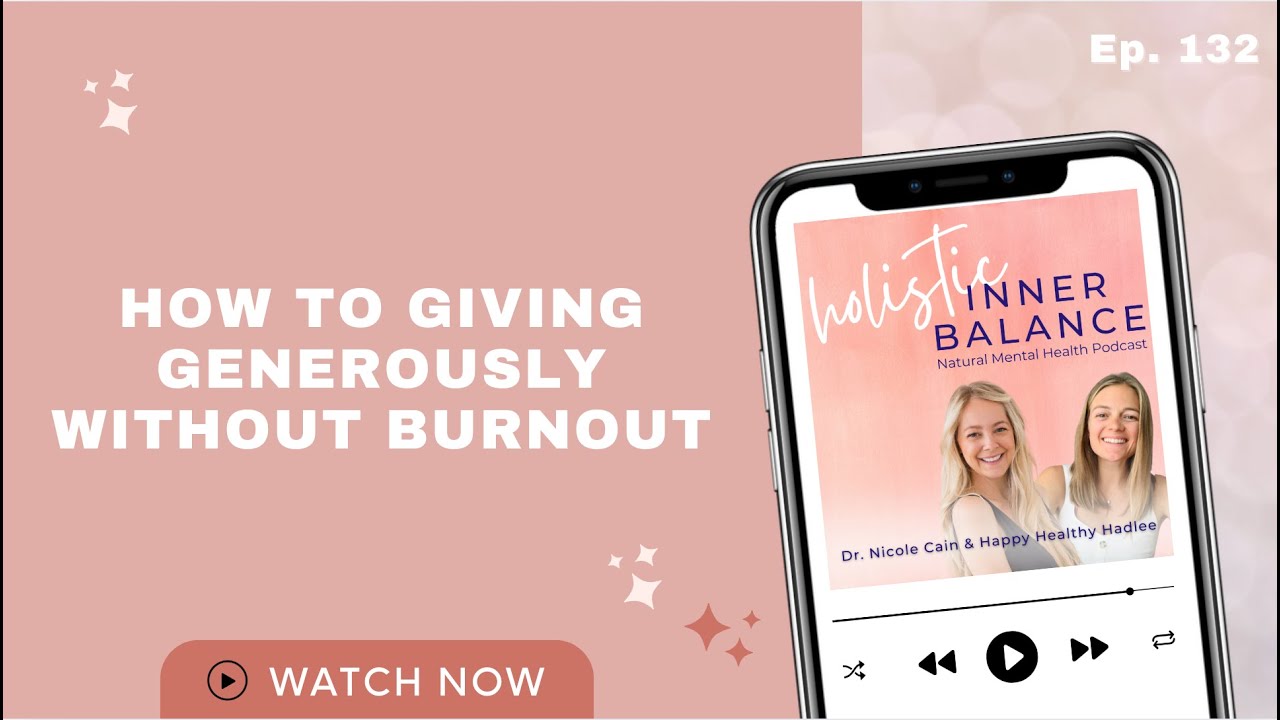
In this episode of The Holistic Inner Balance, Dr. Nicole Cain interviews Hadlee Garrison to explore the paradox of generosity: how giving can increase happiness yet also lead to burnout. The conversation weaves personal anecdotes (a 10‑year‑old’s PowerPoint wish list, Charlie Brown’s "tens and twenties"), psychological frameworks (spoon theory, chronic‑illness energy units), and cultural metaphors (Stone Soup) to illustrate how people can shift from "obligatory" giving to "overflowing" generosity. They introduce the concept of "energy leaks"—activities that drain spoons without replenishing them—and present practical tools for identifying and plugging those leaks: body‑based awareness of an "icky stickiness," journaling, the Essentialism pyramid (Greg McKeown), delegation, and hiring help. The episode emphasizes that giving from a place of alignment and joy creates a positive feedback loop, increasing one’s spoons and overall wellbeing, while giving out of obligation creates depletion. Listeners are invited to reflect on their own giving habits, experiment with the suggested strategies, and share feedback.
Chapters
All right, Hadlee, I have to tell you a story. Are you ready?
Yeah, I wanna hear it.
So I was talking with a client recently who explained to me that she had just gotten a PowerPoint from her 10-year-old niece of all of the gifts that she wants for the holidays. And this steps out too.
Oh my gosh, that's so good.
I was like, whoa, your 10-year-old knows how to make a PowerPoint presentation. That's incredible. But also, it felt like a little bit like a pause for me of this, like, culture behind, like, I want these things, I'm going to make it easy on you to deliver me these things, here's a list. And that's actually an inspiration for this conversation on my side when you were talking about generosity and giving and why I was so excited about it. And so do you, as you're listening to this conversation, resonate with— does your family give each other lists? Do you have a budget that you're supposed to meet? Do you feel like you're getting a little burned out on like the whole sort of corporatization of gift giving. And what can we do about that? What is another option? And so welcome to The Holistic Inner Balance. And I am Dr. Nicole, and I'm joined by—
I'm Happy Hadlee Hadlee.
And so, Hads, what do you think of that?
Oh, that's so interesting. So, like, on the one hand, I feel like that can be helpful. Right? I think it's hilarious. It reminds me of the Charlie Brown Christmas movie. For anyone who's seen that. I watch it every year with my family. And his little sister is reading off this list of things that she wants from Santa. And at the end, she's like, if this is too much for you, you can always send cash. Tens and 20s are great. And he's like, tens and 20s? This is from the '50s, right? Yeah. So he's like, tens and 20s? Everyone is so— consumerism, all of that. Yeah. My own doggone commercial. It's so funny.
Which, by the way, if you like look at that, like Snoopy is like eating a stack of human-sized femurs. Yeah, he
is. You're right. Oh my God.
It's so weird.
It's so fun. That— oh, those movies are so good and they're still so timely. Like if you watch them, you're like, oh my gosh, like Lucy's like pretending to be like a psychotherapist. Like, wow, this was ahead of its time. Totally. But anyway, so, so we're going to talk today about how to give in a way that actually doesn't deplete us and instead actually gives us more life. It's something that I've been thinking about a lot recently, or for the past like 5 years, honestly, because I have seen— so there's like 2 sides of this and we're going to bring the nuance because that's what we do. So like on the one side, There are so many things that are saying that we, you know, in order to feel happier in our lives, giving is the way to do that. When we are generous, we actually become happier. There are many, many, many studies to show that this is true. Like, there's— there was one study that showed that participants were asked to tell the researchers all of the things that they think would make them happier. And then the researchers kind of like made a lot of that stuff happen. Like, oh, I would be a lot happier if I like got more sleep, or I would be a lot happier if I could go on this vacation, or I'd be a lot happier if I got this, whatever. They saw no change. And then they used the same— the same people came back the next week and they gave— I think they gave them money and they were like, go give this to someone who you want to give it to. And that actually made a difference in their happiness levels. And so— and whereas the self-care stuff, the stuff that was like like self-care wasn't actually bringing them happiness. But I also am seeing all over the place that people are burned out by giving too, because they're like, I'm doing all— I'm overgiving. I'm doing all of this stuff for all of these people and I have no time for myself. And I'm like, how are these two things? How can these two things be true? So something that I've just been like marinating in for the past like 5 years since I started my, my business, 5 and a half years, I guess, is how do we, like, rectify this? How do we actually bring these 2 things together? Can they both be true? And so we really wanted to talk about this with you today. It's something that is— I'm finally fleshing out. I'm finally, like, trying to kind of create a philosophy on this. And Dr. Cain has a ton of really great things to add to this to, like this, this sense of how do we give from a sense of overflowing generosity without feeling burnt out? So the thing that I want to say here is that there— I actually don't know that overgiving is a thing. So that's like kind of my bold statement here is, is overgiving really what it is? Or Is it actually giving out of alignment from how we actually want to give, how it actually feels like it gives us more life? So can we give generously from a state of like overflowing generosity rather than from this place of feeling like we are obligated, that we have to, that we should, that like, you know, I have to do this for this person because they did something for me, or I have to do this for this person because that's how our relationship is, or I need them to like me, or whatever it is, and rather can we come from a place of I just want to give this because it lights me up, it gives me more energy. And then that's that, that what that study I think is talking about, where when we do that, then we don't need all of the, you know, I have to go take care of myself and then I can start giving again, and then I have to go take care of myself and then I start giving again, which self-care is important. But giving in a way that actually gives us more energy makes it so that we don't have to go repair ourselves after the fact as often.
Yes. And I'm thinking about this in the imagery of spoons, which is funny because you guys, Hadlee bent a spoon into 3 bends recently just with her sheer mind willpower.
Maybe we should do a podcast on that at some point.
I think we need to because you blew my mind. So maybe that's why I'm like, I'm still on the spoons even after 2 hours of talking to you, and I'm still on the spoon. But spoons can be representations of bandwidth that we have or resources that we have, whether it's financial, like the girl with the PowerPoint, or tens and twenties from the Charlie Brown, or it could be time, or it could be energy, or it can be intellectual property. It could be really anything, but the spoon represents your bandwidth. for giving. And when you give, you release a spoon and you hand that energy bite to somebody else. And so the paradox that you've just presented us with, Hadlee, is that we get spoons by giving, but we have to have spoons to give so that we can get spoons to give to get spoons to give, right?
Yes. Oh, it's so good. It's like spoon theory.
Spoon theory.
This is a thing. This is a thing. Yeah.
Wait, spoon theory is a thing? You're not just inventing that right now?
No, no, it's a— spoon theory is a thing for like chronic disease management. It's thinking about how there are always people who have a chronic illness have to think about their energy in terms of spoons. So it's really weird that you don't know that, but that it was spoons that you came up with. That's really wild.
Girl, sometimes my brain is like, I know things that I don't know that I know that I don't know that I also know. Yeah, totally. So that's interesting. So spoon theory is about using spoons as a unit of energy. And so these individuals have these specific limitations of energy units that they have to then figure out where I'm going to spread it out. But what your research that you were just describing is saying in order to attain more of that spoon energy, you give. But the nuance that you were just introducing at the beginning of the conversation is that there's different ways of spending our energy, and that some ways of spending our energy put us in a deficit, and other ways of spending our energy can actually put us in an abundance, right?
Exactly, yes. And I think that this is something that is like People aren't really thinking about. We often think that energy is like our energy, like, just gets depleted throughout the day. And, you know, we only have so much energy. But really, there are things that we do that actually bring us more energy. And one of those things can be giving.
I love that. I'm thinking about the old story called Stone Soup. Do you remember that?
Yeah, I do, from when I was like in kindergarten. Yeah.
Yeah. And I don't remember it and can't represent it adequately, but I'm gonna try. And because I think this is important as we're really allowing radical acknowledgement of where we are as a country economically, is that when, when I see a, a video heading or an article heading and it's like all about redefining generosity And then I think about all of the people that are out there, which is the majority of people who are like, I don't have enough spoons to meet my needs today, let alone redefining generosity. And so Stone Soup is, I feel like, a really interesting portrayal of that where you have a bunch of people who arguably start with nothing and then they end up with this amazing soup. And so the first person I think they have a fire and a pan, and then they have a stone that they add in there. And then somebody else comes along and they have something small that they can add to it. And then they're—
Like a carrot top or something.
Carrot top. And so it's like, as more people come together and they contribute to this communal thing, there's enough soup for them all to be well fed. And it's so good. And I think about What can we in this modern era learn from, from that lesson where if I'd have walked by and I would have held on to my carrot top, I would have been hungry. Yeah. But in this magical fiction story, I wasn't hungry. I was— I had community and I was nourished and fed. And of course it's fictionalized, but I think that there's really something to it, especially when we think about that energetic currency. So can you tell us a little more about that energetic currency that can come from different types of giving?
Yes, totally. So I was recently doing a somatic experiencing practice with my clients and like slash journaling session, and I was asking them to kind of come up with, you know, how they— at the current time of this recording, we're in December. And so I was having them identify, okay, so things that you want to experience during the holiday season or throughout the rest of the year and really like hone in on what you actually want without like obligating expectations, without, you know, all of the shoulds? What would your experience look like that you would want to have? And how would you want to give during this season? How— what would actually make you feel so excited to give to someone? What, you know, whether it's gifts or whether it's time or whether it's like volunteering somewhere or whether it's making something, like what would feel— if you had all the time and energy in the world, what would feel so exciting to you and would feel make you feel so, so lit up? And one of my clients was like, I realized that I don't give that generously in that way. But, and, you know, instead of feeling bad about that, because that would be a lot of times where we go is like, oh my gosh, I'm not as generous as I wish that I were, which was me like my whole life. I always wanted to be more generous than I was, and I always felt like I wasn't a generous person. And she was like, but I realized that it's because I am like— she didn't say this, but basically leaking energy to all of these other areas where I feel obligated to give. Because we were talking about giving from obligation versus giving from overflow. And so the reason she wasn't giving from overflow was because she was leaking all of this energy on all of the things that are shoulds, that are things that she feels like she has to to do. And so, so a lot of times we hear be more generous if you want to be happier or like be more generous to be a better person, right? Like, that's, that's a classic one. I, you know, especially if you're in like, you know, religious, religious communities and stuff. And really, it's not that you're a bad person. I mean, if you're listening to, listening to this podcast, you're like probably more of the kind of person who tends to like give, give, like, quote unquote, overgive because there's so many things that you want to be doing for other people. Not that you're just like, you know, oh, I don't care about anyone else. Like, if you're listening to this podcast, that's probably not you. So how can we start to give in a way that actually instead of— and so how can we say no to all of the things that we're doing that is leaking our energy so that we then can become this like overflowing generosity person? And That's what I've experienced even in the last year. I would say I feel like I have kind of plugged up a lot of those leaks where I'm not doing as much of the shoulds, and I'm still not perfect at this by any means. I'm still working on, you know, different things and identifying where, where those leaks are coming from. But it's giving me so much more capacity to have that overflowing generosity. And so it is, you know, so the self-care piece is really just like the plugging up of the energy leaks of where you're giving in places that don't feel in alignment. And it's going to be different for everyone. Some people might really like to go over to someone's house and cook for them. But, but you might not like— so you don't have to do that if that's not what you love to do. Some people might love to like make things for other people and like be like, you know, all Pinteresty and stuff, and you might not. And so you don't have to do that. And you can say no to things. We just talked about in our holiday podcast episode about you can say no to going home to your family for the holidays. Gasp. Like, that is a possibility for you. And then like, you're going to have so much more bandwidth if you allow yourself to then give generously after that. Then it's like you're just going to have so much capacity to give to wherever it is you actually want to. And that gives you— that makes you feel it up.
So how do you find energy leaks?
Oh, I like that question. Basically, any time you feel like there's like an icky sticky— that's what I call it, like an icky stickiness.
Yes.
Where you're like, this doesn't feel— I don't feel excited about this. I feel like there's just like in the kind of just like the energy between you and that other person or you and the event or you in the like situation that's, that's going on, that's an opportunity for us to really be like, hmm, okay, what's going on here? And it's not to say that you have to like be like, nope, I'm not doing that. I'm not doing it. I'm not doing this. I'm not doing this because these are energy leaks or like I'm cutting this person out of my life because it's an energy leak. It might just be there's— there needs to be just like a little tweak that needs to happen that, that moves you into a, into a new dynamic, a new relationship dynamic or a new way that you show up Or, you know, and, you know, asking someone else to show up in a different way. There just— there might be just like little, little teeny tiny tweaks or there might be really big things that need to happen. But identify— but how you actually identify it is just noticing where does it— where is that icky stickiness?
Yeah.
Yeah.
And that might involve like scanning your body is like imagine yourself doing the thing or buying the thing or whatever it is that's the energy expenditure and then saying, okay, if I notice this, how do I feel? Do I feel more energized, or do I feel a little bit excited? Or is there, like, a place in my body where there's that kind of stickiness, the icky sticky you said? And what would be really interesting is to allow that icky sticky to inform you about what unmet needs you might have, because then you can take it deeper than, like, oh, wow, well, maybe I shouldn't do this thing. And you can take it deeper than just putting up a boundary or drawing a line or saying no. You could actually go and go go to that origin of that, that thought, that emotion, or that sensation and say, okay, what is this rooted in? So it may be that I want to go out with a friend, and I love this friend, and I love spending time with that friend, but I just feel dread going out.
Yeah.
And it's probably not that it's a currency exchange that would be detrimental or deleterious, but rather it's bringing up something else that maybe an unmet need. So maybe I need more rest, maybe not less of that time with that person or to give to that person, but I need to schedule in more time to rest. Or maybe I have a person in my past who took advantage of me expending energy and they have the same haircut. Like, it could be anything. Yes. And so allowing that icky sticky to inform you about, is there anything that, that could be rooted in? Because all of these opportunities provide us space to do even deeper healing.
Yes. And we, we don't— it doesn't need to be— I like how you gave the example of like, you know, maybe you're like, oh, I just want to cancel my plans with this friend because I don't— I feel depleted or whatever. That could be a tweak too. It could be like, well, I'm feeling the icky stickiness, but I know that I really like enjoy spending time with this person. So it's not necessarily like the person. Or the relationship dynamic. But maybe it's like you were planning on going to grab coffee and the icky stickiness for you is feeling like, I don't want to be around a bunch of people right now because I don't want to, like, you know, just be like overstimulated or whatever it might be. Or maybe it's like, I don't feel like going, going for a drink because I don't like to drink and I don't— it doesn't make me feel good or, you know, whatever it might be. And so maybe the tweak is we do something else. Or they come over to my house, or I come over to their house, or we go for a walk, or something that actually makes you feel like, now, now it feels like it would be a great, a great experience. Now it feels like I would really want to do that. So it's a good, like, small example.
I love that example. And I was thinking about gifts in that I don't actually love giving Christmas gifts, but I love giving gifts for randomness. And so like the other day I bought Ashley a necklace. There's this like necklace that our friend Taylor at the office has and we all love it. So we all keep getting the same necklace and copycatting her.
I love that.
And so I was like, thanks Taylor. And she's so great and she's like so generous about it. She's like, fine. And so I bought this necklace for Ashley because she expressed that she liked it. And so I gave it to her and she's like, oh, you could have saved this for Christmas. And I was like, but it's fun giving it to you and it's not expected and I don't have to. I'm not obligated to.
And that's totally how I feel.
And I don't want to energetically say that I feel obligated because I celebrate getting them gifts. It's just different when it's maybe expected, but she doesn't expect it. So I'm trying to figure out how I want to frame that. And so I hope that you guys who are listening are hearing me convey that I especially find it energizing and puts more carrot tops in my soup when I get to give randomly.
Yes.
And so I want to— I'm going to leave it at that.
Yes. No, I love that. That's actually— Todd and I are the same way. Like, when we hear someone say that they love something, we will be like, oh, did you hear that? Like, we got to go, like, just go order it right now and then we'll give it to them because it's so fun. Just like that, like that, that's that surprise, that spontaneity, and that feels so energizing for us. Whereas, you know, with, with Christmas gifts, it's also the sheer amount too, where you're like, oh my God, I have to get something like— and it has to— and like, and I always want it to be like, you know, special. Like, I want it to, to not just be like random crap. Yeah. Um, but I also do like, for, for like holidays, sometimes I will do things that are more like, you know, making like Christmas cookies or making things that are that are like consumables for a bunch of different people. And then I can do those specialized gifts throughout the year, if that makes sense.
It does. And the way that people feel is really different. And I'm thinking about a patient that I had once where her mother was the person who's expected to prepare all the meals for their family. And you and I talked about this in another podcast episode about how a certain person who has the expectation of preparing all the meals and how If that's not their love language or if that's not how they feel in abundance and spoons given to them, is that can create a lot of distress or even resentment. And so this patient of mine has been really working on when she sits down to meals is that she has this grief in her belly. She feels guilty, she feels unworthy. And so we were processing through that, what it was like for her to sit down and have meals growing up and her mom. was really stressed out whenever cooking and felt angry and resentful. And so when she would receive this meal, she felt shame and like a burden and felt guilty.
Mm-hmm.
And so it's interesting as you're talking about, like, I want to make these cookies, it's so fun, it energizes me. I guarantee you that the person who's eating those cookies is going to have a different experience eating those cookies versus if you were like, I have to make flipping cookies because they expect me to do it every year, and I'm so annoyed, and I'm going to slap them together, and they better darn well like them. The experience of receiving is impacted by your experience in the giving.
Exactly. Yes. And then you're also able to give more of yourself too. And then you're like, oh my gosh, I'm so energized by this. Now I want to go do this thing to give to someone. Now I want to go do this. And it creates like a momentum. And then you just become a generous person. And then it's just like, it's— life gets a lot more sparkly, which we also have talked about sparkly conversations and stuff. And it just feels, yeah, a lot more fulfilling. And now I also want to mention, like, people might be like, well, I have so much going on, I can't give that much. Like, I have too many things. So I want to also mention That like you got to plug up those leaks. Like you got to, you really got to, like you need to, or you get to really, you get to plug up those leaks if you, you know, if you want to, if you want to do this work is you get to plug up those leaks that are, that are those icky sticky things. Because I know that a lot of times people are like, well, I overgive. But if you're giving from that place of, of obligation, that's where the overgiving feels like it's coming from. But yeah, it's really like you're giving out of, out of alignment. You're not actually feeling as lit up as you could feel from giving in other, in other scenarios.
Can I give a practical example of how to assess this and do it?
Yes, please.
So the— there's this book, it's called Essentialism, written by Greg McKeown, and I think you and McEwen. I've said his name wrong for like 10 years. Oh my goodness. I even listened to it on Audible. It's like Ayurveda. Say
it.
Ayurveda, right?
Yeah.
Ayurveda. So that's so funny. Wait, McEwen?
McEwen.
McEwen?
Yeah.
Okay. I'm going to mispronounce that again. Just keep correcting me. So he talks about how our culture is often doers of all and masters of none. Yes. And we often say yes to all these things, and they are energy leaks. And what he teaches is you draw a triangle, kind of like a pyramid shape, and then at the base of the triangle, you list all of the things that you're doing. And so in this scenario, maybe all of the ways that you're giving or spending energy, all of the yeses that you're outputting. And then at the top of the triangle, at the point, is you write down what your main mission is, or that thing that fills your cup, or where you feel the most important or valuable, or like you can contribute, whatever it is, that, that unicorn star at the top. And then you start to look at what things you're saying yes to are pointing you towards that. And what things you're saying yes to are not.
Yeah.
And so that's the first step is so you like get really clear on what you're doing. You get really clear on where you want to go. And then in a perfect world, you would plug up all those gaps, get rid of all of the yeses that aren't getting you there, and then you would be like rocking and rolling. However, I understand that that's not reality, but maybe you can start by plugging some of those up or delegating them or getting rid of them. And so starting somewhere can make a little shift, can make a big difference. And the fruit of that, what we're describing here is that you're going to have more of that overflowing generosity because you're going to have more spoons, right?
Yes, exactly. Yeah. And really, it comes down to you feeling like lit up by the, by the things that you're, that you're saying yes to. And that's going to look a little bit different for everyone. But like we've talked about in the past, like basically it's, it's like good feeling sensations in your body. So you can like, if you're asking yourself like, should I do this thing or should I do this other thing or should I not do this, should I do this? Like just tapping into your body and seeing like, does this make me feel more alive to think about doing this? Does it make me feel excited? And, and I'm bringing in some details there too, because sometimes people are like, well, you know, I'm like going back and forth. It feels good, but then it doesn't feel good. And I'm like, well, maybe it's just like the timing. Maybe it's not right. And maybe it's a not right now kind of situation where it'll feel good to do, but like maybe sometime in the future or it'll feel good to do. But maybe there's like a slight— there's like a slight tweak. So it would feel really good. So we gave the example before of my mom who had us all for Thanksgiving, she had us all make, make a different dish. And she didn't— she wasn't in charge of it at all. She was like, you have to figure out what timing it's going to be like. And, you know, and finally all of our Thanksgiving food was cold, but it was fine. We just put it in the microwave when we put it on our plates. It was great. And so you can tweak it. So like my mom wanted to have everyone for Thanksgiving. That felt really good to her, but she didn't want to be in charge of it all. That didn't feel really good to her. So you can make these little tweaks too so that it actually becomes something that you actually do want to do and that it feels like this, like, uh, this energy, like this zing of energy rather than a depletion of energy.
I really love that. Yeah, your mom is so awesome.
She is.
So in the last couple of minutes that we have together is I talked about like my favorite way of Identifying energy leaks, referring to the book of Greg McKeown.
McKeown.
Oh, Greg. Referring to Mr. Greg. What do you have an additional strategy that you use when you're starting to feel out of bandwidth and feeling that icky sticky?
I journal so much. It's like my lifeline is because a lot of times I don't even know what I'm I'm feeling and thinking and all of that kind of thing. And so that's really the tool that I use that helps me really get— I'm— yeah, getting it out of my mind and onto paper helps me have breakthroughs all the time of like, oh, this is why this is feeling like that icky stickiness, or, oh, you know, this is why. And so now I get to choose to change this. And, you know, even writing down like, how might this be different? How might this scenario be different? And not even coming up with a solution right away, but writing that question down and giving it to my subconscious mind to just mull over. The answer usually will come to me throughout the rest of the day or the week or whatever. So journaling for me is huge, just kind of stream of consciousness. I'm feeling this way about this situation. Why is that? I don't understand why that is. And just kind of journaling it all out. I did want to also touch on the fact that you mentioned that sometimes this needs to be a thing that we do, that we, you know, don't do anymore. Sometimes it needs to be something that we delegate. And I want to also mention that, so a lot of times we think like delegation, okay, delegation is me being in charge of the thing, but giving tasks to other people. tasks to different people, but it doesn't necessarily have to be that. Delegation instead can be, I am— I don't even want to have to think about this at all. Can you be in charge of this completely? Right? Yeah. So like the Thanksgiving thing, in the past, my mom has delegated. Like she has done, okay, you be in charge of this, you be in charge of this. But she was like orchestrating the whole thing the whole time. Because she was in charge of it. So instead she said, you're in charge of this now. You're in charge of this. You have to figure out, like, time— the time that we're eating dinner is at this time. It's all got to be ready by then. Cool. So this is something that we can do, especially if we have, like, a lot of— like, we're taking on too much of the mental load at work or at home in our families where we are in charge of all of it. Mm-hmm. This is the classic example is like a, like, hetero couple that's like husband and wife, and the wife is like constantly thinking of all the things that have to be done around the house, and the husband is more than willing to help. And they say, just tell me what to do, like, I want to help. But the mental load is all on the wife to figure out what there even is that needs to be done. So in that kind of situation, it would be helpful to do something where it's like, okay, I am in charge of grocery shopping, or I— you are in charge of picking up the kids from school, or I am in charge of the lawn work, and I— and the other person doesn't have to think about lawn stuff at all, ever. Or I'm in charge of laundry, the other person doesn't think about laundry at all, ever. And so splitting things up that way so that we can— so because sometimes the energy leaks come from the fact that we're thinking about the things that we have to delegate out. And so I don't want that to become a trap for people.
I really appreciate that. That's a very valuable insight. And I'm thinking about all of the things that I was just talking with Haley about today is like, what is making you feel drained and what is really energizing and what can we delegate out have someone else do. And I think adding to that conversation would be really valuable in asking her, what do you not even want to think about?
Right.
In terms of giving someone else ownership of that and knowing that they've got it. Because I think that what you're pointing out is that there is the actual load of activities, like building the house, but there's also the architecture piece of figuring out how it all goes together. And that can be very draining too. So thank you for bringing that in. That's really good.
Yeah, it's so needed. Like, oh my gosh. And so then that gives you more bandwidth to be able to be the generous, like, excited, enthusiastic person that you want to be in your life. So it's huge. It like, it matters so much.
Yeah, yeah, yeah.
And also the other thing is that like the individualistic society that we live in is like we we should be able to do all of these things on our own. I also want to point out that, like, asking for help with these things— when you become the, like, generous, overflowing generosity, like, person, people want to do stuff for you. Like, yeah, it's not like people are, like, resentful of you asking for things, right? Like—
Yes.
So, so, like, asking for the things that you aren't as good at or that you don't like to do and asking someone else for help with that becomes a lot easier when you have that overflowing generosity kind of like coming from you. And it's so helpful, like, so it's so helpful to be able to ask for those things. And it's really helpful to like, to— well, okay, I also want to say that you don't have to, you can pay someone. This is, this is something too that that a lot of people, I think, kind of get tripped up on of like, I should be able to do it myself. I shouldn't pay someone to do something that I can do myself. Even sometimes we also think that things cost more than they do. I remember the first time I heard of like a personal assistant and I was like, oh my gosh, when I'm like a million gajillionaire, then I'll be able to hire a personal assistant. Right? But no, You could— like, I actually did some, some of this work when I was starting, first starting my business when I lived in Seattle. I nannied for this family and they had the, uh, the kids only half the time because they, uh, the other half the time they went to their dad's house. And so the weeks that the kids weren't there, I would just run errands for the family. And like, this is a thing. Like, you can get someone to do this without spending like exorbitant amounts of money if you want to just have someone like run errands for you. Like, you can get creative on these kinds of things too. And you can pay people. And the other thing that I'll say is that, like I mentioned, we think that, oh, I don't want to put this off on someone else because it's like the sucky thing. Like, no one likes to do this. If you think that if you hate doing something, someone else, like everyone else, must hate doing that thing too. But that's not true. Like, one of my clients was talking about how she hates going through the fridge and like getting rid of stuff that, you know, has gone bad or whatever. And I'm like, I love doing that. Kind of thing. That's— I like doing that. Like, I love the organization. And so it's not that you're like putting off the bad stuff on other people so that you can like only focus on the good stuff. It's that you're just putting off the things that aren't part of your like zone of genius, and you're giving it to someone else who's willing to take on— take that on. Maybe it's their zone of genius, or maybe they're just— they just want to do it for whatever reason. And so I want you to, like, get your mind out of that space too.
Oh, that's so awesome. Yeah, personal assistants are the best, and they're allowing you to stay in your zone of genius so they can do their zone of genius, and then more gets done. And then, you know, thinking about, like, cost— like, if it— if my hourly expenses require that I bring X dollars and I can contract some of that out so I can make more X dollars. Like, that just seems financially practical. So I really, really like that.
Totally. And sometimes it also helps to save money in other areas too. So yeah, like exploring a little bit of that too, because yeah, I think we're so unwilling to— if it costs money, we are so unwilling to hire it out. But, uh, sometimes it is a lot cheaper than we think it's going to be, and it's going to help us actually make more money or save more money as well.
That's so beautiful. So I learned about spoons, and I learned about giving generously versus giving out of obligation. We talked about energy leaks. We talked about the essentialism pyramid. We talked about burnout today. We talked about soup.
And stone soup.
Talked about alignment. And I felt like this was really good. So what kinds of questions do y'all have? How do you feel like you How do you fill your cup while being generous? I would love to hear more about that.
Yes, tag us, you know, if you want to share this episode on like your Instagram and tag us. We, we love to, uh, you know, repost and everything, and we love to hear from you. So, and if you have anyone who would benefit from this that you want to just like directly share with them, that would be amazing as well. We appreciate you so much. I just like, I, I love getting messages from you guys and hearing about how the podcast is helping you in your own life. And, and we just, we love you guys. It's like, oh, this podcast is like one of my favorite things to do in my life. So thank you for listening. Thank you for giving us an opportunity to help you with these different things. And if there's anything that you really want to learn about next, please let us know. Please reach out. Or you can leave a review, leave a rating and a review on the, on Apple Podcasts. That really helps us. And you could even ask your question in there as well, like if you want us to, to talk about something in future episodes.
Oh, I love that. Thank you so much.
Yes, thank you. Much love, everyone.
See you later.
Bye.
More from Hadlee
Happy Healthy Habits: Automate Your Habits. Optimize Your Energy. Unlock Your Capacity.
Join us at the Align & Thrive day retreat Sunday 1/11 in San Diego 🩵 Comment ALIGN for the link
Fueling the Future: ESS60, Mitochondria & Mission Longevity with Chris Burres | Ep 156

Dancing Through Life: The Healing Power of Showtunes with Danella Mercati | Ep 155
From Breakdown to Breakthrough: Reinventing Life at Midlife with Wendy Valentine | Ep 154

Your Soul Wants To Be Surprised: The Good Life with Michele Lamoureux | Ep.153
BONUS EPISODE: Fawning: The Trauma Response Hiding in Plain Sight With Dr. Ingrid Clayton | Ep 152
Fall Asleep Faster, Rest Deeper & Wake Up Refreshed Using Sleep Science with Devin Burke | Ep 151

Your Oral Microbiome & Mental Health: The Overlooked Link with Dr. Namrata Patel | Ep 150
Acupuncture & Energy Flow: Unlocking the Body’s Healing Potential with Dr. Felice Chan | Ep. 149