How to Make Your Mind and Body Your Own Safe Haven: Havening with Elle Louise McBride | Ep. 147
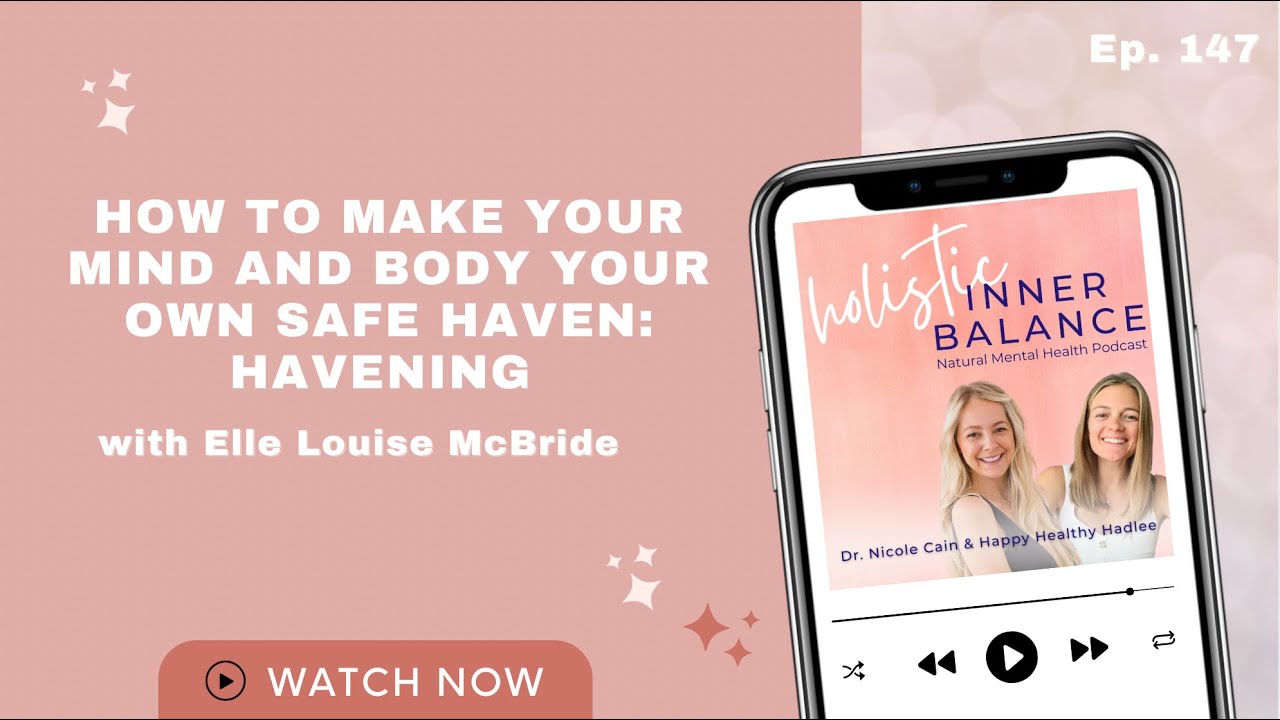
In this episode of the Holistic Inner Balance Podcast, host Dr. Nicole and co‑host Hadlee Garrison interview Elle Louise McBride, a globally recognized trauma‑informed Havening Technique practitioner, trainer, and neuro‑self‑care expert. Elle shares her personal recovery story—from a near‑death experience and years of complex PTSD to discovering Havening in 2016, which transformed her mental health and launched her career as a practitioner and trainer. The conversation delves into the science behind Havening, explaining how gentle self‑touch (arms, face, hands) combined with cognitive distractions (alphabet, counting, visualization) triggers amygdala depotentiation, releases serotonin, oxytocin, GABA, and alters AMPA receptor activity to reduce trauma‑related activation. Elle outlines the three main application domains—emotional trauma, stress/peak‑performance, and self‑help—and provides concrete examples: treating migraines, supporting children in schools, aiding childbirth, and everyday anxiety management. The hosts walk listeners through a live 10‑minute guided Havening session, demonstrating the touch sequence, counting, alphabet recitation, and affirmation integration. Throughout, Elle emphasizes the importance of balancing removal (detoxing) with addition (gratitude, affirmations, self‑love) and frames healing as a neuro‑plastic process of re‑wiring neural pathways. The episode concludes with practical resources (Elle’s YouTube guided session, Instagram, upcoming trainings) and an invitation for listeners to try Havening on their own.
Chapters
Hi everyone, this is Dr. Nicole and
Happy Healthy Hadlee.
You're listening to Holistic Inner Balance Podcast, and today you are going to learn how to make your mind and body your own safe haven. We talk about Havening with Elle Louise McBride. And she is a globally recognized trauma-informed Havening Technique practitioner and trainer. She is a neuro self-care expert, and she does corporate training, and she has a developmental background. Her focus is to deliver rapid, positive, and long-lasting results, which has made her a sought-after practitioner for those who want to. heal or unlock their full potential. And she has an impressive list of clientele that include influential individuals, thought leaders from around the globe. And beyond her one-on-one work, she's an accomplished inspirational speaker, which you'll probably gather from this amazing conversation. She's a podcaster, passionate, brilliant writer, and she hosts workshops, retreats, and she speaks Online and in-person events all over the world. So I'm really excited to, to do some Havening with you guys, and especially with you, Hadley. That was really fun.
Oh my gosh. Elle has— she's a force. Like, her energy, you'll all feel it, is just very palpable. Yeah. Yeah. It's exactly like that. It's like, like It's so good. And the practices that she— well, we literally do a practice in this episode, so stay tuned for that. And the tools that she gives us throughout are going to be so helpful for— I mean, I know they're going to be helpful for me, and I know that they're going to be really helpful for you all as well. She talks about how, you know, a lot of times we have— we already have these coping mechanisms. We already have these different ways of doing things to make ourselves feel better. And she's like, just add Havening to those coping mechanisms and you'll find out how you can do that in the episode. But oh man, it was so good.
Yeah. Well, let's dive in.
Let's do it. Have so much fun listening to her and just soak in her energy.
Yes. All right, everyone. So when you and I first connected, you talked about how Havening changed your life and you're so passionate about it and not just as a healer and as a scientist and academic, but as a person. who's experienced the gifts of Havening. And so I would be so grateful if you could tell us a little bit about your story and your experience with Havening and what it's done for you.
Yeah, of course. Well, for myself, in 2016, I was really at my rock bottom. I had been there a few times but hadn't necessarily stayed there as long as I had stayed in this one. So 3 years prior, 2013, I essentially had a near-death experience. And a month later, I had a panic attack. And in that panic attack, I was reassociated into trauma that I couldn't work out. Is this mine? Is it not mine? Was it true? Was it not true? Was it real? Was it not real? Was it this? Was it that? And for 3 years, I really sat in this space of very complex PTSD where I was being traumatized on a daily basis. by these memories. And I really felt like I couldn't go to anybody. I was seeking out all of the professional help that I could get. Mind you, I really didn't want to go down the path of pharmaceuticals. I'd been placed on antidepressants at 16 and really just didn't like the way it made me personally feel. I'm not against pharmaceuticals in any way. I think that they definitely have their place and they can be so incredibly helpful. And But for myself, I just knew that if I had gotten myself into this, I just had this belief that I could come out of it. And so I was really on the path trying to get as much help as I possibly could. And then I happened to be visiting the Gold Coast. Really, I used to run away a lot. And so I had lived overseas for close to 3 years. I'd lived in all the different states in Australia, or almost all of them. And Everywhere I went, there I was. I couldn't outrun myself, but things had gotten pretty hard in the town I was living in, so I was ready to go again, but I didn't know where I wanted to go. So first trip was to the Gold Coast. And while I was up here, I live here now, I met a woman in a coffee shop and she had just been in the UK and studied in this modality called Havening. And I just was like, I'll give anything a go at this point. I have got nothing to lose. I'm pretty skeptical about this. I remember watching some videos and being like, oh, that's good for them, but I'm really messed up and thinking that's a placebo or that's just like a video. Very skeptical, very skeptical, but very open-minded to give anything a go. And so the next day we had a session and the session went for close to 2 hours, but within 15 minutes, there was a disconnect from this memory. It went from being, to say, like, right in front of me to just feeling like it was like a movie or a book. There was this separation from it where I could look at it, I could talk about it, I could understand it a little bit more, but not through the lens of shame and this pain that I carried. And so then I was on a tour of where do I want to live. And so I went to Melbourne and went to Canberra, and I just kind of kept doing this Havening thing on myself, this gentle stroking of my arms or my face. And I just kind of say the alphabet and count to 20. I just was doing what this lady had done on me whenever kind of something came up where I felt triggered, or we didn't even use the term triggered. 8 years ago, but when I just had this sense of anxiety, which I also didn't have a label for, but anything that felt unsettling, I would just Haven on it. And within 3 weeks, I had left that town, packed up my car, moved to the Gold Coast, and met up with this woman again, Karen Hedges. And she told me that the trainers were coming over from the UK for the first training. And I just remember laughing, thinking, absolutely not. I cannot not become the therapist. I need the therapist. I need 1,000 more sessions before I could ever consider this. And little do you know, I ended up in that training, and now I'm a leading practitioner here in Australia, globally recognized. And now I train practitioners of this modality as well. So it's just like a full circle. And I know that Havening found me. There's like an intuitive aspect to healing that does come into it, even though it's heavily based on science. And I really appreciate the science. Actually, every year it's like I grow more in love with the science behind Havening. But it doesn't need to be understood in order for this to work, right? We know that when we do a soothing touch, we're stroking our hands, our arms, our face, that feels quite nice. But if we were to pinch our skin, we know that that hurts a little bit. Yeah. So those C tactile fibers communicate different messages. And so when we look at Havening, we're like, oh, it just makes so much sense as to how this works. But then it's backed up by science. And so as a practitioner, I know that changes are happening. Biological changes are happening. But also it's very protective of myself. Um, clients don't have to go into detail. When I sat in that chair with this trauma that had been just suffocating me every day, right, multiple times a day, it was gone. And I didn't have to share with the practitioner. I literally couldn't talk. I sat in the chair and all I said— she said, so why are we here? And I said, when I was— and I burst into tears, right? There was snot and sweat. Oh, gosh. She was a wonderful practitioner holding that space for me that day. And we're still very good friends as well, which is an added bonus. And so for it, I didn't have to share. I didn't have to go into the details. I didn't have to retraumatize myself. And I remember, as I mentioned, at 16 being placed on antidepressants. I'd sit in a chair. I was too ashamed to share what I was going through. So I'd give little snippets or beat around the bush, as we say here in Australia, to not talk about the real thing. So, yeah, that's just a little snippets of my story in there. The full-length one goes for about an hour and a half because it's just been a wild journey.
Wow. Wow.
Yeah.
Thank you so much for sharing all of that. We talk a lot about on this podcast, we talk a lot about self-massage and self-touch and how regulating that can be for our nervous system. So I'm sitting here, I have this black velvet shirt on, and I'm just stroking the shirt because it feels so nice.
I have a pillow in my clinic room that it's like a fluffy pillow. And especially when I work with teenagers and children, they'll just sit there Just stroking the fluffy, fluffy pillow. It's so good.
So nice. Yeah. So,
yeah.
So for our listeners who have not heard of Havening, can you tell us a little bit about what the, what the modality is? You mentioned that there's touch involved, self-touch involved. Can you tell us a little bit more about it?
Yeah. So Havening really, um, it is a psychosensory therapy. So using the body to change the way that we feel. So for us, psycho being mind, sensory being the body, being touch. Yeah. So with, with this, with a client, we're really working on 3 different, um, areas, or there's to say 3 distinct applications of Havening where there's one emotional disturbances or, um, encoded psychological trauma. You've then got wellness or stress management, peak performance, and then as a self-help tool. So you're really able to use this in many different aspects. We've got Haveners that do specialize into different things. For myself, I'm kind of across the board in how I can support people, but it really is altering thought, mood, and our behavior as well. So going into a session, depending on kind of those 3 areas where somebody is wanting to work on. They may not put it into that kind of box of wanting to work on emotional wellness or their stress management, but depends on what their presenting kind of issue is, then we will take a different route dependent on that. Yeah. But Havening was created in the year 2001 by Harvard-trained medical doctor Ronald Rudin, along with his brother Stephen Rudin. And it really has been hailed a remarkable breakthrough because because they were first introduced. Ron was first introduced to EFT through Paul McKenna, who many may know. I've been lucky enough to train with Paul in hypnotherapy. And yeah, so Paul introduced Ron to EFT and Ron was like, wow, there's something in this. Recognized that the science behind it at that point was just a few pieces were missing. He kind of was like, I need to figure out what going on here. And then EMDR really was making its way, which EMDR is using the lateral eye movements. So it really sparked more interest. Melvin Harper brought out a study around touch, and there's been so many studies throughout decades around touch and the difference in children that experience loving, kind touch compared to children that don't. So it really just took took its own path to then in 2013 was marked as Havening techniques. Prior to that, they'd really been working in this space of amygdala depotentiation because through the science, that's what Ron really worked out was happening, is that through either tapping, stroking, eye movements, that this sense of the amygdala changing its ability to respond. And so, yeah, they chose the name Havening because it really is creating a safe haven within ourselves. And amygdala depotentiation, although I think some people wish it had kept its name for the scientific purposes, a lot of us love the name Havening. Yeah. Or
delta brain training. I love that. I'm from a town in Michigan called Grand Haven. Oh,
beautiful. Yeah. Amazing. We should run our conference there. That would be great. I'm surprised it hasn't. It's usually in New York or London, but next year we are having it in New Zealand, which is really cool. Just shows the growth of it because it's either been in one of the major cities for so long now.
So if I can ask a little more, with your experience, it sounds like, was it more of a big T trauma event that the Havening was really transformative for? Or was it more so like you and I? So I got, I got to experience Havening. And so the target that I picked is a target that has shown up 20,000 times. And so it'd be interesting to learn a little bit about where the brain will integrate so much more because of all the different data points and experiences getting integrated versus a big T trauma or one main thing that happens. And then, of course, there's the subsequent PTSD that can come from that big T trauma. But can you talk a little bit more about that?
Yeah, absolutely. So in my case, mine was that a trauma had been blocked out for 23 years.
Yeah.
And then all of a sudden, I was traumatized by something that I couldn't work out if it was true or not.
Yeah.
So this is not an uncommon thing. I've since supported people through this. Then there are people that are like, oh, no, I know specifically where this happened.
Yeah.
A lot of people, even with pain, they'll go, I've had this pain in my back and it's been there ever since this specific event happened. So a lot of the times, if you haven that event, the pain that's being stored in the body will also alleviate. Now, when we are looking at events, when we get into the Havening, because it is creating that safe haven, that touch is saying, it's okay, I'm safe. So our mind really will present what's not supporting us, what really needs to be let go of. So we're able to go into that memory specifically, almost not reliving it, but reviewing it. Like, okay, I'm aware that it's there. I'm just going to spend 10, 15 seconds just really thinking about it, allowing myself, giving myself permission to think about the thing that I've been trying so hard not to think about or to push aside or to just, okay, I'm going to have all of these coping mechanisms to just not have to think about that one thing. So we give it the time of day to go, no, if it's there, let's look at it. And as we're looking at it, what we're doing is we're really increasing that adrenaline and the noradrenaline, the cortisol, even dopamine is really released in that message. Then we've got really fast kind of chemicals that go. We've got glutamate receptors. And again, if I go into the science, we'll be here a little while. But essentially, our amygdala starts sending off what's called AMPA receptors. And these AMPA receptors, when there's trauma, those AMPA receptors will stay permeated. They're glued onto the surface. Yeah, they're there. It's like a biological super glue called phosphate. Yeah, so it's there. So when we've had a trauma, the reason why we keep thinking about it or it keeps revealing itself is because AMPA receptors on the amygdala have said, I'm going to remember this forever. I'm not going to let this go. Now, the reason why Havening works and works so profoundly is because when we bring up that memory again and those AMPA receptors get triggered and are standing up, and that happens almost instantaneously within 10, 15 seconds, then the Havening touch, what it's doing is producing serotonin, oxytocin, as well as a neurotransmitter called GABA. Now, GABA neurotransmitter, many people have heard about it, kind of is a neurotransmitter that I like to say brings in a stop sign. It stops the message from being passed along. Now, we've also got where the chemical changes is the calcium ion channels start moving a lot slower. Different chemicals like comodulin and calcineurin are released. And what this does is it permanently starts to depotentiate those AMPA receptors on the amygdala. So then we can have the memory without having trigger. And this can happen very quickly within what we call rounds of Havening. And so that's why for myself, when I sat down in the chair with this trauma, that I literally could say 3 words before I was having a full abreaction and response to it. That within one round of this Havening, in about 15 minutes, it felt so much lighter. Right? It was like a 10 out of 10 trauma, and it went to like a, a 5 out of 10. Yeah. I continued to do work on it. New things got revealed. Um, I was covered in, in so much shame about it. That then when I returned to the Gold Coast, there was like this righteous anger within me, this like, I'm really now quite angry. I'm disturbed. I was like all these new things that I hadn't been able to have access to. So my Havening wasn't just for myself and many of my clients, wasn't just that one session, but that one session alone also brought me freedom. Like, I think about it, if I had gone from that 10 out of 10 where it was really bad to that 5 out of 10, I would have grown in more capacity. Yeah, I would have had more in my tank. Yeah, I was completely full. Nothing— everything was too much. You know, a day of work, I'd need to go home and just go straight to sleep. Like, catching up with friends was just almost too hard unless there was copious amounts of alcohol. I couldn't have fun. So my capacity that I had was very, very small. So going from like a 10 out of 10, if you think about it, if you cut that in half, you've got 50% more capacity. Yeah, I wasn't where I am now in a full sense of freedom, but there was this like alleviated stress and shame that was given that I could cope again. I could walk outside. outside and hear the birds and look at people and smile at them when they were smiling at me instead of thinking, that person knows, that person's judging me. All of these ruminating thoughts that I used to have were just gone. But it didn't mean that the work wasn't over. I still have them all the time. I still have sessions with Karen, my mentor. She's like a mentor, best friend, auntie, sister. she comes and supports me now in my trainings. And yeah, it's a bond that will never be broken. But this understanding that that's also science, for me, it really just brings this like, yes, okay, I can feel that I'm stressed. I can feel this high level of cortisol. What if I was just to stroke my face for just 5 minutes, even when the times when I don't want to, and I'll just sit there and haven for 5 minutes sometimes just to To music. I'll just put classical music on, which soothes my soul, um, and I'll just sit there. Other times, if you're, you know, if you know a little bit about Havening, for those that are listening, you may chant the alphabet or count backwards from, you know, 100 by 6s, you know, something outrageous that's really going to cause a distraction can be a wonderful, wonderful process. Yeah.
Yeah. So when you say Havening, that verb of Havening, you mentioned stroking your arms, stroking your face, and then the alphabet too. So it's clearly not just touch. What is the technique, I guess, of Havening as that verb is?
Yeah. So we do. We use touch, which is 3 different areas down our arms. like we're giving ourselves a nice hug. We have across our forehead and our cheeks, which it's like we're washing our face. And then we have our hands almost like we're washing our hands. I like to imagine like there's dirt on my hands and I'm just like trying to get it off, or I'm running my hands under the water and just feeling the soap or putting moisturizer on. Sometimes I have those visuals. And so then we do, we have distractions, and those distractions can be simple things. Spelling the alphabet. Sometimes me and my clients will go for a grocery shop in their mind. Um, I just had a client yesterday who read 50 books last year. So I said, can you tell me as many of the titles of the books that you can remember? So they can be very simple things like, again, the days of the week, the months of the year, or then they can be quite a lot more personable, um, depending on the, the client. And then we also can use visualization as well. Like I said, I'm seeing myself just rubbing moisturizer into my hands, maybe walking down a flight of stairs. And so what the distractions do is they really allow us to access different parts of the brain. Because when we're really activating trauma, the thalamus is there, the amygdala is so activated that we really want to start creating more capacity and new neural pathways and delinking current pathways. And so for the For the distractions, it's really bringing in the hippocampus, the prefrontal cortex. Like, it's allowing the brain to access different parts and different information and information that feels really quite safe for us. There's nothing threatening to— look, it can be, but to say the alphabet, there's nothing really threatening about spelling out our name or saying what our phone number is. I remember learning the hard way. I was doing a group presentation once and I thought, oh, it'll be great. I'll get everyone to visualize that they're walking down 20 flights of stairs. So I've got this beautiful group and I say, okay, now we're going to start Havening. And it was about 3 or 4 distractions in. I said, we're going to walk down a flight of stairs. And so we're Havening, we're all counting, and we go through this wonderful process. Everybody's sharing feedback afterwards of like, I was feeling so stressed about this and now I've got new clarity. And someone was like, wow, I went really deep and went into something that was really quite heavy, and it's fully shifted. And then another lady says, oh, I worked on a memory of when I was younger and I was pushed down the stairs. She said, so when you asked me to walk down the flight of stairs, I kind of got triggered. She said, but by the time I got to the bottom of the stairs, the memory felt so different. So it's just so fascinating that something can be triggering at the same time as really healing. Wow. So in her mind, she was like, it was wonderful because I just saw myself walking down all of the stairs this time. I didn't trip and fall. So it's just so wonderful that even though sometimes it can be triggering, we can use that trigger. Right. We can go into those places. But with my one-on-one clients, there's definitely more history taken and we're learning what's going to work well. I never assume that everybody knows how to say the alphabet or— because for some of us, we think it's been 30 years since I've said the alphabet in school or to count backwards. So, yeah, we really personalize it.
Yeah. And so it sounds like the process would be you identify the target, that thing you want to work on. So, like, being pushed down the stairs or whatever it is. And then you focus on it, you notice it, and then you distract and soothe. And so you do the Havening and you do the counting and the alphabet. And I think that's really neat because it's like, what's the word? I'm trying to find the word. It's like where you— no, I don't know. Desensitization.
Yeah,
it's a systematic desensitization, right? So you pop in, it comes up, and then you reprogram. You pop in, it comes up, you reprogram. So it's like a way to slowly drained out.
Yeah. And we keep going back to the event and checking back into the event as well. And each time we usually check in, I never assume that it's changed, but I'm just simply asking the client, what do you see now? What do you notice? And again, I'm really wanting them to go into it and find the discomfort or find the emotion or find the emotional pain, even the physical pain. I had a client yesterday who just said, Emotionally, I feel so much better. I just have this heaviness on my chest. I said, great. I want you to just focus on that heaviness in the chest and everything that represents. Because sometimes we don't have words for what it is we're feeling. Yeah. It's like when we say, how are you going? And people are like, good, because they don't know how to answer it. Yeah. We don't know how to communicate what we're feeling because what we're feeling is often very complex. And as much as I love talk therapy, I have benefited so much from talk therapy. Absolutely here for it. But the benefit of talk therapy came after I had done the work on the things that I couldn't talk about. Then I had this huge desire to be like, I want to talk about this now. I want to unpack it because I don't carry that shame that I did have. So it became incredibly beneficial for me because I then was like, it was like my tongue was unleashed. I wanted and desired to talk about the things that I had been through, that I had spent a really long time feeling like so misunderstood, like no one would get me, like I was just So unworthy of taking up any form of space. So, yeah. And I did use my tongue a lot, but it was just in, like, you know, just ways that were never beneficial. Could talk down the whole house, but it was really from that space of anxiety and lacking of confidence. It's quite interesting that a lot of feedback I always get is like, oh, you were always so confident. And I'm I was riddled with anxiety. I may have looked like that, but yeah.
Yeah. I'm curious, how can Havening help us if we don't— like Dr. Cain was talking about, we maybe don't have this one event that happened. And you also mentioned you can use it for just like personal development and upleveling in that area as well. I'm curious how it can help us when we don't have that, just one specific event.
Yeah, well, then it would be looking at, well, what's the intention for why you're here? So for us, when we think about a newborn baby or a kitten or a puppy, they just know how loved they Yeah. And so if somebody was to come in going, you know, like, I just feel so unlovable, so unworthy, you know, I don't see them for that. I see them as that puppy dog or that kitten, right? That's just like, give me all the attention. And so we're born with that innate belief. Things do happen. And sometimes, you know, because the hippocampus, which is like our memory bank, our internal library, doesn't really come on board until we're like 3. Then some people's younger, some people a little bit older. And so for us, we are then designed not to store all of our memories. Yeah. And what is something that's big to somebody can be very minor to somebody else. And so there is going to be events, right? But we don't need to remember those events. Within the Havening techniques, we have got a lot of different techniques. Yeah, it's most prominently— and when you look on the internet, if you were to look up Havening techniques, I can guarantee you'll find processes which is called event Havening, where we're specifically targeting events. But when you work one-on-one with a practitioner or you decide to become a practitioner yourself, you learn a lot of different protocols that come with the practice too. So it's not necessarily like in a session we're going to go, okay, now we're going to use event Havening, and now I'm going to go into transpirational Havening or event or affirmational informational outcome or role. That's all of them. And then we've got lots of subcategories that people have created. And so for it, there's There's a lot of tools. So we may not have one memory, but we may go, look, there's like 10 memories. How do I choose? We can work on those 10 at the same time. But a lot of the times what also happens is that somebody may not remember. And then when we start Havening, the brain, once it starts to feel a little bit safer, it's trusting to say, if you're working with myself, it's trusting my voice. Mm-hmm. my guidance. You're working again through some of that shame or the emotions that have come with it, the anger. And sometimes it can just reveal itself. And sometimes it's not. I say there's big T and little t, right? There's the big traumas and then there's the lowercase traumas. And they can be, you know, to the mind, we can go, no, that wasn't traumatic. That wasn't traumatic. But if it changed us, it was trauma. Trauma changes us. And so it doesn't necessarily need to be something so big. It can be, I felt dismissed. You know, my younger sibling was born and I just felt ignored. You know, to a, to a 3-year-old that's been, you know, the star of the show for 3 years and it's the world's revolved around them. Be rather traumatic to have somebody else come along and the attention's all on them. So, you know, for us, yes, we're absolutely doing our best. Our parents did their absolute best. Um, but there's, there's gonna be stuff. There's always gonna be stuff, but we don't need to specifically work on it. In, in short answer, we can work on a lot of things. We can work on the emotional side of things. Um, we don't need to know what made us feel angry, but we can work on the anger.
I love that because, yeah, I feel like there are a lot of times when I'm like, I don't know, I don't think there was an event for this. I've just been experiencing it for a long time.
We can also get into the thing of like, oh, I've got to find the thing. I've got to find the needle in the haystack again. That's going to fix everything. And if I can just figure out what that needle was and where it is, then I'll have freedom.
Yeah.
But we don't need to know. Yes, it can be helpful. Right. And yes, I think we sometimes do get there. But like, in my experience where I shared before, it was like a 10 out of 10. It was so bad. Right. I don't think I would have made it another 2 weeks in my own head. Like, I was willing to not be here. It was so bad. So when I had that sense of freedom, where still to this day, I haven't worked on that specific event ever again. That was dealt with. It was the repercussions of the other stuff that came. You know, it was the sadness of what those 3 years of complex PTSD took away from me. It was the environments and the habits that I had created as a coping mechanism because of that one panic attack that I had had. So it wasn't necessarily then the event, it was the, the coping. of alcoholism and addiction with an ex-partner that I had had, really obsessive compulsive disorders and all the labels that I could have been given at different times. This riddling anxiety that I'd wake up in the morning and be running to the bathroom doing countless pregnancy tests thinking, this isn't normal. There's something wrong with me. Um, you know, for us, we— it was all of that. It wasn't necessarily the event. And that came, came later. That came with not just going and seeing my therapist and having the counseling— that, the, sorry, Havening sessions— that then came with journaling, daily meditation, daily affirmational Havening where I would sit. I had affirmations everywhere. One of the greatest things I think I ever did for myself was I got a pen and paper, A4 paper, just a pen, and wrote down affirmations. And I put them in the shower. And anytime I got in the shower, I'd read out my affirmations. I've still got this piece of paper. It's actually framed now. And I just haven and read these affirmations out every day. I'd sit and I'd haven. I'm enough. I am enough. I am enough. I am enough. I'm enough. I'd sit on the beach and I'd do this for hundreds of times over and over again. I had to take radical responsibility because Because if I was pulling out weeds in my neural garden, right? I like to think like the brain, like a garden. And I was pulling out the weeds. I was pulling out like oak trees that had been there my entire life. Like, I was going to town on the gardening of my brain. But often people do this. They go on this healing journey. They just want to heal everything, right? They want to pull everything out. But we forget that it's our role to then put back in.
Oh, yeah.
Yeah. It's our role to go, okay, I can— we can be on a healing journey to fix ourselves, right? But will we go on the journey to then create ourselves as well?
Yeah.
If I don't want the belief that I'm unworthy and I'm not good enough, well, I need to then equally choose the belief that I am enough. Otherwise, I'm just going to do what I've always done. and keep that belief. And no one's coming to knock on my door and go, El, just so you know, Daily Mail has said that you're enough, right? No one was coming to do that. Yeah. No one was coming to tell me that I wasn't this person that was riddled with shame. I had to do that. My therapist couldn't do that for me, right? My practitioner, right? my mom would tell me that she loves me, right? Friends would tell me that I'm amazing, right? I didn't believe them because I didn't believe it for myself. So for us, it's going, okay, well, do I want roses or lilies? Like, what do I want? What do I want? And that is one of the hardest questions. I was going to say it before and then I didn't, but it's come back into my brain. I worked with a client the other day. She said, oh, Elle, I just, I really just want to feel more confident. I want to feel more confident. And we really broke down what that meant, and she was able to tell me what it wasn't but wasn't able to tell me what it is. Yeah. And so when we, when we look at that and we go, ah, ah, this is an identity. We've got our skewed identity here. So who am I? And if we all sit, you know, everyone that's listening, I'm sorry. I hope you have had your coffee before listening to this, but it's going, well, who am I? And that's such a hard question to answer because we overcomplicate it. But what I've come to realize is like, I'm love. I'm love. That's— it can be beyond that, but I'm love and I'm enough. I mean, I have enough because enough on whose scale? Like, who designed the enough, you know, like meter? Like, who, like, where did that come from? Right. It's an internal, it's an internal thing. It's a comparison thing. Yeah. So it's just, ah, so good. It's so good. Our brain is so brilliant and it will give us what it thinks we want. We just got to learn to communicate with it, to direct it, to tell it what it is that we want, and it will come and find it. That's why practicing gratitude, probably the second outside of affirmations, gratitude was one of the best things I did on my journey of reprogramming my brain to look for things that I'm grateful for. Because it's very easy in this world to look for things that are awful. And annoying and frustrating and things that other people are doing that, oh, we wouldn't do that. But when we start looking at the world through a sense of gratitude, we'll reprogram our brain very quickly.
And we can't just always be trying to identify things to fix. Yeah, I love that you said You were basically saying you can't just strip away. You can't just find all these things that, like, okay, I'm healing, healing, healing. In Ayurveda, which is one of the tools that I use with my clients, there's this principle that— and we're obsessed with detoxing right now in our society, right? We're obsessed with stripping away. And in Ayurveda, it's like, whoa, whoa, whoa. If you just do that, you're stripping away everything. And you have to also nourish. You have to bring in over top of that removing. You have to bring in more, whether that's with food, bringing in more oil and fats and these things that are going to then nourish after you do some sort of stripping away process. Or whether it is taking away something from the subconscious mind and bringing in something new. So I just love that you said that. I think it can be applied to all areas of our life.
Yeah, absolutely. And there's a time for healing, and then there's a time for growth, and there's a time for self-love. The best way, if you ask any home renovator, renovate one room at a time. You know, they're gonna tell you that, right? If they're a good renovator, right?
Yeah.
They're gonna tell you just do one room at a time. Focus on that one room, get that one room done, and then go to the next. Yeah. I recently just helped a friend, um, in the garden at her business, right? Big, beautiful garden out the front of her, of her cafe. And, um, I just showed up. I was like, yeah, got my gloves. Let's go. Pass me a shovel. And so we're ripping out this garden. It's all going. And there's like insects. And in Australia, there's spiders and wasps. And it's all going on. It's like a full party. Everything's gone now. And then yesterday, she's designing what it is that she's wanting in that space. Right. Hours and hours of redesigning, walking outside, looking at it, questioning it, taking pictures. You know, really, she had this image before she ripped out the garden, but now that the garden's gone, ah, it's clearer. More ideas, more— there's more space for bigger ideas where before, literally, her cafe was just covered in a garden, right? Beautiful garden. Right. But it was covered that she couldn't see what it was that she wanted. So again, here comes another layer on top of this, of so many people in that healing journey not knowing what to pull out, thinking, I've just got to do it all at once. Yeah. The problem that my friend is now going to have with his garden, and she probably will listen to this podcast because she's a great supportive friend, is that— She's now got so much of an open landscape that she doesn't know what she wants. Do I do this? Do I do that? What do you think about this? And if it looks like this now, I can tell you that weeds are going to start growing in that area that she's landscaped.
Yeah.
Yeah. Things are going to start happening in that space. But also, the people that used to come to the cafe, this beautiful cafe with all this greenery, it's going to look pretty bland for the next month or so until she fully gets it done, because she didn't rip out the gardener and then say, okay, landscaper, now come in and build the retaining wall that I want. They didn't show up an hour later. They're yet to be booked, right? Decisions are yet to be made. And so this is the thing for so many of us is we go, okay, I'm going to heal because I want that. But often when you heal, And you go through that journey, what you thought you wanted, you're like, oh, I can do better than that now. Yeah. I can have more than that now. Worked with a lady yesterday, and she was working on quite a traumatic experience in a relationship and a big decision. Then that relationship ended, and she's for 2 years been hoping that potentially they'd get back together. And she's been holding this hope in her heart. And as we were going through the journey and the experience, and this is like her 3rd or 4th session, at the end of the session, she goes, actually, I don't even know if I like him.
Oh,
wow. But she'd been entertaining that out of the shame that she had carried around the decision that they they had made about their future. So it's just like when we go through that healing, we go, oh, wow, the possibilities can open. But it's such an individual journey for us all.
So how can someone get started today just putting their toe into Havening? Is there just a quick little exercise
Yeah, absolutely. On my YouTube video, on my YouTube video, my YouTube channel, there is a 10-minute guided session with me, and I highly recommend it. I still to this day send it to my clients. It's a wonderful process where you're actually viewing it at the same time, so you feel like we're doing it together. If you don't have YouTube, all you're going to do, and you don't have the minutes and you want to do it right now, highly recommend it. What you'll do is just go with how you're feeling right now in this moment. Yes, we've talked about how Havening can go in and truly change the landscape of your mind and heal this trauma. I tell my clients, don't go digging for it, but if it shows up, Haven on it. So if there's something that you're feeling, do we have time to even just go through it? Yeah,
let's
dive you both through something.
Okay, nice.
We're aware of the touches. I've been visually being able to see you even just stroking Your arms. So reminder, shoulders to elbows, like one stroke per second if the clock was ticking, and then across the forehead, down the cheeks if that feels comfortable for you. And then we have the hands. So anywhere that feels feels best for you. All right. So let's get started again. Let's not go into you know some some major T. Let's just go with how where. feeling right now in this moment. So I'll have you pause the Havening touch and close down your eyes if it feels safe and comfortable. Please, if you're driving, just skip this part. So just allowing yourself just to be present with what's there in this moment. Any physical sensations, thoughts, And allowing yourself to really sit with any heaviness, anything that feels unpleasant. Just be with it for another 10 seconds as I go quiet. And now when we're ready, we're going to haven together, wherever feels best for you— your arms, your face, your hands. Wonderful. And just out loud, let's count to 10 together. So starting at 1, 2, 3, 4, 5, 6, 7, 8, 9 and 10. Wonderful. And now we're going to count backwards from 10 to 0. So starting at 10, 9, 8, 7, 6, 5, 4, 3, 2, and 1. And 1. Wonderful. And now, are you able to spell— both spell out your full names for me, first and last names? And now we're going to say the alphabet together. So starting A, B, C, D, E, F, G, H, I, J, K, L, M, N, O, P, Q, R, S, T, U, V, W. W, X, Y, and Z. Wonderful. And now just one more time, we're going to count backwards from 20, and we're going to see if we can do that by 2s. So 20, 18, 16, 14, 12, 10, 8, 6, 4, 2, and 0. Wonderful. And now just resting your arms, taking a nice deep breath in and out. And you can take a moment and just check back in on how you're feeling. And then you can just repeat that again, that process again, applying the touch. You might then choose to finish with an affirmation, and and let's do that together now. So you may have wanted to have repeated that process or paused or gone back. My favorite affirmation is I choose to feel safe, peaceful, and calm. All is well. I choose to feel safe, peaceful, and calm. All is well. I choose to feel safe, peaceful, and calm. All is well. And maybe there's an affirmation that's on your heart. Something that you're wanting right now in this moment. And again, staying that as long as you like, and when you're ready, you can come back out. So that's a really simple way of looking at, at Havening. So those distractions, you know, again, you could go back and repeat that a few times or even just write down those distractions. A lot of my clients will have like a, a list of distractions in their phone. And then if something comes up, they just take themselves off to the bathroom if they're at work or, you know, they're, they're in the shower or, and they, you know, they just look at their list and okay, A, B, C, D, E, F, G, me and work through it on the go. Those real triggers are wonderful in sessions. There's a safety that's created, so the brain will go, oh, I can just rest here. But we do really want to create an activation of those AMPA receptors. Yeah.
When I just dialed in on myself in that moment, I was noticing pressure and congestion kind Kind of in the neck and chest area. And then even after just one Havening and we checked back in, that felt much less, which I was like, oh, that was neat, actually.
Yeah. A lady yesterday I ran into, she said, Elle, I'll never forget the time I had that really bad headache. She suffers from migraine. She said it almost was turning into a migraine. She said, and I remembered you just stroked my arms and you said some funny things. Um, and it was gone. She said, now anytime I get a headache, I just do that. I said, wonderful. You know, the freedom that can come with that.
Oh, that's such a gift. I'm thinking about like teaching kids this, teaching kids how to regulate.
We— in the, in the US, there's a few studies being done in a few schools where they start the morning with, I open my mind to learning, I open my heart to friendship. I choose to feel safe, peaceful, and calm. And so it's this wonderful way, imagining, especially in the US, in comparison to many other, like, the schooling there in comparison to Australia is incredibly different with the daily stresses that I suppose would come in those schools. Yeah. And so for it, To know that this is something that's being run throughout— don't quote me, but I think it's 30 different schools— is just phenomenal. Yeah. Wow.
Oh, I can't wait. My sister is a 4th grade teacher, and I've gone into her classroom before, and she actually does affirmations, and she does little time for silence, like 20 seconds of silence or whatever. But I love this. I love bringing this into the affirmations and stuff. Would be so cool.
We have a phenomenal woman named Erica Neal. Highly recommend looking into her. She has written a book on Havening with children, and she's actually in Africa at the moment and working with children. But there was just a video in our private Havening practitioner group, and the children were then teaching adults and doing Havening with the adults. And, oh, my heart just has been burst again and again. But, yeah, just phenomenal work. I don't specialize in children and mental health. I do work with a lot of children, but usually once I've worked with the adult. And so the parent has got a really good understanding of Havening. And then if they're aware that the child has gone through something or is going through something, But I'm a very proud auntie. And so my niece and nephews know Havening, and it's just such a gift to be able to give to them. My niece thinks that it's a magic trick, but it's just so wonderful. It's just such a gift.
When you were saying that about the woman with the migraine, it does seem like a magic trick. Are you a witch?
I know. And far from it. That's why I love the science, because without the science, you can think that, oh, you're doing this. I've got to go and see that magical woman from the Gold Coast, Queensland. No. Right. Like, my clients do this. It's got nothing to do with me. Yes, I'm an incredible facilitator. And I like to consider myself a humble person, but I don't think humble people say that they're humble. So I stay away from saying that. But for it, yes, I take part, but it's the clients. And what I love about it is that even from my own experience, my own willingness to say yes to that session with Karen that day, to sit in that chair and go into those hard places and then to know that she stroked my arms and had me say the alphabet a few times. Much more complex than that, but so deceptively simple. And it changed my life that then I had this sense of like, wow, I continued to do that for myself. I continued to do that for myself 8 years later. And it makes it so much more self-empowering. I didn't have to go unnecessarily I had to rely on somebody else to guide me through those hard places like I would if I was to drive to Brisbane today. I have no idea how to get there without my GPS. So the guidance is really good.
Yeah.
But also, I've got to be the one that puts the address into the GPS. I've got to be the one that's willing. So for it, love that there's this ability, this self-reliance, which then creates resilience. Yeah. And when we're more resilient, things are less likely to impact us because we're either feeling really resilient or we're feeling really vulnerable in the landscape of our mind. My friend's garden right now at her cafe is really vulnerable, where a few days ago it was really resilient. It was flourishing. There's one palm tree. I think we pulled a few too many palms off. I don't know if it's going to be here in 6 months because its environment has changed so much. Yeah, I won't again say that to her.
She's listening. Yeah, I really appreciate and honor that. Like you were both saying earlier, is we want to detox, we want to take it out. But I think just as importantly, it's like the balance of yin and yang, the light and dark, all of the opposites, is we want to add while we take away and add and take away.
Yeah, I always think about it like, if you've ever met a 2-year-old, how they'll hold on to things. They've got that hair tie in their hands and they ain't going to let it go. Right. And it doesn't matter what it is, they're not— I've got a 3-year-old dog, and I remember when he was a puppy, he did not want to let go of my shoes, so I'd have to give him something that was more entertaining.
Yes.
Yeah.
I mean, it's the same. Why do we think that we are not still that 2-year-old?
Right?
We are still that 2-year-old. And so, yeah, it's going, okay, well, if I don't want to feel shame, pain, anger, resentment, what is it that I want? But if you ask somebody when they're covered in shame and pain and resentment and hurt and anger what it is that they want, 99% of the time they're going to say, I just don't want to feel like this. Yeah. They've lost sight of joy and happiness and self-compassion that they don't even know. I had another lady the other day and she came to see me and she said, Ella, just been feeling really tired since our session. Just this deep sense of like, I get into bed and I'm just falling asleep straight away. And I said to her, I said, well, are you tired or are you feeling rested and restful and desiring rest now? And she was like, oh, wow. Yeah. She was like, I knew it wasn't tired. But for her, she didn't know that another reality was available to her because tired was like an easy label that she could give Yeah. But when we've been carrying around a couch into every room that we've ever walked into, and then we finally put that couch down, there's gonna be a sense of like, oh man, wow, like, I didn't realize how hard that was.
Yeah.
That was a lot of energy to just simply get through a day carting that 3-seater sofa everywhere I went. And then that's where sometimes the anger can kind of come up, but it's this righteous anger. It's not anger like we have been shown that puts holes through walls. It's this anger of like, I've been taken from— my peace has been disturbed and it wasn't out of my own will. There's this anger that that can be incredibly motivating at times to create change. We need all emotions. People come, oh, I just want to get rid of this anxiety. I've been anxious for 25 years. I say, well, no, you haven't. No, you haven't. You've experienced high levels of anxiety and you're never going to get rid of it. I said, you're never going to get rid of anxiety. You need it. When you get to the edge of a cliff, you want anxiety to tell you that you should take a few steps back. I said, but you just don't want anxiety when you go to the shopping center.
Yeah.
You're experiencing anxiety. You don't have anxiety, right? Because if you had anxiety, it would be 24 hours a day. You wouldn't be separate from it. So do you have anxiety when you brush your teeth? When you brush your hair? No, I just brush my hair. Okay. You don't have anxiety. You have a nose, right? You have fingers. I don't have anxiety. Where is it? Yeah, right. But it's not something that you have, it's something that you experience. And it's the anxiety, not my anxiety, is the other advice that I give to people. You know, then the anxiety, not my anxiety. My nose, the anxiety gives it less power.
Separates you from I am. Um, X, Y, or Z, but rather I experience.
Yeah. You know, my good friend that's got the cafe, she's really making an appearance today. Um, she's, she's got a new dog. Yeah, a new little puppy. So I brought my dog to come and meet her, her dog. And my dog's 3 and a half, so it doesn't really care for a puppy. And, um, I can tell you right now, I love my More than I love her dog. There's a learning in this, trust me. I love my dog more than I love her dog, right? My dog is mine. Her dog is outside of me. The care factor is less. So when I say my anxiety, there's an attachment from me. When I say the anxiety, there's less of an attachment. Yeah. And so when we're working on healing things, depression, my depression, the depression, it's a visitor. It's a visitor. It's come, it's in high frequency. And those neural pathways have fired together for so long that they've wired together. And we know that with neuroplasticity that we can create those changes.
I'm writing that down too. Your anxiety is a visitor.
Yeah, I love that idea. Thinking about it like knocking on the door. I'm back.
And when it comes here, we either go into that high cortisol, right? That high stress. It's here, right? And I remember that, guys listening. I get it. I get it. It was there every day and it didn't even knock. It just opened the door, right? I didn't even see it coming, and it was just like in bed with me. Um, you know, it was a
horror movie.
Yeah, it was a horror movie. And, you know, for— and I was coping. Nobody knew. Nobody knew, right? Nobody knew. That's the hardest part. And so, you know, now when I tell people, they're like, I had no idea. I'm like, yeah, of course you didn't, right? It was an internal battle every day for And so for it, with this, it's knocking on the door. Anxiety is coming, right? It's rearing its head. You've got coping mechanisms. Sometimes you can see it coming. If you don't, well, it's just going to open the door. But that high adrenaline cortisol that's triggered the anxiety, add the Havening, you get the serotonin, the oxytocin. After a few minutes, you'll start getting glutamate. and GABA neurotransmitter, a slow calcium ion channel. Right. It starts changing the way that we're feeling a few minutes of this. And then you might do the good old, what's 5 things I can see, 5 things I can smell? Whatever tool you've already got, just add Havening to it. Yeah. Add that touch to the tool that you're already finding is supporting you. And Within that, there will be a change. We know that love drowns out all fear. Yeah, there's studies done on it. I don't know what Bible verse it is, but it's true. Love drowns out all fear. And so when we look at adrenaline, cortisol, right, they produce a fear response— fight, flight, freeze, or fawn. Serotonin or oxytocin produces the love chemical. So when we're feeling fear, if we produce more love, it will drown it
out.
It creates that change. Serotonin, oxytocin, all they're powerful. I supported a birth on Monday. We do Havening birth. And this is a client. She'd had 2 very traumatic births prior, and we've built a beautiful therapy client relationship. And she's now studying to be a practitioner of this modality. And so she was pregnant with her third child. She'd had a miscarriage in between the two traumatic ones and then this one. And so we'd done a lot of work on releasing trauma, things around motherhood. And yeah, then she asked if I would come and support her in the room and the delivery of this baby. Incredible experience. And we're Havening leading up to the birth, and then we're Havening during the birth. And very similar to how you would use hypnobirthing, if you're familiar with that practice, but you're using Havening instead. And yeah, this was the following Monday. And so then this week I caught up with her again, and I'm just holding this baby, this newborn baby. I'm holding this baby for about half an hour. We're all just talking and holding the baby, shaking the baby. baby. I then hand this baby back and I felt high as a kite. I literally was like, someone has given me a drug. Like, oh, serotonin and oxytocin right there. Like, that is, you know. So what, what have you got to do? Do you need to go and visit some kittens and puppies? You know, go and stare at the birds, go take yourself for a walk, do something. that is loving to yourself. I said to— I did a presentation last night to a group of people, and I said the greatest act of self-love that I give myself at the moment is having a shower at 5:15 PM in the afternoon. I said the light that comes through my bathroom is just magical. My bathroom turns orange, and it's just stunning. I said, and when I have that shower, I know that I love myself. Nobody else might resonate with that ever, but I know that that's something that brings me pure joy and reminds myself that I've got my best interests at heart. So find whatever it is for you.
Yeah. So for those who are listening, is figure out something you can put in your flower bed, something you can put in your garden, something you can do to boost that oxytocin, that beautiful love serotonin. And people are going to want to learn more about you. I'm sure they're going to want to learn more about Havening, and we'll include the links that you gave us in the bio. And what would be your favorite way to connect with listeners?
Yeah, my favorite way. I love when I get the Instagram DMs. Um, you know, the, hey, I'll just listen to you on this podcast, or, you know, my takeaway was, or, you know, I get emails quite often about my YouTube video. Um, there's one woman that she was like, I've just done it every day for the last 30 days and, you know, just created so much change in my life. Like, so cool. I have no idea, you know. Um, so yeah, that's, that's the one-on-one sessions are available anywhere in the world. Uh, trainings are available anywhere in the world as well, just online. So, yeah, it can all be found. Instagram really is the main place. We'll try and be better at TikTok, but I was saying that this time last year and I didn't really do anything with it. So we'll see. We'll see. But, yeah, it's all available there. Yeah.
Perfect. And we'll put all of those in the show notes as well. So if anyone just wants to go and click a button, you got it.
Yay. Elle, this has been so wonderful. Thank you so much for your Your candor, your heart, your wisdom, and for being a trailblazer for Havening in the world. I think this is— this could be really life-changing for so many people. And so for those who are listening, go and find that YouTube video or rewind this video. And she gave us a lovely little moment. And so I hope that— I hope that it's great. And let us know, send us all a message and let us know how it goes. All right, everyone, thanks for listening. We'll see you soon.
Bye, everyone.
More from Hadlee
Happy Healthy Habits: Automate Your Habits. Optimize Your Energy. Unlock Your Capacity.
Join us at the Align & Thrive day retreat Sunday 1/11 in San Diego 🩵 Comment ALIGN for the link
Fueling the Future: ESS60, Mitochondria & Mission Longevity with Chris Burres | Ep 156

Dancing Through Life: The Healing Power of Showtunes with Danella Mercati | Ep 155
From Breakdown to Breakthrough: Reinventing Life at Midlife with Wendy Valentine | Ep 154

Your Soul Wants To Be Surprised: The Good Life with Michele Lamoureux | Ep.153
BONUS EPISODE: Fawning: The Trauma Response Hiding in Plain Sight With Dr. Ingrid Clayton | Ep 152
Fall Asleep Faster, Rest Deeper & Wake Up Refreshed Using Sleep Science with Devin Burke | Ep 151

Your Oral Microbiome & Mental Health: The Overlooked Link with Dr. Namrata Patel | Ep 150
Acupuncture & Energy Flow: Unlocking the Body’s Healing Potential with Dr. Felice Chan | Ep. 149