How to Tap into your Inner Self for Ultimate Wellbeing with Dr. Christian Gonzalez | Ep. 141
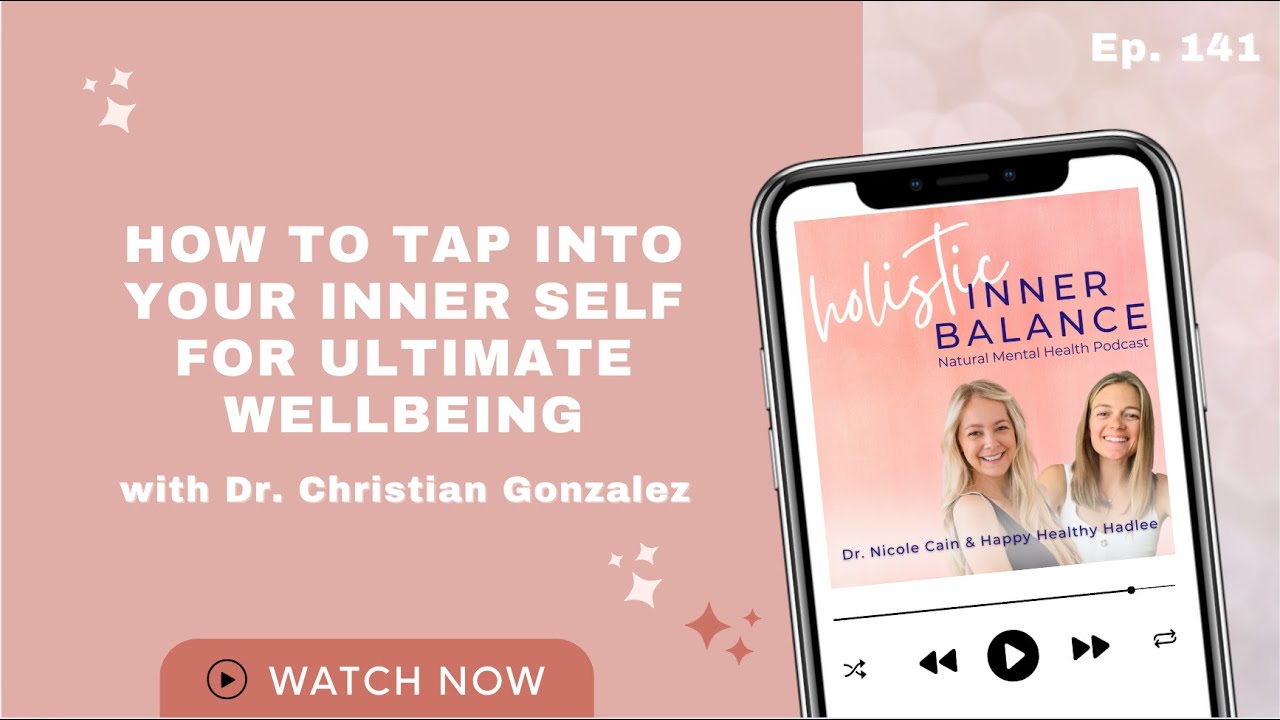
In this episode of the Holistic Inner Balance Podcast, host Hadlee Garrison (joined by co‑host Nicole Cain) interviews naturopathic doctor and Heal Thyself podcast host Dr. Christian Gonzalez. Dr. G shares his unconventional path from aspiring orthodontist to naturopathic oncologist, sparked by his mother’s cancer and a growing curiosity about environmental and emotional factors in disease. He explains how fascia – the body’s connective tissue network – is a sensory‑rich, piezo‑electric system that links physical tension, trauma, and mental health. The conversation delves into somatic regulation techniques: breathwork, resonant vocalizations (the “voo” sound), and the use of sound to release fascia, alongside hands‑on myofascial release with simple tools like tennis balls. Dr. G describes how chronic tension signals distorted fascia and offers practical steps for listeners to notice and work with it. He also outlines his educational initiatives, including the Integrative Psych Institute’s somatic certification and upcoming master’s program, and shares his three daily self‑care non‑negotiables (mindful walks, fascia‑centric movement to music, and the Voo breath). The episode closes with resources for further learning and encouragement to integrate these bottom‑up practices for holistic wellbeing.
Chapters
Hello and welcome back to the Holistic Inner Balance Podcast. I'm Hadlee of Happy Healthy with Hadlee, and I'm here with Dr.
Nicole. Hey.
Hello. Oh my gosh, you guys are gonna love today's episode. Oh, it's so good. So many mic drop moments and so many moments where I'm like, this is going to be a huge game changer for so many people. So do you want to— do you want to give a little intro on our guest today?
Yeah, this is Dr. Christian Gonzalez. He is brilliant. We were really lucky to have him here. Uh, I met him because he interviewed me on his podcast. It's called the Heal Thyself Podcast, and It's just— he's just a genius at all things. And so he's known as Dr. G. He's a naturopathic doctor. Yes, amazing. And he completed his doctorate at the University of Bridgeport College of Naturopathic Medicine, and that was in 2014. After his mother passed from cancer, he focused on oncology and did a residency at the Cancer Treatment Center of America in Philadelphia. But through the process of self-healing, his career took a turn, and he uncovered the intricate relationship between the body's fascia, the nervous system, and emotional well-being, recognizing that the body possesses an innate wisdom and capacity for healing when given the proper care and attention, often involving our logical egoic selves getting out of the way. And this realization was the foundation of this amazing holistic approach to health and wellness that we dive into together. And since this time, he's become a leading voice in integrative health, hosting the top podcast, Heal Thyself. He empowers people to take control of their wellness, and he's been featured all over the place, including MSN, the LA Times, Shape, and Right now he is on a mission to change the landscape of mental health, and you definitely need to follow his accounts. Uh, we'll include the links in the bio— his Instagram, Dr. Gonzalez, his Heal Thyself podcast. And then also at the end, you're gonna wanna stick around for that because he tells us about a mind-blowing project that he's doing right now that is, I think, going to be a real forerunner in the, the mental health profession. So. Are you guys ready? You gonna ready dig in?
Oh my gosh, let's do it.
Can you tell me about what is your story? What got you to where you are, where you're sitting right now, when you could be doing so many other things with your skill set, your talents? Why are you here and how did you get here?
That's a, that's a great question because it seems like you and I have converged in many ways with the way that we see medicine. And coming into health and wellness was a long journey. I was going to be a dentist, and I was actually sure that I was going to be an orthodontist because that's what I wanted to do. And I feel— I felt purposeful because I had my own relationship with bad teeth growing up. They were all mixed up, and I felt so insecure in high school, and I didn't want to smile. It was like a real weight to confidence, especially when it's blossoming. Right. early on.
Yeah.
So going into dental school, it seemed purposeful. I just knew I wanted to help people, particularly young kids getting into, you know, their awkward years. And things happen. And we know there's always these beautiful spiritual divine interventions. And if you want to call my mom getting cancer divine intervention, not at the time, it didn't feel like it. But over the past 12 years, it was. And that happened, and it sort of redirected my experience and my goals from working with teeth, giving these young kids confidence, into maybe something a little bit bigger. I didn't know what it was, but I knew— I found out about naturopathic medicine. That's the only thing I knew about, and it made me feel good learning about this field that I wish I learned about when I was in college. And that redirected so much. When I— when my mom had cancer, I started going really into natural medicine, holistic medicine. How else can we heal? What, you know, just as many people do. But the difference was I got into the schooling, and when I went down that route, it really lit me up because I'm like, wow, there's actually science that I'm not learning— that I'm learning. It's not just the holistic woo-woo stuff that I thought it might be, but there's real science foundational stuff. But I'm also learning the art of medicine that has been lost medicine for so many years. So I felt really charged up coming through that schooling. Unfortunately, my mom passed away in my first year of school. It really, again, divinely redirected where I'm to go. And I didn't want to go into oncology, but I did because when my mom passed away, I just felt like I needed to do that. I had— there was some sort of purpose. I— it was a duty. And going into oncology And I'm saying all this because I wanted to tie into the people listening that when things happen in life, there's a reason. And even if there's someone you love who is diagnosed with cancer and ultimately dies, there's a reason. Because I was going to go into pediatrics. I was cool with the kids. I loved being around kids. And I was so interested in pediatric disorders. And then when she passed away, it led me into oncology. And then I started seeing cancer. And I started wondering over the years, well, Well, what's causing cancer? Because it has to be more than just the exercise, diet, alcohol, smoking, right? Like there's more there. Mm-hmm. I got into 2 things, environmental medicine and then emotions or stress or repression, somatics. There was more real data on environmental stuff. So all of a sudden I went down that road ablazing and I was go— I go, I want to be the leader in environmental medicine. And so many of my podcasts started blowing up because people didn't know about mold or they didn't know about BPA or they didn't know about formaldehyde. And it really started like filling me up teaching people, knowing, hey, there's things that are causing cancer that we're not talking about. And then came the part where I felt like I was putting too much fear in people versus empowerment. And that's the opposite of the mission what I wanted to go for. So I go, a few years ago, I was talking about this emotional stuff. Well, I wonder what's going on in that realm. And then I checked and I was like, oh, there's so much more than I believed there to be. And when I got into that, that's when it set my life ablaze in the best way. It felt so purposeful. And that's when I started seeing real reversal of diseases that when I came out of naturopathic school, I was like, well, okay, we can treat it in the lens that we know, but there's so much more that's missing in what we learn. And when I saw this somatic nervous system regulation, expression of emotions, true embodiment of who you're here to be. That's when things started really changing. And that's how the long-winded way I came into this world of nervous system somatic regulation, all the way from going into, I want to be an orthodontist.
Yeah. I, I, uh, had braces until I was a sophomore in college. And I, before that, my teeth were like, my parents used to call me a shark because I had rows of teeth that were like growing in ahead of, you know, I so resonate with you.
My mom always says it built
character.
It builds character. It's just so, you know, kids, we have these big teeth and big braces and we want to smile for pictures and we got a gap here and a row here. It's, it's really like traumatizing.
It's so, so rough. Yeah, absolutely.
I feel compelled to like go down this rabbit hole. I'm gonna shelf it, but there is a lot of interesting studies about the relationship between our teeth and dental alignment and the oral microbiome, and then, of course, our brain health and the rest of our health. So I'm really resonating with that. I want to pause on that because there's additional goodies that you brought up that I would love to explore more. But for those who are listening that are like, oh my gosh, I had braces, I had implants, I've had root canals, and does that have anything to do with it? I think that your journey Dr. G is like winding us through all of these different parts of the human body. You know, we used to look at mental health from just the shoulders up. And what I really admire about your journey is that you're rocking in the, the bottom-up approach. You're looking at the body instead of the direction I went, which was good too, but quite the opposite, as I went into top-down. I got a master's in— clinical psychology, and my thesis was in cognitive behavioral therapy. So very much top-down, very much like we want to rationalize our way out of these things and try to think our body back into compliance. And you're, you're coming at it from a different direction, which I think is really innovative, really refreshing, and pretty new. So I'm curious about what, what got you into somatic work in particular, as opposed to more the dominant
I'm going to tell you something, and, and, and this was— I met— much of my experience in health and wellness has been— it's so funny that it's called Heal Thyself, this whole brand, right? Because it's like I was gifted this divine name before I even knew what it meant. And so much of my healing has opened up this capacity to speak about more, right? Because it's a new lens. So every time I go through this healing process, I have a new lens and a new lens, and I speak about more and more people like, wow, that resonates. So I say that because for me, I went through this week many years ago, and I would— I'd be sleeping and I wake up and my whole body would wake up convulsing and shaking, you know. And like, if a doctor came in, they'd be like, that man's having a seizure, you know, and get him these medications and we'll do this. Um, and if a priest came in, they'd be like, he's having an exorcism. You know, we need to do an exorcism, right? But in reality, it was my body processing everything that I was avoiding, or at least what needed to be expressed for so many years, because I was cognitively trying to figure shit out, right? Mm-hmm. I was trying to figure it out. When was the time that I became like the way that I am? Well, what happened with my mom? What happened with my dad? What happened in school? Oh, this memory. And in that moment, as I'm shaking in my bed and contorting like The Exorcist and, and making these weird sounds— and I've always been actually very visual, so I close my eyes, I can see visions and just many things that are going on in my head and memories— I'm going to myself, oh my God, it has nothing to do with my thoughts. It has nothing to do with what I'm thinking, because that process was a process of no thought. It was pure experiential processing. It was the body going. I had enough of you trying to take the reins on what is healthy for me. I'm gonna do this. It's like I'm trying to drive this car that's so sophisticated, that has all these buttons, and I'm not even utilizing it to its fullest potential because I only know like two buttons in the steering wheel. And then at some point, the body's like, move over, let me do this. Dee dee dee dee dee dee boop boop puts all the buttons on, and it's going hyper speed. And so that happened 4 days in a row, and it happened the same time every night. And for me, that was the biggest change in my health journey, was that I was able to see that the body in its own intelligence will process when you remove your egoic logic away from it. The thinking mind, the I have to figure this out, I need that aha moment to feel better about myself. And when I have this figured out, everything will be fine in my life. And we've become a society that is so dictated in our health and wellness, especially mental, by looking at that lens instead of being so good at dropping into our body. That's a muscle that we have so weak, but it's a muscle that we had very much so developed as children. I don't know if any of you have children. I don't, but I've been around children. I know children. They, I know that they don't think about or put logic into anything. If they're gonna cry, they're gonna cry. If they're gonna poop, they're gonna poop. If they're gonna jump for joy on the bed, they're gonna jump for joy. And that authentic expression, or lack of for us as adults, is the very thing that is causing the stress on our body, on our nervous system, mental and physical health. We're seeing the downstream effects in medicine as physical health, physical disruptions, and we're going, okay, here, take this protocol, either drug protocol or supplemental protocol, do this diet, and let's see how it goes. And off the top, things seem better. But, but the real— there's always people going, I don't know, there's something missing. Mm-hmm. If people are viewing, listening, going, I don't know, there's something missing, that something that is missing is way deeper than the stuff on the surface. And it's the things that I'm talking about. Your body's desperate for you to have that exorcism moment or moments peeling off those layers of all the times you've abandoned yourself. All of the times that you've actually wanted to express and didn't feel safe. All the identities that you've created for yourself. I'm a happy person, therefore I never get mad. People love me. All the identities that are blocking you from expressing that authenticity instead of going, you know what, I can be really angry and that's okay. Whoa, that's scary to me. That's not part of who I am. But who you are is so much bigger than what we believe ourselves to be. We've been living in this like really narrow, expression of us. But when we were kids, we were the full expression. We were taking advantage from 0 to 100. Now we're living at like 50 to 55 and calling that being a human, but it's not true. And we're not healthy humans because of that.
Wow. Mic drop. Yeah. So good. And we wanted to talk with you a little bit about, uh, about fascia today. as well, because, you know, more and more people are, are now learning about nervous system, learning about like, oh, actually we can't only do the top-down approach like Dr. Cain was talking about. You know, we need this bottom-up approach as well. We need to regulate our nervous systems in order to be able to move through different emotions and move through these things. But you bring in this whole whole other component, which is not actually a whole other component at all, but you bring in the fascia, which is something that not that many people are talking about. And so, we really wanted to learn from you today about what is fascia for anyone who doesn't know that and why does that tissue in the body impact our mental health so much?
And thank you for asking this because it's so important when I try to get my message through on nervous system healing, somatics, emotional expression, that the fascia needs to be part of the conversation more. Now, Doc, you know that in school we don't really have much on the fascia. I think we've had it mentioned a few times in anatomy lab. I know that we, we see this like lining on the tissue and they go, it's just fascia, and then they cut it away and then we get to the muscle. Right. It's just like some weird Saran Wrap that we don't need, and we're really trying to get into the real substance. When in reality, I think that when we in medicine put value and priority in fascia, we'll understand healing so much better. It's because fascia is one, the most mysterious tissue in the body. We don't know enough about it. We have a council that is trying to redefine it every single year as we learn more about it. What we do know, at least if you would Google fascia on or look at it on Wikipedia or something, it's going to say that this is structural support for the body. Fascia is a tissue that is enveloping our whole body, but it's not just the muscles, it's the organs, it is the bones, it is every single thing that makes you a human being of matter, or seemingly matter, is wrapped around with fascia. Okay, so it's giving us support, postural support. When we jump from a ledge to the floor, it helps redistribute that force to our whole body so we don't break bones or injure ourselves, right? It helps with the fluidity of movement. Oftentimes when people feel stiff, it's because their fascia is stiff, their fascia is inflamed. So, you know, we think about like loosening muscles, so we go for a massage and then it's the same 2 days later, right? It's because there's a nervous system fascial component that is not breaking. It's the— the muscles can relax momentarily, but if the fascia in itself is contracted or inflamed, we're going to have chronic issues, physical and ultimately downstream mental, and I'll tell you how. So the fascia, we're also learning, is exquisitely in communication. It is something called piezoelectric, meaning it has its own electrical frequency. It gives off an electrical frequency, and it's also sensitive to electrical frequencies. And this is important because us as electromagnetic beings, right, our heart has an electromagnetic frequency. Our fascia can sense people's electromagnetic frequency. So when we think about intuition, I think about maybe the soul speaking to us through the fascia. Because the fascia, we see and learn that it has anticipatory rebound expressions, meaning that if there is danger, our fascia will contract before we even realize there's danger. Mm-hmm. If we were traumatized and there was a perfume by our perpetrator or a cologne by our perpetrator, if we get a scent or something that mimics that scent, Our fascia is going to contract before we even realize that we don't feel good in this area. Our fascia, in its own magnetic sensory scanning of the environment, is there to protect us. Next to the skin, fascia is the second most sensory-rich tissue in the whole body, not only just sensing where we are in movement, but pain. Thermo changes, movement changes, stretching changes. It is so rich in sensation. And so it's there to protect us. So what happens when we're traumatized with the fascia? So we as kids, we're flowing with our fascia. Our muscles are flowing. You see how flexible kids are? You see when they fall and they don't break things? Because they're just like wet noodle fascia, fascia, moisturized fascia little babies, right? And us, oh, I'm really tight. We have to kind of like stretch just to get up off the couch sometimes, or, you know, we injure ourselves. We're not the same as we get older. It's because our fascia becomes inflamed. But in the, in the context of trauma, what happens is the fascia is tightly connected to different parts of our brain. The emotional centers of our brain around the limbic system have a direct line of connection to the fascia. So that means that when the fascia is sensing in the environment something that isn't safe through its sensory receptors and that electromagnetic mechanism, it's sending the signal all through those nerves to the emotional parts of the brain. That's why we're connecting emotional experiences to something that is happening. So if we smell that cologne, the fascia's already— Of the perpetrator. And it's reminding us, the fascia is giving us that message. Putting it all the way up to our brain, and our brain is going, protect yourself. And then it's creating that cascade of a sympathetic response. Cortisol goes up, epinephrine, and our whole body's— we don't know why we're feeling anxious out of nowhere. Maybe we realize it's the cologne, maybe we don't, but our fascia is protecting us. Also, because I said it's a sensory to electromagnetic, we can sense people. So when people are not expansive in their heart, when we don't sense that they're good-intentioned people, And they're walking past us and we can feel our heart is so contracted, their energy is so contracted, that fascia is picking up that signal like a Wi-Fi wireless antenna and also doing the same thing. We don't have to smell it, we can sense it. And when it's doing that to the brain, it's the same thing, releasing cortisol, epinephrine. Now what happens when this is over time? The cells of the fascia called the fibroblasts, they become contracted over time. They distort. And that's when we start getting contractions. So if we're not allowed to express ourselves, let's say in our home, it's a very unsafe home. Dad comes in yelling all the time. And we know it's safe until dad comes home and he's maybe an alcoholic or going through a lot in his life. We begin to close our fascia. We brace as kids. We brace, right? Dad comes home, we brace. We're not open anymore. Now, if we're in the age where we're repressed and we can't express, we know we can't get mad because when we get mad, dad throws the glass across the room and it explodes and everyone's scared. So we can't get mad like dad does. Mad isn't good. Angry is not good. So if we see something that elicits anger and we can't express that, the fascia is going to hold it in. There's going to become a distortion in different parts of our body and our nervous system is going to keep holding in our fascia, We keep distorting it. What happens over time? We have distortions in the fascia. We develop pain. We develop inflammation, chronic. We develop disease. So until we understand the science of the fascia, how it implicates mental health and physical health issues through the mechanism of the distortion and inflammation, then we're not going to really understand how to help people come through traumatic episodes, how to help people come back to their body, how to restore openness in the fascia. So it's communicating. And an open fascia, a hydrated one that's not inflamed, the body feels good. The blood can start flowing. The lymph starts flowing better. We start feeling— the Chinese medicine talks about meridians. That's all through the fascia. Those are just fascial lines. When our energy is flowing better, we're more vital. When we're more vital, we have more color to our cheeks. Our eyes are more white. We have more life to us. What comes online? connection, empathy, compassion, purpose. This is when we feel good being human. Most of us are on the other side of the spectrum.
So somebody listening, if they're like, oh my gosh, could this be what I'm dealing with? Could this be me? What are signs that somebody can reflect on to see if this could be part of their story?
Chronic tension would be one of the best indicators that Your fascia is distorted, inflamed in a brace pattern, and your nervous system is saying that it's not safe, right? Mm-hmm. So you shouldn't feel tense. You work out, you can feel sore. You injure yourself, yes, there's going to be a reciprocal tension that you have to work through. If you have surgery, scar tissue, yes. But if you're seemingly healthy and your body's healthy, You shouldn't be living in chronic tension. And so what you can do is take some time, take some time and maybe move away that paradigm of maybe I need to talk to someone about my problems right now. Turn it off. And instead of maybe talking, we can feel more, right? Mm-hmm. Instead of talking about things, logically trying to conceptualize things, give your mind a break, right? Give the ego a break. And drop into the body and begin to feel, okay, what does tension feel like in my body? Can I just be present just a moment, even 30 seconds? You can even put on a timer if this is— you're just starting. If I have tension in my upper right belly, ooh, okay. What does it feel like? Let me drop in there. Let me just— every single breath I take, every exhalation drops me deeper. Can I take 30 seconds just bringing curiosity? What does the tension feel like? Us and our own egos and the way we're programmed thinking about mental health, we're going to go, okay, it feels like I'm angry. I feel like I'm angry because, oh yeah, I know why I'm tense, because my boss— stop with the stories.
Mm-hmm.
Just be curious about what your body's trying to show you. Because what happens is we open up this gateway when we bring curiosity, when we bring presence to what the body is showing us, the body starts taking over. Just like it did for me. The thing is, I didn't bring presence. I didn't bring curiosity. It waited for me to sleep so it can override my overactive mind, my hypervigilant mind, to show me and go, oh, you need to go through this process if you're going to survive in this world. This is either going to make you sick, chronic disease, or I'm going to express all this energy that has been non-expressed for 25, 30 years. So for us, bringing in that curiosity and silence— now, the more you practice this I always say the body is like this next-door neighbor who loves you but is weary about you because you broke the relationship with that next-door neighbor unconsciously. So you go and knock on the door of the next-door neighbor, they might not answer for 4 or 5 days, maybe for 2 weeks. But then at some point the door might open up and you might see your neighbor's eye and go, who are you? I feel like I remember you, but who are you? And they're still weary. But ultimately that person, though your body loves you, it wants to show you, wants to connect with you, it wants to process. That door wants to open. So the more you create this, like, okay, well, I go to the gym, I have all these practices that I do. What about the practices to be? Can I just be? Can I just be with my body? Can I just be with my tension? And you're gonna see that your body, once it sees that you're showing up, you're showing up for it like it's showing up for you, this process begins where it begins to show you, whoa, did I just see a memory? What was that memory? Okay, I don't need to think about it. Let me just feel into it, stay with my body. And And then it begins to unfold. That's when the intelligence takes over. When it takes over, move yourself out. You don't need to do it. You just need to witness and that's it. And the body will take over and do what it needs to do in its own intelligence. It is smarter than me or any other somatic doctor or any other doctor in the world or any other practitioner in the world.
Ooh, I'm feeling, I'm really feeling moved by what you're saying. And it, for me, it was my sleep too. And I remember some of the, the original symptoms. So 20— 2015, I've talked about this a little bit, that I had like a nervous breakdown, if you will, where I was having constant panic. I stopped sleeping. I— that's— that was the birthing place of Panic Proof. And it came out of my sleep. And I remember that one of the first symptoms is I was laying on my back trying to fall sleep. And it was like a violent jerking in my chest where I would rise up off the bed in like terror on trying to fall asleep. And, and so I resonate with what you're describing, is that in this, this very Western do-it, fix-it, analyze-it kind of approach to things, that the body's like, well, then I'm gonna wait till your logical do-it brain is offline so that we can then start doing the work. So I appreciate that, and I have a lot of compassion for you having lived through that. And so somebody's— someone's listening to this and they're like, okay, I'm practicing being with the body, I'm noticing, and you're emphasizing try to not analyze it or necessarily try to reason through it or do something about it. But what comes next in the practice of noticing curious being?
Yeah, so the more you're dropping into the body, it's a matter of first and foremost building a relationship with that part of your body, right? So because we are so on the go, we lack presence. So building your own ability to be present and your own relationship with your body is the first step. Like I said, There, it's, it's bidirectional. Your body has to be like, oh, you're coming again to knock on the door? All right, all right, okay, I'm going to show you a little something soon. I just got to see that you're going to keep up with this. Because we're so impatient, you know, people, we want to drop in our body and be like, well, why isn't all my trauma coming out? Well, first, your body has to be in a place where it feels safe enough to do that. But to be there, you have to be able to drop into your body and stay there with presence. The breath and the sound is a really important combination. A lot of— I love breathwork. I think that it is profound. It can really, really help regulate the system. I don't think it can get deep, deep, deep into what's there. Breathwork is amazing at cathartic on the surface. So if you're really angry for the past, like, 2 few weeks and you go to breathwork, you're going to scream. Or you're holding in a lot of sadness. But deep shame that you're holding in, deep guilt that you're holding in that is unwitnessable to you, much less the people around you, is not going to come out through just one breathwork. So it comes out through the relationship with the body. Again, it's until the body starts feeling comfortable with you and you feeling comfortable with your body, it begins to start being shown. Because the things that we witness within ourselves Can sometimes be really identity destroying, right? If we don't believe ourselves to be angry and then we see the reservoir of anger that we have underground and it's becoming expressed, that challenges you as a person. Now, most people are like liberated by it and they feel good, but for people who are like, oh my God, I can't be that angry, not— I can't express that part of me, it's not safe anymore, it can really challenge us. But the breath and the sound, to come back to it, is really important combination. A lot of people miss the sound part. I always tell people when it comes to emotional healing, the fascia and the emotions that are repressed in the fascia need a resonant sound. Otherwise, they're not going to move. They don't move, right? You can't. What does a kid do? What does a kid do when when When a little kid's running and they fall to the ground, you don't hear them doing breathwork. They're not right. They go like this, and they start crying, right? There is a resonant sound to the moving up of that energy. That's what you see—the pulling up of that energy—and then they scream or they cry, right? So for us, it's really important. To create that sound. Now, the interesting part is that so many of us have contracted that ability to express that sound by virtue of not being safe at some point to express emotion. So if you're not safe to express any emotions, you grew up in a house that is not safe for that, inevitably your full expression of your voice is not going to be there. It's not. Unfortunately, a lot worse for women. A lot of women are speaking from up here and not wanting to drop into their true voice. Maybe society says you need to speak like this, right? Or you need to be seen but not heard. Maybe you grew up in a house with a mom telling you that or something. So the bigness, the expression, the full openness, right? The being big in a woman is tough. That's a tough That's a tough intersection of going, oh, whoa, hold on. This isn't, you know, I'm usually well put together. Everything's nice for me. When in the meantime, there's a Tasmanian devil that wants to be expressed with hair everywhere, sweat everywhere, boogers everywhere, drool everywhere, a wild woman. And that wild woman banshee within the women, and I'm speaking about women in particular because I've seen a lot of women.
Yeah.
That wild woman banshee in particular is one of the most healing embodiments that I've ever seen in a woman. I have seen that expressed. I have seen a woman who was not being able be pregnant for 2 years and who finally embodied that, expressed it, felt it, made friends with it, connected to it, reconciled with it, and got pregnant. And a month and a half after she was able to go through that process. Why? And she was on the supplement. She was about to start IVF. They took all the tests. They, they just couldn't get pregnant. They didn't know why. It's because the body holds this memory. It keeps a score, right? And so the breath, the sound needs to be expressed and it needs to be resonant. The sound of sadness, if it's open in the throat, comes out. If the sound of anger, you need a really open throat. You need to be able to project from your belly, your low belly, not from up here, ah, but, ah, really deep. It needs to echo like opera and take over the house. It needs to be felt by the people around you. Or your practitioner, that involves an open throat like a runway. It needs to be able to accommodate that which wants to move.
And so then does that sound then basically like massage the fascia? Is that kind of what you're saying? Like the resonance of it?
Question. Yeah, this, the sound— look, like, now we're stepping into like What is the energetic mechanism of an emotional release? And there's an energy component that will never be able to be measured, at least maybe in the near future. What I can say is like, and I'll go back to answering this, but what I can say is that the emotional repression comes from those fibroblasts in the fascia that are holding in a bracing pattern, speaking to the brain, further inflammation, further bracing pattern, further— further holding in, further distortion. And, and we feel that. And, and for the people viewing or listening, the fascia is like a— it's like if you, if you roll your shirt around one part of your finger, you'll see it pulling different parts of your shirt, right? Mm-hmm. And that's like the fascia, right? Like we can feel sometimes pain in our shoulder, but really the trigger point is in our chest, or pain in our shoulder, but the— but we feel so much pain, we get headaches or jaw hurts. The fascia kind of— it's not localized all the time. And in an emotional release, it's the reversed order. There's the distortions, the cell open up, the bracing pattern opens up, it liberates all of that energy that is being used by the nervous system to hold it. It takes a lot of energy for the fascia to distort and actually be held in distortion, right? It's like holding down a beach ball for a long time underwater. So the liberation Is that nervous system energy that is being held in that distortion. Now, what is the measurement of that and how does that— what happens after that? I don't know. What I do know is that the voice in itself with the breath can activate those distortions. We go through this state of we have to feel safe to do this first. So we're in a parasympathetic state, right? We feel safe in our body. And if we have a practitioner, we feel safe with a trained practitioner. And then we have to go through the sympathetic activation. We have to feel safe, but also in that, oh my God, is everything okay? Oh my God, this is a lot. This is intense. We have to go through that. The beautiful part is our body will always give us what we need. We are not— we feel like we might be spiraling or we might die, but it's not true. We'll never die. We're not going to die through an emotional release, right? It's going to be intense. And then after that is this parasympathetic state that is unfelt, that has not been felt in our, in our lives because we don't remember what it feels like to feel good. And that is the most potent healing state because everything is flowing. We finally made friends with the deep parts of us that are being unseen. So the voice helps activate that part of the nervous system. The voice and the breath start bringing us towards that parasympathetic to activating. And then when the body takes over and there's ultimately that cathartic release, at least on the first layer and the approximating layers, then we begin to see the body healing in that parasympathetic after.
I love it.
I want to validate this story. I had a woman, she was working at this clinic in Scottsdale and she had really severe Lyme and quite debilitated. So she came from East Coast to Arizona and they often would refer to me for the mental health piece. And I identified a big part of her experience is that she was so suppressed and so much is held in. And I made a really small offside comment. I don't think I realized at the time how big— and this is exactly what you're saying. I didn't realize how impactful it would be, but I was like, maybe it would be valuable for you to just like go into the desert and just like scream and like kick a rock or a cactus or something. Mm-hmm. And I— it was just, you know, a small part of the treatment plan that I gave her. And for her, it changed everything. She went into the desert, she screamed, she did what she felt like she needed to do. She said what she felt like she needed to say. And it was like overnight, her symptoms started unwinding. She started getting better. Within a week, she left the clinic and went back home. Wow. And a year later, she wrote me and she was like, I'm doing great. I'm back at home. I'm back in the moldy house. I don't have symptoms anymore. And I think that's a real testimony to just the power of free, full releasing. And so thankfully, she was able to do that on her own. But I can tell you, like, for me, that I would go out there and I'd be like, ah, wonder if someone's gonna like call the police and then feel embarrassed by my own presence, even if no one else was there, guaranteed I'd still be embarrassed. It'd be so hard. So I, I would need someone to go with. But I, I see there's a lot of power in what you're saying.
Shame, right? It's that shame that I can't be this big, to be this loud in my own wild woman that's inside of me. And this is across the board, that shame so common in women that they are afraid to truly express Not their scream, but their blood-curdling pain that they have inside. And women not only holding their own life pain, they're holding collective pain for women and generational pain. Do you know how many women come in with generational pain? Their mother exactly expressing the way and the repression that their mother had, exactly expressing that. There is a giant weight. And don't even get me started on men, what we go through. But like, there's the women really coming into this empowered state. For me, like, I, I hold a space where I am with the person but also holding myself so I don't lose myself or get overwhelmed or I take on people's energy. And one of the most beautiful moments across the board is when a woman is moving from her sadness— it's almost always sadness to anger— moving from her sadness, and I can see the anger start coming up. The face starts getting red. The jaw starts clenching. The fists start all of a sudden unknowingly start tightening up. The muscles start tensing, and when I'm leading them through this part of the anger, it's a really sacred moment because in I can see that for the first time this woman maybe in in her adult life, definitely in her adult teenage life for a lot of them, is expressing this potent scream. And these screams you got I've seen five foot two women scream and the whole House or studio shakes. Like, I can feel all that, and it's, it's unbelievable because they come out of it. And you want to talk about anti-aging? Every single muscle of their face that was super contracted, their face is just relaxed. Their skin is glowing. There's redness. Finally, the blood vessels are filling up the cheeks. The eyes are calm. The face is calm. It's like this post-orgasmic parasympathetic feeling. that is our God-given right to live in, right? And yes, that's available for all of us. It really is. It's a matter of creating that relationship with the body and dropping into the body and sort of prioritizing that as a thing that we 101 should learn from being a human from the get-go. Kids need to be learning how to stay authentic. Unfortunately, we grow up in households, households that repress this. And don't allow for the full expression of authenticity. That's okay. And we all have the ability to start moving back or moving the needle towards that. And it's potent every single time we inch it. Just an inch goes a mile in our health.
So amazing. I'm also curious about, you know, myofascial release is like a popular thing that people do. Is that something that you are a fan of? fan of, or are you more of a fan of letting the fascia release itself by doing these other, like being with the body and using your, using the sound and that kind of thing?
Yeah. And my technique that I created, I do have some hands-on with working with the fascia. There's just a way to do it. And again, it's always in combination with the breath and the sound. There's a lot of people I've had myofascial release, And I'm just like not encouraged enough to use my voice. I'm just like, ooh, ooh, ooh. When in reality, if I tune into what's being released, I can actually create a resonant sound. And that resonant sound, that's when it opens up. So when I teach people to do anything, because there's at-home practices you can do using a tennis ball or even maybe a little bit harder lacrosse ball, but starting off with the tennis ball and really just being gentle with the fascia, if you really tune in to like, let's say I have it on my side, on my IT band here, and ooh, it's really tense, it's really painful, right? And it's pushing down on the trigger point of where I know the fascia is distorted. That can be from overuse, that can be from working out, that can be from an injury, a sports injury, or maybe that can be emotional for sure. It's typically not like— there are emotions that are there, but usually they're Like belly and chest and throat, womb. But if you tune into the sound and you make the sound that really wants to come out resonantly, you'll feel that your fascia relaxes above that ball. It'll melt on top of the ball. Sometimes, especially if you do it in your belly, but be careful with your ribs, sometimes when you roll that ball in your belly and then make the resonant sound, there's a motion to start moving. So I've seen people like do just like an athletic fascial release, but use their voice and sound in resonance. And all of a sudden they're like, I don't know why I'm feeling sad right now. I'm like, okay, just be with it and breathe and sound, keep the ball there. And that's a really easy way to really start working with the fascia at home.
Oh my gosh, I'm so excited about this. My husband is like very into myofascial release, just Like physically. So I'm excited to share this with him. I think he's gonna love it.
Well, my partner will hear me doing it and she'll know I'm doing it because all of a sudden she'll come down the stairs and I'll hear just like these weird sounds coming out. I'm like, oh, you know, but it helps. Like it really opens up. It's so much better than just rolling and just kind of watching TV and hoping that like it opens up. Instead, just find the place that is most tender and then use a resonant voice and sound, breath and sound, and it'll create this, this opening of the fascia. And that's a great way prophylactically to just keep your body open. That doesn't mean don't create a relationship with your body. Create a deep relationship with your body. And as a supplement, yes, you can do the myofascial.
Ah, this is so exciting.
And I want to say, Doc, like when you came on the podcast and spoke about your protocol for someone going through an anxiety attack, it's the same idea. You're bringing awareness and curiosity to the body, right? And you're bringing that moment— like I've used your mechanism a lot of time. Like I've experienced a few things where anxiety comes up and I'm like, okay, where do I feel it? How do I feel? Like bringing curiosity to it. And I love that you actually bring the next prompt of like, when was the last time you felt this? Right, or as a kid. So for me, I— for me, that works really well because I'm like, oh wow, I felt this when I was alone as a kid. I actually feel kind of lonely right now. And then I'm feeling into my body and I'm like, okay, what do I feel? I feel a little sad. And you know, that's really powerful too. So I really— I just want to say I applaud you and your somatic practice because it's so tangible and it takes 60 seconds less.
Yeah, I like that it's fast. You know, so many of us feel like we don't even have the bandwidth to wash our hair. I've gotten messages from people lately, especially, they're like, what about if I just can't do basic ADLs, activities of daily living? Like, I'm just like, I can't function. And so what about that? And I like that you said that this could be just 60 seconds. You could lean into it longer if you have that space and the bandwidth, but it doesn't have to be an all-or-nothing practice. It could be a minute.
Yeah, yeah, easy stuff. But like, that's called creating a relationship with your body, right? So if you're in anxiety, drop into your body. If you're feeling like angry or just like uncomfortable in the moment, drop into your body. Social anxiety, drop into your body, right? Like, it's, it's really easy when we begin to know that we can just drop in and what do we feel right now in the moment? Forget about putting stories, right? Just what do we feel? And And ultimately, can we allow ourselves to feel that? Right? When we resist, it will always persist. And a lot of times we resist what's there. We will never not know what's there. Our subconscious and our soul will always know, even at 1%. If we quieted the noise 99%, we cannot fake ourselves out. Our body is too intelligent. Our soul's too intelligent for us not to know. So everyone walking around who's even numb to their body isn't 100% numb, maybe 99%. That means that we always know when we're not authentic. And, and if we're not authentic, we're going to be suffering and, and feeling this, this energy of like, I'm me, but it doesn't feel like the real me. There's a fraudulence to me, right? And, and a lot of us are walking around in that small expression of us. But I promise you, as you begin to reconcile your relationship with whatever parts of you that are repressed, whether it's your anger, fear, grief, sadness, sexual shame, shame overall. When we begin to make amends with that and seeing that as part of us and a loving part of us and actually embracing that part of us that, yeah, I'm Christian, and just as much as, you know, all this like spiritual stuff and personal self-development Just be love and just be joy. You know, you are love. Yes, and you're the darkness too. And we forgot to bring the lens to the darkness. And until we completely reconcile the darkest parts of us, we can't fully express and embody the lightest part of us. It's a proportional expression. So if we're at 50 to 55, right, right between that little miles per hour and expression of us, when we really are 0 to 100. Then until we start going to the darker parts of us, we won't have that proportional expansion of the light parts of us. The more darkness we reconcile, the more light we can embody. That's beautiful, because when someone says be love, it's not just be loving, it's being all of you. Being love is also being shame. Being love is also being in sadness. Being love is also being in anger. That's truly what love is. That's unconditional, not only expansion and expression of you, but it's also the people around you who are able to hold that. You want unconditional love from someone, that person has to be able to hold themselves to be— show up to fully hold you. And that's where, where the, the North Star is for me in healing. Like, that's the quote-unquote goal, if there ever was a goal, in relationships and in, in self. But it involves looking at a lot of that mud that we were hiding from right now.
So people are probably just chomping at the bit to know how they can learn more from you, how to find you. Tell us all the things that you have going on so that people can stay in the Dr. G land.
Yes, I, uh, as you know and you were on it, um, the Heal Thyself podcast has been, um, we're like at 350. We've been non-stop with this show. It's been sustainable, it's been great. And in that show you can find all the things that we've spoke about, but also physical health stuff. There's like reviews about like the best protein powders, the best nail polishes. Like, I've reviewed a lot of consumer products too, just to add variety to the show. But the show this year will be more focused on spirituality and mental health and keeping those reviews because people love those. The— I've co-founded the Integrative Psych Institute, Psychology Institute, and that institute is right now certifying somatic practitioners. So it's open to anyone who has any sort of certification, whether it's a health coach, Reiki, massage, yoga, physicians. We're certifying them in a 6-month somatic program, 100 hours. I'm teaching, but I have a lot of other teachers coming. Now, those— that program that we created, we just got word that we can create that as a master's program. So at the end of the year, we'll be launching that as a master's program. So people who want to get their master's in psychosomatic therapy, that's where we're going to make that a foundational root. So you're going to psych school, but you're learning not only about counseling and psych stuff and mindset stuff, but you're also learning about the roots, the somatic stuff. You're learning about the somatic healing that I've created. You're learning about the— you're learning about the nervous system, the fascia, like the real That is going to be revolutionary for this next wave of therapists coming. That's super exciting. And is there anything else? Those are the 2 biggest things. Anyone who wants supplements, go to The Swell Score. That's the online platform where we have the best handpicked everything— supplements, PMF mats, saunas, all the stuff that is picked by me and other people who are holding high integrity. I'm busy. I stay pretty busy.
You are.
But I love it.
Okay, so rapid fire real quick. What are the top 3 things that you do for your own self-care that, like, non-negotiables, these are the 3 things?
Uh, daily walks. Um, and I haven't done those because the air quality has been really bad in LA, so now I'm feeling some sort of way. Daily walks, no phone, no audio podcasts, And in that daily walk, I remind myself that like I can feel okay. Like my life is okay, my body's okay, my house is okay, my relationships are okay. Because I have a lot from when I was younger that has made me very hypervigilant. So that okayness walk and being mindful and present of— we have the canals, I see ducks every day. I listen to the ducks, I watch the egrets. I just really focus on being present. So present walks, immediacy, that's so important. 2, movement, but not— I'm not talking about just exercise. Exercise is fantastic, but I'm talking about in the context of what we spoke about. I'll put on music and I won't necessarily dance to it. I'll connect to my body and ask my body to move in accordance with the music. So how does it feel if the music comes through my whole body, through my fascia, and my fascia begins to Unwind. This is a practice that I created that is really potent because as music moves through us, you're going to see you begin to like distort. It's not necessarily dancing, it's just these movements and the body starts opening up. You want to talk about stretching on steroids? On steroids. You come out of that and your whole body is, is like, oh my God, it's like I did a yoga class in 15 minutes. And it's because I'm using the intelligence of the body to unwind. So fascial-centric Get your mind out of it, but movement, like connective movement. And the last thing I would say is, God, I do a lot of stuff, but probably the most important thing, I really, really, really feel good when I do, um, when I close my eyes, when I drop into my body, and I'll, I'll do this sound that helps my nervous system. It's a deep breath to the belly, fills up the belly. Mm-hmm. Never the chest, just full belly. And then from the belly, I make a voo sound, V-O-O, like voo. And I do that like 10, 15 times, 16, 20 times, knowing what I need. And you want to talk about a way to get yourself in like deep parasympathetic, you're just like buzzing in a good way. You do that 20 times, you're going to feel good. You feel anxiety, that's a great way to regulate yourself. Those are 3 things I do that are easy. These things take a few minutes.
And they're free.
See what I'm talking about? No, I'm not doing anything right here. That is straight up free. So yeah, free stuff. That's what I want people— accessible, free stuff to change your health.
I love it. Yeah, the Voo breath is crazy powerful.
It's so powerful.
It's so good. Yeah.
You want to talk about a sound that resonates, right? Like, it's a sound that is resonant to your Parasympathetic nervous system. Your vagus nerves loves that sound. Your nerve is just activated with that voo sound more than like a woo or, or coo, right? There's a— there's something about a voo that is long-winded, but it vibrates the vagus nerve. It stimulates it, and it's really, really potent.
Oh, thank you for being here. You are just like doing the coolest stuff. You're You're a trailblazer. And I'm really grateful for your time because I know when you say yes to being here, you're saying no to other things. And so I honor you and I'm grateful for you.
Thank you so much, Doc. I really, I really appreciate, you know, you give me a lot of motivation through words of affirmation. So thanks for seeing— thanks for seeing me because you're someone in the field who I respect and is doing similar work. So that's beautiful when I see colleagues. And Hadlee, thank you for having me and your wisdom and being able to just engage and ask these great questions.
Oh my gosh, absolutely. Thank you so much for being here. I'm so excited to get this, this episode out for people. I think it's going to be a big game changer for a lot of people. So thank you for sharing.
Yeah, 100%. And, and you can go— oh, Instagram, Dr. Gonzalez, D-O-C-T-O-R.G-O-N-Z-A-L-E-Z. And the Integrative Psych Institute is a link right there if anyone's interested. Check it out. We do a lot of good stuff on mental and somatics.
And we'll include all of that in the show notes. So everyone, thanks for listening. Go and follow his social, make sure that you check out his website, all the cool stuff he's doing. If you're interested in getting additional training, he has some really cool stuff in the, the hopper there, as you described. So we will see you all next time. So thanks, everyone.
Bye.
More from Hadlee
Happy Healthy Habits: Automate Your Habits. Optimize Your Energy. Unlock Your Capacity.
Join us at the Align & Thrive day retreat Sunday 1/11 in San Diego 🩵 Comment ALIGN for the link
Fueling the Future: ESS60, Mitochondria & Mission Longevity with Chris Burres | Ep 156

Dancing Through Life: The Healing Power of Showtunes with Danella Mercati | Ep 155
From Breakdown to Breakthrough: Reinventing Life at Midlife with Wendy Valentine | Ep 154

Your Soul Wants To Be Surprised: The Good Life with Michele Lamoureux | Ep.153
BONUS EPISODE: Fawning: The Trauma Response Hiding in Plain Sight With Dr. Ingrid Clayton | Ep 152
Fall Asleep Faster, Rest Deeper & Wake Up Refreshed Using Sleep Science with Devin Burke | Ep 151

Your Oral Microbiome & Mental Health: The Overlooked Link with Dr. Namrata Patel | Ep 150
Acupuncture & Energy Flow: Unlocking the Body’s Healing Potential with Dr. Felice Chan | Ep. 149