Opting Out of Family Gatherings | Ep. 107
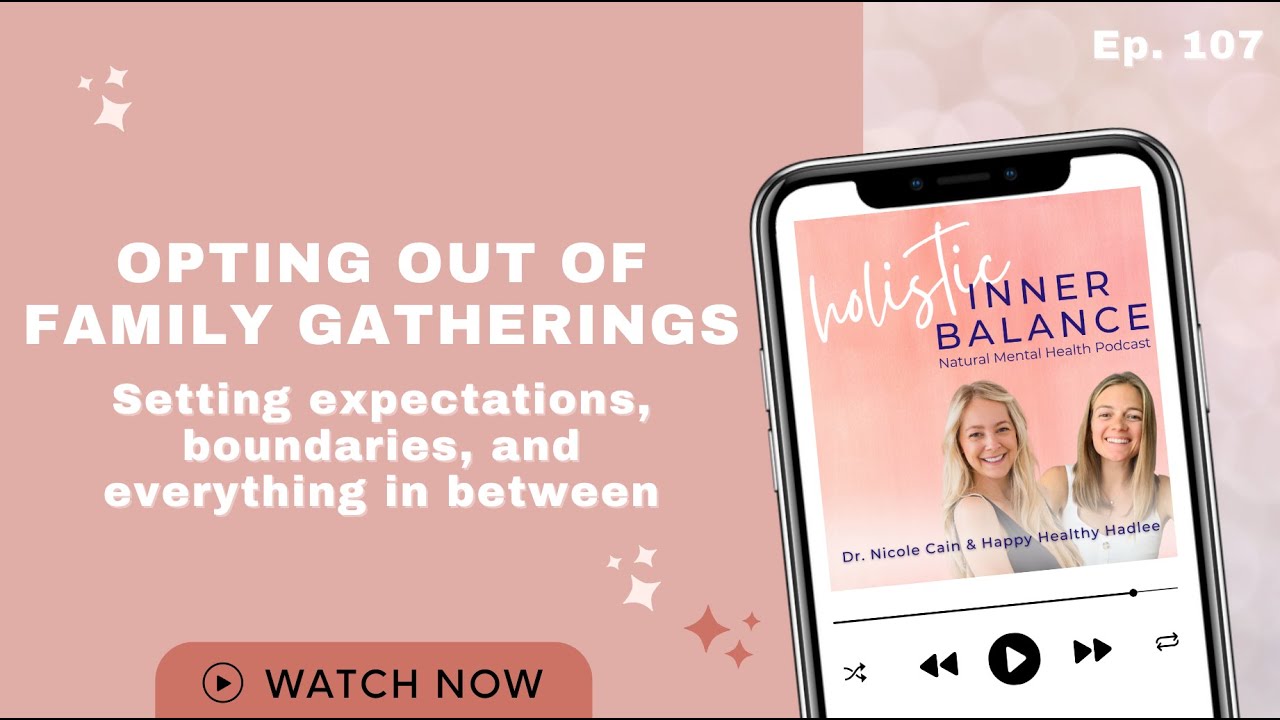
In this Holistic Inner Balance podcast episode, host Hadlee Garrison and guest Dr. Nicole Cain explore the emotional and practical aspects of choosing to opt out of family holiday gatherings. They discuss how the pandemic prompted many to rethink traditional expectations, share personal stories of feeling dread, cultural and spiritual misalignment, and family dynamics that feel draining. The conversation offers concrete guidance through a five‑step framework: (1) acknowledge feelings and bodily sensations; (2) give yourself permission to opt out or modify plans; (3) create protective supports and self‑care after the decision; (4) communicate the plan honestly and directly; (5) release the responsibility of managing others’ emotions. Throughout, they illustrate the steps with examples—opting for a shorter visit, a pot‑luck instead of a full‑hosted meal, traveling to a different location, or simply staying elsewhere. They emphasize authenticity, the ripple effect of personal boundaries, and encourage listeners to visualize their ideal holiday, make bite‑sized changes, and share their experiences via Instagram. The episode ends with a call to rate the podcast and a reminder that these strategies apply beyond the holiday season.
Chapters
Hello and welcome to Holistic Inner Balance Podcast. I am Hadlee of Happy Healthy Hadlee.
And I'm Dr. Nicole.
And we are here to talk to you today about holidays and specifically how you might come to the conclusion that you need to opt out of holidays with your family. So we're going to talk about all of the nuances that come here. So it might not be— that might not be the decision for you, and it might be the decision for you. And we're here to— if that is the decision for you, we're here to give you permission that that is actually an okay thing to do. So Dr. Cain is going to talk about this a lot because she has a whole host of different things that she has experienced with her her own family and has a ton of wisdom on this topic. And so I'm really excited to dive into this because I think it's something that a lot of times we think is not an option for us. And so we're going to go into that and see if that is the best option for you.
I love that. And you guys are going to walk away with 5 steps for opting out if that's the route that you decide to take. And so you will have an actionable at the end of this conversation.
Of course, because Dr. Kane always is coming at us with all of the step-by-steps.
Yes. So, Hads, are you going home for the holidays or what are you doing?
So I am actually not. My husband's family is coming to California and we're all meeting up here, which I'm very excited about. Don't have to go back to cold Michigan, but I went to see my family for Thanksgiving. So we kind of did it where it was like Thanksgiving with one side of the family and Christmas with the other side.
That sounds like a good balance.
Yeah, yeah, it's really nice because what we've done in the past is try to do every single— see every single person. And it's actually been so nice to just like, just kind of like soak in the energy and, you know, have that connection time and then be like, okay, now we get to just like rest and not have to force ourselves to do all these crazy things. And I feel like with the past couple of years, things have shifted so much where people are realizing like, this is something that I could maybe do, is I could do— I can, I can do a different thing than I've normally been doing. I can like opt out of certain dynamics. I can do something that is slightly, slightly different or very different from what I've done in the past that actually works for me and maybe works better for everyone involved anyway.
I agree. I think that we had a huge pattern interrupt with the pandemic where, at least in my life experience, it's like, this is what's expected. This is what you do every year. And it's not because it's what we're all choosing enthusiastically to do. It's because it's what we've always done. And then suddenly with the pandemic, we couldn't do everything the same every year. And so I agree with what you're pointing out. And I think the research is agreeing too, is that people are starting to question, like, do we have to do it the same way? If we don't do it the same way, what do I want to create? And that's really interesting and exciting to me.
Oh, same. I'm all about creating the most intentional life, like, possible. And so being able to decide, actually decide, oh, oh, this is what I actually want to be doing. And ultimately, a lot of times when we do that, when we actually decide what we want to be doing and kind of like, like, what is, what is our deeper desire, we can ultimately make a positive ripple effect on the people around us too. Even if, you know, even if at first they aren't happy about our decisions, it might start to get them to think a little bit differently and be like, oh, I can actually be intentional with this too.
I think what started this conversation in my mind in terms of what I chose to do this year is I was feeling this sense of dread as we were coming towards the holidays. And so I was starting to look in and reflect on my experience. And I always encourage my patients, like, what are your thoughts, your emotions, and your sensations? And when those come up, that's data from your body, your mind on what needs healing and how. And so I was having this experience and had the opportunity to stop and start to explore that. And one of the big obstacles that I found myself coming up against is kind of touching on what you were just saying, is how is this going to affect the other people around me? Is that resistance? And I feel like for a lot of people, it's like, I would want to do this. I would want the people around me to be really supportive of that. But I'm scared, and I think that it might not go that way. And so I love that you were kind of pointing out that sometimes we just have to choose to do what's best for ourselves, and that can be inspirational for other people. And I think that takes a lot of bravery and a leap of faith for each person to do that, not only for themselves, but then to perhaps provide an opportunity for their family or their friends or whomever to grow too.
Totally. And even if it's not in the moment, even if they're like, you know, like they might be angry, right? It might. And I know that you've had some experience with this. Like they might— it might not seem like you're like inspiring them, right? But you might find like years from now that it, it like planted a seed, right? And so we have to do what is the most like aligned for us. And ultimately that usually ripples out for other people as well.
Yeah, the doing what's aligned for us and then seeing that kind of ripple outward is so very true when we look at what we're finding in quantum physics and how our intention can affect so many things beyond just material choices that we make. And so I want to emphasize what you're saying also and say like, hey, Neil deGrasse Tyson talks about some of this stuff in his work and I would love to go down a rabbit hole for that. But yes, Hadley. Yes, yes,
yes. It's so big. And like, I mean, we'll, we'll definitely go on a rabbit hole with that topic at a future date. I think that needs to be something that we go into. Yes, for sure. But yeah, it's, it's, it makes a really big, it makes a really big difference in our own lives. I find that when we can sort of reorganize how we do things and how— and reorganize the relationship dynamics, it's so, so impactful. And sometimes we can't reorganize relationship dynamics in person, so we have to opt out completely from being with people in general. So I'm wondering if you would be down to share a little bit more about your story, what you kind of have decided on for yourself this year so we can inspire people and show people that, you know, they aren't bad or wrong if they've been thinking about this?
There's a couple of reasons that I— when I was noticing my dread or the thoughts, the feelings, and the sensations, is there's a couple of things that stuck out for me. One is that I don't identify with the culture That is emphasized by my nuclear family around the holidays, and I feel like I don't necessarily need to immerse myself in that culture anymore. And so I'm trying to like figure out how to walk around like being really authentic, but like not being overly specific. But, um, in terms of like, what do you eat? And so there's like all of these very specific meals that are cooked every single year, and if there's any adjustments to it, then people are very upset. And I don't eat the standard American Midwestern meal fare, and I don't feel good when I eat it. And my husband is allergic to gluten, and he's gluten intolerant, so he can't have it anyway. And so there's that cultural aspect, but then there's also the spiritual aspect of there's expectations that we participate in spiritual traditions that I don't really feel in alignment with. And Yeah. It's one thing I can go and support other people in their spiritual traditions, but it feels like a little bit too much. And being there and staying there and being in that environment can be a little bit much. And then there's also just the way that my nuclear family interacts, which doesn't feel very honoring and fulfilling. And so this is when we get into family dynamics and interpersonal trauma or neglect. And when you go into a family environment Especially Iowa in the winter where it's like 20 degrees outside. There isn't really much that you can do to get out of the house unless you want to go to Kohl's or a half-shut-down mall. And so it feels like a very trapped experience versus when I'm out in the West Coast or in the South, you could just go outside and go for a walk without freezing. And so there's this kind of trap. So there's the family dynamic and feeling really trapped in that dynamic, which for me at this time in my life feels very othering. We were with the Holidays last year, and Paul and I were there for 3 days, and nobody asked us a single question
the
entire time that we were there. Wow. There wasn't like, how are you? Like, what are you up to? Do you like this? There was zero. There was nothing.
Wow.
And I felt like my cup wasn't filled. And I do have this role in my family of being the peacemaker, of being the people pleaser, fawning. And I feel like the healthier that I get, The less inclined I am to fill in those gaps. And so when I was noticing those feelings of dread, I started to think about what would my ideal Christmas or holiday look like? And I allowed myself the luxury of just sort of indulging in a fantasy of what that would be. And I envisioned like people were inside of a home and they were laughing and Paul was playing the piano and I walk outside. And the sun is beaming down on me, and I have an espresso in my hand, and I'm in a fuzzy robe.
I love it. And
it's like very, very comforting, and it felt so beautiful. And I told Paul about that, and he's so very supportive, and he's like, wherever you want to go, whatever you want to do, like, I've got you. And I'm so very grateful for that. And the conversation is Well, why can't we do that? We're middle-aged adults. Oh my God,
you're— are you middle-aged?
No, I'm like over the hill. Don't they say like 40 is over the hill?
I thought that was 50.
Oh well, I'll take it. 50. I'm not middle-aged, I'm a youngster.
Oh my
God. I'm a youngster. I'm an independent, becoming more independent youngster. And I was like, why can't I do that? And I, I gave myself permission to do that. And there's like other things that kind of catapulted that decision that made it a little bit easier that happened, which I'll save for my therapist. Yeah. Um, but I gave myself permission to do you, to, to Choose that I am as much of a priority as the other people in my life, that I'm not necessarily less of a priority or more of a priority, but I am also a priority, and that I get to choose to opt out, and I get to choose what I want to opt out in. I get to choose what I want to endorse in. And so I got gifts for my family. I opted in on getting gifts. But I'm opting out in going to Iowa. Instead, we're going to go to Arizona and we're going to ride bikes or we're going to hike with our best friend Michael. We're going to— I'm going to manifest. I'm going to create that. I'm going to go out onto my patio in my apartment in Arizona, and I'm going to make Paul make me a latte. Probably actually more of like a Rise Mushroom caffeine-free latte. It's like mushrooms. No, they are not sponsoring us, although you guys could. Um, but I'll like have—
Well,
we'll totally endorse that. And so having my like mushroom latte and like creating the holiday that I want, and that was really hard. And circling back to what you were saying earlier, Hadley, is I hope that that will have a positive impact in creating a pattern interrupt in the dynamic that has been so problematic for so long. And if it does, that's great. We can all grow and I would Love that. But it's also really possible that it could result in more estrangement and more alienation. And I'm willing to accept that that is a possibility because I can only control myself. I can't control other people. And for me, it felt like being authentic to who I am and being in integrity with my needs. was more important than maintaining a status quo to avoid estrangement.
Yes. Oh my gosh, it's so good. It reminds me of— there's a quote by Glennon Doyle where it's like, you have to disappoint as many people as you like, as you need to, in order to not disappoint yourself. So good. It's so good. I don't know if I said that exactly right, but that's the gist of it. And it's Yeah, it's coming back to our authenticity and in giving ourselves what we need and recognizing that it's not necessarily selfish, or just that maybe it is selfish, but selfishness is not necessarily a bad thing. We recently talked about being self-full on a podcast recently. And I really like that reframe for sure. And So yeah, so it's— it comes down to really honoring what we need. And something else that you did in here that I really want to point out, and I would love to invite all of our listeners to do, is, is like really visualize what would be your ideal holiday experience like and get really like excited about it. Like allow yourself to really like let it, let it feel really good in your body. Maybe for you it's being in the snow. Maybe for some people it's like you being in the sunshine. Maybe, maybe it's something like doing some sort of volunteer event. Maybe it's being with family. Maybe it's being with a circle of friends. I love how you said like the piano, Paul playing the piano like that gave me chills. I would love to experience that on Christmas, like all standing around and singing Christmas carols. That sounds like my ideal. my ideal situation for Christmas. And so, yeah, so, so what do you all who are listening, what do you— what would be— and, and it's not to say that your Christmas this year or your holidays, whatever you celebrate, has to be this this year. But let's get clear on what would be the ideal, and then we can work toward it, you know, in future years. Like, we can make little teeny tiny tweaks if that's what you feel like you need to do right now and not just make this like huge, like, jump this huge, big decision of whether or not you're going to actually see family or not, what little tweaks can you make to have that experience that you actually really are yearning for?
I love that. I like the small changes because otherwise it can get totally overwhelmed. And I would have opted out probably many years ago, but it was way too big and way too scary and the ramifications felt way too overwhelming. And so I like the idea of making little choices. And so this is probably easier if your family lives in the same town as you, but maybe everybody goes to 10 events and you can choose if you want to go to 1, 9, 10. You can make small steps. Or maybe everybody eats turkey, but you really want to eat sushi. You can make small— maybe that's huge. And
hey, you could get it takeout.
You could get takeout. Yeah. But you— I like that, Hadley, because it makes it a little bit more bite-sized, pun intended.
Totally. Can I give an example of like opting out of certain dynamics and making it a small thing? Okay. So I love this example. So, um, and then my mom is like one of the coolest people ever, and she will not mind me sharing this because it's been a really awesome experience. So She is not a cook, or she's like a decent cook actually. It's not that she isn't a good cook, but she doesn't like it. She doesn't like having all everyone over and having them all having us all like just you know feeding all of us. For some people, it's like that's like their love language is like feeding the family, right? But for her, she would just as soon have like a little like she would just have like popcorn for dinner if she although. She has a lot of vata in her constitution, so she's realizing that that's not the most helpful thing for her. So she's been opting for other things, but she just doesn't like to cook. And so in the past, she was in this state of like, like, and she wasn't meaning to, but it was like a little bit of like resentment, that martyr, that martyr thing. And I think I've maybe mentioned this in the past, but we had a really great experience during this Thanksgiving where She was like, okay, for Thanksgiving Day, I am not only not going to make all the food, because in the past we would help her, we would help make all of the food, but she was in charge. She had the mental load, which is like such a thing for moms, unfortunately. She had the mental load of figuring out when everything needed to go in the oven, what, like how to do all of the things, you know, who's in charge of what, and like making sure that we were all on task. So she was like a taskmaster or whatever. And she was like, this— I don't like this. You know, we've shifted things in the past so that we will bring our own. We'll bring— we'll each bring a piece of the meal. It's kind of potluck style when we go over there. But for Thanksgiving, we were all in one house. And so it's a little bit harder to like bring stuff like a potluck. And so what she did this year was She just said, you're in charge of this, you're in charge of this, you're in charge of this. You guys have to figure out what time it needs to go in the oven. You guys need to figure out how it all— like, what time you need to make your thing so that it works out for timing. This is the time that we're going to eat dinner. Figure it out. And it, it was wonderful. Our food was totally cold, but we all just put it in the microwave. When we got our plates, we just stuck our plates in the microwave by the time By the time dinner came around, it didn't matter. It was hilarious. And so that was her opting out of that dynamic so that she could be the person that she wanted to be in relation to us rather than being the stressed out, frazzled, resentful, you know, self that had been happening in years past. Plus, we weren't super grateful about it because we could feel her resent— resentment. And so it was just like this vicious cycle of like us not being grateful because we wanted to get away from that energy. And then her being like, oh my gosh, I did all this stuff and they're not even and grateful. So instead of needing someone else to change, it's like we're opting out of that dynamic altogether and doing something that's seemingly not that different. But the dynamic is a completely different dynamic. And it was so great. She was like, like she was just like shining. It was amazing.
Oh, so she noticed her thoughts, her feelings, her sensations. She was experiencing distress. If that had continued on and on year after year after year, I imagine resentment would be building.
Right.
And so feeding her family in the way that she was wasn't working. And so she opted out of that in the way that you've been doing it. And it sounds like it was really helpful and beautiful and sparkly for everybody, not just her, but like everybody.
Oh, 100%. Yeah. It made the whole dynamic. And that's what I'm saying is like, we can opt out of these old dynamics and then it becomes better for everyone around us, right?
Yeah.
And I even see for you, like, you know, your family probably doesn't see it right now, but you being there and feeling resentful, like, isn't helpful for them. Right? Right. So it might ultimately be better for them at some point. And it doesn't have to be, but it might be, you know, somewhere down the road. Yeah. So that's like just a really good tangible example that I love to— that I love to give my clients and stuff is like, we can do things differently. And we just sometimes we just have to get creative. Sometimes we have to like get way out of the box of like, how could this look different? Another thing that I'll say is you don't have to always stay with your family either. So something that I've done in the past is I haven't, I haven't stayed with my parents actually in years. Mostly Todd and I will go home for like a month at a time in the summer. And so we rent a different place. And it just, it just works a lot better because I'm a very independent person. And sometimes you just have to decide like what's best for you. And then you can show up in the way that you want to show up for other people as well. You don't have to opt to stay with your, your family members. So that's another option.
And that can mitigate some of that trapped kind of feeling that I was describing. Like maybe you are going somewhere where it's freezing cold outside and you can't like really spend time outside. So you could play, you could stay somewhere else if that's not cost prohibitive for you, is to like create that other space where you can then show up at will. I love that.
Right, totally. And if it is cost prohibitive, it might be— I mean, staying for a shorter amount of time too, rather than like staying a full week. You could also stay for like 3 days or whatever, and that I mean, I've done, I've done things like that before as well, where it's like, okay, instead of coming for a full week, we're gonna come for a long weekend. And then it feels— as long as it's something that feels like authentic to me, it feels really good. And, and then you're able to make those connections in a way that feels like it doesn't drag on for as long. And it, it just feels like, oh, we came in, we made those connections really on a really deep level. And then we were able to go and like rest and all of that and do what we need to do for ourselves.
That's brilliant. I think that's so good. And then you're able to show up from your centered self and everybody will sparkle from that.
Exactly. Yes.
So as we finish up, let's give some tangibles. Let's talk about 5 steps for opting out. Are you ready?
I love it. Yes. I'm really excited to hear what these are, you guys. I don't know what these are yet.
Oh, I hope that, that they blow your mind and that your jaw drops. And that you can't wait to tell Todd.
I can't wait, although he'll listen to the podcast. He's, he's our— he and Paul are our number, number 1 and 2 fans.
Totally. I know, it's so sweet. So Todd, this is for you. No, just kidding. Um, so number 1 is to acknowledge your feelings and preferences. And, you know, I was at lunch today with some of my counselor colleagues, and one of them was making a joke about how Feelings are not for feeling, they're for stuffing and suppressing and putting under the rug. And so the opposite of that is what you want to do. Yeah. Is just simply acknowledge and notice. And so maybe set aside 5 minutes or 30 minutes, whatever is good for you, and just notice when you think about the holidays, what thoughts come to your mind, what emotions do you feel, and what sensations Do you notice in your body? And then step 2 is if those thoughts, emotions, or sensations are unpleasant in any way, if you're feeling dread, if you're not feeling really excited or like pleasant anticipation, then give yourself permission to opt out in whatever way that looks like. Hadley gave us some really good ideas on not total opting outing, but some like little changes you can make. And then when you imagine those changes, go back to the body and see what you feel. And you're looking for a little bit of a sense of relief or a little bit of sense of peace, and your body will tell you the right next step to do.
Yeah, any sort of pleasant sensation is kind of what we're looking for here.
Yes, any sort of pleasant sensation.
Or if it's not pleasant, at least neutral, at least something that doesn't feel Like tension or like contraction.
I love that. Yes, it's something that feels like a little bit of a release of that tension or contraction, maybe back to neutrality or maybe pleasant, depending on how, how possible it feels for you to like—
yes,
do
your job. Yeah, totally.
So then number 3, step 3, is to create a protective scenario or support for yourself. So you've acknowledged it. You've noticed your body, you've given yourself permission to opt out, and then before you make any changes, it's time to give you support because you're going to need to be strong if you're doing something that feels a little bit difficult. And so I talked to my husband and I upped my self-care and I gave myself time to think about it and I made a plan of what I was going to say and when and how. And so creating protective supports for yourself.
I love that. And even having something that I was just— that I just learned about from Lori Harder. I don't know if anyone has heard of her, but she's wonderful. She just spoke at an event that I was at, and she was talking about how she has this group of friends, and she was talking about it in an entrepreneurial setting, but where she was like, I was going to have this call with a publishing agency, and I was either going to need to be celebrated afterwards or I was going to need to be picked up off the ground. And she was like, so I had— I scheduled a call for— with those friends right after. So even so, you can plan for all of these things before, but then also having like a network of support for after the fact that you like plan out ahead of time so that you can lean into that support can be so, so helpful too.
I think that's brilliant. I'm going to tell my whomever, I'm going to make this choice for myself to fulfill myself, fulfill my needs. And I have this scheduled after it so that I can get the support, celebration, or picking me up off the ground. I
love that. Yeah. And it can be in person, it can be a phone call. It can be, you know, maybe it's like I'm going to plan like a night with my girlfriends for after this so that I can feel rejuvenated, or I'm going to plan like a self-care night so I can, you know, just Take care of myself, whatever it might be, just planning something for afterwards if it's going to be a really hard conversation.
Oh, that's so valuable. And then number— step number 4 is express your plan with honesty. And I think one compulsion that we often have is to either make up a lie that feels acceptable to other people or to give a lot of platitudes, which may not feel sincere or right. And so just being very direct and very clear and then just allowing them to have whatever reaction they need to have. And some resources, some clinicians will advise that you do a little hint ahead of time, like, it's possible that I might not be able to make it to Iowa this year, and so stay tuned, so that when you finally do deliver the news, that they aren't just in shock.
Right. It's not like, yeah, blindsided.
Blindsided. They won't be as blindsided. But then when you do tell them, be really Really honest and really clear about it and not like, well, I don't think we're going to make it. Well, I have a huge deadline that I don't really actually have, or I really want to see you, but I can't, which maybe you don't want to see them at all. Right. So being really honest and saying, here's something you could say is, I love you. I wish I could be with you this year, but I just need some time for myself. Or, um, you know, I'm looking at what's going on in my new year, and right now I need to choose to lie low and not spend the holidays with the families. Like, something that feels really sincere and honest.
Right. I love that. Yes, I tend to go for the white lies, and it's something I've been learning— I mean, working on for like years. But yeah, it's like you could even say something like, I need to prioritize this over this, right? You know, and that goes for anything. That's something that I learned from the book The Big Leap by Gay Hendricks, where it's like instead of saying, I don't have time to do that right now, that's not necessarily true. You could create time for it. But I, right now, I'm prioritizing this thing over this thing, and that often people are People are often taken aback by it at first, but then they're like, oh, you can do that? Like, you can, you can prioritize different things over, over different other things. It's pretty cool.
That is such a good book.
Oh my gosh, it's so good.
It's so good. Oh my gosh, it's awesome. Okay. And so then the last step, step number 5, is letting go of the responsibility of managing others going forward.
Mm. So good.
Yeah. Yeah. Like, uh, when I, when I declared that I was opting out, I got, um, radio silence. Nobody responded to my message about it. And then I think it was like 2 weeks or 3 weeks later, I got a call and there was like all sorts of emotions that were being expressed. And past Nicole would've said, okay, like I have to. make up those white lies, or I have to give platitudes, or I have to soothe, or maybe I should backpedal and maybe I should go. And it's really important to let go of that need, that responsibility of managing others. And sometimes that can be really hard. And so if, as I'm saying this and you're listening and you're like, easier said than done. Yeah, I know. Right. And counseling can be really helpful for that because maybe the need to manage others is there because it was adaptive for you at one time and it helped you survive. And it was a really important cornerstone of the family dynamic that got you to where you are today. And it's also possible that that is no longer serving you. And so going in and looking at that dynamic, looking at why it exists, and then unwinding that with EMDR therapy, counseling can be really, really helpful. And this was helpful for me.
Mm-hmm. Oh my gosh, it's so good. Yeah, not being responsible for other people's emotions is— I mean, that's the name of the game for all things, but it's so, so important here. And, um, and it also helps people to step into being responsible for their own emotions.
Totally.
It might— I mean, they might not like it, but it, it actually does help them to be able to do that in the future for themselves. Otherwise, they'll constantly rely on other people to sue them, right? Oh, it's so good. I was going to say one more thing and I forget what it was, but I think we've done a lot here. So I'm really— Me too. I hope that this was helpful for everyone. Whether you decide that it's time to opt out completely from your family holiday or whether you decide to do things slightly differently, we would love to hear about it. Which things are you— what are you tweaking? You can DM us on Instagram. You can share this, share, share this podcast episode with anyone who this might be really relevant for. We would love to be able to spread the word about this kind of thing and help people to really make, make positive decisions for themselves in the holidays this year. And then even just going forward doesn't necessarily even have to be a holiday season thing, but really just deciding what they truly want in their lives.
Yeah, let us know what you think. And if you haven't, please rate us. We would love, love the love on our— or not our Instagram, but our podcast.
Yes, it's so helpful and it gets this— it gets the podcast out to so many more people. It helps so much more than you might think it does. So if you have like just 1 or 2 minutes to rate and review, we really, really, really, really appreciate it.
Oh, awesome. Thank you for listening, all y'all.
Yes, thank you so much.
All right, see you later.
See ya, bye!
More from Hadlee
Happy Healthy Habits: Automate Your Habits. Optimize Your Energy. Unlock Your Capacity.
Join us at the Align & Thrive day retreat Sunday 1/11 in San Diego 🩵 Comment ALIGN for the link
Fueling the Future: ESS60, Mitochondria & Mission Longevity with Chris Burres | Ep 156

Dancing Through Life: The Healing Power of Showtunes with Danella Mercati | Ep 155
From Breakdown to Breakthrough: Reinventing Life at Midlife with Wendy Valentine | Ep 154

Your Soul Wants To Be Surprised: The Good Life with Michele Lamoureux | Ep.153
BONUS EPISODE: Fawning: The Trauma Response Hiding in Plain Sight With Dr. Ingrid Clayton | Ep 152
Fall Asleep Faster, Rest Deeper & Wake Up Refreshed Using Sleep Science with Devin Burke | Ep 151

Your Oral Microbiome & Mental Health: The Overlooked Link with Dr. Namrata Patel | Ep 150
Acupuncture & Energy Flow: Unlocking the Body’s Healing Potential with Dr. Felice Chan | Ep. 149