The Secret Language of the Body with Jennifer Mann | Ep. 126
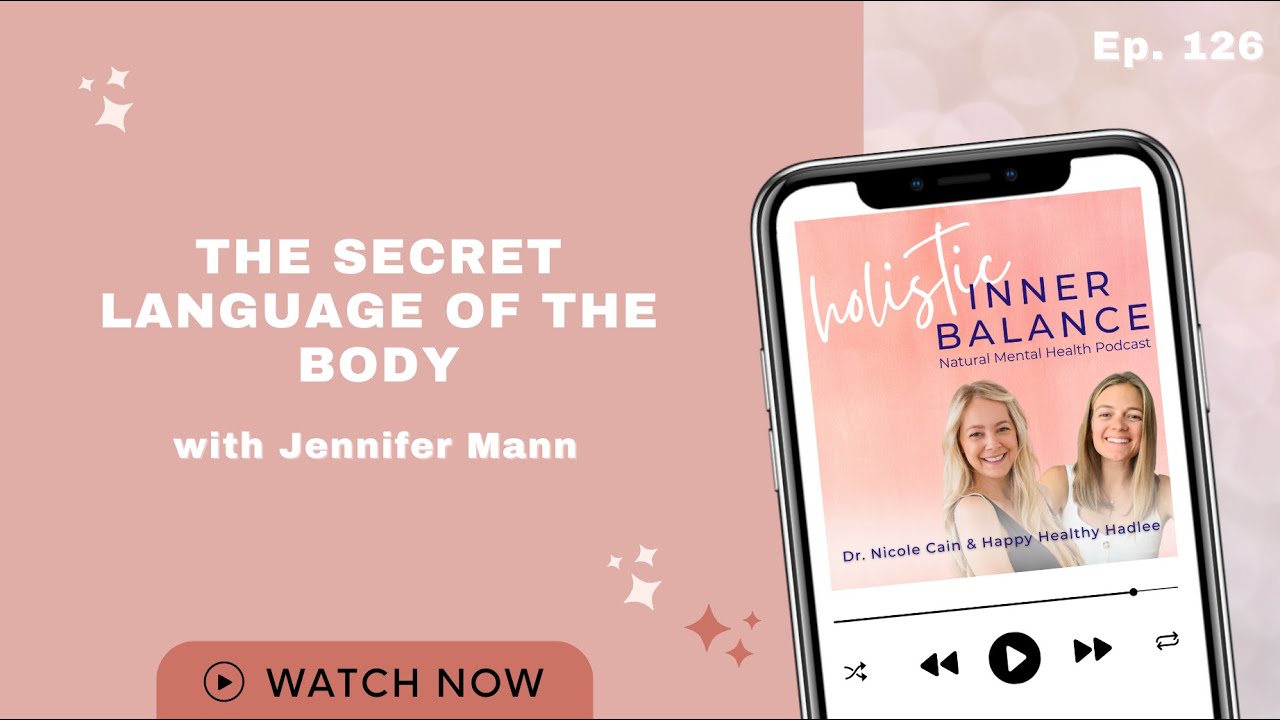
In this episode of the Holistic Inner Balance podcast, host Dr. Nicole Cain and co‑host Hadlee Garrison interview mind‑body practitioner, yoga instructor, and author Jennifer Mann about her bestselling book The Secret Language of the Body. Mann shares her personal story—from a childhood marked by anxiety, parental loss, and a stutter, through elite ballet training, severe injuries, and a year‑long crash of chronic fatigue, to a rapid recovery using trauma‑informed mind‑body techniques. She explains the core concepts behind her healing framework: (1) viewing symptoms as data from the nervous system, (2) recognizing anxiety as a bodily experience rather than an emotion, (3) using brain retraining (awareness → interruption → redesign) to rewire neural pathways, and (4) integrating polyvagal theory, somatic experiencing, and controlled dissociation. The conversation also explores how perfectionism can become an identity that sustains illness, how play, visualization, and “stepping out” of oneself facilitate neuroplastic change, and how her program Heal (offered through Somia International) provides free entry‑level brain‑retraining tools. Practical take‑aways include daily self‑inquiry, grounding through movement, and using a “healing self” to re‑frame perfectionist urges. Listeners are directed to Mann’s book, Instagram (@iamjenmann), and free resources for the community.
Chapters
Hadlee, we just had the most amazing conversation.
Oh my gosh, I'm like buzzing. My whole body is buzzing. Yeah, it was so good. You guys are going to love this conversation.
Let me introduce our expert guest.
Yes.
So this is Jennifer Mann, and she just wrote a book, and it is a number one new release on Amazon right now. It's called The Secret Language of the Body: Regulate Your Nervous System, Heal Your Body, Free Your Mind. And you can get it right now. It just debuted July 2024, and it's awesome. And so she came on our podcast today, and we just had the most brilliant conversation. And so, Hadlee, I'm curious what your, like, number one favorite part of the conversation was.
Ooh, I think, I think the end, honestly, when she really dove into how— well, we talked a little bit about perfectionism, which I think most people have at least a little bit of perfectionism, and how Why it comes up in the body. And she went deep on that. You guys are going to absolutely love that part and benefit from it immensely, too. There's just— there's so many nuggets. The other one that I wrote down was about how anxiety is not an emotion. So you'll have to listen in to hear about what that means. But I'm curious, Dr. Cain, what about you?
I really admired her story and how by doing the mind-body work, she got such powerful and fast results. And it wasn't just a placebo because when she discovered this process, she thought it seemed a little salesy and was super skeptical. But when we're at those rock bottom moments, we'll try anything. Yes. And so we're gonna learn about something that you can do today. To start reprogramming your mind, your body, and your nervous system, which is super exciting. So before we dive into this conversation, let me read her bio and then we will click in. Are you ready?
Yes.
So Jennifer Mann is a mind-body practitioner, yoga instructor, and functional movement therapist. She's battled severe chronic fatigue. She began researching alternative approaches to healing chronic fatigue and was able to completely recover Using trauma-informed mind-body healing. And now she leads a community of over 100,000 followers on Instagram. She's the co-founder of Somia program. It's called Heal, and she's helped thousands of people from all around the world regulate their nervous systems and get their lives back. And so without further ado, let's dive in.
Let's do it.
My full-time job. We, Cardan and I, have co-founded Soumia, Soumia International, and we have a program called Heal. We've had, I would say we're about to hit the 3,000-person mark that have come into the program. And yeah, we have like more than hundreds, I would say nearing to the thousand, like full recoveries from chronic fatigue, chronic pain, mind-body syndromes. And yeah, so if that fits anywhere, that's like what I do. Yeah.
That's incredible. So I was wondering if you could share a little bit about how you got to where you are today, this amazing writer, this incredible healer. I did your polyvagal practice, the yoga exercise. It was amazing. Your voice was so comforting.
Oh, thank you so much. So, um, where do I begin? All right, so traditionally when you experience, let's say, um, like a chronic illness, or the story would, would start there, um, but I, I think it actually starts in childhood, um, that's, that's the beginning of it all. So From a young age, I experienced a lot of anxiety, and my dad left when I was young, and my mom was left as a single mom. So I had a lot going on inside my little developing nervous system and brain. And I grew up in East Africa, and my mom moved us to Italy when I was 8 years old, and I had such a bad stutter. When we moved to Italy, I remember feeling so like a fish out of water and just this feeling, you know, now that I know in hindsight, just unsafe really in my body, in my new classroom with the new language, you know, Italian and stuff. So yeah, I had a stutter that was so bad I couldn't speak properly for a couple years. So I went to speech therapy, I think that was like my first toe dip with a psychologist because then it became an extended therapy thing and I loved it. She used to ask me to like analyze photographs and I'd be like, I know what you're doing, sneaky you. And anyway, so then I navigated through that and then I became very early on a professional ballet dancer. And I left home at 14 years old. So I was in another country. I moved to Germany, actually, around my 15th birthday. I got a full scholarship in an academy, and I went from one ballet academy in Italy to another one. And it was really hard, a lot of verbal, emotional abuse, a lot of trauma, a lot of pushing. So You know, why I'm sharing all of this. There's, you know, the element of anxiety, the core abandonment wound, the sort of instability and feeling of unsafe that was like already a layer. And then on top of that, there's this layer of being a pro athlete, so pushing my body really hard and then having people tell me every day, you're not good enough, you're not worth it, you're nothing. Like, why are you here? Why? So that was for like, yeah, I would say a good like 5 years. Then I graduated, I became a professional ballet dancer, and I was often injured. And that was already making my brain question, like, I wonder whether my anxiety has anything to do with my injuries because people around me, I was like, she's doing the same as I am. She's waking up just as early as I am before class. She does You know, Gyroton. I'd go to the gym after, like, I was doing so much care, physio, everything. And I was like, I shouldn't be getting injured, you know? And I remember this one time I injured my knee and I tore all my ligaments in my left knee. And in that time, I think it was when I really started to make those mind-body connections for the first time. I was 17 and I was like, maybe one day this is what I'm going to do after I'm a ballet dancer. So I danced around the world for a few years, and then I had one big injury where I had to stop dancing. And so I transitioned and I became a movement therapist, helping people move better, feel better through— I became a yoga teacher, Pilates instructor, personal trainer, Feldenkrais, gyrokinesis, like you name it, functional movement pattern, like just everything. I was like, I want to get in the unconscious of your moving, of your feeling, sense of your body. And then I was just working with them, with clients, and realizing like something's still missing. Like I'm not really able to get to them still. There's a puzzle piece missing. So I decided to go back to school. I studied biomedical sciences and then physiotherapy. That's where I wanted to end up. But— High school for me was history of ballet, history of music, languages. So when I was like, I want to study physio, they were like, yeah, you can't do that right now. You have to study some other stuff first. So I loved it. But what that element gave me was just, again, perpetuating my perfectionism, my competitive environment that I'd been in for so many years in ballet. So I started to get the first signs in my body of something's not right. But being a, you know, strong, trained artist and athlete, I was like, you know, keep going. Nothing will stop me. Ignore this because I need to keep moving forward. I can't rest. I have clients and patients before and after school. Then I have school, then I have to work out. And It was a lot. Even looking back, I'm like, wow, how did I not slow down a little? But when you're in it, it's cool until it's not. So in my second year of physio, learning about pain, learning about all the things that I was— I was like, do I have that? No, I don't have that. Do I have that happening in my breathe? No, I don't. And so one morning I was doing my yoga practice just at home, and I injured my spine, or really my muscles. I didn't really injure my spine, but it felt like I did. And I was like, okay, I think I need to rest for a couple of days. And then that was the beginning of my so-called crash. So from— I decided to rest for a couple of days, and then the symptoms began. And within a couple of weeks, I had all these flu-like symptoms. My face was covered in acne, nausea. Oh, my gosh. Within a few months, I'd lost so much weight. And yeah, I was just completely housebound for over a year. And I did all the conventional stuff, and I did so many tests. And then I kept meeting people who had chronic fatigue syndrome and POTS and fibromyalgia patterns, which is what I had been diagnosed with, saying they'd been stuck and sick for so many years. And I was like, no, this is not— how is this possible? And then having the doctors tell me that as well, like, You're quite severe, so we're not sure what the outcome will be. You just need to rest. And, you know, bearing in mind I'd been resting for a year, like I'd literally been in bed for a year. And so tried everything under the sun. And then I stumbled into brain retraining with the little energy I had, which we can talk about more if you want. But basically, within 3 or 4 days, I was walking again. I could talk. I got my appetite back within a week. My Mm-hmm. acne was completely cleared. I'm not even joking, um, because when I say it out loud, I'm like, that sounds, that sounds crazy, but it's the truth. Um, and actually, when I found the brain retraining, it was through a video online, and I was like, this sounds really scammy. I don't, I don't know if this is gonna work for me. Um, but when I did it, it was my same exact same experience. And so I quickly transitioned, as I started to recover, I was like, whoa, right? Neuro-linguistic programming, hypnotherapy, brain nervous system. What is going on here? And how is my fever gone within a few of these exercises? Like, what's going on? So then I found myself recovering really well, but having emotional triggers giving me physical symptoms still, even if I wasn't in a crash. And so that's when I found polyvagal work, somatic experiencing, and just going back to the body a little bit more after being in, in operating in that top-down, like the brain retraining, change your thoughts, change your, the origin of what's triggering those things and the feelings. And then I was like, wait, there's some core stuff here that needs to shift in order for, you know, that awareness to be even bigger. So. Long story, not short, because I told you everything. But basically, that's how I got to what I do now. I sort of— I went headfirst. I went back to school and I asked one of my mentors, like, how do I do this conventionally? Like, how do I work with patients like this in a mind-body setting? And he was like, yeah, so you'd have to get your bachelor's and your master's, then a PhD. And then it would be a fight. And I was like, okay. But it was just not what felt right for me. I was like, I know how to do this. So I started, I met my business partner, we started helping people, and that's where I am today. So helping people recover and move through these mind-body symptoms, which most people maybe wouldn't even know that they're mind-body, you know, just like— Maybe just body or just mind. Yeah, that's it, basically, in a big nutshell.
Wow. Oh my gosh, that is such an epic story. Like, the fact that you were able to heal so many things so quickly. And also, I want to— I wanted to mention that what amazing foresight you had as a teenager that you were like, There— I feel like there's something going on with my mind that's impacting my body.
Like, wow.
Because I remember as a kid, like, I, I was so disconnected from my body. And I mean, and dance can, can help with that. But also, like, the actual act of dance can help with that. But like, the culture of dance is like taking you so far away from that body intuition.
Yeah.
So how cool that you were able to, to kind of realize that at that time.
Yeah, I think I had— I think, you know, the therapy sessions I'd had for those years kept tuning me into wondering, like, I wonder if this is connected, you know? I wonder. And I was also parentified, so I kind of had to grow up really quickly and be, you know, have that to survive, have that kind of foresight, I think, in order to be— Yeah. I think that's Maybe what happened.
Yeah, absolutely. That you are like, oh, I'm, I'm more of an adult than a teenager. I can think about these things in a very— yeah, yeah. Which is, you know, partly a superpower, right? We talk about that a lot where it's like these things that happen to us obviously are— we— there are things that are detrimental, and also we can still keep the superpower part of, of it while we heal. Yeah.
I love that. Yeah, it's so true.
You talked about the brain retraining as kind of one of these initial aha moments. And so I was wondering if you could expand a little bit on that.
Yay. Okay. So when we experience a symptom in the body that's chronic, right? coming back, it's coming back. And you've done all the tests to rule out cancer or genetic diseases or anything that is alarming or life-threatening. And the doctors keep telling you, we just don't know what's going on here. And the symptoms can range from flu-like symptoms, inflammation in the body, skin experiences like just hives, rashes, or Yeah, like acne, psoriasis, eczema, and also things like post-viral syndrome. So I had Epstein-Barr mono when I was 18. So everyone fixated on that and they were like, this is why you're sick. It's because of Epstein-Barr. And if I wasn't more aware of the other puzzle pieces, That I would have been sold, I think, because I was like, yeah, that makes sense. It gets stuck in the body and then it reactivates. But then when you get a little bit more knowledge around what makes the immune system behave that way and the connection and the communication of the immune system with the nervous system and the brain and who gets the message of the threat first and who delivers the message back into the body and What impact does stress have on, you know, like a reactivation to show up in a blood test? So all these kinds of things. So with brain retraining, what you're doing is you're becoming of the unconscious experience of your mind and body. So, you know, we all have thoughts that we think and feelings that we have that we're not necessarily tapped into because we wake up, we brush our teeth, and then we drive to work, and then we're working, and then we have lunch. lunch break, and then we come home, we see our kids, or whatever your life is like. You know, there's some form of automation, right? Automatic. And actually, that's how the brain works best. It's this habit repetition, energy-saving organ, and it's made to repeat patterns so that it can execute the other million tasks that it needs to execute when it needs to save energy. So it makes sense. But when you tap into those thoughts, like, what is the first thing that you think when you wake up in the morning? And I just remember being asked that and I was like, I don't know. I just, I don't know. I've never thought of it. And then all of a sudden it just kind of came to me and I was just kept saying, but I was thinking not then and there when I was ill, but even like the years before, like, what's the story that I'm waking up with? And the story was like, this is too much. I want to snooze my alarm. I don't know if I can get through this. This is very overwhelming. And the word was like, I don't want to. I literally don't want to get up. And so you're starting the day with anxiety. And I didn't know that. I just thought I was in this state of like, go, go, go. There was a lot of awareness there, but not in the sense that I had when I had to heal my body from, you know, these chronic symptoms. So you become aware of your thoughts, and that's information. Then you become aware of, of the feelings. Like, anxiety is not necessarily an emotion. It's like an experience in the body that happens when there's an emotion that's beneath that firing, you know, up into the brain. And the mind, a meaning-making machine, is like— let's try to make meaning of this uncomfortable feeling that we haven't yet communicated with, you know, mind and body. So then, you know, I tapped in a little bit there. And then, you know, the feeling for me and for many of us actually is like, I was doing all of that because I felt like if I didn't, I wouldn't be worthy and I wouldn't be enough. And then what am I if I don't achieve or do something perfectly or, or get through the day having achieved something. And so that realization of like, wow, I'm carrying this load of stress in my body constantly. And when, when you call it, when you name it, when you recognize it, like all of a sudden it just goes— I mean, the anxiety is like, Oh yeah, that's why I'm here. I can relax now. I don't need to be as hypervigilant as, you know, the last 30-odd years. And then it comes back, but then you tap it. So awareness of thoughts, awareness of feelings, and you're like, this is what I have right now, you know, these feelings, and this is what I want. So what is it that I want? And then you do some coaching around, well, what I would really want is to feel ease in my day. And I would like to tell myself things like, you've got this. Like, you're amazing. You know, you can do this. What happened to you doesn't define you. And it's different from an affirmation because you're sort of tuning into the root cause and you're becoming your own, your own like cheerleader, your own coach, coach to get yourself out of this. And then you do some state building through visualization. And the visualization for me, for anyone, the type of visualization that you would go for is something that evokes a strong feeling in your body where you don't have to fake feeling happy or at ease. You go back to an anchor that made you feel that. And there's some in some— I had done the Lightning Process by Dr. Phil Parker, who's brilliant. There's so many others. Karden and I have created our own that has a little bit more somatosensory aspects to it. Like the good mover that I am, I was like, let's use the body a little bit more. And you repeat it hundreds of times. So when I learned this process, my day for a couple of weeks looked like I don't know, it, I guess, looks like I was this odd person speaking out loud, moving in circles, doing weird stuff, like over and over and over and over. And I just didn't let go until I felt a shift in my body. And there's an element of trust, placebo, right? When your brain believes it, it starts to feel safe. And so I was like, this is working. So that helps to kick, you know, kick you forward a little more. And so that was the beginning of my fever going away after a year and a half. After a few hours of doing this, my fever went away. I remember like screaming to my husband. I was like, I had closed off our living room. I was off social media. Like, I'd been off social media during my being bedbound. But in this time, I was like, I want no communication, nothing. Like, everything is going to be for this. this, and it's gonna change my life. And so I closed off the living room, and I was like, I'm gonna be in here doing these rounds all day. And then I remember screaming, like, I don't know, at some time in the afternoon, being like, my face is— And, um, yeah, my husband came into the room, and he was like, he couldn't believe it, right? He'd been witnessing me being so sick for a year and a half uninterrupted. Like, I'm talking about a fever for a year and a half. Like, a fever. Like, I have a little bit PTSD with fever. It took me some time to like, when I got a flu, when I was recovered a couple of years later, I was like, oh, fever, very triggering for me. And I worked on that. But yeah, that's basically what brain retraining is— awareness, interruption, and redesign through repetition and practice and elements like play, motivation. And depending on the person, You know, to get that neuroplasticity to really turn the wheels, you need to, to hit those elements that are going to help you feel motivated, help you feel inspired, playfulness, because we know play speeds up that neuroplastic learning curve. And yeah, so that's, that's, that's brain retraining.
Oh my gosh. I know we're going to get so many questions about like, how do I do that today?
And you, you
created created a process with your partner and you're standing on the shoulder of giants. You referred to Dr. Phil Parker. And so if somebody goes to your site, they go to your Instagram or your website, where would they click? Because I know we're going to get these questions.
So on Instagram, Somia International is the Instagram handle, and the program is called Heal. And you can actually start the brain retraining for free, like right now. And then, you know, the latter part of the process where, you know, it's a bit more individualized. So, you know, like for me, but a lot of people get a lot of relief already with those key ingredients. Accessibility is really important to me because like I, when I was sick, I just couldn't believe, yeah, just, you know, the people that were doing their job, but I just felt so drained. You know, I was just all the tests and the things I was I was crying. We had to borrow money. It was a lot. It was a lot. So, yeah.
Well, what's beautiful about it is that so many of us, we spend all of this time and all of this money on functional testing and supplements and herbs and treatments and going from doctor to doctor to doctor, and they can make it so very complicated. Like, okay, This is Epstein-Barr reactivation. And so then what we want to do is we want to X, Y, and Z, right? And what I love about what you're describing with the brain retraining is that you're the healer. Your body is giving you this data, which is so consistent with the way that Hadley and I see symptoms and how we teach about it here. So I love this message. Is that your anxiety or whatever your symptoms are, are giving you data. They're giving you information about what needs healing and how, and that you've identified this really beautiful, concrete 3-step process, the aware, the interruption, and the redesign that can then be personalized to people. And it doesn't cost thousands of dollars in testing and supplements. This is something that you can do. You can lock yourself in your living room and you could do it. Yeah. And you can get results quickly.
Yeah. And I think that when you know a little bit about the physiology of stress, just a little bit, it doesn't take a lot, then it all makes sense. Then you're like, oh, of course this is going to work. So, um, I think that sometimes when you have things like anxiety and a chronic illness in your body or your mind, which is both, but, you know, some people may identify You, especially if you've had it for a long time, you kind of sometimes wear it as a badge of honor, which, you know, if you do, that's totally okay. But it can be— you can get stuck there, and that's okay, and that's your journey. And I think it can be so freeing to know that whether that's there or not, or something else, your body is changeable and So plastic in ways that once you just know a little bit, just a little bit more, you don't need to be like a PhD neuroscientist, then it's like, oh, wow. Yeah, that makes sense. And there's some really tangible examples for that. But yeah, I love that.
Do you remember the lupus story?
What's that?
Do you remember the lupus story?
Oh, yeah.
I feel like this is such a good example of what you're describing, Jennifer, about the body getting stuck there and how when we hold on to something and identify with it, that it can be an obstacle to healing. Do you mind if I share that quick story?
Oh, I would love to hear it. Yeah, please.
My teacher, many, many years ago, before he was teaching, he was in private practice. And he did integrative approaches for mental and emotional and physical healing. And he had 2 women that came into his practice completely separate from each other that had the same diagnosis, which was lupus, an autoimmune condition. And their age was quite similar. Their symptom picture was quite similar. And so he's like, hmm, this will be Interesting to watch and see how they progress. And so they, they would each come for their independent visits again. They, they don't know each other at all. And he was treating them fairly similarly. He was giving them the integrative remedies and, you know, all these good things. And one of them was getting better and better and better. And they're like, yes, you're getting results. This is what we expect. Amazing. But the other woman wasn't. She wasn't getting better. And he's scratching his head and he's like, is there something I'm missing? Is there something going on? He couldn't figure out why she wasn't getting well. And then one day at the end of their visit, she was his last patient. So he was walking her to the door so he could lock up. And he watches as she walks to her car and he notices something that forever changed how he practiced. She got— I
think I know what it is.
No,
no, no, go ahead.
Okay. Okay. Okay. I bet you do. Oh, when I heard this story, it sticks with me forever. I will always remember this. So she gets into her car, and on her license plate, it says Lupus Me. You knew it. You knew it. And I'm getting goosebumps as I talk about that, because she had identified so strongly with this is who I am. And it's almost like that thing that you said, it's like we wake up in the morning, We have all these fresh, delicious new cells and neurons that are waiting to be programmed. And what are we telling them? And so that was her obstacle to cure. So I love that you knew that. Tell me what your brain was doing as I was telling you that story.
Instantly, I was thinking of a sticker on the car for lupus. I was thinking of the number plate in having the ribbon or something for— yeah. And it's because it's Yeah, it's very common and it's— everyone has their own journey. Thank you so much for sharing that. That's— I think that's really powerful for anyone listening to hear that, like the impact that just our beliefs, systems, experiences have on our health. And that's okay. But sometimes the reality is that, yeah, they can keep us stuck.
Absolutely. I remember when I, I very much resonate with the term perfectionism my whole life, and it caused a lot of health issues for me. And I remember the day that I realized that I was actually identifying with the term perfectionism, and I was like, oh, I'm just like working on my perfectionism. I'm just such a perfectionist. You know, I, you know, I'm a recovering perfectionist. Whatever. And I realized the day that I was like, I, I remember it clearly. I was in Seattle, and that's where I lived at the time, and I was biking. And it just— the thought came to my mind that I do not need to identify with being a perfectionist anymore. I can just decide not to be a perfectionist anymore. And so since then, I mean, sometimes I'll have like tendencies come up, but be able to be like, okay, that's not actually part of my identity anymore. That's not who I am anymore. And— And, you know, work through whatever tendency comes up. But I think it is so powerful to make that decision.
Hadlee, I'm wondering for you and your story how you connected that your lived experience and the perfectionism, how you connected that and identified like, this is something that I might need to do some work on.
Oh yeah, it was a lot of, um, a lot of disordered eating and disordered health in general. Um, there was a lot of needing to control and, um, like the deprivation binge cycle. I had been doing that for probably over 10 years because I started when I was quite young. And so that was the biggest thing where I realized, okay, the perfectionism is actually the thing that is causing this, which a lot of times perfectionists think, no, I just need more willpower. I just need to be better at, you know, restricting or managing or whatever. But really it's the actual act of, or the actual being of perfectionism that causes those— those patterns. So that was a massive, massive shift for me, and I had been working on it for a few years, but shifting out of that perfectionism fully was the biggest game changer.
Yeah, I think about the perfectionism piece as I was using this metaphor with a client yesterday, actually, where She's from the UK. And so I was talking about how, you know, you go to the UK and you have the British Guard and they're like holding really still and they're not moving. And then, and then you go to the yoga, the yoga practice down the street and they're all the opposite. They're like bending, they're doing sun salutations. And then we think about the nervous system state that can come from more of a free Flow yoga dance practice or just play like you were talking about, Jennifer, versus the nervous system state of I must do this, I must be rigid, I must be perfectionistic. Because if our minds are trying to be rigid and perfectionistic, can impact our bodies. And so, Jennifer, what I, I think is really interesting about your story is that it did start with perfectionism in the body. The ballet is— it's a very precise and specific journey. And then you were describing how you kind of then transitioned it. So how can you talk a little bit about how you live in your body differently?
Can I say something else before I— Yes. Yeah.
Yes.
So with the work that we do with the nervous system, we're always trying to understand But why are you— let's say that perfectionism is a doing, right? That we're doing it. So, but why are we doing it, right? So perfectionism might be the cause of some of the patterns that come after. But perfectionism in itself is a behavior, an experience, and a set of neural pathways, feelings, emotions, that is in place when we're triggered and we feel unsafe. So what is beneath the perfectionism is what then kind of like unlocks all the doors. And, you know, for me, for you, for everyone, it's slightly different. Everyone has a different experience. The primary sort of— if we look at the nervous system through the lens of the polyvagal theory and how our nervous system Sends us into these survival responses in times of, of, of distress, of discomfort. First, it's engaged and connecting with the person that's in front of us. Then it goes into a bit of an appeasing. Let me try and please and see if that works. No, it's not working. Let me go into flight. Let me try and run. No, that's not working. Okay, now I need to fight back. Still not working. Shutdown, still not working. And then there's the freeze where you're frozen, which sometimes freeze gets confused with the shutdown. They're 2 different things. The shutdown is the dorsal vagal pathway where we're actually numb and completely dissociated and our body is in a state of really, you just want to curl up in a ball and fall asleep. In a freeze, Yeah. There's actually a lot of sympathetic energy of anxiety, but you're frozen. So it's like the dorsal and then the parasympathetic ventral on at the same time, like the gas pedal and the brake on at the same time. So with perfectionism, people-pleasing perfectionism, high-achieving, avoiding, repressing, like all these patterns, When we are young, our brain is learning from the modeling of our parents, from the words they tell us, these silent mirror neurons that we're learning from. Okay, that's how my mom responded to that argument. That must be how one must respond. And it's all subconscious, and we're learning and learning. And so either through, through trauma, through attachment injury, or just attachment style, Or through modeling, our nervous system, you know, starts to learn these pathways. It's like, okay, when someone raises their voice, what worked last time to ease that, you know, diffuse the situation was for me to literally run away. I went to my room, it was gone. Okay, that is going to be what I'm going to do every single time. It's not conscious, but our nervous system is like, tick, it worked. Pattern saved. I'm an energy-saving system. I don't need to think about it next time. Tick. Let's do it again next time. Or in that moment, you fought back and it worked. Tick. I'm going to be in fight mode whenever anyone raises their voice, and so on and so forth. So with perfectionism, there's like a wound that is coming from a place of, you know, either a rupture that was never repaired or something that caused the person to repeat the pattern of, well, the only thing that works to help me feel safe is when people see me, perceive me as perfect, and they tell me, and I finally hear those words. You tell me that I'm perfect. Yeah, yeah. Okay. You tell— you see me that I'm perfect. You love— okay. That must mean that somebody loves me in this world. That must mean that I'm worthy. And so when we— I know that I'm going like kind of all over the place, but I hope that there's like a golden thread. So when we look at the symptoms in the body, it's not enough to look at thoughts and emotions. You know, like the deeper aspect where you need to go deeper is, but what is the pattern that is making my body do this? Like, why am I anxious from the moment I wake up? Like, what is happening there? Or why am I angry and fight back when someone criticizes me? And I had an interview a couple of months ago with Brian Keane, and he said this one thing, and I think it's brilliant. And it's, if it's hysterical, it's historical. And I love it because it's almost like, When it's repeated and it's kind of blown, not for your experience, because our experience is valid no matter what. If we storm, if we want to punch a door, like nobody's taking that away. That's my experience. But if the relative, you know, experience or trigger didn't necessarily match that outcome, it's usually coming from the past. So all of that to say, um, that when you dive into the body, which is going back to your original question, Nicole. you become familiar with not just— and this is where somatic experiencing comes in a little bit and polyvagal theory— not just the thoughts and the feelings, emotions, but the actions that your body wants to take, the sensations like the tingling, like, oh my gosh, I can actually feel the fight response in my hands and my face and my eyebrows, or, you know, these really strong messages, or wow, like my feet, You know, my legs are trying to, you know, they're moving constantly. They're trying to discharge energy and they're telling me I want to run away, but I can't. So I'm just going to keep tapping my fingers or moving my legs and having this experience of like trying to discharge that energy of discomfort that my nervous system is in. And it's all this beautiful adaptive coping organism that, you know, we've identified in history as, you know, like, oh, we've we've given things all these names, inner child, and, you know, all the things that help to understand ourselves better. And but really, the experience of the body is so— it's not easy when you dive in, right? Because there's stuff that you worked so hard to keep hidden, right? To, to, to perfectly brush under the carpet every time, and to control, and to make sure that like, it just just didn't come out. But when you go into the body, it's so inevitable, and you're like, wow, like this— I, I— and so that's when, you know, some support can be necessary, like you work with a therapist or, um, or, you know, um, specific, um, guided, uh, roadmap. But essentially, the way of moving through these experiences, when you do it through the experience of mind-body connected, it's always the best because there's so much information and they're one. And when you're like, oh, this— I was writing just a post for my Instagram this morning. I was like, oh, I think that would be a good one people would relate to. And it was like, the unresolved trauma response might be, they didn't invite me. Like, I'm going to ghost them. I'm never going to speak to them. And now I feel alone and I'm lonely and I don't belong. I don't belong. I'm not worthy. And then you have a whole set of experiences, behaviors, feelings. You might get a headache, a tummy ache, and then days go by. And then the other one is, what is your mind saying? Your mind is saying all these things. And then what is your body saying? Your body is saying tightness in your back. Clenching in your jaw, a gut punch in your stomach where, you know, shallow breathing. And then what is the healing self saying? And then you piece everything together where you just can weave this tapestry from all of the, all of the different strings of information that you're learning to hold a bigger container for the experience. Because the The goal I find is not to, you know, get rid of stress and like heal from stress or heal from anxiety. It's actually to increase our capacity for it so that when it arises, you're like, hi friend, it's okay. I, you know, you come here and visit me sometimes, and so on and so forth. But I'm gonna stop talking now. I
love that you just said you ask the body and then you ask the stress. You also said you ask the healing part. Can you say more about that? Because I think that's like huge.
Yeah. So if there is a part of you— so I'm going to ask you actually right now, with your perfectionism, you know, in that moment you were like, I don't identify with it anymore. And that's kind of— that's— What would be something that your healing self, a self that walks into a room with people who've hurt you, who trigger you, who are strangers, who love you, and instead of being like, oof, all of these experiences tugging at my heart, at my gut, at my brain, at my mind, need to get out. You just walk in and there's like this bubble around you, and you're feeling like the fear, the upset, the love, the joy, the anger, and you're sort of holding the container and you're like, hmm, hmm, okay. So what experience, um, does that give you in your body, and how would that healing self respond instead of perfectionism? So What would you like, Hadley, in, you know, instead of perfectionism, what would you like to do instead? And when you tap into the self, that is the part of us that's already within us that is capable of holding more, is capable of being more objective. And we do it all the time, right? With a friend. Like, we all know a friend who has a partner or something that maybe isn't good for them. And for us, it's so obvious. We're like, why doesn't he or she just leave them? And but for them, they're in it, right? So they're like, I don't know, I think this is okay. Yeah. And then you just kind of— you're in a cycle and you don't see it. So the healing self gives you the opportunity to be objective. And this is one of the tools in brain retraining, actually. You step outside like you're literally standing. So if I were doing this with you, Hadlee, I'd say, stand up and you are in your perfectionist self-recognizing thoughts, feelings, emotions, experiences. And then I'm gonna say, step outside yourself and look back at yourself. So literally, like, stand. So you're here, and then you, like, stand and you look at yourself.
Mm-hmm.
And you're like, now what do you see? And then it's so clear. And then you're like, wow, yeah, I see someone who is XYZ, who feels— but it's a little bit more objective. And you can keep going. And that's an NLP technique. And you sort of, um, you, you dissociate to associate. So you're helping yourself, actually. You're not, you're not shutting off. You're actually increasing your, your, your container because we are, instead of being stuck, all of a sudden now there's all these paths and we're like, oh, I can really— and when you take the third step outside, you're seeing yourself looking at yourself and you're like, Wow, now I'm even more removed, and it's so clear now what, what I would want instead of, of the perfectionism. So clear what she needs, not what I am, what she needs. And then you're like, what if I was a fly on the wall watching me watching myself watching myself? And then you're like, oh, okay. I mean, now it's super clear what she needs. Like, come on, why is she doing that? So, you know, there's all these ways to like, because at the end of the day, our brain is just this fascinating organ perceiving itself and others. And, you know, things can change like this at the drop of a hat, or not. You know, it takes time, but change can happen. And so there's all these ways to help that. But does that help in understanding what I was explaining with the healing self?
Yes, absolutely. That was such a great explanation. I love it. I love the idea of stepping out and then also stepping out again And having it be even further removed. That's so good. And I love that you brought in like some humor there too. Like, oh, like now it's so obvious because I think we sometimes take ourselves very seriously.
Yes.
In the healing process. And I think, yeah, I mean, you had mentioned before that play was such a big part of it, especially with perfectionism, to break out of those patterns. Yeah. That's why I laugh as much as I do because I'm like, that's what I need all the time. So yeah, I love, I love everything you just said.
And I love the somatic part of it where you actually stand up and turn your body.
Yeah, me too. So good.
Yeah, it's, um, there's a lot of studies around how the brain perceives, perceives itself in space. Like even in, let's just say physical therapy, rehabilitation, neuro rehab, when you're rehabbing parts of your muscles that aren't working because the neural connection isn't there. When you teach your brain a new way of perceiving itself, whether it's through thought, you know, re-perceiving like language or movement, when you move your body and give your brain a different experience, it's like, what's that shiny object? Oh, there's another. Oh, another shiny object. So our brain is, is very interested When something piques its interest, but it's not usually— it's not enough for it to stay there. That's why you need to practice and practice and do this again and again and like step outside of it, step outside of it, step out. Okay. And then one day, not long after, you're like, oh yeah, it's so easy for me now to actually understand that that was then and now is now. And my body is just actually behaving in a different way. And I actually don't have a tummy ache today for some bizarre reason. I guess it's the practice I've been practicing. But yeah.
And it's controlled dissociation, which I love because I feel like for a minute there, the mental health community was like, dissociation bad. Don't dissociate. Ground. Get back in your body. But dissociation is part of the default mode network, which is circling back to what you were saying earlier in this conversation. It helps us conserve energy, and it helps us be able to focus then on what's really, really important. And so if we can learn to control that and to use it as a part of our healing process by removing ourselves again and again like a fly on the wall, I think that's, that's beautiful. And then we're accepting all the parts of ourselves.
Yeah. And if the part of dissociate to associate can land even more, it's like you're removing yourself Because it's a shortcut to grounding. Because from where you're at, how can you get to where you want to be if your feet are so stuck in the ground? You're like, oh, I want to get there, but I can't move. And then when someone comes and just chops the roots and you can move again, you're like, oh, yeah, what, what, what was that again? And then, you know, it comes— But that dissociate to associate into new states. Yeah. But I love what you said.
Oh, I have absolutely loved this conversation. I feel like I would love to talk to you for hours and days on end. This has been so enriching. I feel like my biggest take-home is that reiteration of our symptoms are data. And I loved what you said earlier is anxiety is an experience of something going on from the body, something going on deeper. And then we make meaning from it and we name it. And then once we acknowledge it, that it's like, oh, okay, I can rest now. You said, I don't have to keep telling you because I know you got it. And that really sticks out to me. Hads, what stuck out to you the most today?
I actually wrote down the exact same thing. Anxiety Anxiety is not an emotion. It's an experience in the body caused by an emotion. I was like, oh, that's it. That's amazing. Yeah. The way you said that. Because I think, yeah, sometimes people are like, oh, I'm feeling anxious, like that's the emotion. But really, there's something underneath that. that feeling of anxiety. And so it's so good.
Yay. I
have so many notes here.
Yeah.
Amazing. Yeah, I always take notes.
Yeah, I love that so much. And all of this and more is in the book that I co-wrote. It's called The Secret Language of the Body. And honestly, my goal and our goal was to write a book on how to So like, how do I get unstuck? How do I heal my symptoms? So it's literally the most accessible product, in my opinion, a book, because it's like, you know, often goes under $10 for sales on Amazon, like so many times a year. But it's like in that price range. And yeah, it's just the reviews that we're getting are literally that people are finding aha moments that are helping them already heal from things like anxiety and Pain and so on and so forth. Yeah.
And it's rated number 1 and number 1 new release right now on Amazon, I saw.
Yeah, we're a bestseller in multiple categories as well. This is the book.
Oh,
it's so beautiful.
The Secret Language of the Body.
Everybody, you must get the book, The Secret Language of the Body: Regulate Your Nervous System Heal Your Body, Free Your Mind. And then definitely go and follow her at her Instagram, @iamjenmann, I-A-M-J-E-N-M-A-N-N. And then you can stay up to date with all the awesome stuff that she's doing. And she's been so generous that there's gonna be some freebies for the, for the Holistic Inner Balance community and family. And so we'll include those in the show notes. So definitely check those out. Take advantage of that because, oh my gosh, you are such an inspiration. Your work is so great. Thank you so much for being here writing this book. It's going to change so many more lives.
Thank you. Thank you. And I know that your, your book is coming out soon too, because I saw. But it's so nice to meet you both. What an amazing conversation and Yeah, I look forward to catching up soon.
Thank you.
Amazing. Thank you so much for being here.
Yeah, thank you.
More from Hadlee

Happy Healthy Habits: Automate Your Habits. Optimize Your Energy. Unlock Your Capacity.
Join us at the Align & Thrive day retreat Sunday 1/11 in San Diego 🩵 Comment ALIGN for the link
Fueling the Future: ESS60, Mitochondria & Mission Longevity with Chris Burres | Ep 156

Dancing Through Life: The Healing Power of Showtunes with Danella Mercati | Ep 155
From Breakdown to Breakthrough: Reinventing Life at Midlife with Wendy Valentine | Ep 154

Your Soul Wants To Be Surprised: The Good Life with Michele Lamoureux | Ep.153
BONUS EPISODE: Fawning: The Trauma Response Hiding in Plain Sight With Dr. Ingrid Clayton | Ep 152
Fall Asleep Faster, Rest Deeper & Wake Up Refreshed Using Sleep Science with Devin Burke | Ep 151

Your Oral Microbiome & Mental Health: The Overlooked Link with Dr. Namrata Patel | Ep 150
Acupuncture & Energy Flow: Unlocking the Body’s Healing Potential with Dr. Felice Chan | Ep. 149