The SECRET to STOP SABOTAGING Your Health!
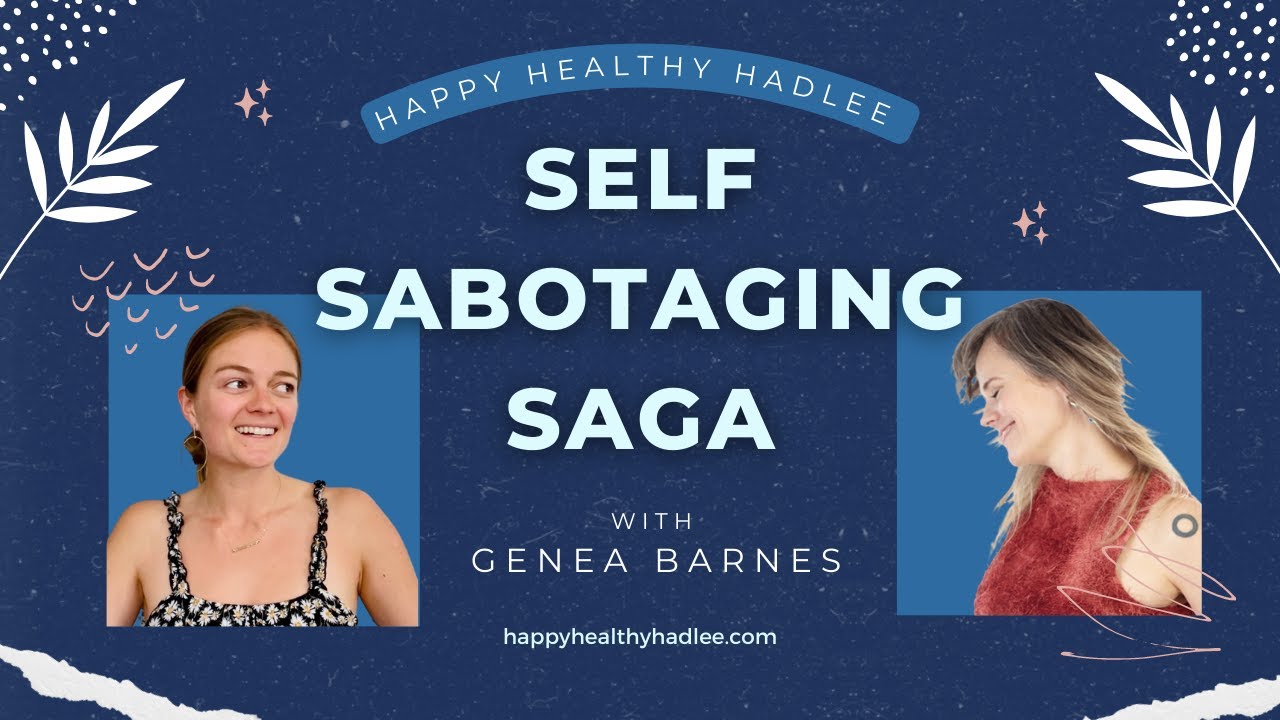
In this episode of Self‑Sabotaging Sagas host Speaker A interviews health coach Hadlee Garrison about why people repeatedly undermine their own health and how to break those patterns. The conversation moves from personal anecdotes about seasonal affect and the healing power of sunlight to deeper psychological mechanisms such as decision fatigue, subconscious programming, and early‑life conditioning that drive short‑term comfort‑seeking (e.g., food, Netflix, alcohol). They discuss behavior‑change research that shows rewards must feel immediate, and they explore practical tools for making healthy habits feel present‑focused. Hadlee introduces her Ayurvedic‑informed coaching framework, contrasting it with Western acute‑care medicine and functional medicine, and shares personal health stories about hormone/adrenal imbalance, autoimmune flare‑ups, Candida, and the Amazonian frog medicine Kambo. Both hosts emphasize the importance of “digesting” emotions and experiences physically, building resilience, and re‑wiring the subconscious so that habits persist without constant willpower. The episode ends with a pitch for Hadlee’s year‑long “Happy Healthy Habits” program and Speaker A’s 6‑month self‑worth workshop, positioning both as complementary pathways to long‑term health, self‑worth, and personal empowerment.
Chapters
Hello, everybody. Welcome to today's episode of Self-Sabotaging Sagas. We're gonna talk about health and self-sabotage around that. I am here today with Hadlee Garrison. She's a health coach. She's super fun and super awesome. So why don't you tell us a little bit about yourself?
Awesome. Hello. Thank you so much for having me on. I'm really, really excited to be here. I've been really looking forward to this. Self-sabotage is a huge piece of what I do with my clients, so I'm very excited. Yeah, so I am a health coach. I help people implement health habits and, you know, work through mindset blocks, come up with behavior change strategies that work for them in order to have a thriving mind-body even spirit, if you so choose. And really, I like to help people who tend to want to kind of get more of a control over their time, their day-to-day. A lot of times I joke that I help people with adulting because it is sort of a hard thing to do in this day and age with all of the distractions that we have going on with social media and media and the news and Netflix and all of the things. And so a lot of that has to do with self-sabotage. So that's a big piece of what I work on. A little bit more about me personally, I currently am in San Diego, which is amazing. I've been here since October. Sunshine. Yes, sunshine. Super important. I lived in San Diego, or sorry, I lived in Seattle for the past couple of years, and I'm originally from Michigan, which I'm going back there in a couple months for the summer for my wedding. So there you go, that's a bit about me.
Awesome, awesome. It's funny, we were talking about the sunshine right before this and how important it is. It's, you know, you lived in Seattle for a little while, and talk about the Pacific Northwest is that place where people get really depressed because they don't see enough sunshine. I think Portland, Oregon and Seattle both, it's something around the average days of zero sunshine is something like 280-something.
Yeah.
So imagine, imagine that for those of you that don't live in the Pacific Northwest, that the sky is completely gray and overcast for 9 months out of the year, basically.
Well, and actually it's really interesting because I looked it up with my family and my hometown. So I'm from West Michigan. Um, and I, I'm like from right on the coast of West Michigan. So we get a lot of like lake effect snow, but we also get a lot of lake effect clouds. So my hometown actually has even more cloudy days than Seattle does. So I have a lot of experience with not being in the sun. It gets a little bit better. Like I went to University of Michigan for undergrad and grad school, and it's a little bit better over there. We get a little bit more sun there than in the West Coast of Michigan. but obviously still quite cold. But yeah, it's a real thing. It's very, it's really hard to get through the winters in a lot of those places. So a lot of my clients have really found that my program has helped them kind of get through the winter blues and all of that kind of thing when they have worked with me, so. That's exciting for sure.
Yeah. Well, I can see it. I was telling you a little story about how I had this knee injury and I was basically inside for like a full year, a little more than a year. And I finally, I was craving the sun so much. It's where I discovered my little south-facing window perch. And I sit there in my bra and underwear and soak up the sun in the winter. But the first time I did it, after sitting for 20 minutes, all of my cells were vibrating. And it's— it goes more than vitamin D. I mean, I take vitamin D every day. My doctor, when they do my blood tests, they're like, wow, you're not vitamin D deficient at all. They're always surprised. But interesting. The sun has more to do with our healing power. I think there were even some studies saying that people that spent time in the sun during COVID if they had COVID, um, they healed faster. And there were definitely things back from the 1918 flu where the patients that were outside, that spent time outside, they healed faster. So there's something really important about that. And, you know, talking about getting through that seasonal affect— I always think of the Aflac duck. I'm always getting it wrong. I'm like, Aflac, seasonal Aflac disorder. But so if you're in that space and you're getting that naturally, when we don't feel good, we tend to reach for our things that give us comfort. And most of our— a lot of our things that give us comfort come from our subconscious mind. And a lot of times they are food, comfort foods, sitting in front of the Netflix and checking out all of those things. So it makes sense Scrolling. Yeah, it totally makes sense to me that people's seasonal Aflac disorder would get better if they're putting the healthy items in, because our natural inclination when we don't feel that good is to put the comfort items in, which are not always comfort for our body. They're just comfort for our mental associations and I'll talk a little bit about that, about how we anchor in those unhealthy habits and what happens in our subconscious around that.
Right. Well, and it's comforting for our mental health, but only in the short term. And then it makes it actually more uncomfortable longer term too. Yeah, totally.
I think one of the big things, Especially when it comes to health, is we all have to think beyond the short-term moment of right now. And a lot of us, if we had childhoods where we were told we were gonna get something and we didn't, if that happened, then we naturally— if it happened on a regular basis especially— we naturally have a pre-wired disposition in our brains saying, It's not going to be there later. I have to do it now. I can't look at what the bigger benefit is going to be if I wait. I have to just take what's right here, right now. It's also a survival mode thing.
Mm-hmm.
So a lot of us are running in fight or flight. So to move towards that healthier habits, we have to start thinking about what is the secondary benefit, not the benefit right now in this moment, But what's the next level?
Totally. Well, and it's interesting because in like behavior change research, the, the longer, like the further away in the future a reward will be, the less motivating it is actually. So like, so you know, this was like a classic thing that I learned in my master's in public health was like a— so you don't want to tell kids that they're going to get lung cancer if you want to tell them to quit smoking. Instead, you want to tell them like, your teeth are going to get black or whatever. You're going to have smelly hair and smelly clothes or whatever right now rather than way off into the future. the more we can bring it to like the right now or as close as we possibly can to the right now, the better it's going to be. So instead of thinking like, oh, I'm going to, you know, I want to eat healthy so that I don't get like heart disease or, you know, different diabetes, anything like that in the future. If we can actually bring it into like, okay, how am I going to feel if I eat this in 10 minutes? Right. Rather than how am I going to feel like way off into the future? And I think that there's a little bit of a disconnect in the health and wellness industry that we are like, well, don't do that because you're going to be unhealthy later on. And that's true. That's absolutely true. And for— when we're working with individuals, we can start to really like bring it, bring it as close into the, into the present as we possibly can so that that motivation continues like even when the motivation to, to be healthy like long-term isn't quite there. That part's important as well. That education piece is important as well for like especially for broader changes, but for individuals, I find that it's really effective to think about how close can we make this motivation factor to ourselves right now.
Yeah, and they say that the people that are naturally eating healthy and don't overeat and all of that, that's what they do, like instinctually. Yeah. The people that have just naturally developed those healthy habits and don't have these emotional triggers that tie into stuff, they were taught to think about like, how is this gonna make me feel? So they're gonna have that piece of chocolate cake, but they're only gonna have the little piece because they know if they have a big piece that that sugar rush is going to, if they're not addicted to sugar, is going to make them feel a little off and balanced. Like today I really wanted some chocolate chip cookies. And so I had 3 as opposed to eating the whole bag, which I used to do because I knew that, yeah, I knew that the sugar would zing me out and make me feel funky. And sometimes I'm okay with that, but I know I'm going to come down later, but I'm aware and doing it consciously versus like sugar now.
Yeah. So it's intentional. It's like, okay, I know the consequences of my actions and I'm still choosing right now to do that. And that's totally fine. Like, that's great.
Yeah. You don't want to slide into that habit. So here's the thing that I always thought, at least this only works for men. And this is actually a true thing. Um, I'm going to get a little bit graphic, you guys, but if you get really overweight, As a man, especially if you don't have a strong core, your, your organs in your body start to kind of fall. Like, you get this big belly and they start to sort of fall out and get loose. But what this actually does is it pulls up your inner, inner, like, areas around your groin. And it actually, in some ways, pulls your penis up into your body and your penis gets smaller.
No way!
Yes. So you can Google search that one.
I've been seeing there's some stuff that's been like— there have been some articles that have come out recently about this kind of thing. Really interesting. My mom actually sent me one.
Could you imagine if men were taught this in high school in their health ed classes?
That would be a motivator.
Yeah, talk about a motivator. Like, I mean, nobody wants that.
Yeah, interesting, huh?
So, and the same, same similar thing happens with women. Again, as everything gets loose and not contained and not toned, your vaginal walls are not as toned. So it's a similar, a similar kind of thing. It's like that, uh, you know, you get the smaller penis or the hot dog in the hallway. I don't know, I feel like, I feel like those— that's motivating for some people anyway. Maybe not everybody, but—
Right. Yeah, yeah. Well, and yeah, and that's— so that would be like motivating for teenagers for sure. And yeah, it's so interesting what motivates us, right? Like what different things motivate us at different points in our life and just like what kinds of things motivate us at different points in our day too. So that's a big piece too. Totally. Decision fatigue is a huge part of what I, what I talk about with my clients is like, okay, how can we actually implement these habits and automate them so that we can be as, you know, so we don't have to be motivated all the time, so we don't have to rely on willpower all the time.
Right.
So that we can like actually just do these things as part of our normal everyday life, so then we can have all of this brain capacity to be able to do all the other stuff that we want to do. I always say that like health isn't just about doing all of the habits, eating the right way, and exercising the right way, and all of the right things. I'm putting those in quotations. It's more— yes. It's more about living the kind of life that we want to live. So the WHO now does not say that health is just the absence of disease. It used to be that that was kind of the definition of health. And now they're starting to say like, no, it's actually like a whole person wellness, mental, physical, spiritual, or like purposeful, that kind of thing. And, and so how can we, how can we actually start to reduce decision fatigue, make that a part of our life, and then be able to live the kind of life that we want to live rather than just like obsessing about our health all the time? Right.
I'm actually— I'm so excited and really shocked that the WHO is actually changing the mindset because, um, we live in, of course, a Western society, and the Western mentality is wait till something goes haywire and then let's put Band-Aid on top of Band-Aid. Let me give you a pill that's gonna give another symptom and another pill that's gonna give another symptom. By the time you're 80 years old, you have, you know, your container with your 18, like, pills, then your alarm's going off all the day. You have to— oh, I have to take my blood pressure pill now, and then this, and then that. And talk about that in itself. I mean, imagine as you get older and you want to have more ease in your life, you don't want to have alarms going off every 3 hours because you have to take a pill. Yeah. Just so you can sort of feel normal. But the Eastern philosophy of medicine has always been about taking care of the health now before you have the disease, and that whole body wellness and healthness. And you do a lot of work— I know you do a lot of work with brain science stuff, which I geek out on because— Yes. I work with Shifting the brain. I work with reprogramming the subconscious. But you also do a lot of work with Ayurvedic stuff and Ayurvedic theory and philosophy.
Yeah. Yes. So the habits that I coach my clients in are based on the habits of Ayurveda. And for those of you who don't know, that is like the sister science to yoga. It's an ancient Indian health science medical system. It's genius. It's been around for thousands of years. Thousands of years. Like, think about that. The U.S. has been around for what? Like 300, 350 or something like that. Thousands of years that this has been around and has people have been using this for optimal health and well-being throughout their lives. And and the definition of health in Ayurveda actually the word is vasta. And it's a Sanskrit word. But basically, it means like health, like pure health is essentially having a thriving mind, body, and spirit. And they really bring in the spirituality aspect as well. Right. And essentially, like yoga was this like path to enlightenment. And Ayurveda was like this being able to even like get to the path to enlightenment. Essentially, it's like, okay, how do we like get our stuff in order so that we can get to the enlightenment part. Right. It's kind of like a prerequisite. And so, yeah, so the habits of Ayurveda that I teach my clients and everything are now finally being proven by modern science to be effective for all of these things, which is really exciting. We're in a pretty exciting time right now that kind of the worlds are colliding. And so I try to bring those 2 worlds together because like I said, my background is in very like Western, Westernized, like public health and biopsychology and that kind of thing from University of Michigan, which is very like, you know, modern science-based university. But then my passion lies in Ayurveda as well. And so I, so I like to bring those 2 things together and it's, it's really fun. So yeah.
Yeah. Years ago, my family started seeing this doctor in Texas. Texas, and I don't remember exactly what his name was, but they always just called him Dr. Ziploc for short. And he was, he was an OMD, a Western MD, and he pulled all of the pieces together. Absolutely. And you're seeing this more and more with functional medicine. So if you go see a functional medicine doctor, they're going to be able to pull in and really think about your overall wellness, not just I mean, you know, I went for a physical not, what, 2 weeks, 3 weeks ago? And what do they do? It's like they put you on a scale, they take your blood pressure, they take your blood, they ask you if you have any problems, they listen to you breathe, and they send you out on the way.
Right.
And then, you know, totally, I get my, I get my test results back and she looks at me and she's like, wow, these are really good.
Yeah.
But I mean, my exercise hasn't been as great as I would like it to be because I'm still tweaking out off this knee injury, but I'm on an upswing, which is great. But I've been eating clean. I take Ayurvedic herbs every day. I— so I make sure to sit in the sun, and my blood work shows that. But another thing that's interesting, years ago I had All my blood work came back and they said the same thing. You're— they're like, at that time I think I was 43, 42. I'm almost 48 now, but they were like, oh, your blood looks like you're 18 years old. But what they didn't do— I was working with— I was working with a naturopath and I'm like, something's wrong. Mm-hmm. I'm sluggish. I cannot lose any weight. Everything is off. I gained some weight from some steroids that I took for an eye infection, and I couldn't drop it to save my life. So I went and saw this naturopath, and she did tests on all my adrenals, and everything was way off. My serotonin was 6 times higher than it— no, 6 times lower than it should be. Cortisol was 6 times higher than it should be. My dopamine was 4 times lower than it should be. The norepinephrine was about 3 times lower. Estrogen was, I think, 5 times higher than it should be. And the progesterone was like, where was it?
So, okay. Yeah.
She, she looked at me and she looked at my results and said, well, you, if you had any one of these things, you would probably be gaining weight, but You pretty much can look at a donut from across the street and probably gain a pound. That's how whacked out my adrenal system was. But again, my blood work showed up like I was 18 years old. So my Western medicine doctor is just like, there's nothing wrong with you because they're not— Right. Most of them are not trained to look beyond the lab work. And if— unless they're going to do— if— unless I have now in the past, I ask them to run a panel on my adrenals just because.
Right. Yeah. Yeah. And that's like a lot of it now. And we're having so many more autoimmune issues than we've ever had in the past. And we're having so many, um, you know, so many things that have kind of been unprecedented up until this point— chronic diseases, things like that. And there's a lot of reasons for that. But we, you know, our modern Western medicine, like medical system, is great at acute care, you know, surgery, fixing like accidents, things that happen. It's, you know, it's great. And there's stuff that is missing from it. Yeah. A lot. My story is kind of— I gained probably like 20 pounds in college and started getting psoriasis all over my body, all over my face, around my eyes. Like, it was— people were like, what is wrong? Like, are you okay? All of these things. And I was on antibiotics like 3 times in 1 year because I just kept having these— There you go. Yeah, these infections and everything. So I went to my Western doctor, got like steroid cream that I believe that that also impacted like some other things poorly in my life afterwards. But I was able to, once I went through the program that I'm now certified as a health coach through that program, I, you know, I was able to manage it and essentially get rid of it. There are some days, sometimes that it'll flare up again if I don't get enough sleep or have too much stress or too much sugar or whatever. But for the most part, I've been able to like get it into, I guess you would call it like remission or whatever, through lifestyle things. And, you know, for some people it's a lot harder than for other people to do the lifestyle things, but it is what works. And so we need more of a focus on the things that really work for people. And I do think that it's starting to happen. Totally. Which I'm very excited about.
I agree. I mean, you said that right there. You're like, a few cycles of antibiotics, some steroid cream, and everything in my body is like, oh my God, Candida! You like got an overgrowth of Candida. And that happens a lot with skin problems, and the— it will manifest in skin problems. I had a period where I was having big trouble with Candida. I've had trouble with it off and on throughout my life, but it's actually— I did— are you familiar with combo?
No. Oh, like the seaweed?
No, combo is an Amazonian frog medicine. It's basically frog poison, and they like— I don't know if you can see the— let's see, can you see the little dots? Yeah, yeah.
Yeah.
So they burn your skin and then they take the little blister off and they put the frog poison on your skin and it enters through your lymphatic system and it basically kicks your entire immune system into gear at once and then it will begin to reset everything. So I did it to deal with the Candida. It actually had a lot of other benefits in healing some trauma and some triggers as well. Traditionally, they use Kambo to, like, right before a hunt because it just really clears everything up, clears up your mind, keeps you really focused. They use it to get rid of fears. Wow. But I was using it for health issues to help balance my adrenals and to get rid of the Candida. And you throw up and It's, it's, you know, it's not a pleasant experience, as you could probably imagine.
Totally.
I literally threw up a big chunk, probably like half the size of my fist, of Candida, which was crazy. Like, it must have been sitting, like, probably, as we could tell, maybe like at the top of my liver or gallbladder, like right there. So It's crazy, these stuff that— and I think— Wow. For me, I think a lot of that Candida was dormant in my body because it really flared up after I had some big, huge breakthroughs emotionally. And a lot of times when we have big breakthroughs emotionally, stuff that we've been holding tight in our body will release. And so it's like, if you've been keeping your whole life compartmentalized like this, you can imagine you're probably keeping little buggers and bacterias and stuff buried and compartmentalized too. So when you start to break that stuff open, sometimes it will just explode. It's like, oh, it's like the healing crisis. You get a little worse before you get better. Yeah.
Mm-hmm, totally. Well, and in Ayurveda, they have like known for so long that if we— so basically, like, it's all about digestion and digesting things well. And, you know, basically, like, it's like you digest your food, but you also digest everything. You digest all of the inputs from your senses, you digest your emotions, you digest everything that you experience. Experience in this life, you have to digest. So Ayurveda is all about like actually digesting all of those things. Otherwise, we have things like that that just like come up, and they could they could come up years down the road, you know, or right away, whatever. But in order to actually like have the thriving life that we want to have, we have to digest those things in the moment, or digest them. You know, we can digest them retro retroactively as well. It'll probably just take more effort than digesting them in the moment, especially if you layer stuff on top of each other. And that's fine. You just, you just, just know that, like, that's something that you have to kind of dive deep into and digest more. But it makes life a lot easier after that, for sure, to digest those things.
I love that idea of thinking of everything as digesting everything, because I work a lot with people to— I mean, we do the subconscious clearing and clear out those trigger points. And you just talked about going back in the past and clearing that stuff up. And that's a lot of what I do. But we also have to work on how to digest things in the moment, how to move those emotions through. Because every time you hold this, you— every time you hold an emotion in, you are literally keeping energy stored in your body. I like to think of one of the analogies I use a lot with emotions is every time you have an emotion, it creates a rock in your body. And if you— what do you do? Do you want to carry that rock around forever? Because it's going to be there until you actually let it move through. So sometimes when I say that to people and I ask them how many rocks are you carrying? Like, and they feel really heavy. And as people start to clear, you start to have more energy, you feel lighter when you start to clear these old emotions. When you start digesting your emotions currently, you get to literally take off the backpack full of rocks.
Yes. Oh, that's a great analogy. I love that. Yeah. Yeah. Because most people that I talked to when they come into my program, they're feeling heavy in like mind or body, either one, and just feeling like that like lethargy kind of the energy is just like downward. And, and they might feel also overwhelmed at the same time, which is really interesting. It's kind of like the like wired and tired phenomenon where people are really, you know, really overstimulated probably mentally overstimulated and then like physically understimulated. And that kind of creates this like, this wired and tired feeling of just like everything is too much and I feel too heavy and it all feels like it's like crushing down on me. And so, and that's where a lot of times you get both anxiety and depression pairing together. Totally. That's why that's so common, right, that they both go together. So yeah. Working through these things is really important, and then also putting things into place so that you can not only, you know, have the tools to work through them in the future, but also create the resilience to work through the things in the future, right? And so that's where I find that these habits of Ayurveda come in to create that resilience to be able to deal with the things that are happening in our lives. Because otherwise it's pretty hard to do if you don't have that resilience. Yeah.
Well, and one of the things you and I both do is we work with people for 6 months. And we do this because you want to create the integration. And I was reading somewhere recently, some people say it takes 3 months to create a habit. Then I was reading somewhere else to really create and wire in that habit, it takes 8 And that seems more like the truth to me. Like, if I think about, for me, when I started meditating 2 hours a day, I did it straight pretty much for 2 years. Now I fluctuate, but it's so depending on how much stuff I have— need to get done. I don't say have, but want to get done. There we go.
There you go.
And, um, but because I did that practice religiously for 2 years, that habit is ingrained in. So it's not difficult for me to jump right back in, whereas if I had only been doing it for a couple months and then I started fluctuating back and forth, it would be much more difficult to stick— to slide back into the routine. And, you know, 6 months is a good time to get a good foothold on really creating those permanent integrations, and especially when we're doing shifts with the mind. And like, I'm assuming you're working with firing those neural pathways over and over and over till you start to create the new ones that start to have the bigger grooves. And I just go into your subconscious mind and rewire that crap out.
But,
but
so both would be great.
Right. Well, the other part of the work that I do is I, you need to still create the new habits on top of clearing out the bad habits. So it's not just— so when you're tired, you don't slide so easily back into the old habits, the subconscious programming. So that's where the rewiring the subconscious, in either way you do it, is so important. Because It's when we're tired, we're depleted, we're stressed out. When those things happen, we slide back into the old programming. Consciously, we don't want to. I mean, we all know when we're walking to the refrigerator to get some ice cream because we had a bad day, or pour that drink because we had a bad day, we all know consciously Hadlee, that this is not the best choice. But there's some point in our life where it was programmed into our subconscious that ice cream— for me, it was ice cream equals love.
Yeah.
Sugar equals love. And so therefore, I've had a bad day, and when I felt the best in my life, for me, was when my grandpa and I would hang out together, and he would really listen to me and understand me and support me, and we would have ice cream together. So that is anchored into my subconscious. And so not anymore. I got rid of that anchor. That's good. Well, I, I got rid of the anchor around the ice cream part, the sugar part anyway. So, so my subconscious, when I have a bad day, it's like I want to feel that feeling. And it associates the ice cream with the feeling. And so as we— this is why we sabotage ourselves. We know consciously, you'll even be like, I shouldn't do this. You're holding it, you're the spoon, and now you're making it even worse because you're feeling guilt on top of the thing. And it just— all this shoulds, the shoulds don't serve us.
Yes. And then we should all over ourselves. Exactly. Yeah, yeah. And, and that cycle, oh my gosh, I remember like I had that cycle pretty young. Like I was using food as comfort as a kid. Um, and you know, there's, yeah, there's so much with food for sure. And that's a big piece of what I do with, um, my clients is kind of work on their relationship with food. And a lot of these habits that I coach people in help help to improve their people's relationship with themselves, their bodies, themselves, and food. Um, because a lot of times people think it's about the, like, food itself, like, I need to be eating, like, this kind of thing, or I need to not eat this, or whatever. But, like, it's not about the actual food. There's a little bit of, like, nutrition information that we— that, like, you know, I like to provide, and that's helpful for people, but A lot of the time, if there are problems with food, it's not about the actual food itself. It's about like our mindset around the food. Um, so that's huge. Yeah.
Yeah. And really understanding what each food makes you feel. As I've gotten my diet cleaner and cleaner, I've realized, I mean, I've known I'm gluten sensitive for a long time. Like I'm not going to get sick if I eat it. I'm not going to break out in hives, anything like that. But what I've discovered lately, because in the last year I've really been eating clean, is that if I eat gluten, the next day I have anxiety and overwhelm. And that is—
So interesting.
Crazy. It's like I always would— I always knew, okay, I get a little foggy head, I get a little stomachache, nothing, nothing crazy. And sometimes it's worth it. Sometimes it's totally worth it. But now with this new, like, realizing that anxiety and that overwhelm because I'm not plying myself with caffeine and amping myself up in that space, I'm much more aware of that edging up that it's causing me to do. And It's really interesting. I don't love it. So I'm gonna have to play with those moments of, is this really worth it? And going back to that idea where you said earlier, where it's like we think about how something's gonna make me feel. So we, we're used to doing this with alcohol, right? We're like, yeah, do I really want to get drunk? How much do I, how much do I like Do I have the time to be hungover tomorrow? What is on my plate tomorrow? Do I need to be focused and present, or can I just lounge around and take a day to feel bleh?
Right.
Um, so we're used to doing that with alcohol, so we have that training in us. So we can start to actually use that concept the way we think about alcohol and start to think about food that way.
Mm-hmm. Totally. Well, and a big piece of like what I do with my clients is helping them to actually discern like, okay, what is my body actually communicating with me? Right? Like, what is it actually saying? And so when we, when we are more connected to our bodies, when we're more tapped into our physiology and what our bodies are communicating, then we can actually be like, okay, my body is communicating this thing? What led to this point? And get really curious about it rather because we also, we have, we live in this like diet culture mentality where it's, yeah, where it's like, oh, like this is good. This is bad. This type of food is good. This type of food is bad. This type of health behavior is good. This type of behavior is bad. It's like Okay, what if we just took the morality out of it? Like, we don't have to assign judgment to the behaviors. We can just decide whether or not we want to do the behaviors based on how we want to feel, and that can be our compass rather than like, is this like good in the eyes of our society or in the eyes of my parents or in the eyes of whoever, you know, it is? Um, is it— does it just Does it make me feel good? Does it does it kind of bring me the life that I want to have? And so again, it goes back to like yes, I'm going to consciously choose to eat the freaking pizza sometimes because that's bringing me the life that I want to have. And if that's the case, then you know you choose that and great. You know you you have the quote unquote consequences or I guess the cause and effect we'll call it that of it and then. That's fine. And you can choose again later on if you want the same cause and effect or not. Um, and it's okay. It's all good.
Yeah. Well, it's interesting too. Like I've been working, I've been putting together this self-worth workshop and self-worth leads into so many things. So one of the things I think we do with ourselves, whether we're conscious of it or not, because again, you know, I of course am always looking at what's the unconscious programming, what's the subconscious programming, is, oh, everything's going really great, really great, I'm feeling good, I'm feeling good. And then that subconscious mindset's like, I don't deserve this, I don't deserve to feel good. So how can— what's the fastest, quickest way for me to not feel good? Oh, I'm gonna eat that cake, or I'm gonna eat those potato chips fast. Boom. Now I'm bringing myself back down to where the— what kind of feeling that I think I deserve, which is full of guilt and punishment and whatnot. And most of us are living this life where we don't believe that it's possible or that it's okay to feel good all of the time.
Yes, there's a really good book about that. Have you heard of The Big Leap?
Totally, yeah.
Okay, that one, recommend, highly recommend to everyone. It's like we all have, he talks about how we all have this upper limiting problem, and it's, we, we like, once we feel really good, we, our subconscious like jumps in, and it's like we can say, yes, I want to feel good all the time, duh, of course I do, but our subconscious is like, but I don't deserve it, or You know, I can't handle it. I can't handle feeling this good, this this much, and so it jumps in and creates self-sabotage, wreaks havoc.
Yeah.
So yeah, yeah, yeah. It's a great one.
Well, yeah, especially you know taking his what he talks about even further is that when we think about your childhood, especially those of us that had little kind of. Tumultuous childhoods. And it doesn't mean your childhood has to be that tumultuous. If you are not receiving all of the components of love all of the time, which is like protection, acceptance, understanding, support, encouragement— if you're not, if you're missing one of those moments, those things in your childhood, whether it's some of the time, all of the time, or lots of those things are missing, You are brought up to believe your, your brain is pre-programmed. Okay, I'm not going to get into the default mode network right now, but your brain is programmed from the time that you are little to believe that you cannot feel good all the time. Right. And because this is wired in, programmed into your brain, From the time you are so little that you don't trust it. You don't know. It feels uncomfortable to feel good all the time. So as you move forward, you're eating well, you're doing all the things that feel good, exercising. You're like, wow, I feel great. I'm gonna live like this forever. And then there's the part of you that's like, this can't— this can't all be true. I don't know what feels like to feel good all the time. So your subconscious mind's gonna sabotage you because you're just waiting. If you sabotage yourself, your subconscious thinks you have more control over it. So it's much easier to sabotage yourself with a little bit of food or some lack of exercise than the world coming in to squash you.
Yes, totally. Yes. Our, our, like, subconscious mind or ego or whatever you want to call it, there the main thing that it wants to do is like protect us, right? So like it's—
Totally.
We don't have to be like, oh, it's evil, like the ego is evil, or like the subconscious is like evil. Really, it's just trying to protect us. It's trying to protect us from all sorts of things and it's you know, that coping mechanism, you know, like it served us, served a purpose for a while. And like once we realize that it's not serving us anymore, we can start to do the work to, you know, break out of it and work through it. Yeah.
Yeah. You can also think of this, you guys, about— think of it like Your mom, right? Your mom— well, not everybody's mom, but a lot of people's moms are a little protective. They're trying to keep you safe. You know their intentions are good, right? Even when you're a full-grown adult, they're still telling you what they're not evil to do. They're not evil. But they're, they're trying to like keep you safe, to help you succeed, to do all of these things. Your subconscious mind is very much like that. Yeah. But just like your mom, your mom doesn't understand who you are necessarily always. Your mom doesn't understand that a little freedom is going to help you have some autonomy and grow and become the best person you can be. But the mom is trying to keep you safe, and by doing so, it's limiting you. It's keeping you in this little nest. And it's limiting you. And this is what our subconscious does. It's got the same good intentions. They're always there. It's trying to do right for us. It's not— doesn't want us to step into that uncomfortable zone of feeling good because the whole world's going to come crashing down if we actually get comfortable feeling that. You know, we talk so much about, you know, avoiding bad feelings and running away from bad feelings, but When you do that, you are also in the habit of running away from the good feelings.
Yeah. Ooh, that's good. Right? Yes, totally. Yeah, we're running away from all the feelings. I even— when you were talking about, you said like all emotions create like that rock in your body or whatever. And you said all emotions, which I thought was really interesting because it's not just negative emotions. Like, we have to feel all of them. We have to allow ourselves to also feel the good emotions.
Yeah.
Yeah, it's huge. It's huge. So important.
It's an interesting thing. If you catch yourself, like, start to really pay attention to this, catch yourselves in these moments of joy and bliss. And a lot of us, especially if we were taught to stuff our emotions, which is probably 80% of Our society, probably more. I'm being generous with that.
Oh yeah.
So you— and I catch myself still sometimes, and I've done all the work. Like, I have hardly any triggers anymore. I get excited when I find a new trigger to rewire in my brain. Like, but
I love it.
And I know, and I know how to move the emotions through, but I'll catch myself sometimes walking down street and feeling this moment of joy, and then I'll feel my shoulders like pull in all of a sudden. It's like, oh wait, no, can't, can't stuff it, keep it. It's like, oh no, take a deep breath and expand and let it flow. And when you actually really let the good feelings— when you don't punch your body or pull them into your body and you let them expand and go, all of a sudden you start getting these like epiphanies and these ideas. And this is what happens when you let stuff flow. You let the bad feelings flow. You also sometimes get epiphanies and stuff, like a trigger of like, oh, that's why I do that. So it's always breathe into those emotions, like breathe in and open up. I like to breathe into the heart because as you breathe into the heart, you As you do it more and more, you start to sync up your brainwaves and your heartwaves, and that really— it also pulls you into your body, which is where your emotions live. And you cannot clear your emotions if you are not in your body.
Mm-hmm. Yes, so true. Yeah, we have to do it through our body. And that's another piece of what Ayurveda says, is like, we have— we have to digest our emotions through our physiology. There's a quote, and I forget who said the quote, but it's like, we can't change the problem from the level of the problem. So a lot of times we try to change like our like mental things from like from the level of the mental, but really we need to drop, drop in and fix it from the level of the physical rather than the mental. Totally. Yeah, yeah,
I
love it. So good.
Absolutely. Well, speaking of the body, why don't you tell us a little bit about what you have to offer people, and then I'll tell people what I have to offer.
Yes. Yeah, so I am launching the next round of my program called Happy Healthy the habits. It's all about actually implementing these things in your life. If that sounds good and if that sounds like something you want to explore a little bit more, I do offer free 30-minute health goals sessions with people to kind of go in deeper into like what it is that you are experiencing right now, where you want to be, you know, 6 months from now, a year from now. And I actually do, I actually work with people for a full year. Oh. And so, yeah. So, so it's like It's, it's, it's a big commitment. But if, if it's something that you're like, okay, I really need to get this into place in my life, you know, for the long haul rather than just like a quick fix, you know, like 10-week thing, whatever, then I really would love to talk to you. And yeah, we'll kind of dive deeper into that and see if it's, see if it's a good fit working together. So yeah. And you can just go to my website, happyhealthyhadley.com. And you should be able to sign up for a health goals session there.
And for those of you that are only listening and not watching, the way she spells Hadlee is H-A-D-L-E-E.
Yes.
Happy, healthy, happy, healthy, happy.
It's a tongue twister.
Yes. You can also send her a DM on Instagram. Instagram. And yeah, a full year. I mean, that's awesome because some people are really ready and having that accountability is exactly what some people need. And especially not just white-knuckling through.
Yeah.
To create that big, healthy— to create so many. That's how we were taught, you know, willpower, willpower, willpower.
Right.
I'm just gonna do it through willpower. And so that's one of the things that I love about the work that I do with people is it's not about the full willpower. We actually rewire and reprogram those subconscious triggers that are pulling you back when you get tired. So it's not like you have to be on your game all of the time. A lot of times people work with coaches, and this I think it works Well, with you too, is they work with coaches for a period of time to get them to a goal. And then once they're through, they slide back and there becomes this cycle of always having to have a coach. And I think both of us are in that mindset that we want to set you free.
Yeah, exactly.
With the tools to be able to live your life. And so I teach, I actually teach people how to heal their triggers and their beliefs Like in the 3rd stage of my program. Amazing. Yeah, it's like you get to live your fullest life and you have the tools. I mean, you might need a business coach or something down the line or whatever it is, but once you have the skills to live a healthy life and to be able to identify those triggers and those self-sabotaging mechanisms and reprogram program them yourself, when stuff comes up, you can just take care of it and move forward. It's awesome.
Yes, it is. It is awesome. Yeah, I'm all about making it so that people don't have to work with me forever. It's like, let's get these things in place for the long haul, for the life.
Totally, totally.
Yes, I love it.
Yeah, so you all can reach out to me, you know, Facebook, Instagram. through my website. I do free initial consultations, like quick conversations to make sure that what you're looking for I can help you with. And then if I can, then we'll do a longer complimentary session and dig deep. But I've got the 6-month programs. I've got a self-worth workshop, which I'll tell you guys, self-worth— we talked about it a little bit— is the number one saboteur of Everything. Hit a fact.
Oh yes.
Everything. And so that's a 5-week workshop. And yeah.
Yeah, it sounds like, um, yeah, people should definitely work with both of us. It sounds like very complementary, right? It's like work through the stuff and then like get the habits into place, and there you go.
Totally. Yeah.
Yes.
It is one of those things. It's like I always feel like I'm that perfect foundational, like, first kind of coach person. I'm an elevation guide, you know, because I do a little more than traditional coaching, but I'm such a great foundation for setting you up for everything else. Like, whatever you're going to do, like, if you're going to continue working with different kinds of coaches for different specific things, getting that subconscious like wired in the way that you want it to be wired in. I mean, and here's the thing, you know, we get to keep our superpowers because our little traumas and our emotional events, they do give us strategy. They give us survival mechanisms which create superpowers. Mm-hmm. You know, that person that can multitask and do a million things all at once, We're not technically wired to do that, but because of whatever trauma you had, you learned how to do that as a coping mechanism. So you get to actually keep those skills while you get rid of the triggers that make it compulsive, which is the really cool part. I love— it's like you get to keep your superpowers. Because we do. We get superpowers from our traumas and our things that we grew up with. And, you know, there is a point we all need some, like, adversity in our life to grow. Yes. So there is, like, you've seen sometimes the people that have the most idyllic, perfect childhoods are sometimes the people that are the most messed up because they don't— they didn't have anything to push against To help them to grow. So nobody, nobody is messed up. We're all just doing the best we can. Our subconscious is being our mom, fighting for the good for us. But sometimes we have to teach our mom what is actually good for us.
Yes, I love it. Yeah, we're all doing the best with what we've been given. My dad always used to say that. So good. So good. Yeah. Awesome.
All right, everybody. Thank you guys for tuning in today, and we will hopefully hear from you. Send us messages, even if you just want to say hi. If you're watching this on the replay, leave comments. We'll get back to you on the comments. And thank you guys so much for watching.
Yay!
Awesome.
Bye!
More from Hadlee
Happy Healthy Habits: Automate Your Habits. Optimize Your Energy. Unlock Your Capacity.
Join us at the Align & Thrive day retreat Sunday 1/11 in San Diego 🩵 Comment ALIGN for the link
Fueling the Future: ESS60, Mitochondria & Mission Longevity with Chris Burres | Ep 156

Dancing Through Life: The Healing Power of Showtunes with Danella Mercati | Ep 155
From Breakdown to Breakthrough: Reinventing Life at Midlife with Wendy Valentine | Ep 154

Your Soul Wants To Be Surprised: The Good Life with Michele Lamoureux | Ep.153
BONUS EPISODE: Fawning: The Trauma Response Hiding in Plain Sight With Dr. Ingrid Clayton | Ep 152
Fall Asleep Faster, Rest Deeper & Wake Up Refreshed Using Sleep Science with Devin Burke | Ep 151

Your Oral Microbiome & Mental Health: The Overlooked Link with Dr. Namrata Patel | Ep 150
Acupuncture & Energy Flow: Unlocking the Body’s Healing Potential with Dr. Felice Chan | Ep. 149