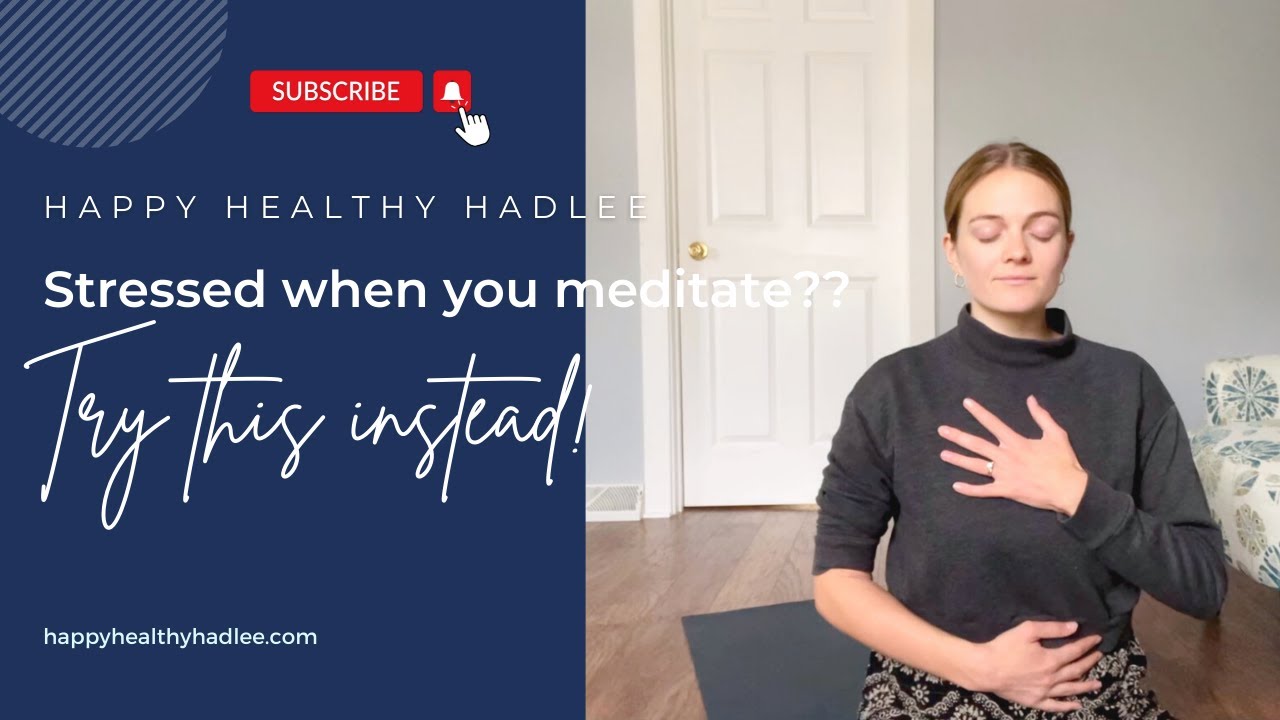
In this guided video, the presenter introduces a body‑based somatic practice designed to regulate the nervous system before entering traditional meditation. She explains that many meditation techniques can inadvertently trigger a fight‑flight‑freeze response because they do not first calm the nervous system. The practice begins with flexible positioning—any comfortable posture is acceptable—followed by an external awareness phase where the viewer scans the room, notes distances to walls, and orients themselves in space, mirroring animal instinct for safety. Afterward, the eyes may be closed or kept soft‑gazed, and the focus shifts inward: the viewer applies gentle pressure with their hands to various body parts (forehead, neck, shoulders, chest, abdomen, back, thighs) to create grounding sensations. Optional gentle swaying is encouraged if it arises naturally. The session emphasizes autonomy, encouraging participants to adjust positions or pressure to what feels safe. The guide explains how this embodied attention calms thoughts, allowing a smoother transition into meditation. She concludes by inviting viewers to use the technique in everyday moments (e.g., hand on shoulder during conversation, hand on heart while watching TV) and promotes her Happy Healthy Habits coaching program for habit formation and deeper nervous‑system regulation.
Chapters
Let's do a body-based practice together to help you regulate your nervous system. Sometimes meditation practices can actually make us feel more stressed or more anxious, and that's because the type of meditation isn't first regulating our nervous systems. So our attempts to release our thoughts or kind of detach from the thoughts in our mind can actually start to get us into a fight, flight, freeze state, can start to dysregulate us, which of course is counterproductive to the goal of meditation. in the first place. So this practice is designed to help you get into your body. It's designed to help you connect to your surroundings, your space, and it's designed to help you get into a state of nervous system regulation so that you can get all of the benefits you've been looking for from meditation but maybe just haven't quite found yet. If you haven't subscribed to my channel yet, hit the subscribe button and the bell to be notified every time I post a new video about creating a happier, healthier mind, body, and life. For the past 4 years, I've been helping people implement the habits of Ayurveda in order to feel amazing in their bodies, confident in themselves, and more joyful in their everyday lives. And having some sort of somatic experiencing practice is a really huge piece of what I do with my clients. So I decided I wanted to share one of those practices with you today so you can start to feel these benefits Let's dive in. So I'm going to have you start by getting into some sort of comfortable position. And unlike normal meditations, I'm not going to give you any cues for how you need to sit. You don't need to sit cross-legged. I have a little meditation cushion, but you definitely don't need to, to do that. You don't need to sit cross-legged. You don't need to sit with your spine perfectly straight. You don't need to really do anything. You can lie You can lie down if you want. You can stand if you want. You can do this position just lounging on the couch. You don't have to have a specific position for this practice. This is a practice to help you to feel safe in your body and to actually feel really, really good. So whatever position that's going to be for you, listen to your body, kind of tap in and see, does my body want to lie down right now? Does my body want to sit? And just do what, what your body needs. And then what I'm going to have you do is I'm not going to have you close your eyes yet. First, I'm just going to have you, if it feels okay, to start to look around the room and just allow yourself to get really curious about your space, your surroundings. Okay. Maybe you're outside and this works just as well. But just start to take stock. Where am I in space right now? And don't forget to also turn around and look behind you too. Once you've started to get curious about your surroundings, I invite you to start to sense how far away your body is from the wall in front of you. So, you know, just— you don't have to actually put a number on it or anything, but start to get a feeling for, okay, I'm like about this far From the wall. Just sense where your body is in space compared to the wall. And then you can start to notice to your left side how far away you are from the wall. You can do the same for your right side. And you're probably not right in the middle of your space, and that's okay. That's great. You're just gonna notice, okay, I'm further away from from this wall than I am from this wall. And then you can notice how far away you are from the wall behind you as well. This is something that animals do whenever they get into a new space. They start to orient themselves in space. You might notice that your dog will roam around the perimeter of a space when you walk into a room. Right. This is— we are also animals, so this is really helpful for helping us to feel safe in our bodies. And then once you have kind of taken stock, I invite you to close your eyes if that feels okay. And you can do this with a soft gaze with your eyes open if that— if having your eyes closed makes you feel more stressed. So now I want you to just start to tap into your body. We've had our awareness, our attention on the outside, on our external space, and now I just invite you to bring your awareness to your internal space. You can even sense for a moment, okay, I'm still this far away from this wall. I'm this far away from this wall. You can— there's this sense that we have of, of how far away we are from things. We have a sense of our body in space. And if there's any time that you feel like, oh, I actually feel like I'm not that comfortable this far away from this wall or with this thing next to me, please just move it. Move the thing that's next to you or move yourself in space if you can so that you do feel safe. Remember, this practice is for you. You are not a servant to the practice. Don't force yourself to do something that is supposed to be for stress regulation. Don't make yourself more stressed because of it. Allow yourself to Move to a place where you feel better. This is something that you can use in your everyday life as well. Next, I'm just going to have you press down on any part of your body that maybe feels activated right now, or that maybe has been feeling activated the past day or week. So maybe you put a hand on your heart and you just give that a little pressure, not too hard, but you're just giving it a little bit of pressure. And maybe, maybe it's not your heart. Maybe it's somewhere else in your body. Maybe it's your forehead. Something that feels really good to me is putting my hand on my forehead, my one hand on my forehead, and the other hand right behind my neck, and just kind of leaning back a little bit and cradling my head and my neck in my hands and just feeling really held there. And if that feels really good for you, I invite you to continue doing this, just holding it there. And whenever you feel a sense of completion there, like, okay, I'm ready to move on to the next thing. Then you can move on to the next thing, and that is going to be maybe you put your hand on— both hands on the top of your head and you give your, your head a little bit of pressure. And if that feels good, you can stay there. And if it doesn't feel as good, you can maybe move the positioning of your hands. Further back on your head or further forward on your head. You can tell that I'm not giving you instructions for, for something that you're supposed to do here. You get to decide. You get to have the autonomy. Maybe you place one hand on your shoulder and press down a little bit there. Or maybe you place both hands on your shoulders. You just press down a little bit, not too hard, but just enough so that it feels really good, really grounding. Allows you to feel like, okay, I'm here, I'm in my body. And maybe you, while you're here, maybe you start to sway back and forth. And this isn't something that you need to force, but if, if your body just naturally starts to do this, you can kind of sense into, oh yeah, my nervous system is feeling Is feeling a little bit more regulated. It's kind of doing this little happy little sway back and forth, or maybe it's not a happy sway, maybe it's just a peaceful sway back and forth. You're getting into your body. Maybe you place your hands on your thighs. And you press down there, or you give your thighs a little squeeze with your fingers. Maybe that feels really good, and you can stay there if you'd like. Maybe you place your hand on your stomach. This can sometimes feel not great, and so just skip it if it doesn't feel great. But maybe you place your hands on your stomach, your lower— Lower back. And maybe that feels really grounding for you. We're using our physical body, our hands on our physical body, to actually regulate our nervous systems. Maybe you place your hands on your back. Any part of your back, maybe on your lower back, and you press a little bit there. Or maybe you kind of like hug your, hug your body and place your hands on your back in that way. Often we forget that our back is back there, and it's something that we can, that we can love on a little bit. And now just place your hands on whatever part of your body feels like it needs a little bit of extra support, grounding, and allow yourself to just go with whatever Whatever you need. And it's at this time, once we've taken stock of what our needs are, kind of taken stock of and placed our hands on our body, really brought ourselves into our physical bodies, that's when we can start to feel that our thoughts slow down just a little bit. And that's when we can more naturally tap into this meditation space that So many of us are striving toward trying to like shove our thoughts aside, and this— in this space is when we can start to become more conscious of what's happening in our minds and start to slow down our thoughts and start to just allow our thoughts to pass by. A little bit easier. And so maybe you do that now. Anytime your mind attaches to a thought, just give it a little bit of loving compassion and allow it to drift on by. But if that feels like too much, You can also just go with sitting in silence and allowing your mind to do whatever it wants to do, but bringing your awareness into your body. So putting your hands on your body, bringing your awareness into your body. And if you'd like to stay here, I invite you to press pause on this video and stay here as long as you need. And remember that this is a practice that you can keep coming back to over and over again, just in normal life. You can put your hand on your shoulder when you're talking to someone else and you feel like you're a little anxious or emotional. Or out of your body. Maybe you put your hand on your heart while you're watching Netflix in the evening, or maybe you put your hand on your— the top of your head, or maybe both hands on the top of your head for a moment when you are in the bathroom at work. You just allow yourself to remember, oh yeah, I'm here. Here's my body. Here I am in space. You can also, anytime you go into new space, you can become aware of your surroundings, and that's really helpful for regulating your nervous system as well. I hope this was really helpful. I would love, love, love to hear from you. If you have any takeaways or anything, please comment below. I really do want to hear from you. And if you're interested in learning more about how to implement different habits in your life, how to implement this as a habit, this nervous system practice as a habit in your life, check out my Happy Healthy Habits coaching program. It is a group coaching program and we do all of this stuff together and we start to regulate our nervous systems so that we can have the kind of life that we really, really want to be living the kind of life and the kind of health. And so if you're interested in that, check out the description below, and I would love to have you in the program. If you're new to my channel and want to learn more about behavior change, check out this video next. And if you want more on creating a happier, healthier you, make sure you subscribe and hit the bell to be notified the next time I post another video. See you in the next one.