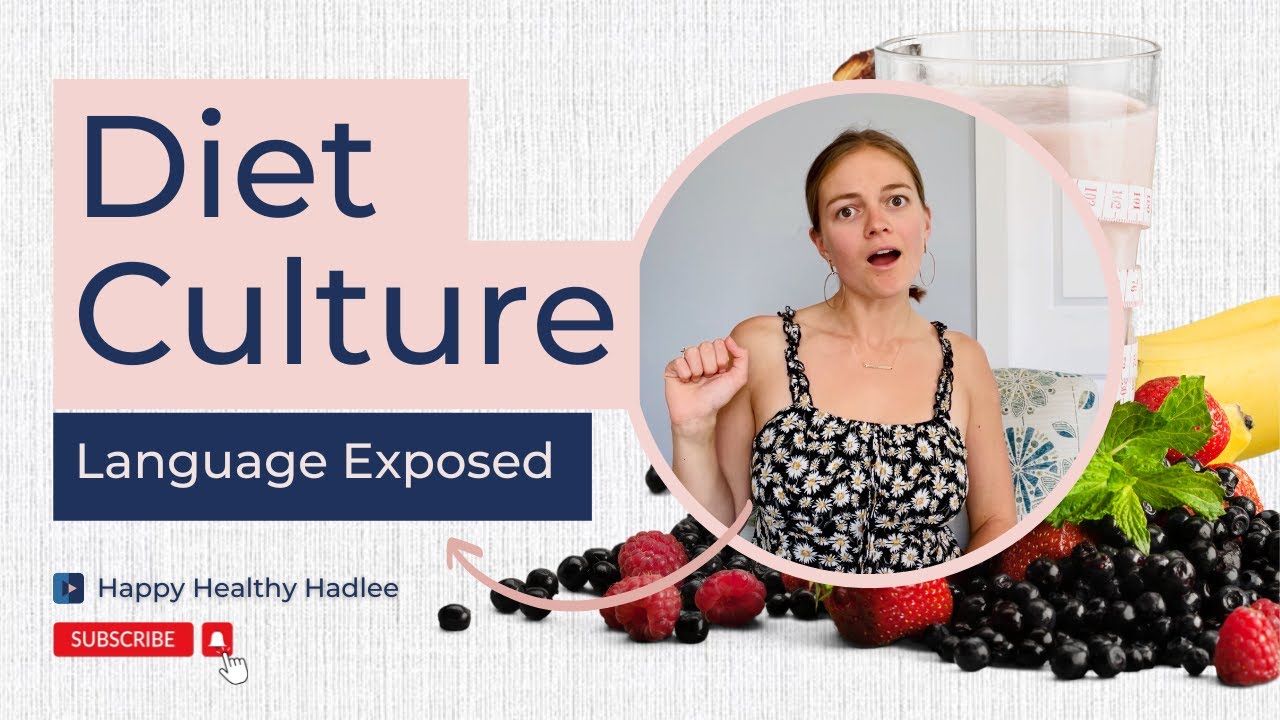
In this video, Hadlee Garrison explains what diet culture is—a societal system that equates thinness, weight, and specific foods with moral worth and health. She argues that the language we use (both to ourselves and others) assigns moral value to foods, bodies, and health behaviors, which reinforces diet culture, fuels unhealthy relationships with food, and can contribute to eating disorders. Hadlee provides a series of common diet‑culture phrases (e.g., “I shouldn’t eat this,” “cheat day,” “you’ll look good in a bikini”) and offers compassionate, neutral alternatives that focus on personal experience, bodily cues, and non‑judgmental descriptions. She emphasizes that worth is independent of weight, size, or food choices, and that adopting a non‑moral, curiosity‑driven mindset can improve mental well‑being and make health goals more attainable. The video also references Ayurveda as a holistic framework for individualized health, warns viewers about the commercial exploitation of diet culture (e.g., “guilt‑free dessert,” “fitspo”), and provides resources such as the National Eating Disorders Association helpline. Finally, Hadlee invites viewers to like, subscribe, and consider her “Happy Healthy Habits” coaching program for deeper support.
Chapters
Are you perpetuating diet culture without knowing it? Most of us know that diet culture isn't actually good for anyone, but the language of diet culture still really permeates throughout our everyday lives. So today I'm going to break down diet culture and how our language actually perpetuates it without us meaning to. Make sure you watch till the end because I'm not only going to give you some examples of common diet culture phrases, but I'm also going to give you options for things to say instead, both to others and to yourself when you're talking about or thinking about food and health. Often I have people ask me what they can say instead of some of these phrases, so this is going to be super valuable to have in your back pocket. If you haven't subscribed to my channel yet, hit the subscribe button and the bell to be notified every time I post a new video about creating a happier, healthier mind, body, and life. For the past 4 years, I've been helping people implement the habits of Ayurveda in order to feel amazing in their bodies, confident in themselves, and more joyful in their everyday lives. But one thing that was hugely, hugely important in my own healing journey, and that has been sort of my secret sauce for helping my clients get to that place as well, is breaking free from diet culture. So we can practice all sorts of amazing healing modalities, but if we do it from a place of diet culture, we're not going to get as far. We're not going to be as healthy, and we're not ultimately going to be as happy as we can be. So let's dive into diet culture so that you can start rejecting diet culture and accepting health. You may have heard of diet culture before. It's becoming more well-known in the wellness space, but we still have a lot to do to make everyone cognizant of how it actually affects us and affects our health. So diet culture is a society that values weight, shape, and size over health and wellbeing. It promotes the idea that health equals thinness. thinness, and that certain foods, certain eating patterns are either good or bad. So essentially diet culture is, well, it's the society we're currently living in when it comes to our perceptions of bodies and food and even some health behaviors as well, like exercise. In this society, we assign morality to weight, food, food behaviors, even whether a person is striving to be healthy or not. We conflate health and thinness and attractiveness and worth, but none of these things Actually make you more or less worthy. And you might think, well, of course it's good for us to be striving toward better health. But actually, I want to challenge that idea and invite you not to just take the morality out of it. So you're not better than someone else for striving toward better health, and you're not worse than someone else if you aren't striving toward better health. You might feel a lot better when you're living in a way that's healthier for you. And, you know, that's part of my goal as a health coach, to help my clients feel as amazing as possible. And, you know, have the capacity to do all the things they want with their lives. But let's just take the morality out of it. This is going to allow you to be a lot more compassionate with yourself when you feel like you're not doing things perfectly, and it will actually also help you achieve your health goals faster, more effectively, and more enjoyably in the long term. So I'm going to explain why that's the case in another video, but For now, just trust me that that's actually true. So basically here in the realm of Happy Healthy with Hadlee, your weight does not equal your worth. Your size does not equal your worth. Neither does what you eat or what you look like, or even whether you're striving for health. You are worthy regardless of all of these things, and you can still create better health for yourself without having to assign morality to it. Let's talk a little bit about how diet culture is normalized. So this happens in a multitude of ways, and the major tool for perpetuating diet culture is assigning morality. Let's take a look at some of the things that we frequently hear and say that assign morality to certain foods or bodies or behaviors. Assigning morality to these things keeps eating from being a neutral and nourishing opportunity. Assigning morality can absolutely result in Eating disorders, though, you know, that's beyond the scope of this video. Even more prevalently, assigned morality has resulted in problematic relationships with food, bodies, and, you know, other health behaviors for many people, and especially for women in our society today. So that's the realm we're going to stay in today. But please, if you do feel like you might have an eating disorder, get the help you need, please. You can start with the National Eating Disorders Association helpline, and I have a link to that below. Where you'll receive support, referrals, resources, treatment options as well. All right, back to assigning morality. Start to get really curious about how our language as a society, and maybe even your own language, perpetuates diet culture or a negative self-image for yourself or for others. And remember, you are not bad or wrong if you've used this language or played into diet culture. You've been socialized in a society where all of this is normal. So there's really no need to blame or shame yourself or blame or shame others. Rather, look at this through a lens of curiosity and compassion for yourself and anyone else who has used this language or perpetuated diet culture. So with assigning morality, we commonly assign morality to certain foods. This food is good, this food is bad. When in reality, there is no such thing as good or bad foods. Rather, foods are just what they are, and they may be beneficial or they may be detrimental to your health depending on your unique body. The day, the week, the time of year, your stage of life, the stage of the month, and so on. And that's actually where Ayurveda comes in. So if you want to take a look at that, I have more videos on that. So it's one thing to say, oh, I don't want to eat a lot of sugar because I won't feel well or function well if I eat that. And it's another thing to say, I can't eat sugar because sugar is bad. Sugar will make you fat. Sugar will kill you. Right? Those are 2 very different things. So here are some more examples of ways we think about food and other behaviors that assign morality and what So here's what we can start to say instead, both to others and to ourselves in our own minds. Number 1, I know I shouldn't eat this, but I'm totally going to. This assigns morality to the food that we're about to eat, labeling a certain food as bad and us as bad for indulging in it. So instead we might say, say the food is brownies. There's nothing wrong with brownies, but I love brownies, so I'm gonna eat this and I'm gonna savor every bite. Or maybe you say something like, brownies don't really make me feel great, so I'm gonna pass on this one. Wow, great job losing so much weight. You look so good. Here we're assigning morality to the way a person looks, right? We, we really don't ever need to comment on someone's weight. So, you know, if we want to compliment someone, which is great, we can do so about something other than maybe their appearance. Something like, wow, your joy is so inspiring and contagious. If someone said that to me, I would be so flattered, right? This not only helps us to reject diet culture, but it actually encourages us to be more thoughtful in the compliments we give to other people and ourselves. And anyone can make a comment about someone's appearance, right? But complimenting someone about something real, can really make them feel seen and appreciated. Number 3, I'm so bad, I just don't have any self-control. In this example, we're first of all labeling ourselves as bad for not having self-control, and then second of all, and perhaps more insidiously, we're actually looking at our overindulgence as a self-control problem, which is almost never actually the case. Instead, a more helpful thing to think or to say might be, Hmm, I wonder what's going on in my emotions that might have made me overindulge. Because that's actually almost what's always happening, even if you don't think you are emotional eating, right? I used to not really resonate with that term, but I was, you know, overindulging a lot. I really do encourage you to get curious about the emotions behind it if you find you're doing that as well. Well, I ruined it and I ate this thing, so I might as well eat this and this and this. And whatever. I see this one all the time, and I used to do this one all the time. When we hold ourselves to such a high standard with food that, you know, we eat something that doesn't align with our diet or just what we think of as healthy, then we just kind of throw our hands in the air and say, well, I'll start tomorrow or next week or in the new year. Again, we don't have to view any type of food as good or bad. Instead, we might say something like, oh wow, that food didn't really make me feel great. The good news is I don't have to eat any more of it and make myself feel worse. Or we could even say, yeah, that food didn't really make me feel great, and actually I don't care today. I'm still going to eat this next thing, and I'm gonna do it without any guilt. This allows us to be conscious about our food and not get into the guilt-deprivation-binge cycle. Number 5, it's my cheat day, so I can eat whatever I want. Oh man, I hear this one all the time, especially in the wellness world. But by saying that we have cheat days, we're actually assigning morality to certain foods. and essentially only allowing ourselves to eat them on days that we've assigned as, you know, being allowed to be naughty or to cheat, which is, you know, most of us think of cheating as morally wrong, right? So instead, we might say something like, well, I can always eat whatever I want, and I choose my foods based on a number of factors, including how I want to feel at any given time. When you don't look at foods as something that you have to cheat to have, you can make much more informed decisions for yourself, and you can break out of this toxic diet culture. Number 6, what, you're not gonna eat with me right now? So this phrase isn't assigning morality to a certain food, but it is assigning morality to a food behavior. And it might seem a little bit backwards, but often we get offended when someone doesn't eat when we eat, especially if we feel guilty about the thing that we're going to eat, and we think that we might feel less guilty if someone eats it with us, like a partner in crime. Crime, right? So something else that we could say or think might be, I'm hungry right now, so I'm gonna eat, but you have full autonomy over your own body and its needs. Obviously, you don't need to say this word for word to someone. That might be kind of weird. But shifting the mindset from the first phrase to the second phrase allows you to make food decisions for yourself without the need to feel guilty about them, and also allows the other person to make their own food decisions as well. Number 7. Okay, this last one is not about food, but it is definitely related to diet culture. So I hear this in workout classes where the instructor might say, oh, push harder, you're gonna look so good in a bikini this summer, or you're gonna look so great in that dress for formal, or whatever big event is coming up. What I would love to see from workout instructors is something along the lines of, Do what your body needs. This is all about feeling good. And then actually allowing their clients to listen to their bodies and, you know, do as much or as little as feels right for them within the class. Better yet, I would actually love to see workout instructors actually teaching their clients how to do that for themselves, because many of us have been kind of trained to not listen to our bodies and to listen to someone outside of ourselves. But I digress. If there are any workout instructors listening, this might be something to keep in mind, to think about. But if you are not an instructor and you're attending a workout class and something like this is said, just know that you don't have to push harder to be worthy. So push yourself if you want to, if it feels good, but know that you are not better or worse if you do. And I do want to point out, if you've thought any of these thoughts or acted out any of these behaviors, said any of these things, it doesn't mean that there's something wrong with you or that you are bad. Same goes if you've witnessed other people say or do these things as well. They are not bad. They are not, you know, wrong people. Remember, we're not into assigning morality around here, even if it's about something to do with diet culture. Diet culture also makes these patterns into a societal norm. So they're a product of our society and not necessarily an individual problem. They're also a product of diet products and businesses that really want us to feel unworthy so that we buy their products to feel more worthy or to feel good or to feel happy or whatever. Think about things like guilt-free dessert or fitspo or new year, new me. All of these things are very normalized and they're also very much designed to sell something. So it's the culture we're swimming in and it's not your fault. But the good news is we can still confront these patterns and this language individually and as a whole. And we also don't have to reject health and feeling amazing. While we reject diet culture. If you're psyched about breaking free from diet culture to live your healthiest, happiest life, hit that like button below. If this resonated with you and you want to learn how to reject diet culture for good while also implementing the health habits, behaviors, and yes, even the food choices that are going to make you feel amazing in your body and mind, check out my signature Happy Healthy Habits coaching program in the link below. This is The program that literally changes people's lives for the better and for the long haul. I'd love to see you inside. If you liked this video and you want to learn more about the Ayurveda piece of what I do, check out this video next. And if you want more on creating a happier, healthier you, make sure you subscribe and hit the bell to be notified the next time I post another video.