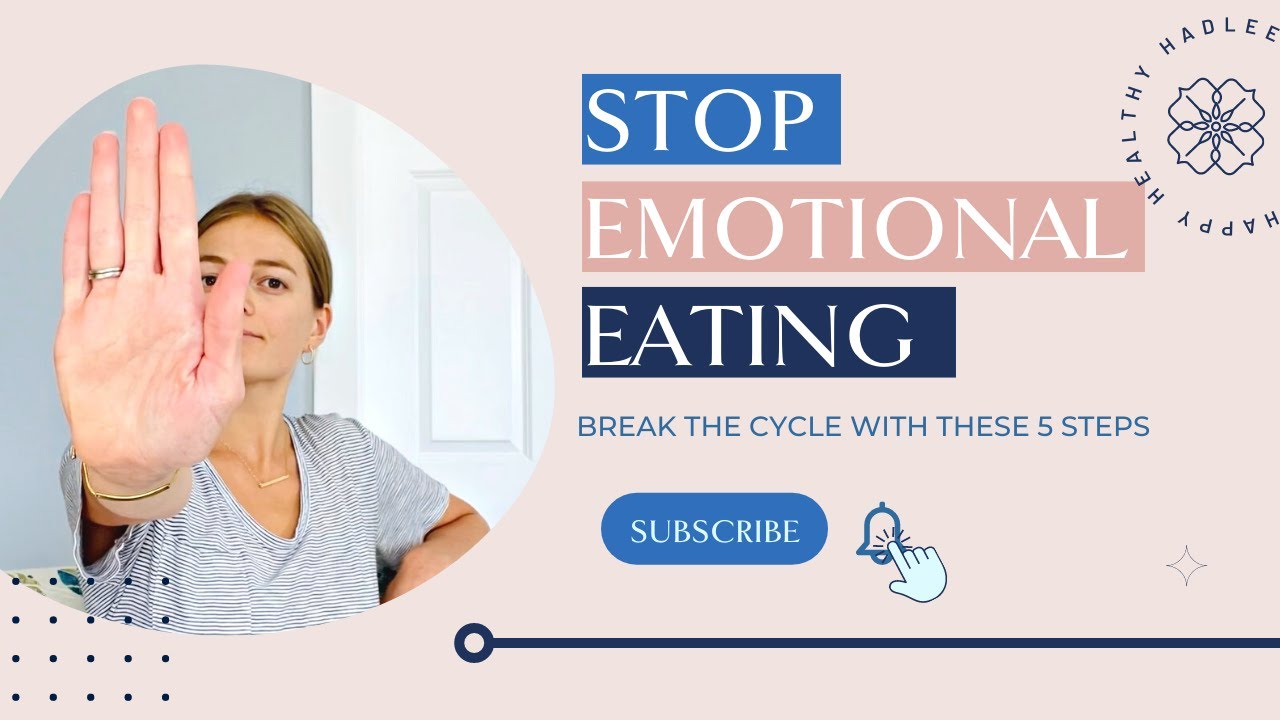
In this 12‑minute YouTube video, Hadlee Garrison explains emotional eating as a recurring five‑stage cycle: (1) experiencing undesirable emotions (including guilt/shame from past overeating), (2) using willpower to deprive oneself, (3) the desire to numb those feelings, (4) overeating as the numbing tool, and (5) the uncomfortable physical aftermath that feeds back into step 1. She argues that overeating is a symptom, not the root problem, and that common advice like “just practice mindful eating” is insufficient when the mind is driven by emotion. Drawing on Ayurveda, behavior‑change science, and psychology, she offers five corresponding “exit points” – one for each stage – to break the loop: (a) meet the initial feelings with compassion and curiosity, (b) stop the deprivation‑binge teeter‑totter by questioning true desire and examining food‑related beliefs, (c) allow oneself to feel the emotions instead of numbing them, (d) use mindful eating paired with a brief pause (breathing or a walk) to savor food and reduce guilt, and (e) treat post‑overeating discomfort with non‑judgmental body‑care (light movement, comfortable posture) rather than punishment. She invites viewers to experiment with the strategies they haven’t tried, share action steps in the comments, and consider her “Happy Healthy Habits” program for deeper support. The video blends educational content with motivational encouragement and a brief promotional call‑to‑action.
Chapters
Do you struggle with emotional eating? This is one of the biggest challenges I see for people who are trying to create a healthier, happier life. In this video, you are going to learn not only why we overeat, but actually how to break the cycle. And no, I'm not just going to tell you to practice mindful eating. So let's get into it. If you haven't subscribed to my channel yet, hit the subscribe button and the bell to be notified every time I post a new video about creating a happier, Healthier mind, body, and life. For the past 4 years, I've been helping people improve their relationship with food, their bodies, and themselves using Ayurveda, behavior change science, and psychology. Often they find that it's not actually about the food, and that's what we're going to dive into today. I do want to note that I will discuss disordered eating patterns today, so please be mindful. If this kind of talk is helpful for you, Definitely tune in. But if it is triggering for you, just maybe skip this one or save it to listen to in a safe space with people who can really support you. Let's first break down what the cycle of emotional eating actually looks like. There are plenty of models for emotional eating on the internet, and this is not the definitive one, but this is one that I've created based on the concepts I've learned from food psychology behavior change science, and also the principles of Ayurveda, as well as simply what has worked for my clients. It might feel like your overeating habit just happens and maybe that it happens pretty instantaneously, but when you break down the pattern of emotional eating, you might discover that it actually starts long before you overeat. The stage we'll start with in this emotional eating process is number 1, Feeling undesirable emotions or feelings. These feelings can maybe include sadness, might be anger or jealousy, anxiety, boredom, loneliness, basically any feeling that you don't want to feel or you don't feel like you're supposed to feel. And it's also important to note that this stage can also include guilt and shame from overeating previously. That guilt and shame can compound on whatever other emotions you've got going on, which might then lead to a bigger binge later. The next stage is using willpower to deprive yourself. Now, this one doesn't always happen. Sometimes we skip over this step and go right to the other ones. You know, we immediately want to numb out the undesired feelings with food. But for a lot of us, and especially those of us who have been prone to dieting, this stage is really a big part of the cycle. So often we don't even realize that our overeating is coming from any specific emotion, Because we've been pouring so much effort into depriving ourselves and using willpower with food. So even though this stage doesn't always play out, it can actually exacerbate this cycle and make the overeating episodes even more extreme, which is why it's so important to include when we're thinking about the stages of emotional eating and how to get out of this pretty vicious cycle. And that brings us to the next stage, which is the desire to numb those undesirable emotions that you felt in the first stage. And importantly, it's also any undesirable emotions that you picked up while you were depriving yourself in that second stage too. And that is followed by the actual overeating phase, which is the tool for numbing out those undesired emotions. And it often works, which is why we keep doing it. So back when I was regularly overeating, I was unsure if it was even caused by emotions actually, because my emotions were so numbed from the overeating. And that's when we start to think that our biggest problem is our overeating. We think that if we can just get a handle on that, then we'll finally have the body we want. Things will just be perfect. We'll feel the way we want. We think we just need more willpower, that we just need to fix this problem of overeating. But we don't realize that really, the overeating is a symptom. It's not the problem. the actual problem. It's a symptom of not allowing ourselves to feel the feelings. We may not want to feel them because we feel like maybe we'll be swallowed by them if we allow ourselves to, or we may feel like we're not allowed to feel the feelings because our conditioning has trained us to believe that those feelings aren't acceptable and we're not supposed to feel them. How many times have you been told not to cry, that everything's okay? How many times have you been told not to get so angry? How many times have you been told that you're overreacting, right? All of these things override the emotions that are okay to feel. Or my favorite one is that you control your thoughts and emotions, so just stop those negative ones. This is one I hear from well-meaning people in the wellness space a lot, but it unfortunately leads us to stuffing down our emotions or looking for ways to numb them, like with food. So we'll get into how we actually break out of that trap, but first let's dive into the last stage, which is the uncomfortable physical sensations that follow overeating. This is the overfullness, the bloating, the just sort of icky feeling that comes afterwards. It's the mental fogginess, the inability to think clearly or to feel emotions clearly, which is kind of the point. We can't think about the emotions and we can't feel feel their sensations because we're overriding them with the feeling of being overfull. But then we ultimately go back to that first step of undesired emotions because what happens after that stage? Often we start to feel guilt and shame for overeating and making ourselves feel so crappy, and those emotions are typically unwanted, so we start the cycle all over again. Now, I've just described this cycle in a lot of detail, but when it's playing out, it doesn't really feel this prolonged or like this conscious at all, right? So here's more of what it really looks like in real time. I've got a feeling I don't want to feel, but maybe I use willpower to keep myself from overeating and just deprive myself as long as I can. Ultimately, the desire to numb the emotions that I don't want bubble up and override my willpower, and then I overeat. Which then leads to those heavy, overfull physical sensations that feel really uncomfortable. And then the feelings of guilt and shame for overeating bring me back to the beginning of the cycle again, back to those undesired feelings. So this whole cycle can start with undesired feelings of any kind, but the way that it becomes a cycle and keeps going is that those undesired feelings of guilt and shame after overeating compound the other emotions and lead to all of this happening again. If you're excited about breaking free from emotional eating to live your healthiest, happiest life, hit the like button below. So what do we actually do about it? Most advice I've heard is just stop yourself when you're about to overeat, take a pause, practice mindful eating, which, okay, is definitely helpful in some situations, But it's usually unhelpful when you're in the throes of emotional eating and you're not thinking like perfectly rationally. Back when I was overeating regularly, this advice was honestly pretty annoying. I knew that I should be eating mindfully, but when I actually had an emotional eating episode, I wasn't thinking rationally or consciously. I could convince myself that eating almost an entire jar of peanut butter was totally fine. It was the natural kind of peanut butter. You know, I deserved to eat it while I watched Netflix because I had had a hard day. So sometimes practicing mindful eating works for people, and it is definitely a helpful tool, and we'll talk about it later, but it's not the only tool. So let's talk about what else we can do to break out of this emotional eating cycle. We talked about 5 stages in the cycle, and what I found from working with people on their relationships with food over the past 4 years is that there's not just one single way to exit the cycle. In fact, I've actually found that there are 5 exit points, one for each stage along the way. So if we go back to the first stage where we're feeling the feelings we don't want to feel, and especially those feelings of guilt and shame from overeating previously, we can break this cycle by actually just meeting ourselves with compassion and curiosity. And through the lens of curiosity, we can identify the specific emotions that triggered the emotional eating from before. So you can ask yourself with compassion, what actually led to me overeating? Not only does this create understanding for ourselves, but it also provides some really valuable information for what might trigger this pattern again in the future. The second exit point corresponds to the second stage in the cycle. While it might seem like we just need more control over what we're eating, that usually leads to a subsequent binge. Instead, breaking out of the deprivation-binge teeter-totter is the way to exit at this stage. I'm not suggesting that you need to eat everything in sight or say like, you know, screw it, I don't need willpower, I'm just gonna eat everything. Instead, something that really helped me and also my clients is to acknowledge that you're always gonna be allowed to To eat the thing, but then ask yourself if you really want the thing. Would you really want it right now if you were always going to be allowed to have it? And then you can make a decision from there. And also investigate any other beliefs around food that aren't serving you. Some of those beliefs are outlined in one of my videos on diet culture and how our words and beliefs perpetuate it. So check that one out. The 3rd exit point from this cycle of emotional eating is from that desire to numb stage. So here, instead of numbing out, it's time to actually allow yourself to feel the feelings. This doesn't have to look like wallowing in the feelings, or it doesn't have to look like acting on your every emotion either. Instead, a lot of times it's helpful to just set aside time to allow yourself to feel the feelings and even explore what those feelings might be telling you you need. Maybe your anger is telling you you need to establish a boundary. of some sort. Maybe your sadness is telling you that there's something that you need to release. Approach your feelings from a place of collaboration instead of trying to make them disappear, and you might be surprised at how much valuable information they hold that you were actually missing out on before when you were constantly numbing them with overeating. The 4th exit point is the one I mentioned earlier, which is mindful eating. Again, this can be a helpful way to exit this cycle, though I do suggest pairing it with some of the other exit points as well, as it's not the only way out. So the strategy here is to pause. Can you go for a walk or just take 3 deep breaths before you dive in? And then once you've taken this pause, you can practice mindful eating. Instead of like depriving yourself and just saying, I'm not going to eat it at all, you can allow yourself to eat it. But instead of just mindlessly eating, give yourself permission to really savor every bite. Take pleasure in your food. You're likely gonna eat less than if you ate on autopilot. And even if you don't, by giving yourself this permission to savor and enjoy, you're less likely to feel the guilt and shame of overeating that then leads to the cycle starting all over again. And the last strategy for exiting this cycle is that uncomfy phase when you're feeling bloated, overfull, foggy, heavy. And while this can sometimes lead to feelings of guilt and shame, the strategy here is to allow yourself to feel the discomfort without judging it as bad or wrong. And also, please don't punish yourself by making yourself feel even more uncomfortable. You haven't Sinned. You don't deserve to feel awful. Plus, the more you can work with your body instead of trying to punish yourself, the more you're actually going to be able to properly digest your food and experience fewer digestive consequences. So, you know, don't wear super tight clothes and sit in a more comfortable position. Maybe go for a light walk, but don't try to work off the calories or do anything else that might be harmful. to your body. This stage seems like it might not be that important, but building this compassion and cooperation with your body is really crucial for treating your body with respect in the future, which will lead to you breaking out of this overeating cycle. So now we've identified the stages in the emotional eating cycle, as well as all the different stops to get off along the way. You may have tried some of them in the past, But I'm really curious about the ones that you have not tried yet. Which ones can you try in conjunction with some of the ones you maybe already have that might be the secret to breaking these patterns for good? And then let me know your action steps in the comments. I would love to see. If this resonated with you and you want the support, guidance, and accountability it takes to end the habit of emotional eating for good, check out my signature Happy Healthy Habits In it, we dive deep into your relationship with food, your body, and yourself in order to come to a place of freedom with food, comfortability in your body, and also confidence in yourself. And if you want to learn more about the secret beliefs we have around food, check out this video on the diet culture language you might be using without realizing it. Thanks, Hadlee. And if you want more on creating a happier, healthier you, make sure you subscribe and hit the bell to be notified the next time I post another video. See you soon.