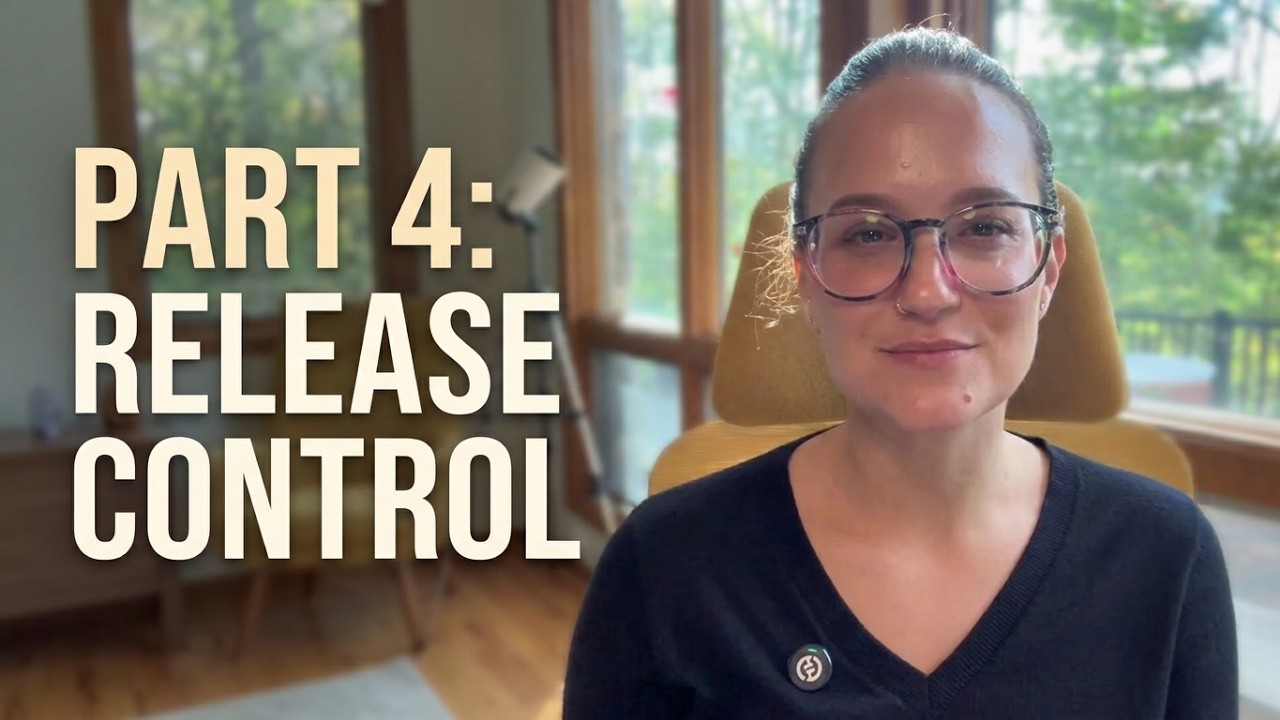
In this seventh installment of a 12‑step codependency series, Hannah Rose, LCPC, guides viewers through Step 6, which focuses on becoming fully willing to let God (or the universe, Tao) remove one’s character defects. She begins by reframing the harsh language of “defects” and “shortcomings” as “wounds,” encouraging a shift away from shame‑based self‑identification. Drawing on her own experience as a therapist in an inpatient substance‑use program, she explains how burnout and a sense of powerlessness drove her to the steps. Rose clarifies that Step 6 is distinct from Step 7: it is about readiness to release old patterns, not yet about actively practicing new behaviors. She ties this readiness to her spiritual beliefs (Tao, nature, the universe) and the internal feeling of alignment that signals being on the right path. The talk explores common fears that block letting go—fear of loss of identity, fear of success, and the pull of enmeshment—using probing questions to help viewers assess their own barriers. Practical tools are offered, including journaling prompts and a recommendation of Melody Beattie’s work (especially “The Language of Letting Go”). The video ends with a call to reflect on readiness to surrender control and a preview of Step 7.
Chapters
Hey everyone, and welcome back to Day 7, Step 6. Now, if you've been doing one of these a day, that means that this marks a week of being together. And I know that I'm recording this here and now, but whatever moment that you are in, you're also in the here and now. And that makes me feel like we are together. And maybe no one will watch this course, but it really helps me deepen my relationship with the 12 steps. Specifically through the codependent lens. So step 6 is— we've got our book— we're entirely ready to have God remove all these defects of character. Now, defects of character may sound harsh. In the 12 steps, some of the language can be harsh. It's, hey, where are my defects? Where are my shortcomings? And the 12 steps really teach us to look at our part. And again, not in a shaming way to say, oh, something's wrong with me, but in a realistic way. So I can say, oh, my part is that I have a tendency of people— to people-please. Notice I didn't say I'm a people pleaser, or I'm codependent, or I'm bad at boundaries. No, that could be a defect of character if we strap our identity to some finite narrative. What about, I've historically people-pleased, or I'm working on setting boundaries, which have been hard for me in the past. When I change the narrative just a tiny bit, it opens the door for change instead of, oh no, that's just who I am. Me, I don't do boundaries. You're never going to be able to set boundaries if you keep telling yourself you can't set boundaries. So we're entirely ready to have God remove all of these defects of character or all of these shortcomings. I have heard Melody Beattie, who's the author of this book, in some of her other books refer to shortcomings and character defects as wounds because she says we're not defective, we're wounded. And I really, really like that because I think as humans we have a tendency to flock towards anything that brings us shame. We will find one example of here's a reason I should feel shame and then grab onto it. And so anything that is shame fodder to me, I'm wary of. And so if the language character defects or character shortcomings instills some shame in you, change the wording. Oh, these are some of my wounds. My wounds have historically led me to be people-pleasy. And not set boundaries and try to save everyone. I became a therapist, and that fueled my desire to save everyone. And I didn't start working these steps until I was working at an inpatient substance use rehab up in Maryland. And I had a lot of patients who did well and got sober, and they're still sober today. And I had a lot of patients die. And it was my feelings of unmanageability and complete burnout and fear and powerlessness and loss of control that led me to start working steps in CODA as well as Al-Anon, on top of the 12-step fellowship I had been in since 2011. And so for me, I needed to reach a pain point. I needed to reach a level of complete burnout to give me that gift of desperation, of being willing to try anything. And maybe you're there now, and if you are, you're not alone. It's really hard when we are humans on this plane of existence and we care about people and we love people, but we may be hurting and dying inside as a result of overstepping where our responsibility ends and someone else's begins. And so again, I really recommend this book. Melody Beattie also has a daily reader in print and an app called The Language of Letting Go, and that was really helpful for me. So every day of the year is just one short reading. I really loved that. So step 6 is about willingness to change. Now steps 6 and 7 often get lumped together, but they are 2 distinct Distinct separate steps. Step 6, we're entirely ready to have God remove these defects of character. So what is it I believe in again? Let's come back to 2 and 3, right? I believe in the Tao, in the universe, in nature. Am I ready to get out of my own way And allow nature to take its course and allow the universe to heal and for things to be exactly as they are. I believe that when I turn things over, I'm able to deeply identify a feeling of alignment in my gut, and that's how I know I'm on the right path. I can feel very easily when something doesn't feel aligned. So step 6 The question really is, am I entirely ready to release some of these patterns of behavior? And I think another question also is, what am I afraid of? So sometimes it's less about how do I let go, and it's more about what is blocking me from letting go— fear, pain. The feeling of powerlessness that many of us don't want to feel, although there can be a lot of freedom and surrender in remembering, oh my God, this was never mine. I say that often— that's not mine. You know, I care that this person is going through something, and that's not mine. I can show up, but I also have boundaries because that's not mine. I know a lot of people say, not my circus, not my monkeys. And that can sound callous if we're used to being enmeshed in the lives of others, but where is the line? And again, coming back to step one, where is my life unmanageable because I'm overstepping, because I'm trying and trying and trying to no avail with no results? How much of my identity and my ego structure is wrapped around being needed and being helpful? Just some things to think about. So step 6, ask yourself, am I ready to let go? Am I ready to release that which I've been gripping? And what am I afraid of? Again, a lot of these steps can feel abstract, but there are so many questions to help illuminate where we're at in this process. Am I entirely ready To allow the universe to heal me. Oftentimes we are full of suffering, and what we never stop to think about is maybe we're actually afraid of, who would I be without this suffering? Like, oftentimes we think we feel failure, but subconsciously we can really fear success. Who will I be? What will I be like? And so, with this step, you can journal. I've asked a lot of questions in this video. You can just sit and allow the dust to settle in your brain and see what's there. Am I entirely ready to have God, the universe, the Tao remove that which is blocking me from it? Am I ready? That's the question. See you tomorrow for step seven.