45 PSM Level I Exam Questions
Walkthrough of 45 PSM Level I exam practice questions covering Scrum concepts like Sprint Planning, Definition of Done, team roles, and scaling. The presenter reads each question, gives the correct answer, and explains the reasoning behind it.
Chapters
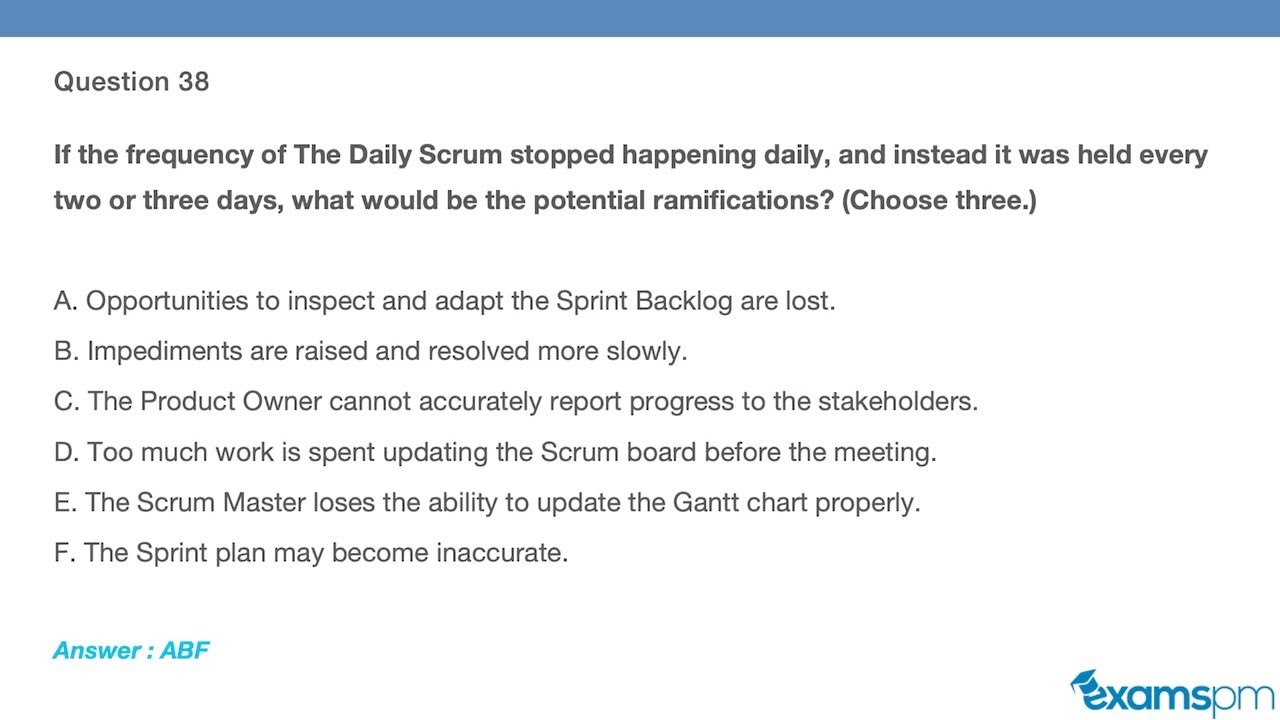
In this video, we will cover 45 PSM 1 exam practice questions. Feel free to pause the video if you need more time to complete each question. If you like videos like this, make sure you hit the subscribe button. Question 1: Should multiple Scrum Teams working on the same product combine all their increments at the end of each Sprint? A. Yes, but only for Scrum Teams whose work has dependencies. Yes, otherwise the Product Owners and stakeholders may not be able to accurately inspect what is done. No, each Scrum Team stands alone. No, that is far too hard and must be done in a Hardening Sprint. Question 2: When is it appropriate for a Development Team to terminate an active Sprint? It can't. Only Product Owners can cancel Sprints. When functional expectations are not well understood. When the Product Owner is absent too often. When the selected Product Backlog items for the Sprint become unachievable. When a technical dependency cannot be resolved. Question 3: What is the primary output from Sprint Planning that supplies the Development Team with a clear, focused direction for their given Sprint? The sprint backlog. The sprint goal. The release plan. Sprint review minutes. Question 4: How does a development team handle non-functional requirements for the most effective results? Ensure every increment meets them. Make sure the release department understands these requirements. But it is not the Development Team's responsibility. Handle them during the Integration Sprint preceding the Release Sprint. Assign them to the lead developers on the team. Question 5: When should you declare a Sprint complete? When the Product Owner says it is done. When all Product Backlog items meet their Definition of Done. When all the tasks are completed. D. When the timebox expires. Question 6: Scrum has a role called Project Manager. A. True. B. False. Question 7: What are 2 successful strategies for the Scrum Team to make non-functional requirements noticeable and apparent? Put them on a separate list on the Scrum Board available for all to see. Add them to the Product Backlog to ensure transparency. Run the integration and regression tests before the end of the Sprint and capture the open work for the Sprint Backlog of the next Sprint. Add them to the Definition of Done so the work is taken care of every Sprint. How long should teams set aside before beginning the next sprint to ensure a successful transition? The break between sprints is timeboxed to 1 week for 30-day sprints and usually less for shorter sprints. Enough time for the requirements for the next sprint to be determined and documented. Enough time for the development team to finish the testing from the last sprint. None. A new Sprint starts immediately following the end of the previous Sprint. All of the above are allowed depending on the situation. Question 9: During Sprint Planning, the Product Owner and the Developers are experiencing difficulty in finding consensus on what should be given priority for upcoming Sprints. Consequently, Developers can't accurately predict how many items to include in their forecast. Despite these obstacles, though, they can agree upon a joint goal for this particular Sprint. Which of these potential actions should be endorsed by the Scrum Master? Choose 2. Cancel the Sprint. Send the entire team to an advanced Scrum training and then start a new Sprint. Forecast the Product Backlog items that are most likely to meet the Sprint Goal and create the Sprint Backlog. Conclude Sprint Planning and start the development work. Continue to analyze, decompose, and create additional functionality during the Sprint. Continue the Sprint Planning event past its timebox until an adequate number of Product Backlog items are well enough understood for the Developers to make a complete forecast. Then start the Sprint. During the next Sprint Retrospective, discuss why this happened and what changes will make it less likely to recur. Ask everyone to take as much time as needed to analyze the Product Backlog first, and then reconvene another Sprint Planning meeting. Question 10: Who has the authority to terminate a sprint? A) The Scrum Team. B) The Scrum Master. C) The Product Owner. D) The stakeholders. Question 11: What are the critical elements of Scrum? A) Sprint Retrospective. B) Members must be stand-up at the Daily Scrum. Sprint Burndown Chart. Release Planning. All of the above. Question 12: How does a Sprint Review benefit your business? To take time to judge the validity of the project. To inspect the product increment with the stakeholders and collect feedback on next steps. To review the Scrum Team's activities and processes during the Sprint. To build Team Sprint. Question 13: Who holds the authority to modify the Sprint Backlog during a Sprint? The Project Manager. The Development Team. The Scrum Team. The Product Owner. Question 14: Who is required to be present for the Daily Scrum? A. The Scrum Master and Product Owner. B. The Development Team. C. The Development Team and Product Owner. D. The Scrum Team. E. The Development Team and Scrum Master. When does the Development Team assume responsibility for a Sprint Backlog item? Choose the best answer. A. At the Sprint Planning meeting. B. During the Daily Scrum. C. Never. All Sprint Backlog items are collectively owned by the entire Scrum Team. D. Whenever a team member can accommodate more work. The objective of a sprint is to deliver a valuable functional increment. A, true. B, false. Question 17: Who holds the authority to create the Definition of Done? A, the Scrum Master, as he/she is responsible for the Development Team's productivity. B, the Scrum Team, in a collaborative effort where the result is the common denominator of all members' definition. The Product Owner, as he or she is responsible for the product's success. The Development Organization, or Development Team if none is available from the Development Organization. Question 18: As 5 new Scrum Teams have been formed to bring one product to fruition, a few developers from one of the teams approached their Scrum Master for guidance on how they might coordinate their work with the other groups. To answer these inquiries, what should the Scrum Master do? Teach the Product Owner to work with the Lead Developers on ordering Product Backlog in a way to avoid too much technical and development overlap during a Sprint. Teach them that it is their responsibility to work with the other teams to create an integrated Increment that is inclusive of all 5 teams' work. Collect the Sprint Tasks from the teams at the end of their Sprint Planning And merge that into a consolidated plan for the entire sprint. Visit the 5 teams each day to inspect that their sprint backlogs are aligned. Question 19: What are the 2 most crucial tasks that the development team should prioritize in their first sprint? Choose 2. Make up a plan for the rest of the project. Analyze, describe, and document the requirements for the subsequent sprints. Develop at least one piece of functionality. Analyze, design, and describe the complete architecture and infrastructure. Create an increment of potentially releasable software. Question 20: What are 3 ways Scrum promotes self-organization? By not allowing documentation. By the development team deciding what work to do in a sprint. By preventing stakeholders from entering the development room. By removing titles for development team members. By being a lightweight framework. Question 21: What is the most important issue when multiple development teams are collaborating on one product backlog? Minimizing dependencies between teams. Clear definition of requirements. Meeting original scope projections. Making sure there's enough work for everyone on every team. Maximizing velocity. Question 22: What does it mean to define a timebox when discussing an event? The event must happen at a set time. The event must happen by a given time. The event must take at least a minimum amount of time. The event can take no more than a maximum amount of time. Question 23: As Scrum teams continue to mature, what should be the anticipated result? They will improve their Definition of Done to include more stringent criteria. The sprint retrospectives will grow to be longer than 4 hours. There is no need for a time-boxed sprint. Sprint reviews will no longer be needed. A Scrum Master is no longer needed since they are a mature team now. Question 24: What is the required timeline for each increment to be released by a Scrum Team? When it makes sense to release it. When the Scrum Team finishes their work. Whenever the product is free of defects. After every Sprint, without exception. Question 25: True or false, a properly functioning Scrum Team will have at least one Release Sprint and may well have several. True. False. Question 26: True or false? Scrum is a comprehensive approach to software development, outlined in intricate detail and geared towards building products step by step. True. False. Question 27: What is the responsibility of a Scrum Master? Managing the performance of the Scrum Team. The meetings and the objectives that a Scrum Team sets for itself. The Scrum framework being adopted and used properly. Keeping track of resource allocation. Question 28: The Developers want the Product Owner to rearrange their backlog as they are currently awaiting an external supplier for a necessary component. If this part does not arrive soon enough, there will be insufficient work in the next sprint to keep everyone occupied. As Scrum Master, what advice would you provide? A. Remind the Product Owner that his primary concern is the flow of value reflected in the ordering of the Product Backlog. B. Tell the Product Owner to reorder the Product Backlog so the work involving the external component can be planned in a separate sprint. C. Tell the Product Owner that the Product Backlog should be ordered to maximize utilization of the Development Team. Question 29. As the sprint planning meeting advances, it becomes evident to the development team that their workload is too demanding. What 2 actions can they take in response? Choose 2. A. Recruit additional development team members before the work can begin. B. The development team ensures that the product owner is aware, Starts the sprint and monitors progress. Cancel the sprint. Remove or change selected product backlog items. The development team works overtime during this sprint. Question 30: As it stands, your development teams are structured to focus solely on one layer, such as front-end, middle tier, back-end, and interfaces. If you're contemplating transitioning away from these component teams in favor of feature teams, there are 3 things worth considering. Choose 3. You cannot do Scrum without feature teams. Productivity may suffer when making this kind of move. Getting support from the business side first helps. Feature teams have less communication overhead. With feature teams, it is easier to calculate the productivity per team. Question 31. When should new work or further decomposition of existing tasks be added to the Sprint Backlog during a Sprint? When the Product Owner identifies new work. As soon as possible after they are identified. When the Scrum Master has time to enter them. During the Daily Scrum after the Development Team approves them. Question 32: What is the primary purpose of having a Scrum Master attend the Daily Scrum? A. To gather status and progress information to report to management. B. To write down any changes to the Sprint Backlog, including adding new items and tracking progress on the Burndown. C. They do not have to be there; they only need to ensure the Development Team has a Daily Scrum. To make sure every team member answers the 3 questions. Question 33: Your management has instructed you to begin using Scrum for your 6 teams who have been utilizing a traditional method to deliver products. In the initial project, there was an individual plan and team assigned for each layer of software systems such as front-end, middle-tier, back-end, and interfaces services, which is called component teams. However, you've also read that organizing by features can be beneficial too. So what are the advantages of sustaining this type of component structure while introducing Scrum? A, there's less initial disruption than organizing into new teams. As they start, they will discover what works best and how to potentially reorganize towards this. B, component teams generally have the skills needed to create a working increment of software that provides business value. Because they have worked together for some time, they are likely able to start producing shippable increments faster than new feature teams would. There are fewer cross-team dependencies than working in feature teams. Question 34: In the event of multiple Scrum teams collaborating to manage a shared product backlog, how can we effectively choose which items will be addressed? The Scrum Team with the highest velocity pulls Product Backlog items first. The Development Teams pull in work in agreement with the Product Owner. The Product Owner should provide each team with its own Product Backlog. Each Scrum Team takes in equal numbers of items. The Product Owner decides. Question 35: How frequently should the members of a Scrum Team be modified? As needed, while taking into account a short-term reduction in productivity. Never, because it reduces productivity. As needed, with no special allowance for changes in productivity. Every Sprint to promote shared learning. Question 36: Who is responsible for ensuring that each member of the Scrum Team completes their duties during a Sprint? The project manager. The product owner. The Scrum Master. The Scrum Team. All of the above. Question 37: Under what circumstances should a development team alter the Definition of Done? During sprint planning. Prior to starting a new sprint. C. During the sprint retrospective. D. Prior to starting a new project. Question 38: If the frequency of the daily scrum stopped happening daily, and instead it was held every 2 or 3 days, what would be the potential ramifications? Choose 3. Opportunities to inspect and adapt the sprint backlog are lost. Impediments are raised and resolved more slowly. The Product Owner cannot accurately report progress to the stakeholders. Too much work is spent updating the Scrum Board before the meeting. The Scrum Master loses the ability to update the Gantt chart properly. The Sprint Plan may become inaccurate. Question 39: Which of the following best represents Scrum? A, a defined and predictive process that conforms to the principles of scientific management. B, a complete methodology that defines how to develop software. C, a cookbook that defines best practices for software development. D, a framework within which complex products and complex environments are developed. Question 40: What Scrum values are shown when you don't create Product Backlog items that have little business value? Choose 3. A. Economic Value Added. B. Respect. C. Focus. D. Earned Value. E. Courage. Question 41: Who is tasked with estimating the Product Backlog item? The Development Team after clarifying requirements with the Product Owner. The Product Owner with input from the Development Team. The most senior people in the organization, including architects and subject matter experts. The Scrum Master. The Development Team alone. Question 42: Who is responsible for initiating the Daily Scrum? The person coming in last. This encourages people to be on time and helps to stay within the timebox. Whoever the Development Team decides should start. The person who has the token. The Scrum Master. This ensures that the Development Team has the meeting and stays within the timebox. The person who last broke the build. Question 43: As the Scrum Master, you are responsible for assisting your newly formed team in getting organized and ready to work. 3 activities that could help jumpstart their productivity include: Choose 3. A. Introduce a bonus system for the top performers in the team. B. Have the Scrum Team members introduce themselves to each other and give a brief background of their skills and work history. Have the Development Managers for each Development Team member introduce their direct reports and go over their responsibilities on the Scrum Team. Ensure the Scrum Team members have compatible personalities. Ensure the team understands they need a Definition of Jira Donegore. Ask the Product Owner to discuss the product or project, its history, goals, and context, as well as answer questions. Question 44: Which 3 phrases best describe the purpose of a Definition of Done? Choose 3. A. It controls whether the developers have performed their tasks. B. It provides a template for elements that need to be included in the technical documentation. C. It creates transparency over the work inspected at the Sprint Review. D. It tracks the percent completeness of a product backlog item. It guides the development team in creating a forecast at the sprint planning. It defines what it takes for an increment to be ready for release. Question 45: How does technical debt impact transparency? Choose 2. When calculated and estimated, the total amount of technical debt shows exactly how long until the product owner can release the increment. It leads to false assumptions about the current state of the system, specifically of an increment being releasable at the end of a sprint. As development progresses and code is added, the system becomes more difficult to stabilize, which results in future work being slowed down in unpredictable ways. It enhances transparency for the product owner as a development team is not allowed to do additional feature development in a sprint as long as there is technical debt.
More from Helena


How to Use Claude Code to Get UNLIMITED Leads in 6 Mins | Best Lead Scraping Tool



These AI Videos Has 21.5M Views — Here's the Exact System (Fable 5 + Higgsfield)




NotebookLM 2.0 Update: Analyze Your Entire Business in Minutes! (Full Tutorial)

