Building Businesses with Integrity: How AI is Revolutionizing Entrepreneurship
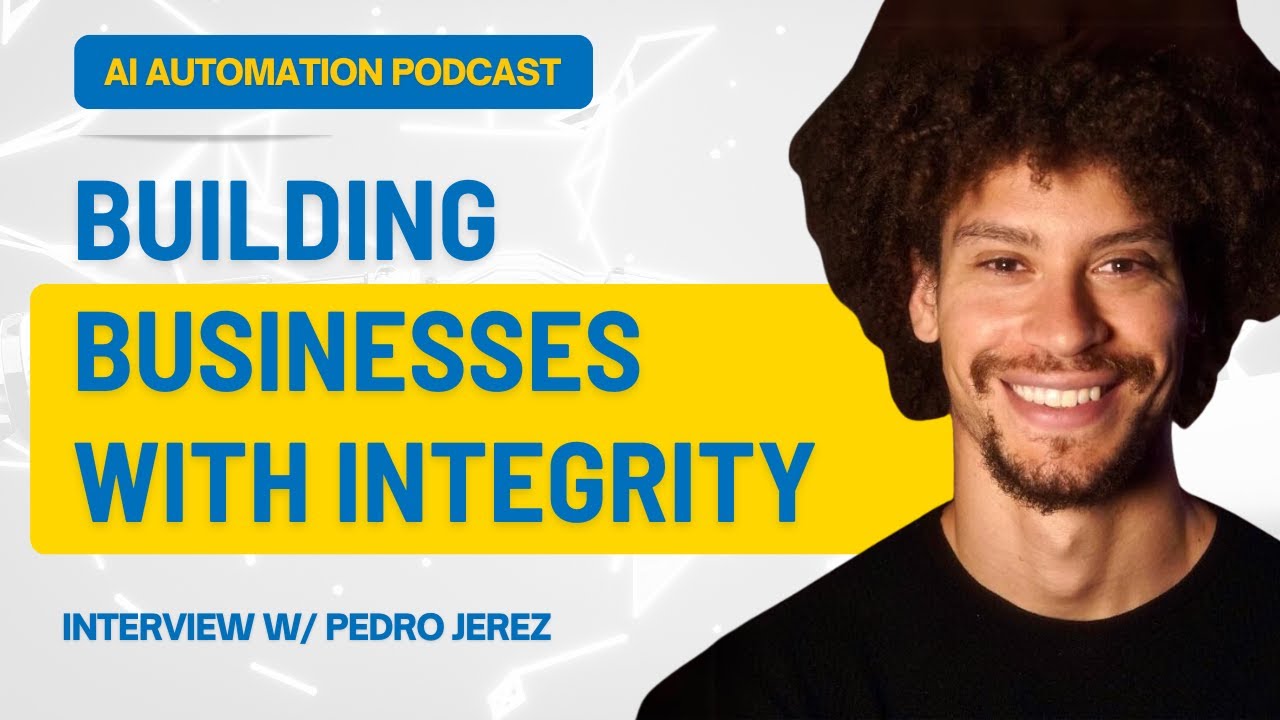
In this AI Automations Podcast episode, host Helena Liu interviews Pedro, founder of Business with Integrity, about his personal journey from a childhood obsession with wealth to realizing the emptiness of profit‑only success and the need for integrity in business. Pedro defines "visionary entrepreneurship" as aligning personal purpose with a company’s mission, citing role models like Yvon Chouinard of Patagonia. He explains how AI, especially ChatGPT, helped him craft a 32‑page vision document and now powers his company’s strategy, marketing, customer service, and investment decision‑making. Business with Integrity is built around three pillars: a world‑class education platform, a mental‑health impact fund (30% of profits), and an impact‑driven investment fund. Pedro outlines how core values are translated into daily behaviors, how he recruits a diverse, “unemployable” team, and how a flywheel of education, impact fund, and investment fund creates growth. He shares a practical framework for founders to develop a compelling vision by starting with a core offering and expanding outward, using curiosity and market‑building examples like Uber. Pedro’s investment philosophy focuses on impact‑driven companies with high integrity, citing research that such firms outperform the S&P 500. AI is central to his workflow: it drafts vision materials, acts as a thought partner for personal and business decisions, and runs AI‑agent customer‑service teams that dramatically reduce human staffing while improving response quality. The episode concludes with Pedro’s overarching goal: to be a guide and catalyst for entrepreneurs who want to uplift communities, lead markets, and reduce human suffering through mental‑health initiatives.
Chapters
Hey, everyone, and welcome back to the AI Automations Podcast. I am your host, Helena, and today we have a very special guest with us, Pedro, and he has started many, many businesses. And most recently, he has left his real estate business, which he was really successful at, to start a business called Business with Integrity, because he believes that you don't want to do business alone. And his mission is to help entrepreneurs and business leaders to change the way that that business is done so that they can grow and scale their business in meaningful ways. So welcome, Pedro, to the podcast. It's really great to have you here.
Yeah, thank you so much, Helena. Excited to be here.
Yeah, as we get started, do you want to tell us a bit more of what inspired you to start Business with Integrity and how it reflects your personal values?
Yeah, for sure. I think to understand why I started Business with Integrity, I think it's important to understand kind of the arc of of my journey. When I was 5 years old, I was walking through the MGM casino with my dad, and we were wearing matching suits. Think like classic Men in Black. And he escorted us to where the grand prize of the casino was being advertised, and it was literally $1 million in cash. Now, I grew up In the Bronx in New York City. And I had never seen that kind of money in my life. But that day I just got very excited. And I look at my dad and I can see how excited he is. He can see how excited I am. And I kid you not, at 5 years old, I told him, I said, I'm going to be a millionaire. And this was the beginning of an obsession with building wealth. And fast forward in my life, at the time I was 25 years old, that came to life and my dad was there to ultimately witness it. And it was only after getting what I thought I wanted that I realized that it's not really what I wanted. And I actually felt quite empty and all these different things. And I started asking myself, that was the beginning of a very deep exploration in my own life of like, you know, how did I get here? Um, and what I realized was that there were some things really fundamentally wrong about how I was approaching my life. Um, and I started seeing the decisions that I was making in my own life that weren't in integrity, um, in the ways in my business that I wasn't in integrity, and then just like seeing the broader business world in the ways that so many people were taking shortcuts along their journey. And I just decided I didn't want to be a part of that anymore, and I wanted to stand for something greater. And then that's essentially when an obsession really started for me to show up in a different way, to find people who were amazing role models who were not only showing up in integrity, but who were leading the way and We're showing that business can stand for something more than just making money, that they can actually make a meaningful difference on the people's lives that they serve and even the greater world.
And I think you, you use a term called visionary entrepreneurship a lot. So can you define that term? And who are some of your role models in, in the space? And how are you like creating this culture that reflects your new values?
Yeah, I mean, visionary— to me, what a visionary entrepreneur means is someone who understands not only why they are alive as a human being, but why the entity that they're creating and stewarding, why that exists in the first place. And when I see entrepreneurs, or literally anybody for that matter, who has lost the love for what they do and aren't as engaged by what they do, that is a classic signal of lacking vision in their life, that their business is lacking vision, and therefore it's not compelling to them, it's not moving them, it's not engaging their team. They're not able to attract the kind of people they want to attract. And so for me, a visionary entrepreneur, someone who's willing, who's able to see far enough out to see where the ship is going even before it even gets there. You have Elon Musk saying, talking about becoming multiplanetary, right? You talk about moving. He also talks about moving to sustainable energy. Like, he has a vision and people get to orient it to that vision. It's an exciting vision. It's a reason to get up every single day. And do the work that he's called to do. And I think this kind of brings me to kind of some of the heroes in my life. I would say probably at the top of the list is a man called Yvon Chouinard, who started Patagonia. And I think what resonates so much with me about who this person is, is that he basically looks at the status quo and asks himself, does it have to be that way? And most of the times the answer is no. And what's so cool about entrepreneurship is you get to do it your way. Now, doing it your way might be harder. You might have to innovate. You might have to ask deeper questions about things that people are okay dismissing and bypassing because it's easier to do so. And here's a man who's had the courage to bring light to the things that he doesn't like about his industry and actually have the courage to do something about it. Right. And he's literally changed the business world forever as a result of it.
Yeah. And shifting the conversation a bit to AI, how does AI play a role in your vision and how do you plan to use AI in your business?
So fascinating. I have a 32-page vision document of my vision for my company, Business of Integrity. And interesting enough, I mean, I used AI to help bring that vision to life. Now, I had some seeds, I had some thoughts, I had some things in terms of where I wanted to take it. I had a framework, I had a strategy. But in terms of communicating it and bringing the words to it so that I can share this with people and compel people around this vision and get excited about it like I did, Mm-hmm. Um, um, I was able to use it to bring it to life, and I don't know what the hell this document would have looked like if I didn't have AI to actually help me bring that to life. So for me, just on a personal level, it's an incredible, uh, collaboration tool. I had a thought earlier today. I said ChatGPT is literally the best $20 that I spend every single month. Like, I'm so freaking grateful, um, because I use it for everything, like, and, and to communicate ideas in a way that inspire people. And this is available to all of us if we just have the courage to use it to communicate our ideas in an impactful way. But beyond that, in terms of building a business, once you understand what to do, usually where a lot of people get caught up is how to do the thing that they know they need to do, because you need skills. Right? And usually people with skills are very expensive. That's not the environment in the world that we live in anymore. Not at all. And so things like in business, coming up with your positioning, coming up with your marketing, your advertising, these are all things that skill is no longer a barrier to bring these assets to life, to create world-class marketing. If you learn how to actually leverage these tools, I think it's just literally leveled the playing field for every single entrepreneur who has a dream and a vision and the right mindset to actually create something meaningful that they want to steward.
Yeah. Can you speak more into what that vision in your 32-page document entails and the ways that AI can help you get there, and all the while balancing the people that's working for you with the new AI intelligence, like how that combines together.
Yeah, so I think I knew where I wanted to take this thing. And for me was I knew I wanted to do 3 things. Number one is I wanted to create a world-class education that has no rival, specifically related to creating an impact-driven brand that gets to lead its market. So that's like number one. Number 2, I knew I wanted to create a mental health impact fund. And basically the way that works, I take 30% of my profits and I put it into this mental health impact fund that invests into viral media related to incredibly important issues in the world to help people make them problem aware so that they can make sovereign choices in their life. And then the third thing I knew I wanted to do was create an investment fund. So I had my vision, right? This is what I wanted to do. However, that's not enough, right? Because I need to engage people into my vision to actually bring this vision to life, aka build the team. Number one, I got to get excited as an entrepreneur. to bring the level of energy and leadership that's necessary on a daily basis. But I also need to engage a team around the vision because really they're the ones who are bringing it to life. I'm a terrible implementer. I'm a great visionary. And so for me, that vision document started off by getting very, very clear on what's our core values like? What do we actually stand for? You know, if this is our vision of what we want to create, And let's say one of those big goals for me was not building a multi-eight-figure company. The first vision that I had, the first goal that I have is I want to give away 8 figures, right? Which is usually like a reflection of a very prosperous business. And so I was like, okay, well, who do we need to be to actually bring this to life? If this is our vision, what do we need to stand for? What are the core values that the people inside of this company would embody? And so I would come up with those things, and then I would ask myself, what do these core values actually look like in action? So if we're living these core values, how do our individual behavior look like on a daily basis? Right. And even giving additional commentary of what would it feel like? What would it be like if we're living this every single day? And then you kind of take all of these core values and you can kind of bring it together and say, okay, Well, if we're living all of this, then what we've attracted is an incredible dream team, right? And going on to explain what that looks like. You know, I talk about things in my personal life, like I really value diversity. I really value hiring people that are unemployable because I'm unemployable because I'm always trying to push the limits, and that doesn't fit inside of a normal job environment. I want to be around people like that because I want them to lead. Right? When you have a vision that's bigger than you, you need people who have the capacity to do that. I go on to talk about team, like what kind of team do we need to attract to create this vision? I go on to talk about how the media is going to recognize us all the way down to what our marketing and sales will feel like for customers to be on the other side of. I talk about our financials and what's our vision for our financials. What's our vision for our impact? What kind of impact we want to have in the world and other things. But imagine you're trying to decide where you want to go and work and somebody is actually taking the time to distill this and communicate this. Where do you think you're going to go and work? Where do you go? I have this belief that everybody is recruitable. Everybody in the world is recruitable if you have a compelling enough vision.
Yeah, yeah, that's, that's, that's true. Vision isn't something I focused too much on, to be honest. I see the importance of it. But I think, I think, I think I might speak to, for a lot of founders and entrepreneurs, I think I get lost in the weeds a lot. You know, not focus so much on the soft skills. I put that in quotes. I don't know if that's making any sense. And then, you know, the day-to-day just happens, and it's hard to always keep that in the forefront. Of my mind as I'm working. Um, yeah, you know. Um, so—
Yeah, I, I just want to say, like, I get that. I think that a lot of people can resonate with what you're saying. Um, and I won't claim to have ever always been really good at this. I would say that this is something that I've learned as I've matured as an entrepreneur and have learned from people who are significantly smarter than me and/or just have been at this for a lot Longer than I have. And I pay very close attention to what they've learned that I don't know so that I don't have to make those mistakes. And what I've learned is that overly committed entrepreneurs who don't have time to think can't transform themselves. And so I want to create a life where I'm consistently transforming myself. I think that this is not something that you can essentially do overnight, but I never build— I don't like to build things in a way where it's reliant on me, and I want to create a vision that's bigger than me. And so I need to approach things differently, and it's uncomfortable.
Yeah, for sure. I guess when it comes to creating a vision, do you have some sort of framework that entrepreneurs can follow to kind of get a vision for their own companies?
Yeah, I think a couple of things that I would think about is one of the things that I'm always looking at before I ever enter of business. So let's just take like Uber, for example. Uber started off as Uber Taxi, and they discovered a very simple problem, which was taxis stink, right? I was just literally just 2 days ago reading the original Uber pitch deck as I have this vision of even something else that I'm looking to build. And that was building a pitch deck, looking to raise a lot of money for it. And what was so interesting is that even though they started off as Uber Taxi, they always had a vision for something much greater. And one of the biggest suggestions that I always have for entrepreneurs in terms of creating a compelling vision is take your core thing. What's the core thing that you sell? So in my case, it's like I'm an education company, but I'm always looking for if you nail your core thing, what happens usually is you create significant more opportunity around that core thing. And so what I'm always encouraging entrepreneurs to do is kind of think outside the box and say, okay, if I built this thing, if this was going to be the smallest part of my business, what else would I do? where all these pieces feed each other. And so an example, if I go into Uber, you have Uber Taxi, but that very quickly expanded into all sorts of things. You have Uber Delivery, you have Uber Packages, Uber Eats. And what you do is you build this massive moat, but it all starts with one thing. So like an example I gave you before as well is like, I'm an education company, but If I build this education company, I can't help but have this mental health impact fund. And if that's doing well, then I can't help but create this investment fund. And if that's going well, it's going to feed my core business. And it's all just growing. It's a big flywheel. You got to zoom out and you got to really think about— you got to think a little bit deeper than if you sell widgets. You got to think a little bit bigger than I sell widgets. Yeah. And so I think that's like the first exercise that I would give people. And then beyond that, just be very curious. I think there's a lot of companies out there that have done a really good job at this and go out there and find them and approach it with lots of curiosity.
So when it comes to your investment fund, which we touched a bit about, what motivated you to start that? And how do you choose companies that you want to invest in?
Yeah, it's a great question. I think investing is like something I've just always wanted to do ever since I was a little kid. You know, some people want to be baseball players and basketball players and ballerinas. Like, ever since I was a little boy, I wanted to do 2 things: be an entrepreneur and invest. Um, like, I was reading investment books like As a teenager, you know, just something about it was just so freaking exciting to me. Um, and, you know, I think that that's how, that's how it started. I was always fascinated by studying investors because of how they think. Um, you know, they're, they're more focused on how to not lose money than how to actually make money. So rule number 1 as an investor is like, don't lose money.
Yeah.
You know, rule number 2 is revisit rule number 1.
That's great.
And no, just that sport, that intellectual form of thinking really does something for me. I don't know, it just gets me super excited, the whole idea of it, like of trying to find value. In terms of like my investment philosophy, all the investments that I'm looking to make are all around impact-driven entrepreneurship. Um, there was an amazing book that I read several years ago which changed my life, which was called Evolved Enterprise by Janik Silvers. And I just had a call with Janik for the first time since I met him 6 years ago, um, 2, 3 days ago. It was a really beautiful moment. And what I learned in that book was that— was like, where the world is going And he gave an interesting stat inside of that book, which was that impact-driven businesses, companies that actually have a cause associated to them, were outperforming the S&P 500 by 15 times.
Wow.
And what this tells me is that while it's early in this world, there is a clear trend. And there's all other sorts of things that I've looked at that really support this investment philosophy, but, you know, I'm really looking for impact-driven companies ran by a CEO who I believe has the right stuff to actually build a company, um, and companies that like just really operate with an extremely high sense of integrity, who have integrity in their supply chain, they have integrity inside of their leadership, and also have the market potential to become a global leader. And yeah, and so you kind of vet for those things as much as humanly possible before betting on somebody. And in my case, I'm a lot more hands-on. So just kind of putting every resource at my disposal to help that person succeed.
Absolutely. And in what ways has AI played a role in that? And has AI ever influenced your approach to leadership and/or team building?
100%. Well, I would just say, just going back to the investing thing, my dream will be to build an AI model that can kind of do a lot of the 95% of the heavy lifting in terms of helping me make investment decisions and then applying my 6 cents, if you will, on the additional 5% to make better decisions. And so this is kind of How I'm thinking about things. But it's an expectation now that everybody who works with me be versed in AI, and in most cases, significantly better versed than I am, because there's really only so much I know. But I want the people that work for me to really know a lot more than I do.
Mm-hmm.
And it's an expectation that every single role look for ways to be more efficient. And do more with less using AI. I think as an entrepreneur, if you're not thinking about that, if you're not making those decisions, then your competitors are and you're going to find it a lot harder to compete inside of those markets. And if you have these resources available to you, I think it's just silly not to Not to use them. For me, I use AI a lot again as a thought partner. So when I'm thinking about making difficult decisions in my life and/or in business, I'm leaning on it all the time to get different perspectives. And I have it play devil's advocate from multiple different angles. I'm using it right now to create Of course, I'm putting a lot of input into it, but I'm using it right now to create a vision for my personal life and a vision for my relationships in my life and really encouraging it to ask me the right questions so that I can move with confidence into the decisions that I'm looking to make. So just got to think outside the box. I just truly believe that it can be used for anything.
Yeah, for sure. That's interesting that you're using it to give you advice as well. I've, you know, I think last week I used ChatGPT to look up different types of medications. I know that wasn't its intended use, but I call it Dr. GPT now as well. It's— you're absolutely right. You can use it for so many different things, and we're just scratching the surface right now. And I just also start using it for some business advice as well, because it's like a mega brain that's probably seen everything. You just have to kind of write the right prompts to get that out of it.
I just remember this. So, like, in my last company, we were receiving, like, over 1,000 emails a day. And we actually created like a customer service department of AI agents, which was so cool. We were getting— once the model was trained, we were literally getting better responses from the AI than any human that we had on staff. More empathetic, more friendly, quicker response times. And we're able to take a customer service team of 6 people or something like that, literally down to 2 people. And that's what's possible today. And honestly, it's what's necessary. People expect quick responses. They're angry if they don't get them. You want to be quick to deal with issues, issue refunds, deal with problems that come up. That's the world we live in. Speed is king.
Absolutely, 100%. Yeah. And last question here for you, Pedro. What's your big goal with Business with Integrity? And how do you plan to achieve that?
Yeah, I would say we want to be a guide. We want to be a guide for people who are here to have a substantial impact in the world for people who are really here to truly uplift their community through business. You know, our big promise is that we help entrepreneurs lead their market, revolutionize their industries, and uplift their community. And by being that for entrepreneurs, actually care and want to do a lot of good and also make a lot of money, we're indirectly and directly in some ways having an impact on humanity. And yeah, I mean, that's what we aspire to, to basically be the catalyst for game changers, be a catalyst for game-changing businesses and game-changing founders. Whether it's through our education or whether it's through partnering with entrepreneurs. And in the process, what we want to be a champion for is like helping reduce human suffering through the work that we're doing with mental health.
Amazing. Well, thank you so much, Pedro, for coming onto the podcast. It was a pleasure speaking with you today.
Yeah, appreciate you.
More from Helena


How to Use Claude Code to Get UNLIMITED Leads in 6 Mins | Best Lead Scraping Tool



These AI Videos Has 21.5M Views — Here's the Exact System (Fable 5 + Higgsfield)




NotebookLM 2.0 Update: Analyze Your Entire Business in Minutes! (Full Tutorial)

