Critical Path Method for the PMP Exam and CAPM Exam
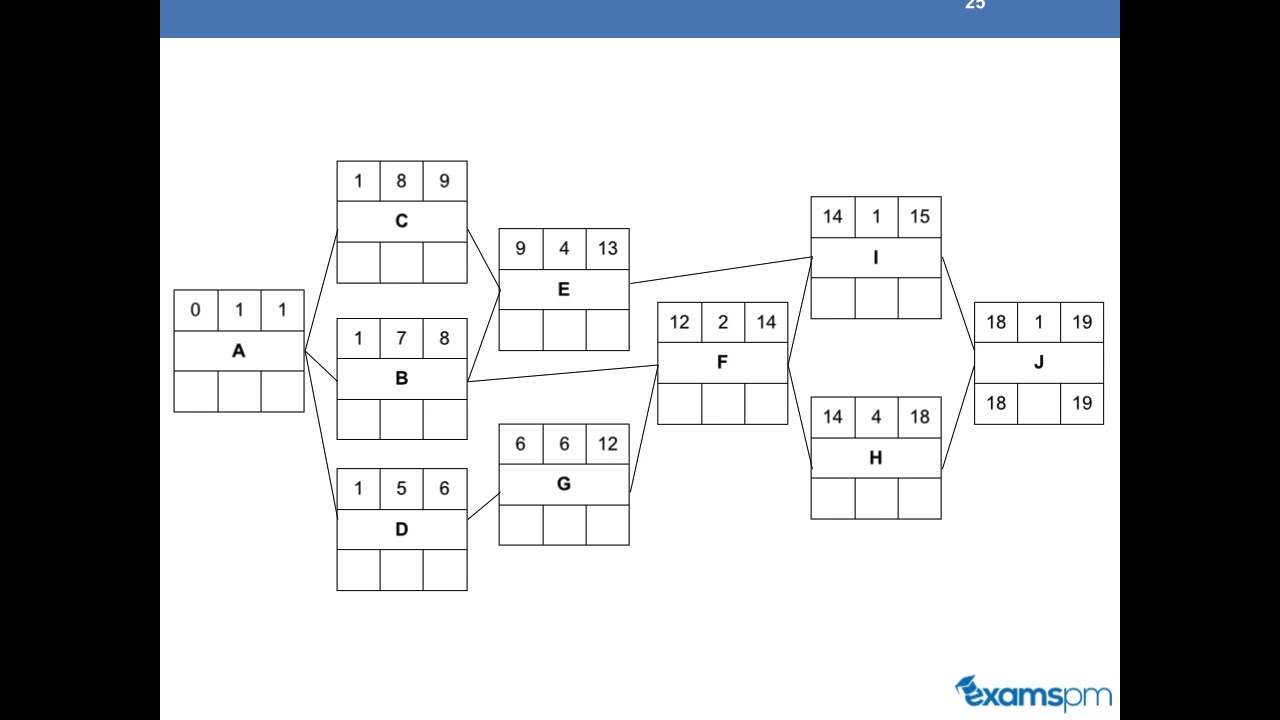
Helena Liu walks through the Precedence Diagramming Method to find the critical path on a sample project with ten activities. She shows the forward pass to calculate Early Start and Early Finish dates, the backward pass for Late Start and Late Finish, then identifies the critical path as the sequence with zero float: A → D → G → F → H → J.
Chapters
Hi guys and welcome back. In this video, we will go through a detailed example of PDM and how to calculate the critical path. You probably heard these terms over and over again in project time management and wondering to yourself, how do I actually calculate that for the PMP exam? Well, this video will show you a very complex example, and you probably will not get an example as complex as this one on your PMP exam, but it's always best to prepare for the worst. So let's get started with the case that we have for today. So pretend that you are George Wriste and you are the project manager of Shark Software Inc., and he decided to bid on a new internet application posted by a financial institution. Greg prepared the following list of activities. You may get a chart similar to this on your PMP exam where you have a list of tasks, the predecessors of those tasks, and the duration of those tasks as well. We can see here that Activity A has a length of 1 week. Activity B follows Activity A and has a length of 7 weeks. Activity C, which is Get User Input, also follows Activity A and has a length of 8 weeks. Activity D, which is to acquire and develop human resources, also follows Activity A and has a length of 5 weeks. Activity E, which is to assess available technology, has the Activity B and C as its predecessor, and it has a length of 4 weeks. Activity F is to create the risk register Its predecessors are Activity B and G, and it has a length of 2 weeks. Activity G is to build the software required. Its predecessor is Activity D, and it has a duration of 6 weeks. Activity H is to test the product with various simulated scenarios. Its predecessor is Activity F, and it has an estimated time of 4 weeks. Activity I is to verify the product meets all the client's Its predecessor, or the activities that has to happen before it, is Activity E and F, and it has an estimated time of 1 week. And lastly, we have Activity J, which is to complete the project and obtain the client approval. Its predecessors are Activity H and I, and it has a duration of 1 week. Now let's just do a quick recap of our quote-unquote 3x3 grid. So in our middle row, we have 3 merged cells with our activity name or activity symbol. On the top left-hand corner, we would put our early start date. In the middle cell of the upper row, we have our duration, and in the upper right-hand cell, we have our early finish date. On our bottom row, at the left-hand corner, we have our late start date. In the middle cell in our last row, we have our total float. So this is the amount of time that the activity can be delayed by without affecting the total end date. And lastly, we have our late finish on our bottom right-hand corner. So this is how you would draw your activity on Node. So it not only includes the activity name, but all the other information related to it. Okay, so that's it for today. Around the activity as well. So as it applies to our project, we will start off with our first task, which is Task A, and we will draw it on our chart with our, our grid. Right now we don't have anything filled in because we don't have any information yet. Our first task is just to draw out all the relationships between all the tasks. So as we see from the diagram, After Activity A is completed, Activity B, C, and D can start because when we look on our 3rd column here in the immediate predecessor, Activity B, C, and D all have A as a predecessor, which means Activity A must finish for Activity B, C, and D to start. So we can draw Activity B, C, and D on our charts. Next, we have Activity E. Activity E has B and C as its predecessor, which means both Activity B and C must finish in order for E to start. So it will look like this. There is a line from both Activity B and C leading to E because both of these activities need to be completed in order for E to start. And you would use the same logic to complete the rest of the chart. So if you want to pause this video and complete the rest of the process by yourself, definitely feel free to, or if you just want to watch, you definitely feel free to do that as well. Next we have activity F. However, we can see the immediate predecessors as B and G, and we currently don't have G on the chart yet, so let's go ahead and draw G first. Activity G has D as a predecessor, so we can just draw a line from D to G, and now we can go back to draw our activity F, which has B and G as its predecessor, so there will be a line coming out of activity B and G leading to F. So let's look back at our chart again. For activity H, we have activity F as a predecessor, So we can draw a line leading from F to H. And then for I, we have E and F as its predecessor. Thus, for activity I, we have E and F leading into activity I. And lastly, for activity J, activities H and I must be completed before J can start. Therefore, there, therefore there is a line from both activity H and I leading into J. And at this point, we have our— the logic of our activities mapped out. We know the dependencies between them. We know the sequence in which they have to be completed in. So this is our project schedule network diagram, and we're going to make it even more realistic by adding Adding in the start and finish date as well as the duration. This will be the second step. This is called the forward path. The forward path, you would just be filling in the top row of your, of your boxes, and in the backward path, we'll be filling in the bottom row of our activities on node. So here again is a look at our project scenario. All the activities we need to do, as well as predecessors and estimated time. The estimated time is just another word for duration. So we can go ahead and fill in the middle upper box of all of our activities on Node because this information was actually already given to us in the project scenario. So this was the, the duration of each of these activities. As well, I also filled in the early start, early finish for Activity A. We know that Activity A has to start at time 0. It has a duration of 1, so the early finish has to be 1. So you get the, the early finish by adding the early start and the duration together. So when you can start the project, plus the duration of that activity will tell you the early finish for that activity. And once you know the early finish for activity A, you know the early start for activity B, C, and D because activity B, C, and D cannot start until A is finished. And since A is finished at time period Let's just say 1 week. Activity B, C, and D cannot start until week 1, and since Activity C has a duration of 8, we would add 1 plus 8, which gives us 9. So Activity C will have an early finish of 9 weeks. Using the same logic for Activity B, 1 plus 7 gives us 8, and 1 plus 5 gives us 6. Now again, if you want to pause the video and finish the rest of the forward path by yourself to test your understanding, definitely you can feel free to do so, or you can just follow along with the rest of the video. Now next, let's look at activity E. E has both activity B and C as its predecessor, which means both activity B and C needs to be completed in order for E to start. Now, Activity B has an early finish of 8 weeks and Activity C has an early finish of 9 weeks. So would the early start for Activity E be 8 or 9? So feel free to pause this video and think about that for a second. Alright, if you said 9, you are correct. The reason it has to be 9 is because both Activity B and C needs to be finished in order for E to start, and at week 8, activity C is not completed yet, so we have to wait until C is completed before we can move on to E. Thus, the early start date for E is 9 weeks, and we add that to the duration of 4 weeks and get the early finish of 13 weeks. In parallel, we can also do activity G. Activity G follows D, which has a Early finish of 6 weeks, which means G can start at week 6. Since it has a duration of 6 weeks, its early finish is 12 weeks. Next, let's look at activity F. Based on the same logic, whenever we have a forward path, we always choose the larger number if there are multiple predecessors to an activity. So activity F has both G and B as its predecessor. The B has 8 as its early finish, while G has 12 weeks as its early finish. So we will use 12 because at week 8, activity G is not finished yet, and both activities need to be completed in order for you to start F. Therefore, the early start for activity F is 12 weeks. Since it has a duration of 2, its early finish will be 14. Now feel free to pause the video and do I by yourself. So if you put 14 for I, you are correct because both activity E and F will lead into I, and since F has an early finish of 14 weeks, which is greater than 13, which is the early finish for E. The early start date for I would be 14. Since it has a duration of 1, the early finish would be 15. Since H only follows F, and F has an early finish date of 14, the early start date for H would be 14. Since it has a duration of 4, its early finish would be 18. And lastly for I, it has H and I as its predecessors. Since H has the greater early finish date, the early start date for J would be 18. Since it has a duration of 1, its early finish would be 19. So again, you always take the greater number when you have multiple predecessors Leading into the same activity. Now let's look at how to compute the backward path. Like its name suggests, you're gonna go from the last process to the first process now. So instead of going from A to J, now you're gonna go from J to A, and that will give you your backward path. So as we begin to compute our backward path, we'll note that for J The late finish and the late start date would remain the same. So the late start and late finish is telling you what's the latest time you can start on this activity without delaying the entire project schedule. So now let's look at Activity H and I. Now since the latest time you can start Activity J is at week 18, that would mean the latest time you can finish activity H and I is at week 18. So even though activity I can be started at week 14, even if it is started at week 17 and it took you a week to do it and it's completed by week 18, you can still complete the entire project By week 19. So as you can already see, we have some float going around in our project. Next we have Activity F. In the backward path, it's important that you choose a smaller number. So we can see that both I and H would lead to Activity F in the backward path. So Activity I has a late start of 17 weeks, and Activity H has a late start of 14 weeks. Now, why do we pick 14 as the late finish for Activity F? So why do we pick the smaller number here? I don't want you to just remember the rules, but I want you to understand why this logically makes sense. So feel free to pause the video for a second and think about this. Now, as we think back into the dependencies of our project, F has to be completed in order for I and H to start. So if F is finished at week 17, H cannot start until week 17. And thus, when we do the backward path, we're taking the smaller number in the late Start date, because the previous activity has to finish in order for the next set of activities to start. So I'll explain that again if it was confusing. Activity F must finish in order for activities I and H to start, and thus we must choose a smaller number out of the 2 late start dates, because if we choose a larger number, we would delay the start date of, of the subsequent activities. So thus, if we chose 17 as the late finish for H, then we must modify the late start for H to be 17, which doesn't make sense. So in the backward path, you're always choosing the smaller number, and by the same logic, we can calculate the late start and finish for We can see that E is only connected to activity I. Since I has a late start of 17, E will have a late finish of 17. Since its duration is 4, it will have a late start of 13. Next, we'll look at G. G is only connected to F from the backward path. So since F has a late start date of 12, G will have a late finish date of 12. Since its duration is 6, it will have a late start of 6. Next, we can look at activity D, which has a duration of 5, and it follows activity G in the backward path. So think of this as like backward arrows pointing back. Since it has a late start of 6, D will have a late finish of 6 minus a duration of 5 will give you a late start of 1. Using the same logic, activity B will have a late finish of 12 because there are 2 activities leading into it. E and F. E has a late start of 13, whereas F has a late start of 12. Since 12 is smaller than 13, activity B will have a late finish date of 12. Remember, you're choosing the smaller number because if you choose a larger number, you will be delaying the subsequent activities since B has to finish before E and F can start. If you choose 13, then you would have to modify the late start date of F to be 13, which doesn't make sense. So thus, you have to choose the smaller number out of the 2. Since B has a duration of 7, 12 minus 7 gives you 5, which is the late start date. And lastly, for C, Since it's led by activity E, which has a late start date of 13, C will have a late finish date of 13, duration of 8, which gives you a late start date of 5. And lastly, for A, we will have to pick the smallest number, smallest late start date out of B, C, and D. Which is D, which has a late start date of 1. So the late finish date for A would be 1, duration of 1 would give you a late start of 0. So I hope that made sense. If it didn't, feel free to rewind the video and definitely try to do this example yourself once, even though you've watched the entire lecture up to this point. It's always good just to refresh your memory and see if you can get the same result by computing it yourself. We'll be moving on to calculate the float now. This is the last box remaining on our diagram. Before we get started, just a quick recap. The duration is the difference between the early finish minus the early start, or the late finish minus the late start. These 2 formulas are equal, so if you take the last— if If you want to remember it visually, you take the last cell in your box, subtract it by the first cell, either on the first row or the last row. It will give you the duration of each of the activities. The float is the amount of time that an activity can be delayed by without delaying the entire project. To calculate the float, you would use the late start and subtract it by the early start, or the late finish subtracted by the early finish. Both will give you the same result, and we already computed everything here for you, but let's just go through an example. Let's look at Activity C. The late finish is 13 and the early finish is 9. So 13 minus 9 gives us 4, and the significance of this 4 is that we can delay activity C by up to 4 weeks and we can still complete this project by week 19. Let's now look at another example. Let's look at activity F. It has a late start date of 12 and an early start date of 12 as well. So 12 minus 12 gives us 0, which tells us we cannot delay activity F without delaying the entire project. So if it has a float of 0, it tells us that this activity is on the critical path. Let's look at one last example. Let's look at activity E. Activity E has a late start date of 13 and it has an early start date of 9. 13 minus 9 gives us 4, which means that we can delay activity E by 4 weeks without delaying the entire project. So remember that you're taking the— you can either take the bottom left-hand cell of this 3 by 3 grid and subtract it by the upper left-hand cell of this 3 by 3 grid to get your float, Or the bottom right-hand cell subtracted by the upper right-hand cell to get your float. So if you can remember it visually, if it helps you to calculate the float. Now after you calculate your float, you are now ready to calculate your critical path. Remember that critical path is a path where there's no slack, where zero float. So that means that if If these activities are delayed, the entire project would be delayed. So if you want to pause the video for a second, try to calculate the critical path yourself, that is totally fine. In fact, I would recommend it. However, if you want to follow along, here is the answer. The activities with 0 float on them are A, D, G, F, H, J. Because they have 0 float on them, this tells me that this is the critical path for my project. I can delay activities B, C, E, and I without impacting my project schedule. So this gives us a sense of which are the most important activities on my project, and I may want to assign my best resources to these activities in order to mitigate the risk that they may be delayed.
More from Helena


How to Use Claude Code to Get UNLIMITED Leads in 6 Mins | Best Lead Scraping Tool



These AI Videos Has 21.5M Views — Here's the Exact System (Fable 5 + Higgsfield)




NotebookLM 2.0 Update: Analyze Your Entire Business in Minutes! (Full Tutorial)

