Ex-Harvard Professor Reveals the Hidden AI Formula for Explosive Startup Growth
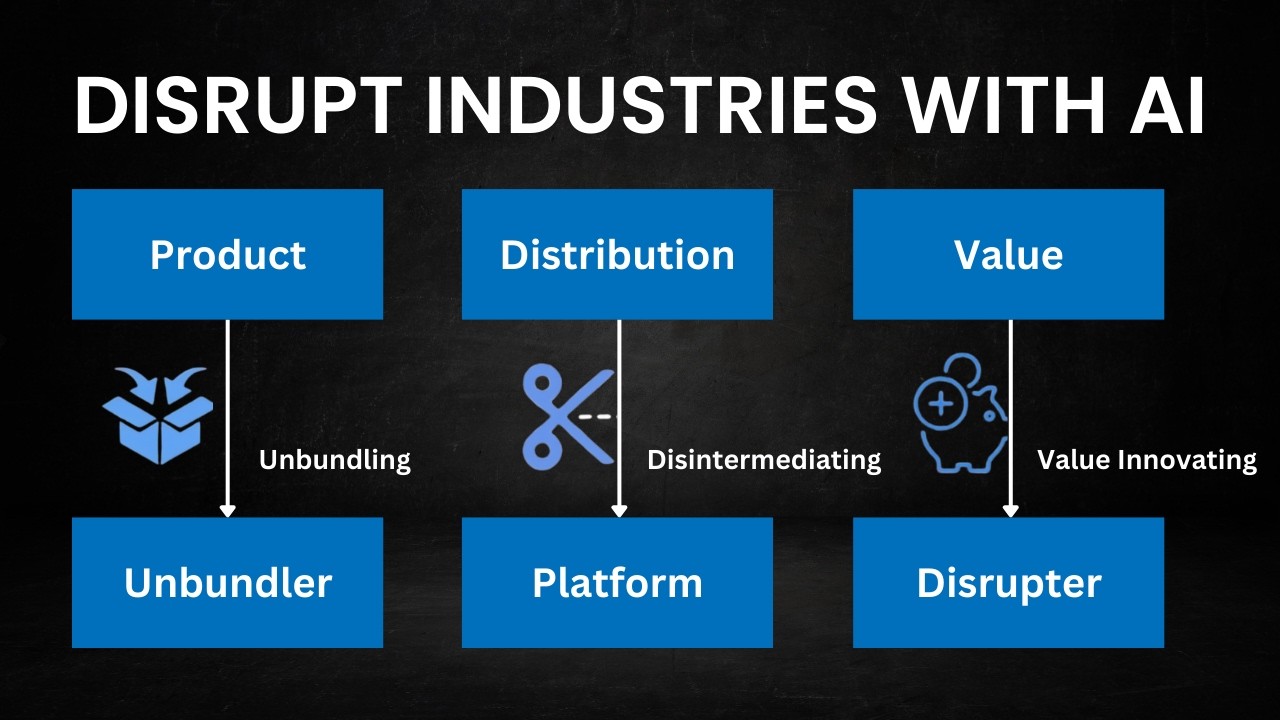
In this interview, Helena Liu talks with former Harvard MBA professor Talis Teixeira about how companies—both large incumbents and early‑stage startups—can cut through the AI hype and adopt artificial intelligence strategically. Teixeira introduces a three‑metric framework (cost, time, effort) for evaluating AI projects and stresses the importance of choosing the right partner and testing rigorously, illustrated by a failed McDonald’s AI drive‑through pilot. He then explains his core methodology: mapping the customer value chain into value‑creating, value‑capturing, and value‑eroding activities, identifying "weak links" where customers are dissatisfied, and applying a "decoupling" strategy to steal those activities from incumbents. Real‑world examples include PayPal’s disruption of bank payments, Twitch’s focus on watching gameplay, and a subscription model that transformed the car‑wash industry. Teixeira outlines how to discover problems through surveys, online reviews, and AI‑driven bots that extract insights from massive unstructured data. He also discusses business‑model innovation, value‑driver mapping, and the three AI buckets—generative, predictive, automation—positioned as an electric motor for distinct value creation. Finally, he addresses employee concerns, recommending executives treat AI as a productivity intern, re‑skill staff toward higher‑value opportunities, and communicate AI’s role in freeing human capital rather than replacing it. The conversation concludes with practical advice for founders and executives on structuring AI strategy across the three buckets.
Chapters
Ever catch yourself feeling overwhelmed by all of the AI hype and just not knowing where to start? Well, the good news is you're not alone, and that's exactly why I created today's video. I have an incredible guest joining me for this video, Talis Teixeira. He's an ex-Harvard MBA professor who has advised all sorts of companies from startups to established companies, including Mark Zuckerberg in the early days of Facebook. And what he is going to teach us today is how do you think through the customer value chain. So how do you identify the problems to solve and then create the software solutions that will solve those problems? A lot of people do this backwards. They create that product because it's cool and because it's trendy, and then they try to force a customer problem onto that solution, which is not the way to go. So we're going to be talking about the entire customer value chain and how do you think in terms of Frameworks when you're trying to come up with your startup ideas? And how do you structure your business in the age of AI? First of all, thank you so much for being here today. It's such a pleasure to speak with you. I know that AI has been all the hype, and every company is thinking about how do I implement AI, right? So how do you think through, are you using AI correctly? And when and where should you actually be using it in ways that help you grow your business instead of just jumping onto the hype?
Well, thanks for having me. It's a pleasure to be here with you. I'm really excited about this conversation. Yes, I think you just immediately touched on the big question. The question now is not anymore, should I use AI as a company, as a manager? With OpenAI ChatGPT, really the barriers to start using the technology anywhere have gone to practically zero, very little cost, very little experience. And so all companies, managers, executives, in my experience, are adopting and using AI in certain capacity inside their companies and roles. And the big question, as you ask, is Am I using it correctly? Am I looking at the right processes in my business, at the right functions and features? Really, given that all of the tremendous opportunity to use AI, GenAI, predictive AI, automation AI, did I choose the few areas in the company that will give the biggest bang for the buck, the biggest impact? And I've seen working with both executives in my capacity as owning a digital transformation agency. I've worked with big companies as well as I teach MBAs and entrepreneurs on how to adopt AI and business model innovation. So I've been seeing both sides of this coin. So starting with the big company executives, you know, things that we've seen is, for example, recently McDonald's tried to use GenAI through a chatbot in their drive-throughs.
No.
What happened? So first, problem number 1, they partnered with a company, IBM, that I'm sure they've worked with many times before. But between you and I, IBM is not a company that is really going in the frontier of AI research and AI products. I never read about anything regarding IBM AI. So that is strike number 1. It's when a company uses a partner That is not known for advancing the tool. I'd say number 2 is they focused on an activity that by and large customers are fairly satisfied with. People that go to McDonald's, you know, with a few exceptions, you don't see long lines in the drive-through. It's very fast. It's not a big issue, a big problem for customers. So you're not being very customer-centric if you're not applying AI to solve a customer problem. You're just applying because, hey, that seems like a logical Step to do. So strike number two, and then strike number three was when they applied it, they didn't really test out if that there will have significantly reductions in cost, time, and effort. These are the three currencies that you should look at. Do you see improvements in that? So when they applied, what happened was many people that were going through, they weren't getting their requests fulfilled correctly because the AI chatbot misunderstood them. A little bit more time. So there's videos on TikTok of people ordering things on McDonald's, and then the AI tool was saying, did I understand you correctly? Do you want bacon on top of your ice cream? Or yes, do you really want 300 boxes of chicken nuggets? And the consumer's like, no, that's not what I want. I want 3 boxes, not 300. And you can see that the tool wasn't, you know, ready for prime time, which caused actually an increase. In the drive-through lines as opposed to a decrease. So, you know, strike 3. This is not the way to go about it. The way I advocate for large companies thinking about how to adopt AI is finding the right partner, really figuring out what are the areas that distinguish your company, what I call strategic drivers of success. What makes your company distinct in the eyes of customers relative to competitors? And in the case of McDonald's, it's not the drive-through. So don't try to apply AI there. Apply where you have an advantage and you want to leverage that advantage even further to be more distinct than your competitors, right? And then point number 3, you should really test, test, test, test, and learn. Make sure that whatever you do before you launch it, you're actually reducing the cost of the process. You're reducing the time for the customers to make something that they did before faster. And you're making it easier for them. So, you know, I think that's the framework that I tend to use for big companies. Now, for startups using AI, there's quite a few differences because they might be applying it in an activity to kind of launch a business. And again, I'm really focusing on the customer-centric approach to innovation. And I've written a book called Unlocking the Customer Value Chain. And I visited dozens and dozens of startups and written Harvard Business School cases on them to really identify that the startups that really grow to disrupt markets, they start focusing on one or two very narrow activities in the customer's value chain because they identify the established companies are unsuccessful at doing those activities well. To give an example, big banks, they do a variety of services for customers. But historically, they've never did payments that well. Payments, you had to go to the bank, it took time, 2, 3 days, you know, high fees, all these things. And so when PayPal came and said, do payments online with us, you don't need to leave your bank, you can still have a checking account, you can still have a savings account, you can still have your mortgage, you can go to your bank for all these things, but do online payments with us. Why? Very little to no costs. And it's much, much faster and simpler. And so that's how they disrupted, started the process of disrupting the market in fintech. That's kind of the approach. Once you understand this approach, which I call decoupling, as a startup, you should think, how can I decouple the activities in the customer value chain and steal one activity that customers are unhappy with the established companies, with the incumbents, and how can I do it better? And then you say, can I use AI to do this thing better?
So you mentioned about decoupling. Can you tell us like, how do you break down the customer value chain? customer value chain to find those specific problems, you know, so you can identify things that you can now solve?
Absolutely. So, so let, let me start with an example. I used to play video games when I was a kid. My customer value chain was, you know, video games were expensive, and so I didn't want to just buy one that I didn't like. So how do I deal with that? Well, first I was interested in a console, and then I would, you know, go around with my friends and see who had this console, and then I would visit their houses saying, you know, let's play together. You play my games, I play yours. I watch you play your games. I learn which games I like. And then after looking at those games, I would say, you know, okay, I'm ready to buy this game because I like it. And then so I would go physically to a store, buy the media, whichever it is, a cartridge, a CD, or whatever it was, come back, come home, you know, play the game, try, try, try, improve, talk to my friends, learn, watch them play, come back, play my game until essentially I got to the end of the game. And then if I didn't want it anymore, I would try to Resell it to get more money to buy another game. So that was my customer value chain. And if you think about these activities, some of them derive value for me. When I did that activity, I got a lot of pleasure, value was created for me. So playing the game created value for me. Watching my friends play that game created value for me because it helped me understand which games should I play. After I bought that game, selling the game was a way for me to capture value. So, that's a second type of activity. Value creation activities, value capturing. And when I paid and bought that game, I was creating, you know, a company was capturing value from me. And everything else, you know, the act of going to my friend's house, the act of going to the store, staying in line, the act of buying a game that I didn't like, all these things were value-eroding activities. I was forced to do it. But I didn't get value out of it. So the customer value chain is all the sequence of steps that customers do in order to derive value from products and services. And you can classify them into value-creating, value-capturing, and value-eroding activities. Okay, so having said that, you can see this was the traditional business model. And there were video game manufacturers and retailers that, that were in this business. And then innovation started happening. More than 10 years ago, these 2 kids, college kids from Yale, decided to create Twitch. And what they learned is people were going online to watch other people play games the same way I did when I was a kid going to my friend's house to learn, to educate myself, figure out what games I wanted to play. People started doing that online and Twitch grew dramatically and it had now 60, 70 million people that are paying Not to play a game because you go to Twitch to watch somebody else play a game. So people are paying for this privilege. What Twitch realized and built a business around it is instead of saying, let's create a video game developer, let's like rent games, lease games, everything, let's just create a portal in which people can watch other people play games. That was decoupling. They looked at all the value chain and they chose one activity and say, we're going to do this better. Why? Because if you go, if you do it the old way, you have to go find friends. You have to go across the street, go to their house. and then their moms are telling them, you gotta go home. And then on the weekends they're traveling, you can't do it. And now with Twitch, you can do it 24/7 for all the games you want. And if somebody's playing a game that is not playing well, you switch to another channel, another, another. So it became a much better experience, right? This is decoupling. Decoupling is the act of looking at the customer value chain, figuring out where customers are unhappy, in this case, viewing somebody playing a game, and build a business around that single activity. And then you're gonna get— capture a lot of customers. A lot of customers very quickly. And then you grow and you start offering more and more services, right? And then Twitch started offering more subscription, uh, tips for you to play. If you want to be a professional gamer, you can do it through Twitch. And it branched out into more and more activities. But they started out looking at a very niche market, just like PayPal— very niche, online payments for small amounts, right? Twitch, just watch other people play games. That is the process of decoupling.
The way that you looked at things was so unique. And what really stood out to me is like, it's not about the tech, and the tech has never been easier to do. And, you know, I have videos on how you can make a software now in under an hour using tools like Bolt.new, using like Replit. So now that the technology barrier has never been lower, Anyone and their mom can now become, you know, a software builder. So, now that the barrier to entry with tech has been so much lower compared to ever in human history, it's about finding the problems to solve. And I think not many people know how to do that very well. So, for the people who are looking to get into the software space, how do you suggest that they find those problems to solve so that, you know, they can go out and create these softwares now with AI to actually make some money or disrupt certain markets?
That's a great— that's a very good question. Well put. Sometimes we think that the barriers to entry are unbelievably low now with technology, as you say, and you're correct. But, you know, even 5, 10 years ago, they weren't as high as we imagined. Just to give you 2 examples. So One is I visited Facebook before its IPO. I saw Mark Zuckerberg in his flip-flops famously like programming, standing up. Well, when I visited Facebook and I asked them, how are you planning to disrupt the social media market? Because there were other social media companies. They never talked about their unique disruptive technologies. They talked about kind of the customer experience, what was not good yet, what they felt could be better. And even Netflix, and you think Netflix is a tech company, they've got to have proprietary technology. But even at the time when Netflix moved from sending DVDs by mail, which any one of us, you and I could have done this. We could have bought DVDs, build a warehouse, and send it by mail. And then Netflix moved to become— to do online streaming. They didn't have proprietary technologies when they did that, right? They didn't have like servers and kind of software that can do that. They built it over time to improve. So, what I teach my students is don't think that you need this amazing new technology to become a successful entrepreneur. Start, as you say, with kind of run-of-the-mill technology. You can improve, adapt, but that's not going to be your differentiation. That's not going to be the factor that will, as people call it, a moat. Very, very hard to get a moat out of hardware or software nowadays.
Mm-hmm.
Finding the right problem, Going back to your question. So, you know, the approach that I've come to realize is first, if you want to find the right problem, you find customers that have that problem, right? And how do you go about doing that? So back to the customer value chain. What I do when I help entrepreneurs that I'm advising in startups and big companies to try to find innovation opportunities, we first map out the customer value chain. We try to understand end-to-end what customers are trying to do. So that means that you should get out of your head of what am I trying to do? I'm trying to find a business opportunity. I'm trying to make money. I'm trying to find a new market. Forget about that for a moment. Focus on looking. Think about a customer. Map out all the activities in the customer's value chain. What do they have to go to do from becoming aware that they have a problem all the way to using and disposing if it's a physical product or canceling if it's like a subscription.
Right.
Online. Map those activities. Identify which ones are value-creating activities, which ones are value-eroding activities, and which ones are value-capturing activities. Why is that important? Because based on my research, there's only 3 avenues for disruption. You can either create more value-creating activities for customers in the sense, for example, back to Twitch, it's watching somebody amazing playing the game. You can either eliminate value-eroding activities, back to PayPal. I don't need to go to the bank or go on a website and fill out a bunch of information to transfer money through wire transfers. It's very, very easy. Or kind of reduce value capture activities, essentially making it cheaper. And now Fortnite and many of the free-to-play games have done that and figured out other ways to monetize. And once you do that, you want to get a sense of where in the customer's value chain are customers most unsatisfied. And one tool that we generally do use is we do, you know, either surveys or go to online reviews and capture that information by activity in the customer value chain. And we've done that with many industries. So we've identified what I call weak links, which is activities that a big enough group of customers are unhappy with their current providers. I'm unhappy with my bank in this regard. I'm unhappy with my supermarket in that thing. I'm unhappy with my telecom provider. there are quite a few activities where customers are by and large unhappy. And in my research, I've shown that disruption most likely happens in the weak links of the customer value chain. So it's about identifying this through surveys, interviews, talking to people, working in an industry. And I'm sure if I ask you, you know, where have you worked before, you will see things the same. My employer, the business that I work for, wasn't great at doing this or this other activity. Those are the first activities that I would look at to see, oh, is there a way that I could do this cheaper for the customer, faster for the customer, or less effortful for the customer? If I can find a way to do that with a combination of new kind of value proposition, new business model, and even potentially technologies, Then I have a clear shot at really kind of starting to build a disruptive startup.
That's really good. That's really good. And so, after you find this problem to solve, how do you get your word out there so that people even know? And so, this is kind of like a 2-part question that may not be related. You know, would this same process work for small businesses like, you know, dentists, chiropractors, kind of like your traditional businesses? Is there ways to disrupt those markets as well? So that's a 2-part question there for you.
So let me give you an example. Let's, let's stop with the tech world, the startups. Let's focus on a very down-to-earth, low-tech business, which is car washing. Yeah, you know, car washing, you know, 50 years ago was manual. And then came companies that automated the process. You go in, No people involved. You know, you get your car washed. But apart from that, which is at least like a 30, 40-year technology, virtually no innovation has happened. You get your car washed the same way. All the car washes have been undifferentiated, pretty much the same thing. Then, a few years ago, a major breakthrough happened that caused the companies that adopted this breakthrough to become highly, highly profitable. Compared to not only to other car washes but even to other traditional businesses. It became such a lucrative business that VCs and PEs started investing in car washes. And what was the huge innovation? It was not tech. It was a business model innovation. It was, we're going to offer you a subscription for car wash. You will pay this much and you can wash your car as many times as you want. That caused such a dramatic change because many people say, hey, I don't want to be paying $15, $20, $25. I can just pay a flat fee and I'm going to be able to come and bring my car to wash all the time. And you would think, well, the cost would be so high, right? But when you look at the data, what happened is people buy the subscription and forget about it. It becomes, you know, a gym subscription. You have it, it's important, you feel important, but how many people are there in the gym day in and day out. There's a group of people that are and most likely are the ones that live very, very close to the car wash. But the ones who live a little bit farther away, they kind of forget and their car is clean anyway. Why am I going to do it? So, they go like twice a month. But this increased dramatically the value. So, this is business model innovation. And it was based on this premise of understanding that consumers oftentimes, they want solutions that is what I call set it and forget it. Right? Set it up and forget about it. I just want convenience. I want to set it up, have a car just come in and out. And so, that understanding that people didn't want to like, should I get my car washed? Is it dirty enough? Should I wait a little bit more? Should I pay more? Should I pay less? Should I pay $50, $20? All these things. So, that was a huge innovation that actually changed the market and made these businesses extremely more valuable by kind of this business So, you know, getting back to your question is understanding, identifying a problem, kind of validating somehow through consumer surveys, reviews, talking, getting information, using it. But then like innovating in the business model, finding another way. And a business model is how do you create value and for whom? And then how do you capture value and from whom? So, it's a 4-part model.
Yeah.
question to really understand your business model. But once your second part of the question, how do you get the word out? Yeah, right.
Find this great.
How do you get— how do you spread the word out? So first, if you identify people that have a problem, you sell the problem. You don't sell the solution. And that's very important. So, if we take a step back and think about headache medication, there's aspirin, Tylenol, ibuprofen, all these things. And if you look at how people solve their headaches, they solve it in different ways. People will Google. I don't know what you Google when you have a headache medication, but you might Google a brand because you're like, Aleve. You already know the brand Aleve, right? And so that's a brand that you Google.
I would never ask ChatGPT. I would say I have, I just literally open up my app now and then I turn on the voice and I said, I have a headache right now. What do you recommend?
And then That's the point that I'm trying to get. You're searching based on the problem. You said, I have a headache. Some people already saying, you know, I want to find painkiller. That's already a solution. And some people say Aleve or aspirin or Tylenol. That's a brand. Can you see the difference?
Mm-hmm.
That you're like trying, you're trying to find different people. One is trying to sell on a brand. One is trying to sell on a solution and the other one is based on what you do. If I had a better solution, I would try to target you because I'm trying to target your problem. You just described, I have a problem. And if you identify that that problem is pervasive and the established companies aren't solving it, just go and try to figure out who's like raising their hand, you know, figuratively speaking, like you and saying, hey, I have this problem. I have this problem. So target people that have this problem. And then bring them in and then offer them a solution and so on and so forth. So targeting based on problems is often one way to kind of get around the fact that you don't have this brand, this big brand.
I know a lot of people listening will just be just starting out, you know, and they may be saying, well, I don't have 1,000 people to survey and look for those problems. And I just want to get started. So for people who may not have those, like, maybe even put yourself in the shoes. If you didn't have those resources, where would you go to start identifying those problems that you can then perhaps use something like an AI software tool to build those solutions to really form a problem?
Yeah. So, the first one is start maybe with a problem that you understand or you had before. So, for example, in my consulting company, decoupling.co, I had a problem Which is my clients that came to me. They came with a problem that they wanted some consulting help with that I didn't think it was their real problem. I thought it was the symptom of their problem. And I needed to dive deeply to understand that. So, from my business point of view, my challenge was my client doesn't know his or her real fundamental, the core problem. And so, I needed to collect data from consumers to kind of show to my client, hey, your problem is not that. That's a symptom of your problem. The root cause is something else, right? So then, I said, well, many companies might have this, right? Because there's a lot of politics involved. You have meetings and CMO says, the problem is this. The CEO says, no, the problem is that. The key problem is this. CFO, no, no, no, no. The problem is something else. So, they fight. And so, I said, well, how can we create a tool that eliminates the fighting, that gets everybody's senior executives in the room? We show them one tool That everybody is like, points. That's the problem. That's the one that we need to address. So, and then once I identified, I said, that was my problem. And then, I started seeing, are there other companies that have this problem? Then, the answer, yes. Oh, so I validated. This is not just Talus's problem. Many companies have this problem. And then, I started thinking, oh, what's the easiest way to address this? Well, let me start surveying customers online. But then, that was expensive because I had to hire hundreds of people, thousands of people to say, please fill out the survey, this long survey. I had to pay them. And then, they would fill out the survey based on the customer value chain. And they would tell me where they're unhappy so I can find these weak links to tell my clients saying, these are the weak links. But this is long and complicated and expensive. So then, I said, well, Can AI help me? And so we created bots that go online and reviews, read all of these reviews online in different websites and get the information on reviewers and tell the reviewer that has written about it says, this brand, I bought this, I brought a car from this brand. The test drive was amazing, but the negotiation was awful. And then we started getting that and joining with surveys, all these reviews to create this map of the customer value chain and the satisfaction in each activity. And we got hundreds of thousands of reviews in each industry. So now, when a client, a potential client comes to me, in a few days, I tell them, I say, I know some of your biggest problems from the customer's point of view. And immediately, I show them and they're like, wow, that's clearly A problem we need to address. So again, just recapping, find a problem that you had, go check around that other people are having this problem. 3, find the cheapest, easiest, fastest way that you can try to kind of get an MVP of a solution. Understand if this is valuable, validate it by showing it to potential clients. And then lastly, collect the data and use AI. Very, very end of the process, use AI. to help you get a lot of scale. I couldn't do the reviews, evaluating the reviews alone. We have hundreds of thousands of them in the industry. And then using AI to get unstructured data to transform it into valid insights to kind of feed into this.
I love what you said there because so many people get caught up that I have to use AI because it is the hottest thing around. But I love what you just said because you're using AI strategically as a goal in this case is analyzing thousands, if not hundreds of thousands of reviews here. So you're using it in a way that actually helps you increase productivity. You're not using AI for the sake of using AI. So with that out of the way, I just wanna say, like, you know, 'cause AI is gonna disrupt everything from generative AI. Just humans cannot beat AI in terms of speed. And I don't know if you've seen things like Claude computer use that just came out that can do that last mile now as well. Yeah. So it can actually like navigate your computer, move your mouse around and type in the URLs that it needs to go to, whether that's a CRM or a spreadsheet. And not only is it computing the numbers from data analysis or generating text or image, it's actually doing that last mile of putting that image into a PowerPoint, putting those numbers into a spreadsheet or CRM. And that technology is only going to get better. Like the AI we have today is the worst it's ever going to get. So how should businesses think about how they should change their business models going forward to still be competitive in the age of AI?
Sure. Well, you know, that in itself is another hour of conversation. So we're going to scratch the surface here a little bit. In my company, we work with companies in various different industries because what I can help them is through customer-centric and innovation as opposed to improving. We're not a consulting industry-specific consulting. So, we come in and we do workshops as well as help identify these opportunities for innovation. But kind of from my experience, what I've seen is about 80% of the companies that we come in, they're saying they're either experimenting or launched AI as a chatbot. So, in their minds, it's like AI is a chatbot. If you think about it, very few companies out there having a better chatbot than their competitors is a source of a distinct strategic advantage. Very few, right? The vast majority won't do a dent, right? If you're just trying to learn applications, that's fine. But they think this is like AI. Many managers think AI is like chatbot. And I think they're missing the point. You know, as all technologies and we talked about it, it's about figuring out the value drivers of your business. So, we have a tool that's called Value Driver Mapping. You try to get all of the value drivers that make your company distinct relative to other competitors in your customers' eyes. So, we do that with many of our clients and we create all of the features, right? So, for example, back we talked a little bit about Netflix. What makes Netflix distinct for us relative to all of the other kind of streaming services? You know, content obviously, but the quality of the content is super important. The speed of delivery, right? What Netflix is like has this way that kind of interruption is very— so latency is very low. So, you know, quality of the content, kind of very diversified and very unique. But there's another one which is kind of the recommendation system because as Netflix started adding more and more stuff, we don't know what to watch. So, the recommendation system was very good. So, they partnered with us to figure out a better recommendation system. And we've identified that that was a source of a value driver, right? Strategic value driver that Netflix said, we want to be better at recommending because if we don't recommend well, people oftentimes don't know what to watch. They go in, they go out, they don't watch. And after a while, they cancel because they're saying, oh, when was the last time I watched Netflix 3 weeks ago, I'm going to cancel. So we went and said, how do you improve a recommendation system? And what we did is we actually asked people to turn on their webcams with their consent, and we got a sample of people watching movies and shows. And then we identified where people were like most expressive using an AI expression tool that figured out, are you smiling, laughing? Are you like making faces? That means that you're engaged. And we got all of these snippets of content, we packed them up together very tightly. And now when you go to Netflix and you kind of hover over one of these kind of a movie or a show, it doesn't start from the beginning. It doesn't just show you the first few minutes or seconds of the show. It shows you a random part of the content, but one that was like engaging, number one, And emblematic of what you'll likely feel if you go and watch that show from the beginning. That we showed in an academic paper that we published in the Journal of Marketing that actually increases engagement, increases likelihood of people watching, therefore reduces the churn. And all of this increase in viewers over time goes directly to the bottom line. It's not really that expensive. So again, kind of Seeing how this process works helps you understand value driver mapping is super critical. What all of the value drivers that make your company better than competitors in the eyes of the customer. And once you identify those, that's part number one. Then out of those, those are the candidates for you to apply AI. AI is like an electric motor.
Yeah.
Value driver helps. So let me put a fast-growing motor on it, and then you'll unlock all of this distinct value for your customers. That's the way that we approach in a 2-step process.
That's awesome. That's awesome. But all of these changes don't happen in a vacuum, and usually in companies you need a lot of buy-in, and there's a lot of fear among the general employees around AI because there's a fear that it'll replace them. Or take away their job. So how do executives and business owners lead in the age of AI, especially with a team that tries to sabotage their efforts? And that was a— that's a thing that I'm seeing a lot today as well.
That's a very thorny issue. In reality, I see 2 things that are happening. And these 2 scenarios will dictate whether AI will be successfully implemented or not. One is a group of employees that are doing a variety of tasks, and when they adopt AI, they really try and are supported, they free up their time to do other activities that are higher value-creating activities, right? So this is the classical case of not having to write emails, summarize research, do analyst reports, a bunch of things. That AI, GenAI tool can summarize documents much better, create content, create reports much better. And then, you have to be in the business of managing an AI. And that's the type of work that I do. I always think about AI as my kind of 24/7 intern. I have to work with the AI to get what I want. But if I dedicate enough time and patience and I tell it when it's wrong, And I also say please and thank you. It's been shown that being nicer to the AI agents actually improves the outcome. Why? I have no clue. But we're seeing that it works. So, I treat it as an intern that once they do some of this nitty-gritty work that they can do better, it unlocks. It frees up my time to do other things. And that increases my productivity. When that happens, you should educate the employees saying, this is what's happening. We're trying to get you to save time this so you can use up more time to be more productive in the value-added activities in which only you can do. Now, there are other employees, other professionals in which the activities that AI can do better and faster are 80%, 90% of them. You know, think of low, like low-skilled copy editing or creating images, you know, editing documents, things like that. Those cases, the reality is AI tools will do a huge portion of that. And then there's a problem. Okay, now that you've freed up the employee's time by 80, 90%, what are they going to do with that time? Now, as a company executive, you can say, I don't know. I'm not in the business of trying to answer that question. I'm going to fire them. And some companies, that's— the executives are doing that. They're firing a lot of people that were like in telemarketing or in journalism or in copy editing in advertising agencies. But I think the intelligent, smart executive will say, now, I'm freeing up my employees' time to do other things. And I have a lot of other jobs or ideas or concepts or innovation attempts that I don't have time or we don't have enough people to do. Let me get those people towards working on these opportunities, right? And I even tell my students like, don't ever go to a job, particularly early on in your career, a job as a problem solver because you solve the problem. Like you're basically, your boss is like, thank you for solving that problem. That's amazing. Like, Try to go for where your boss is saying, I see a huge opportunity here. I'm going to put you to work on opportunity, as opposed to put you to work on a problem that I have right now. Yes, we all have to solve problems. But if your boss is constantly just putting you to work to solve his or her problems, you know, you're not going to go much far in that organization. You know you're valuable when your boss is putting you into opportunity. So, it's part of our jobs as managers of people that are being displaced by AI to help them find— saying, there are a lot of opportunities. I'm not just using This as a cost-cutting tool.
Right. And even for the employees, it's about being proactive and seeing like, okay, so this is not going to go away. So, what's my new value proposition to my employer? And you're probably the best people to identify these opportunities because you're the person on the ground. You see what's actually happening, whereas sometimes the managers are 2 or 3 steps removed and they don't see the actual problems being being, you know, that's happening. And so you're probably the best ones to drive forward a lot of these AI innovations or other opportunities that are presented. So yeah, yeah. So just as we wrap up here, any last advice for business executives or startup founders in regards to AI that we haven't touched on today?
Yeah, no, always think about— I like to think about AI as 3 big buckets. Generative AI creates content. Predictive AI evaluates a future state of the world, estimates it. And then automation AI, which actually executes, takes humans away from the decision process by executing what you talked about, Claude, and AI agents. So always think about kind of what's our gen AI strategy, what is our predictive AI strategy, and what is our automation strategy. And think that ultimately, You're trying to use these technologies to kind of save money, time, cost, and effort in doing them, and then kind of freeing up your human capital to do the things that AI cannot.
That's perfect. I think that summed it up perfectly. Well, thank you so much for coming on board today. I really appreciate your time and expertise, and this has been a very fascinating conversation. So I really appreciate you being here today.
My pleasure. I enjoyed it too. Thank you so much.
More from Helena


How to Use Claude Code to Get UNLIMITED Leads in 6 Mins | Best Lead Scraping Tool



These AI Videos Has 21.5M Views — Here's the Exact System (Fable 5 + Higgsfield)




NotebookLM 2.0 Update: Analyze Your Entire Business in Minutes! (Full Tutorial)

