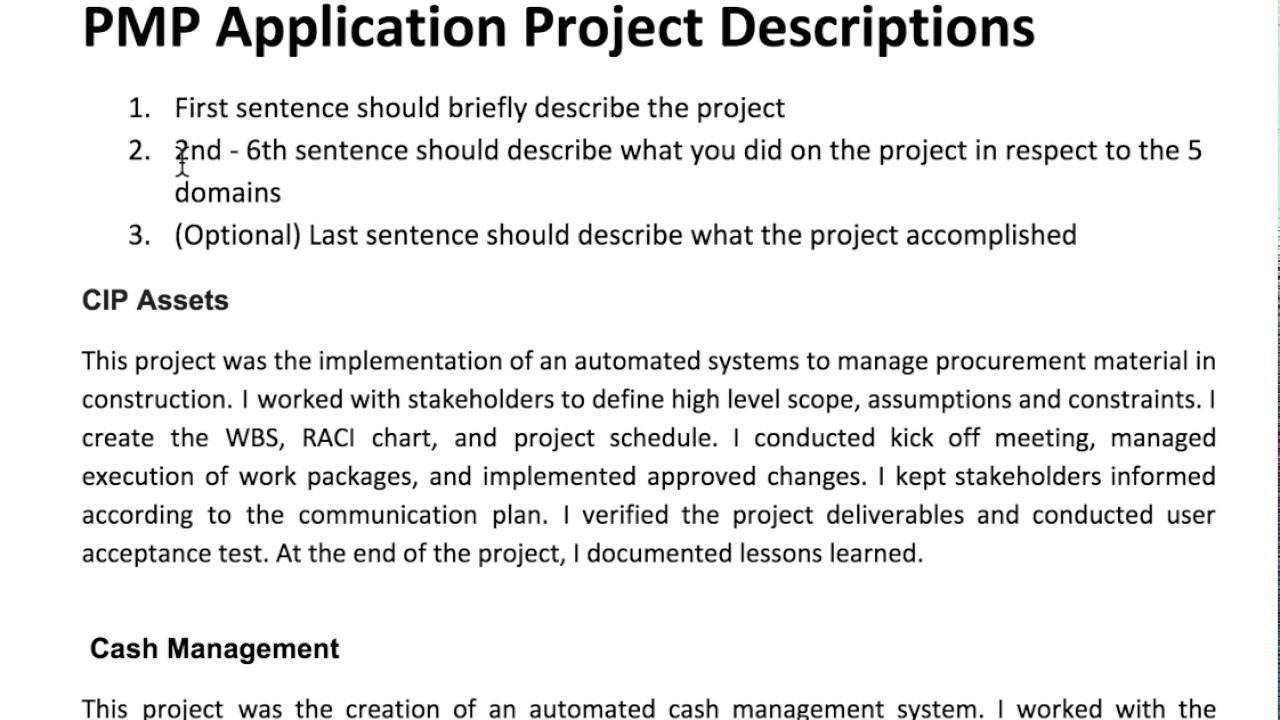
Helena Liu breaks down how to write a PMP application project description in three steps: a one-sentence summary, 2-6 sentences mapping your actions to the five PMBOK domains, and an optional accomplishment highlight. She walks through a real audit-approved example showing how each sentence aligns with initiating, planning, executing, monitoring & controlling, or closing.
Chapters
Hello. Hello. In this video, we are going to go over the 3-step process to writing a winning PMP application project description. If you follow these 3 simple steps, then you are going to write an application description that's going to pass the PMI audit. Now let's go over what those 3 simple steps are. So the first thing you want to do is to write a brief sentence describing your project. Your next 2 to 6 sentences should describe what you did on the project in respect to the 5 domains. So if you claimed hours for all 5 domains, so you need 5 sentences here, 1 sentence describing what you did in each of those domains. If you didn't claim hours for 1 or more of those domains, then you don't need all 5 sentences here, so you only need 1 sentence for what you did in each of those 5 domains. And just as a quick recap, the 5 domains are initiating, planning, executing, monitoring and controlling, and closing. And these 5 domains have not changed between PMBOK 5th Edition to 6th Edition. So there are 5 domains in both the 5th Edition and the 6th Edition. And step 3 is optional. So if you had a major accomplishment at the end of the project, feel free to highlight it in the last step. Now let's go over a few application examples. By the way, these are real application descriptions that students have submitted and passed the PMI audit. So let's go over the first one. This project was the implementation of an automated system to manage procurement material in construction. So very clear as to what this project is about and why it needed to be initiated. I worked with stakeholders to define high-level scope, assumptions, and constraints. So this tells you what this person has done in the initiating phase. I created the WBS, RACI, and project schedule. This is what she or he did in the planning stage. I conducted kickoff meeting, managed execution of work packages, and implemented change requests. This is what she or he did in the execution phase of the project. So you can see that his or her project description is very logical and follows this chronological order of how the project is progressing. I kept stakeholders informed according to the communications plan. This again is in the execution phase. I verified The project deliverables and conducted user acceptance testing. So this is what she or he did in the monitoring and closing phase. And the last sentence, at the end of the project, I documented lessons learned. So this is what she or he did in the closing phase. So you can see that this person followed the structure to a T, and this description did pass the PMI audit. Now, one thing I wanna point out here is that this person had 2 sentences in regards to execution, and that is fine. So this is a basic structure that you follow. You can always customize it slightly to fit your specific needs. Now, there are a lot more application descriptions that we have. We're not gonna walk over every single one of them right now, but what I will tell you is that you can download this PDF in the link below. And you'll have access to all of these project descriptions, and you can feel free to use them as a template when you're writing your own descriptions. So I hope you found this video helpful, and make sure you subscribe to Exams PM. See you soon.