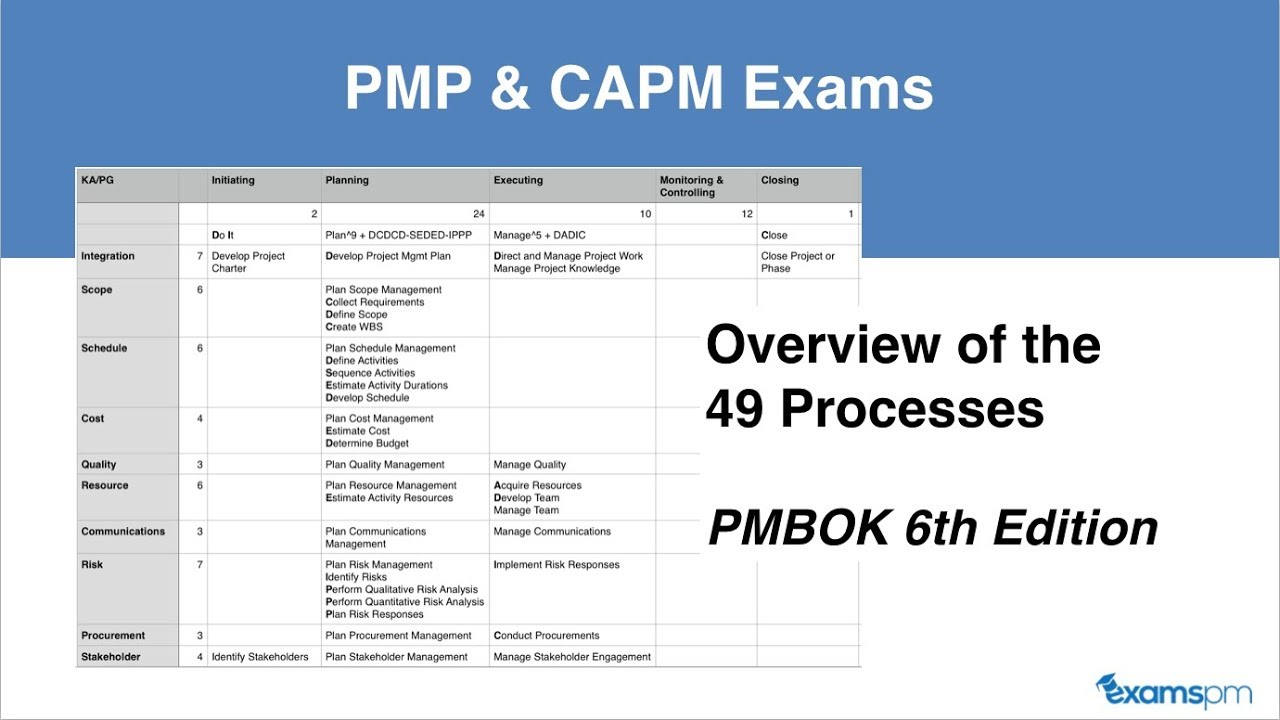
Overview of 49 Processes from PMBOK 6th edition Guide for PMP and CAPM Exams
Helena Liu breaks down all 49 PMBOK processes across five process groups and ten knowledge areas, explaining each one's purpose, inputs, and activities. Essential for PMP and CAPM exam prep.
Chapters
Hello and welcome. In this video, we are going to cover an overview of the 49 processes from the PMBOK 6th Edition Guide. This is essential for you to learn for your upcoming PMP, Project Management Professional, or your upcoming CAPM exams. Now just before we get started, be sure to sign up for a free 1.5-hour course at Examspm.com where we'll go into all of the things that we cover in this video plus more. So we're going to cover how you can pass your PMP in 6 weeks, we're going to cover how to write your application descriptions, and so much more, so you definitely want to make sure you sign up for this training. Okay, now let's dive into the 49 processes. So I have the process chart right here on the slide. So across the columns we have our process groups: initiating, planning, executing, monitoring, controlling, and closing. And then across the rows here we have our knowledge areas. There are 10 of them: integration, scope, schedule, cost, quality, resource, communications, risk, procurement, and stakeholders. And in the intersection between the process groups and the knowledge areas, we have 49 processes. So each and every single process has a corresponding process group as well as a knowledge area. So you can— another way to look at this is you can think of the process groups as sort of a timeline of when these processes will happen. So it's categorizing these processes by time. So when you start your project, you start with initiating, then you move on to planning. Once you finish the planning, you move on to executing. So this is when you're doing what you plan to do, and then you monitor and control, you're checking. You're actually doing what you plan to do, and then finally when all the work is complete, you go into closing. And the knowledge areas you can think of as buckets or categories of tasks, so it's basically classifying these processes by time and by category. That's one way to think of it if that makes it easier for you to understand this chart. Let's now dive right into the 49 processes starting with all of the processes in integration management. The first process in integration management is develop project charter. This is the process where you are developing a document that formally authorizes the existence of the project. So this is when the project gets formally approved, and this is also when the project manager gets the authority to apply the organization's money and resources in order to complete the project work. Now, after the project charter has been developed, we move on to developing the project management plan. The project management plan consolidates and integrates all of the other planning components into one place in order to form the project management plan. So this is a master plan that includes all of the subsidiary plans from all of the other knowledge areas and additional documents into one place, and that's why it belongs to integration management. So throughout the entire integration management knowledge area, you're consolidating consolidating all of the other materials from all of the other knowledge areas into one place. Now, after we have developed our plan, we're ready to begin our project work. So this leads us to our next process, which is to direct and manage project work. So this is when you're leading and performing work defined in the project management plan and the approved change requests. This is when you're implementing or executing what was in the plan. Next, we have Manage Project Knowledge. This is using the knowledge and creating new knowledge in order to achieve your project's objectives and to facilitate organizational learning. The next process we have in integration management is Monitor and Control Project Work. This process is all about tracking, reviewing, and reporting upon the overall progress of the performance of the project and seeing whether or not we're meeting the objectives that was defined in the project charter. Perform Integrated Change Control is our next process in this knowledge area. This process is all about reviewing the change requests that come up throughout the project and deciding upon the outcome of these change requests. So we can decide whether we approve the change request or not. We can also decide whether or not just to put this change request on hold and review it at a later date because it might not be relevant right now. And the last process that we have in integration management is to close the project or phase. This is when we're finalizing all of the activities for the project or phase. Now let's move on to scope management. The first process in scope management is plan scope management. This is a process of creating the scope management plan, which is going to tell you how the product scope will be defined, validated, and controlled. Once we have our plan on how we're going to manage and define scope on our project, we're ready to now collect our requirements. This is the process where we're determining and documenting our stakeholder needs. These stakeholder needs are also known as requirements. This is what our stakeholders want to see as outcomes on our projects. Once we have collected all of our requirements, we're ready to define our scope. You can think of it this way: collect requirements is when we ask all of our relevant stakeholders, what's the wish list of things you want to see on our project? However, given our limited resources, we probably won't be able to fulfill every single requirement. This is why we need to define our scope, which is where we're defining which requirements we're going to satisfy on our project and which ones we are not going to satisfy on our project. In other words, this is when we're developing a detailed description of our project. This is when we're developing the boundaries of our project. Once we know our scope, we're ready to create our WBS or our Work Breakdown Structure. This is when we subdivide the overall high-level project scope into smaller and smaller, more manageable components so that we can divide them into work packages and then assign them to team members. The next process within scope management is to validate scope. This is where we formally get acceptance from our sponsors or our customers of the completed project deliverables. This is when we get our customers or sponsor to validate that we had completed all the work that we said we were going to do in the project scope. And then lastly, we have control scope. This is where we monitor the status of the project scope and changes to the project baseline. The key The key of this process is to prevent scope creep, which is when things that we didn't document in our scope statement happen to be implemented on our project. This is not allowed by the PMI, so you want to avoid this on your project. Whenever you make changes to your scope, you want to make sure it goes through the formal integrated change control process and that it gets approved by the Change Control Board. Now let us move on to schedule management. The first process in schedule management is to plan schedule management. This is where you will establish policies and procedures for planning, managing, and controlling the project schedule. So you're not actually developing the project schedule at this point, you are just planning out how you're going to do it by looking at documents from past projects, by looking at your organization's policies and procedures, and by looking at best practices in the industry. Once you have your approach ready, then you're ready to define your activities, which is where you're identifying and documenting the specific actions you need to perform in order to accomplish the project's objectives. Activities is at the lowest level, so in the previous knowledge area, scope management, we defined or created our work breakdown structure. The lowest level of the work breakdown structure is a work package, and you will further break down these work packages into activities that can be accomplished by your team members. Once you have defined your activities, you're ready to sequence these activities. Sequencing activities is a process of identifying and documenting the relationships among the project activities. In other words, this is the sequence or the order in which you will do these activities. Once you know the sequence or the order of these activities, you're ready to estimate the activity durations. This is when you're estimating the number of work periods needed to complete the individual activities with the estimated resources that you have available. And once you know the duration and the sequence of all of these activities, you are now ready to develop your project schedule. So when you're developing your project schedule, this is where you're analyzing the activity sequences, durations, resource requirements and constraints, and then the output of this is your project schedule. Nowadays we usually use software to help us do this, such as Microsoft Office, but you can definitely do this by hand as well. And the last process in schedule management is control schedule. This is where you're monitoring the status of the project. You're comparing how long each activity is actually taking you versus how much you budgeted this, this activity to take in your project schedule, and seeing if there's a variation or deviation between the two, and if there is, you need to take corrective action to bring the schedule back into alignment. This is also where you're managing changes to the baseline in order to ensure that you can still accomplish your project deliverables on time. Our next knowledge area is cost management. The first process in cost management is plan cost management. I hope you're starting to see a pattern now. Most of these knowledge areas begins with the first planning process, which is where you're defining how you will perform the remaining processes in this knowledge area. So consequently, plan cost management is where you're defining how the project cost will be estimated, budgeted, managed, and monitored. Now it's important to note here that you're not actually estimating, budgeting, or managing cost yet. You're just determining how you are going to do it and what processes and best practices you are going to follow. So once you have Once you have your plan ready, you are now ready to estimate your activity cost. This is where you're developing an estimation of how much money you need in order to complete the activities, in order to complete your project. Once you know the cost of the individual activities, you are now ready to move on to the next process, which is determining your budget. This is where you're estimating the estimated cost of the individual activities or the work packages in order to establish an authorized cost baseline, which is the main output of the determine budget process. The last process in cost management is to control cost. Like other control processes, this is where you are comparing how much you have actually spent on project activities during execution versus how much you planned to spend on these project activities and seeing if there's a deviation between the two. So if what you have actually spent is more than what you planned to spend, then it's probably time to issue a change request into the Perform Integrated Change Control process and make some adjustments to your cost baseline. So this is also the process where you're managing the changes to your cost baseline and making sure that the changes are actually being implemented on your project. Our next knowledge area is quality management. The first process in quality management is Plan Quality Management. This is a process where you're identifying the quality requirements requirements and standards for your project, and where you're also documenting how the project will demonstrate compliance with the quality requirements that you have identified. Now, once you have your plan ready, so you have identified a plan of what your, your requirements are for high quality and how you're going to meet it, now you are ready to translate that plan into executable quality activities. So this is where you're doing in the manage quality process, you're translating the quality management plan into actual activities that you can incorporate onto your project in order to ensure that you have high quality. And then the last process in quality management is to control quality. This is where you're monitoring and recording the results of the executing quality management activities in order to assess your performance as to how well you have adhered to the quality requirements. Our next knowledge area is resource management. The first process in resource management is plan resource management. This is the process where you're defining how to estimate, acquire, and manage both physical and team resources. It's important to note here you are not actually going out and acquiring and managing resources yet. You're just coming up with a plan on how you will do that for your project, and every single project is different, so you definitely need to tailor this process accordingly. Once you have done that, you are now ready to estimate the activity resources. This is where you're estimating the type and the quantity of both physical and team resources that you need. For example, in order to complete my project, I need 4 engineers. So that's identifying the type, which is the engineers, and the quantity, which is 4 in this case. Now once you have estimated how much and what type of resources you need on your project, You are now ready to go out there and acquire these resources to help you complete your project. So the next process is called Acquire Resources. This is where you're obtaining the resources necessary to complete your project work. Now what's important to note here is that we have seen so far the name of the processes really describe what that process is all about. The PMI or the PMP exam is really not out there to trick you. Once you have acquired your resources, you're now ready to Develop Team. So for your, for your human resources, they don't just come and start working together as a cohesive team. You need to build your team so that they work effectively together, which is the goal of the Develop Team process. This process is all about improving competency, team member interactions, and the overall team environment in order to enhance your project performance. Once you have developed your team, you also have to manage them. This is about tracking the team members' performance, providing feedback to them, resolving issues, and managing changes to your team in order to optimize your project performance. So again, people don't just come together and work really well together and give you their 110%. You have to manage them and motivate them so that they perform their best work for you. And the last process in resource management is to control the resources. This process is all about ensuring that the resources assigned to your project are available when you need them and monitoring the planned versus the actual uses of your resources on your project in order to maintain and optimize your project performance. Our next knowledge area is communications management. The first process in this knowledge area is plan communications management. This is a process where we're developing an appropriate approach for project communication activities based on the information needs of each stakeholder or stakeholder group, so how often and what type of information these stakeholders want from us, the available organizational assets that we're producing on our projects, and the overall need of our project. So we're comparing what our stakeholders want from us to what we have and trying to come up with a communication approach that would work. Once we have our plan ready, now we're ready to actually send out our project communications This is what we're doing in manage communications. In this process, we're ensuring timely and appropriate collection, creation, distribution, storage, and disposal of project information. And the last process in this knowledge area is monitor communications. This is where we're ensuring that the information needs of the project and its stakeholders are being met. So this is where we're ensuring that we are giving out the information at the right time to the right people so that they can make decisions or become aware of what's going on on our projects. Our next knowledge area is risk management. The first process in risk management is plan risk management. This is a process where we're defining how to conduct risk management activities for our project, so we're coming up with a plan on how we're going to manage risks on our project. Once we have our plan, we're ready to identify our risks. So this is what the Identify Risk process is all about. We are going out there identifying all of the project risks on our project and the sources of the risk as well. Once we have identified all of our risks, we want to categorize or prioritize them. This is what we're going to do in the next process, which is called Perform Qualitative Risk Analysis. This is where we prioritize these project risks for further analysis. We are determining the probability and the impacts of these risks, and we will sort them by their severity, so whether it's a high priority risk, a medium priority risk, or a low priority risk. And the reason we want to sort them is because we want to come up with an action plan, and it's just impossible to do a detailed response plan for every single risk that you have on your project. So that's why you want to prioritize them and spend more time on your high priority risk. Once we have prioritized our risk, we're ready to move on to perform quantitative risk analysis. This is where we're numerically analyzing the combined effects of the individual project risks. Now it's important to note here that you probably only want to perform quantitative risk analysis on your high-priority risks, so you want to analyze how much and what kind of impacts these high-priority risks can actually have on your project, and it is just too expensive to perform this analysis on all of your risks due to the limited resources that you may have, so you probably only want to do this on on your high-priority risks. Once you have performed quantitative risk analysis, you are now ready to plan your risk responses. So this is what you're actually going to do to deal with the risks that may occur on your project. This is where you're developing options, selecting strategies, and agreeing upon actions to address risk. Now let's take one step back. A risk on your project is an uncertain event that may or may not happen in the future. A risk could be a positive risk, which is also called an opportunity, or a negative risk, which is called a threat. Once we have decided upon our risk responses, we are now ready to implement them if the risk does become an issue. So once the risk actually occurs on our project, we will implement the agreed-upon risk responses that we have just planned. The last process in risk management is monitor risk. This process is where we're monitoring the implementation of agreed-upon upon risk response plans, tracking the identified risk, identifying and analyzing new risk, and evaluating our risk process effectiveness. So this is where we are seeing how effective our plans are, tracking it to see whether or not we are dealing with risks appropriately, and making sure that this process is being continued throughout our project. So we're constantly identifying new risk and coming up with plans to deal with them. This is not just a process that you do once once and forget about for the rest of your project. Now let's move on to procurement management. The first process in this knowledge area is Plan Procurement Management. This is a process where you are documenting the project procurement decisions, specifying the approach for procurement, and identifying potential sellers. Now if you don't have sellers on your project, then you can skip this knowledge area altogether. So the PMBOK is really meant to be a a full set of tools that you can use on any single project no matter which industry that you are in. So on your actual projects, you have to tailor these processes accordingly. Once you have planned out how you're going to do procurement on your projects, now you're ready to move on to the next process, which is to conduct procurements. This is the process where you are obtaining the sellers' responses, selecting a seller based on the needs of your project and the criteria that you have, and awarding a contract the selected seller. Now once you have onboarded this seller, you want to monitor and control and making sure that you're getting the most out of this contract. So this brings us to the last process within procurement management, which is to control procurements. This is the process where you're managing the procurement relationship, monitoring the contract performance, so making sure that your sellers are doing what they said they were going to do according to the contract, making changes and corrections when necessary. And when the seller has completed all of the works, closing out the contract. Now let us move on to the last and final knowledge area, which is stakeholders management. Stakeholders management starts off by identifying our stakeholders. This is a process where we are identifying our stakeholders and analyzing all of the relevant information about them. For example, we want to understand what their interests in our project are and what kind of involvement they want to have on our project, what kind of influence they have on our organization and how much impact they can have on our projects. Once we have identified our stakeholders, we're ready to plan our stakeholder engagement. This is the process where we're developing approaches to involve the stakeholders based on their needs, expectations, interests, and impact. So we want to develop our stakeholders so that they'll be champions for our project. When we have less resistance for our project, it's easier to get our project deliverables approved. The next process is manage stakeholder engagement. This is the process where we are communicating and working with our stakeholders to meet their needs, expectations, address their issues, and foster appropriate engagement involvement. So this is where we're implementing the plan that we set out for each of the stakeholders and actually going out there and ensuring that our plan plan is being executed and that these stakeholders are being engaged on our project. And the last and final process in stakeholder management is monitor stakeholder engagement. This is a process where you are monitoring the stakeholder relationships and tailoring strategies for engaging the stakeholders through the modification of engagement strategies and plans. So this is where we're monitoring whether or not the stakeholder engagement plans that we planned to do is actually giving the desired effect that want it to give. So, and if it doesn't, then we need to monitor our plan and then manage stakeholder engagement again. All the processes that we see in the PMBOK Guide is not just something that you do once and then you forget about altogether. A lot of these processes are being repeated throughout the project as necessary. So that was an overview of the 49 processes in the PMBOK 6th Edition Guide. As always, be sure to sign up for a free course. It's an hour and a half long. You're going to get so much great value out of this. We're going to cover how you can memorize the process chart. We're going to cover how you can get PMP or your CAPM certification in the next 6 weeks. We're going to cover how you can fill in your application, and we're going to cover how you can answer the correct questions on your upcoming exam, because a lot of times the 4 multiple-choice questions all look the same. It's really confusing how to pick the right answer. So be sure to check out our free course at examspm.com/free. We'll also include include the link in the bio below. Be sure you sign up, it's completely free. And as always, be sure to subscribe, like this video, and comment below what's your biggest takeaway that you learned from this lecture. Thank you so much for joining us today, and we hope to see you again very soon.
More from Helena


How to Use Claude Code to Get UNLIMITED Leads in 6 Mins | Best Lead Scraping Tool



These AI Videos Has 21.5M Views — Here's the Exact System (Fable 5 + Higgsfield)




NotebookLM 2.0 Update: Analyze Your Entire Business in Minutes! (Full Tutorial)

