PMP Definitions: PMBOK 6th Edition Glossary (part 2)
In this instructional video, Helena Liu presents the second half of a comprehensive glossary of terms from the PMBOK 6th Edition, aimed at PMP and CAPM exam candidates. After a brief promotional reminder for a free six‑week certification course, she systematically defines dozens of project‑management concepts, ranging from foundational ideas such as knowledge, lag/lead, and lessons‑learned, to detailed process‑group activities (e.g., plan risk management, perform integrated change control), risk‑analysis techniques (Monte Carlo simulation, qualitative/quantitative analysis), procurement procedures, organizational structures, and monitoring & controlling mechanisms. Each definition is paired with a concise practical explanation, illustrating how the term fits into the broader PMBOK framework. The video concludes with a final reminder to enroll in the free training and an encouragement to use the glossary for exam preparation.
Chapters
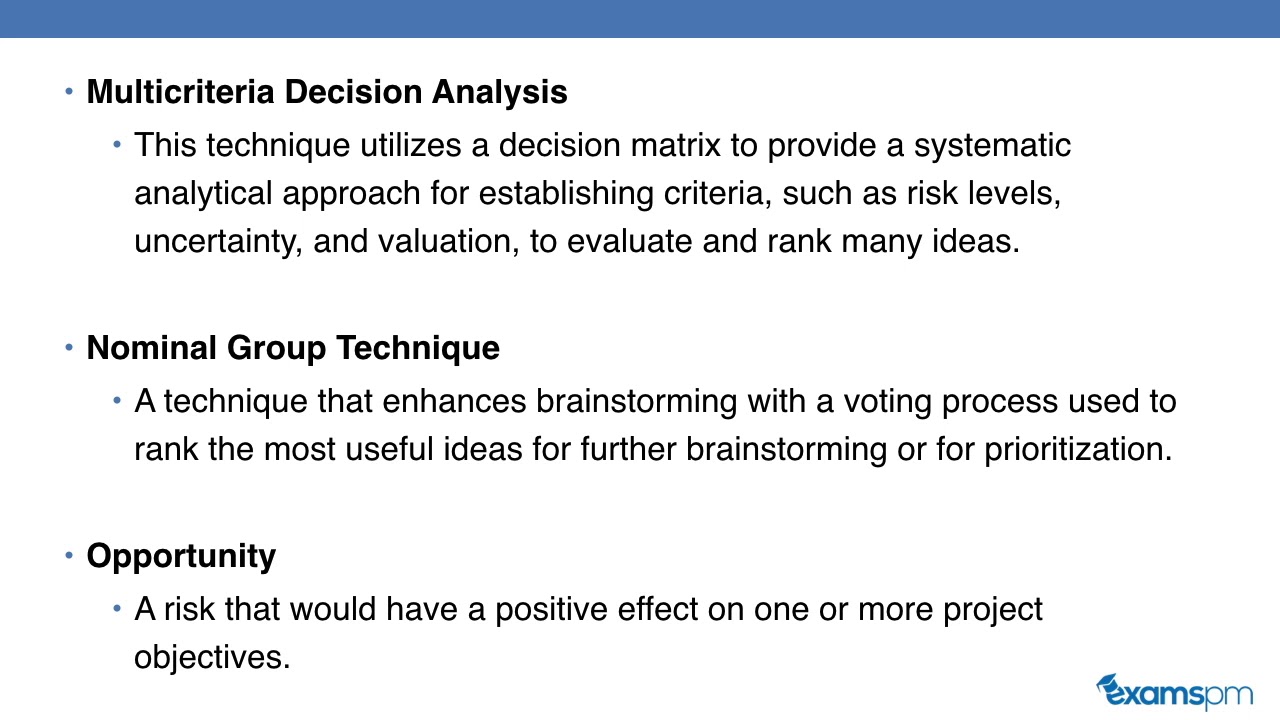
Hello and welcome. In this video, we're going to do part 2 of the PMBOK 6th edition glossaries. And before we jump into all of the definitions, I just want to remind you, if you haven't signed up for a free course yet, please sign up on this URL, www.exampm.com/free, where we will teach you how to obtain your PMP or your CAPM certification in the next 6 weeks. All right, now let's dive into part 2 of our PMBOK glossary. So the first term is knowledge, which means a mixture of experience, values and beliefs, contextual information, intuition, and insight that people use to make sense of new experiences and information. Lag is the amount of time whereby the successor activity will be delayed with respect to the predecessor activity. In other words, it's the amount of time in between 2 activities. Sometimes in your schedule, one activity doesn't happen immediately after the other one has been completed. Late Finish, or LF, is in the critical path method the latest possible point in time where the uncompleted portion of the scheduled activity can finish based on the schedule network logic. Next, we have the Late Start Date, or the LS. In the critical path method, this is the latest possible time that an uncompleted portion of the scheduled activity can start based on the schedule network logic. So in other words, this is the latest time a specific activity can start without delaying the completion date of the project. Lead is our next term. This is the amount of time whereby the successor activity can advance with respect to the predecessor activity. Lessons learned is the knowledge gained during the project, which shows how project events were addressed or should be addressed in the future for the purpose of improving future performance. Lessons Learned Register is where you will store all of your lessons learned. This is the project document used to record the knowledge gained during the project and is stored in a repository so that future project managers can take a look at them. LOE, or the Level of Effort, is an activity that does not produce definitive end products and is measured by the passage of time. Logical relationships is a dependency between 2 events or between an activity and a milestone. Make or buy analysis is a process of gathering and organizing data about product requirements and analyzing them against available alternatives including the purchase or internal manufacture of the product. In other words, this is where you assess whether it would be less costly for you to just buy it from an external vendor or to make it in-house, and you do the pros and cons of both approaches before moving ahead and making a decision for your project. The next term is managed communications. Managed communications is a process of ensuring timely and appropriate collection, creation, distribution, storage, retrieval, management, monitoring, and the ultimate disposition of project information. Management reserve is an amount of the project budget or the project schedule that's held outside of the performance measurement baseline for management control purposes that is reserved for unforeseen work that is within the scope of the project. So basically, it's a reserve that is used when an emergency happens on the project. So you may put aside some time or some budget aside to deal with emergency situations that may happen on your project. Management skills is the ability to plan, organize, direct, and control individuals or groups of people to achieve specific goals. Manage project knowledge is the process of using existing knowledge and creating new knowledge to achieve the project's objectives and contribute to organizational learning. Manage quality is the process of translating the quality management plan into executable quality activities that incorporate the organization's quality policies into the project. Manage stakeholder engagement is the process of communicating and working with stakeholders to manage their needs and expectations, address issues, and foster appropriate stakeholder involvement. Manage team is the process of tracking team member performance, providing feedback, resolving issues, and managing team changes to optimize the project performance. Mandatory dependency is a relationship that is contractually required or inherent in the nature of the work. So for example, you can't start building a house without digging the foundation first. So digging the foundation, that activity has to happen before you can build a house, and in other words, this is a mandatory dependency. Matrix organization is any organizational structure in which the project manager shares responsibility with the functional manager for assigning priorities and directing the work of the person assigned to the project. If you think about matrix, you can also think 2 bosses, so the person doing the work is responsible for delivering upon the project work as well as the work in their functional department. Milestone is a significant point or event in a project, program, or portfolio. Mind mapping is a technique used to consolidate ideas created through individual brainstorming sessions into a single map to reflect commonality and differences in understanding and to generate new ideas. Monitoring and controlling project work is the process of tracking, reviewing, and reporting overall progress to meet the performance objectives defined in the project management plan. In other words, in this process, you're comparing what the plan says to what actually happened on the project to see if there is a deviation. If there is one, then you may need to issue a change request. Monitor communications is the process of ensuring that the information needs of the project and the stakeholders are met. Monitoring and controlling process group includes all of those processes required to track, review, and regulate the progress and performance of the project, identify new ideas in which changes to the plan are required, and to initiate the corresponding changes. Monitor risks is the process of monitoring the implementation of agreed-upon risk response plans, tracking identified risks, identifying and analyzing new risks, and evaluating risk process effectiveness throughout the project. Monitor stakeholder engagement is the process of monitoring project stakeholder relationships and tailoring strategies for engaging stakeholders through the modification of engagement strategies and plans. Monte Carlo simulation is an analysis technique where a computer model is iterated many times with different input values chosen at random for each iteration in order to compute the probability distribution. Multi-criteria decision analysis This is a technique that utilizes a decision matrix to provide a systematic analytical approach for establishing criteria such as risk levels, uncertainty, and evaluation to evaluate and rank many ideas. Nominal Group Technique is a technique that enhances brainstorming with a voting process used to rank the most useful ideas for further brainstorming or for prioritization. Essentially, you would do brainstorming like normal, and then you'll give everyone a certain amount of points and then they would be able to allocate their points to the ideas that they like the most. And this is a way for you to enhance and vote upon the ideas that came out of the brainstorming session. An opportunity is a risk that would have a positive effect on one or more of the project objectives. Our next terminology is organizational breakdown structure or OBS. This is a hierarchical representation of the project organization, which illustrates the relationship between the project activities and the organizational units that will perform those activities. Organizational process assets include the plans, processes, policies, procedures, and knowledge bases that are specific to the specific organization that you're operating in. So as a project manager, you need to respect the policies and procedures that are already in place in the organization that you're managing the project for, and that's is what organizational process assets are. Output is our next terminology, and it refers to the product, result, or service that's generated through a process. It may be an input to a successor process. Parametric estimating is an estimating technique in which an algorithm is used to calculate cost or duration based on historical data and Performance review is a technique that is used to measure, compare, and analyze actual performance of the work in progress on the project against the baselines. Perform integrated change control is a process of reviewing all of the change requests, approving changes, and managing changes to deliverables, organizational process assets, project documents, and the project management plan. It is also the process where you are communicating the to stakeholders. Perform qualitative risk analysis is a process of prioritizing individual project risks for further analysis or actions by assessing their probability of occurrence and impact, as well as other characteristics. Perform quantitative risk analysis is the process of numerically analyzing the combined effect of identified individual project risks and other sources of uncertainty on overall project objectives. The difference between qualitative and quantitative risk analysis is that qualitative risk analysis comes first. This is where you would prioritize all of your risks based on maybe high, medium, or low probability and high, medium, or low impact, and then you would then have some sort of metric that allows you to filter out how you would assess or how you would assign those kind of priorities, those qualitative priorities, to these risks. And then what happens next is that for the high-priority risk, you would perform the quantitative risk analysis because this is a bit more consuming. This is where you would actually quantify, okay, if this risk did happen, how many weeks will my project be delayed and how much would it actually cost me? Not just that it would be a high amount, but what is the actual dollar value that would cost me if this risk did happen? So that's the difference between qualitative risk analysis and quantitative risk analysis. Our next term is phase gate. It's a review at the end of the phase in which a decision is made to continue to the next phase, to continue with modification, or to end the project or the program. Planned communication management is the process of developing an appropriate approach and plan for project communication activities based on the information needs of each stakeholder or group, available organizational assets, and the needs of the project. Planned cost management is the process of defining how the project costs will be estimated, budgeted, managed, Planned value is the authorized budget assigned to the scheduled work. Planned procurement management is the process of documenting the project procurement decisions, specifying the approach, and identifying the potential sellers. Planned quality management is the process of identifying quality requirements and/or the standards for the project and its deliverables and documenting how the project will demonstrate compliance with quality requirements and standards. Plan resource management is the process of defining how to estimate, acquire, manage, and utilize physical and team resources. Now I know we're seeing a lot of plan processes, and that's usually the first process in a knowledge area. So generally in the plan processes, so plan quality, plan resource, Plan procurement, whatever. That's when you're figuring out how you're going to do all of the other processes within that knowledge area. So you're just planning out how you're going to do all those processes in those knowledge areas before you actually dive in and actually do those processes. Now our next one, similarly, plan risk management. This is where you're going to plan out how you're going to do all of the other processes within risk management. So it's a process of defining how to conduct risk management activities for the process. Plan risk responses, like its name suggests, is the process of developing options, selecting strategies, and agreeing upon actions to address the overall project risk exposure. So how are you going to respond to risks that may happen on your project? Plan schedule management is the process of establishing policies, procedures, and documentation for planning, developing, managing, executing, and controlling the project schedule. In other words, this is a process where you're planning out how you're gonna manage the schedule on your project. Plan scope management is the process that documents how the project scope will be defined, validated, and controlled. Plan stakeholder management is a process of developing approaches to involve project stakeholders based on their needs, expectations, interests, and potential impact on the project. A portfolio is a group of projects, programs, or subsidiary portfolios and operations managed as one group in order to achieve strategic objectives. For example, if every single project had their own HR department, that could be a duplication of resources, so in order to save on cost, it could make sense to have HR as a centralized function of the portfolio so each single project don't need to have their own HR personnel. Precedence Diagramming Method, or PDM for short. This is a technique used to constructing a schedule model in which activities are represented by nodes and are graphically linked by one or more logical relationships to show the sequence in which the activities are to be performed. Predictive life cycle is a form of project life cycle in which the project scope, time, and cost are determined in the early phases of the project life cycle. Probability and impact matrix— this is a grid for mapping the probability of the occurrence of each risk and its impact on project objectives and If that risk occurs. A procurement audit is where you will review your contract and all of your procurement processes for completeness, accuracy, and effectiveness, and to see if there's any way that you can improve upon your contract or the processes that are involved in signing that contract. Procurement document is the document utilized in bid and proposal activities, which include the buyer's invitation for bid, invitation for negotiation, request for information, request for quotation, request for proposal, and the seller's responses. Procurement management plan is a component of the overall project or program management plan that describes how the project team will acquire the goods and services from outside of the performing organization. The procurement statement of work describes the procurement item in sufficient detail to allow prospective sellers to determine if they're capable of providing the product/service or result. The product lifecycle is a series of phases that represent the evolution of the product from conception through delivery, growth, maturity, and to retirement. The product scope includes the features and functions that characterize the product, service, or result. Progressive elaboration, the iterative process of increasing the level of detail in the project management plan as greater amounts of information and more accurate estimates are available. So the project management plan is not a plan that you just do once and you forget about it. Over time, you're continuously adding to it as you get to know more and more information. A project is a temporary endeavor undertaken to create a unique product, service, or result. The project charter is a document issued by the project initiator or the project sponsor that formally authorizes the existence of the project and provides the project manager with the authority to apply the organization's money and resources to accomplish the project activities. Project communication management is a knowledge area that includes the processes required to ensure timely and appropriate planning, collection, creation, distribution, storage, retrieval, management, controlling, and monitoring, and ultimate disposal of project information. In other words, it includes all of the processes related to everything that you need to know about project information. Project cost management is the knowledge area that includes the processes involved in planning, estimating, budgeting, financing, funding, managing, and controlling costs so the project can be completed within the approved budget. Project governance includes the framework, functions, and processes that guide project management activities in order to create a unique product, service, or result to meet organizational strategy and operational goals. Project integration management is the knowledge area that includes the processes and activities to identify, define, combine, unify and coordinate the various processes and project management activities within the project management process groups. In other words, this is the glue that's putting all of the other processes together. This is where you integrate and unify the entire project and all the activities into one place in order to accomplish the project's deliverables. The Project Management Book of Knowledge, in other words, the PMBOK, includes the proven traditional practices that are widely applied as well as the innovative practices that are emerging in the profession. This is what the PMP and the CAPM certification is based on. It's based on the Project Management Book of Knowledge. Project management information system is an information system consisting of the tools and techniques used to gather, integrate, and disseminate the outputs of the project management processes. Project management knowledge area is an identified area of project management defined by its knowledge requirements and described in terms of its component processes, practices, inputs, outputs, tools, and techniques. The Project Management Office, or the PMO, is a management structure that standardizes the project-related governance processes and facilitates the sharing of resources, methodologies, tools, and techniques. The project management plan is a document that describes how the project will be executed, monitored, controlled, and closed. Project management process groups is a logical grouping of project management inputs, tools and techniques, and outputs. There are 5 process groups which include initiating, planning, executing, monitoring and controlling, and closing. It's important to note that the project management process groups are not the project phases. In every phase, you have to go through these 5 process groups. Project procurement management is a knowledge area that includes all the processes necessary to purchase and acquire goods and services from teams that are outside of your project team. This is vendors that you may need to bring on board to help you accomplish the project's objectives. Project Quality Management is the knowledge area that includes the processes for incorporating the organization's quality policies regarding planning, managing, and controlling the project and product quality requirements in order to meet the stakeholders' expectations. Project resource management is a knowledge area that includes the processes used to identify, acquire, and manage resources needed in order to complete the project successfully. Project risk management is the knowledge area that includes the processes of conducting risk management planning, identification, analysis, response planning, response implementation, and monitoring of the project risks. The project schedule is an output of the schedule model that represents linked activities with planned dates, durations, milestones, and resources. Project schedule management is the knowledge area that includes the processes required to manage the project to be completed in a timely manner. Project schedule network diagram is a graphical representation of the logical relationships among the project schedule activities. Project scope is the work performed to deliver a product, service, or result with the specified conditions and functionalities and features. Project schedule management is the knowledge area that includes the processes required to manage the timely completion of the project. The project schedule network diagram is a graphical representation of the logical relationship among the project schedule activities. In other words, this diagram will show you which activity comes first, which one follows, and which one follows after that, so it shows you the sequence of the activities. The Project Scope Management knowledge area includes the processes required to ensure that the project includes all of the work required and only the work required to complete the project successfully. Remember that gold plating is not allowed by the PMI. It's not a proper way to manage your projects. All changes must go through the formal change control processes. The project scope statement is a description of the project scope, the major deliverables, what's in it, what's not in it, the assumptions, and the constraints that you are making. Project stakeholder management is the knowledge area that includes all of the processes required to identify the people people, groups, or organizations that could impact or be impacted by your project, to analyze the stakeholder expectations and their impact on the project, and to develop an appropriate management strategy for effectively engaging stakeholders in the project decision and execution. The project team is a set of individuals who support the project manager in performing the work of the project achieve its objectives. So these are the people who are actually doing the work to accomplish the project deliverables. Proposal evaluation techniques— this is the process of reviewing proposals provided by suppliers to support contract award decisions. Prototype is a method of obtaining early feedback on requirements by providing a working model of the expected product before you actually have to build it. And this brings us to the end of Part 2 of our PMBOK 6th Edition glossary. I hope you learned a lot throughout this lecture about the different terminologies that you need to know for your upcoming exam. And this is just a friendly reminder to sign up for our free course where we will teach you how to get your PMP or your CAPM certification in the next 6 weeks. The link is www.exampm.com/free. Thank you so much. Thank you. Much for joining me today, and I will see you in our free training.
More from Helena


How to Use Claude Code to Get UNLIMITED Leads in 6 Mins | Best Lead Scraping Tool



These AI Videos Has 21.5M Views — Here's the Exact System (Fable 5 + Higgsfield)




NotebookLM 2.0 Update: Analyze Your Entire Business in Minutes! (Full Tutorial)

