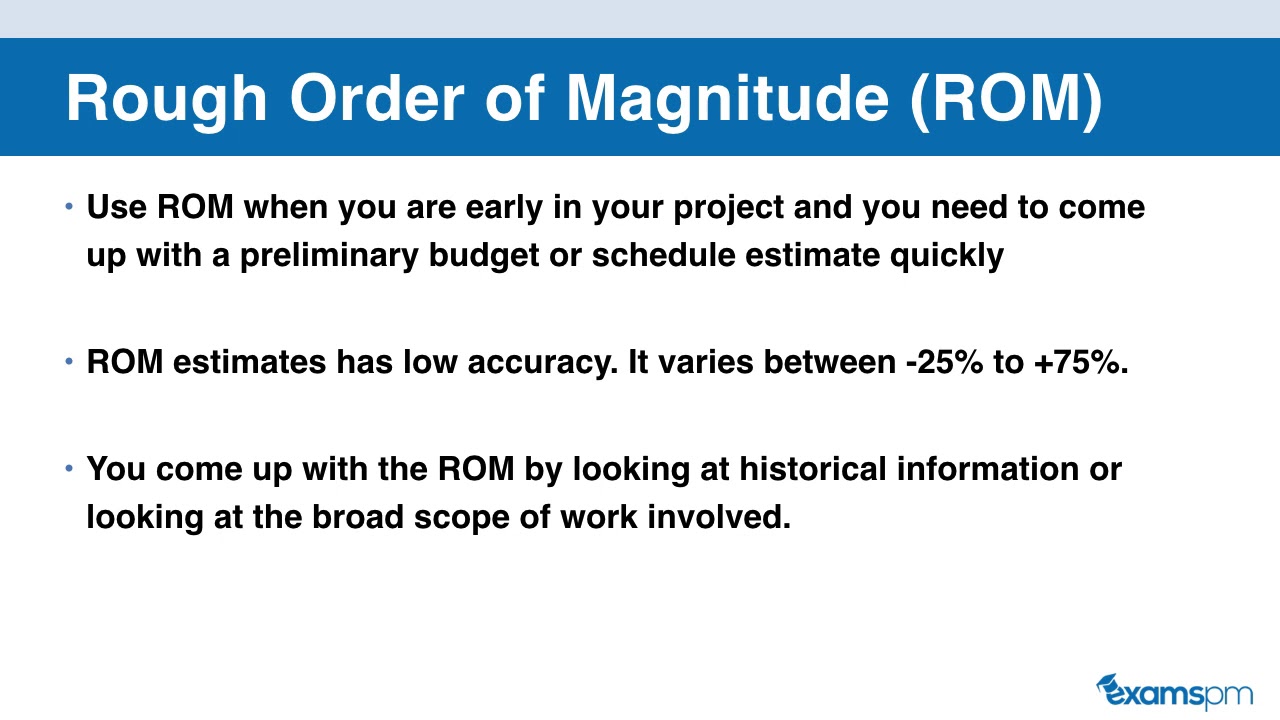
In this PMP exam tips video, Helena Liu explains the distinction between Rough Order of Magnitude (ROM) estimates and definitive estimates. She describes when to use ROM—early in a project for quick, low‑accuracy budgeting or scheduling, typically ranging from -25% to +75% accuracy and derived from historical data or broad scope assessments. She then outlines definitive estimates—used later when detailed scope information is available, offering higher accuracy (-5% to +10%) but requiring more time and resources. Liu highlights the trade‑off between speed and precision, emphasizing that ROM is fast but imprecise, while definitive estimates are slower but more reliable. The video also includes a promotional call‑to‑action for a free six‑week PMP training program at examspm.com/free, aimed at both newcomers and repeat test‑takers.
Chapters
Hello and welcome to Examspm's PMP exam tips series. In this video, we are going to explore the difference between the rough order of magnitude versus a definitive estimation. And if you like training and you want to learn how you can pass your PMP certification in the next six weeks, be sure to sign up for a free training at www.examspm.com/free. I'll also leave the training link right below this video as well. I promise you, in this one half hour training, you are going to learn like just. Everything you need in order to create a plan for success in order to pass your certification in the next 6 weeks. Okay, with that being said, let's jump right into this video and explore the difference between the ROM and definitive estimations. Let's start off by taking a look at the ROM, or the rough order of magnitude. So you want to use the ROM when you're very early in your project and you need to come up with a preliminary budget or schedule very quickly. So you just want something rough and dirty. You want to know how much is this project going to cost you and how much time will it take to complete it. So the ROM estimates are generally pretty low in accuracy. It can vary between -25% to +75%. And you come up with a ROM by looking at historical information, by looking at projects that your company may have done in the past that are similar, or you just look at the broad scope of work that needs to be completed in order to complete the project. Because the ROM doesn't take a lot of time to produce, it's also not very accurate as well, but it is quick to produce and it gives you a rough idea about how long and how much it will cost in order to finish the project. Now, once you get deeper into the project, you have your definitive estimates. You use definitive estimates when the management team needs more accurate cost or time estimations. When you're further along in your project and you have more accurate and detailed information about the scope of work and the cost associated with the scope of work, then you want to create your definitive estimates. It does require more time to produce the definitive estimations than it does to produce the ROM estimations, but the accuracy is also higher here as well. The accuracy of definitive estimates are between -5% to +10%. So the trade-off here is that the ROM is really easy and really quick to produce, but it's not very accurate. But the definitive estimations will take more resources and more time to produce, but it is a more accurate. If you want more PMP exam study tips, be sure to check out our free training at www.examspm.com/free where I will share with you exactly how you can get your PMP certification in the next 6 weeks. These strategies will work whether you have never touched the PMBOK before and you are brand new to the PMP exam, or if you have tried in the past and didn't clear it on your first try, these strategies are going to help you get back into alignment and pass in the next 6 weeks. I can't wait to see you on this training. Thank you so much for joining us today.