The Right Way to Do Retail and Wholesale Pricing (Make More Money FAST)
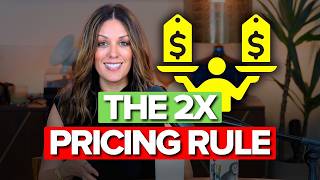
Jacqueline Snyder walks through a 2×2 pricing formula: multiply your cost of goods by 2 for wholesale price, then by 2 again for retail. If your costs feel too high, source materials at business scale and streamline labor instead of cutting quality. Aim for at least a 3× retail multiple on COG before moving to wholesale.
Chapters
Stop guessing your price and use this simple profit formula. If you sell a physical product and you've ever thought, "I have sales, but where is the money?" or "I don't know if my prices are right," then this video is going to fix that fast. Because the goal of pricing isn't just to make a sale. The goal is to be profitable after the cost of doing business. So today I'm going to walk you through the exact way that I teach pricing using a simple structure, the cost of goods times 2 for wholesale, and then times 2 again for retail. Retail. And yes, there are nuances depending on your brand and your market, but if you're not doing at least this, you're usually underpricing. So here's what you'll walk away with in the next few minutes: what cost of goods actually includes, the simple 2x2 pricing math for wholesale and retail, and what to do if the math doesn't work yet without lowering your quality or changing your whole product line. Alright, let's do this! First, your price starts with the cost of goods. And I need you to hear this part. Cost of goods is not just materials. Cost of goods is everything that an individual unit requires to exist. So when I say cost of goods, I mean raw goods and labor and packaging and anything that one unit requires. It's not your rent, it's not your marketing, and it's not your website subscription. Those are operating expenses. Cost of goods is what it costs to make one unit. So let's do a simple example. Let's say you sell a necklace and let's say that necklace costs $10 total to make. That $10 includes your materials, your packaging, and your labor to make one necklace. Now here's the simplest pricing math. Cost of goods times 2 is your wholesale price. So $10 times 2 is $20. So that necklace will be $20 wholesale. And then wholesale times 2 is your retail price. $20 times 2 is $40 retail. That's it. That's the backbone. You start with your necklace. The cost of goods is $10. Wholesale is $20. Retail is $40. And I wanna reframe this for you. This isn't just about doubling numbers. This is about building enough margin into your products so that your business can actually operate, so it can actually be profitable. Because when you have the correct margins, you can pay for the cost of doing business, right? Your processing fees, marketplace fees, booth fees, without eating your business alive. So when you're priced right, you don't panic about fees. You operate from your margin. Now here's a quick nuance. Retailers sometimes are looking at markups that are more than times 2. They might be looking at 2.2 or 2.3. So depending on your product category and the wholesale to retail relationship, that can flex. I also wanna say that my students inside of the Product Boss programs, we talk about the nuances of each category. So while I'm giving you a really simple formula here, cost of goods times 2 to wholesale, times 2 to retail. There are nuances where I will have students go from their cost of goods times sometimes 2.2, 2.3, they might even go times 3, 4, 5 depending on what their brand is. But simple, simple, simple math for you to use here. If you're going by the times 2, times 2 markup, you will be profitable. But I don't want you going lower than this foundation. If you're under that, you're usually trying to make your product affordable by sacrificing your profit. And that will always catch up with you. That's why there's no money left in your pocket or in the bank. Now here's the reframe because this is where a lot of makers will get stuck. So if you're a maker, ears up. You run the math and you go, "Cool, but my cost of goods is feeling too high or my labor is too high." So you think that the retail price goes up and it's insane. This is so common, especially for makers who are still sourcing materials at near retail prices. Or maybe you're getting a slight discount, or perhaps you're doing all the production alone or doing the production of one unit at a time. So let me tell you what I told a student today. She makes bags and her fabric cost was really high because she was buying the fabric basically at retail prices, even with a small discount. So her fabric was priced at over $10 a yard. Now, when she looked at the labor, she said it takes about 3 hours to make one of these bags. So when we priced it like a real business, the math started pointing her to a retail price that didn't make sense for her current market. And what I want you to listen to carefully here is what I did not tell her. I did not tell her to change her bag design first. I did not tell her to lower the quality of her making process. I did not tell her to cheapen her product. Because that's how brands lose customers. That's how brands lose profit and a foothold in the market. So what we looked at instead was how do we reduce the cost of goods without changing what makes the product so special? And there are two levers you almost always have that you can pull. Lever one is sourcing. Where are you buying your materials? And are you buying like a business or like a consumer? We really want the lowest cost for your materials because if you're buying at prices meant for end customers, your margins will always feel tight. So one of the first questions is, is what is the lowest cost we can responsibly get for raw goods while keeping the quality where it needs to be? Lever 2 is process. Now makers may often be creating one unit at a time, and manufacturers create in batches. We actually create in minimums. So when we look at labor, we're not asking how long does it take me when I do it the way I've always done it? What we're really asking is, how do we build a process where time per unit comes down as you make more units? Because the more units that you make at once, the lower labor costs become per unit. Same person, same product, same design, better process. And here's why I'm teaching you this. If your pricing math feels impossible, it's usually not the pricing that's wrong. It's the cost structure that needs to mature. That's why I'll say this really clearly. Sometimes you're not ready for wholesale yet. Not because your product isn't good, but because your cost of goods hasn't come down enough to support wholesale margins. So if wholesale doesn't work yet, here's what the baseline is that I want you to aim for. At a minimum, can you get to 3 times your cost of goods for retail? Ideally, can you get 4 times cost of goods for retail, right? The better and bigger your margins, the better it is for you and your business. Because 4 times cost of goods is what naturally supports the simple model. Cost times 2 for wholesale, times 2 for retail. Now I want you to zoom out and give you the bigger truth about pricing. Pricing is math. And as my life coach says, math, not drama. And your pricing also goes behind your brand. Yes, your cost of goods matters. Yes, your margins matter. But the retail price is not always a perfect reflection of your cost. Because people don't only pay for the materials, they pay for positioning, they pay for brand, and they pay for meaning. That's why a Chanel bag can sell for $10,000. It's not because it costs them $2,500 to make it. It's because the brand stands alone. And I'm not saying that you need a price like Chanel. It's just that I'm saying don't let your brain tell you there's a cap. I'm gonna give you an example really fast. I have two candles in front of me right here, okay? They both are made out of vessels. They have wax, a wick, and the scent that's inside, okay? So what's the difference between these two candles? It's the brand. This candle retails at $35, This candle retails at $380. One is about the brand, the other one is about the candle. So there is no cap. You can just change the way that you want to be reflected in the marketplace. If your brand is positioned right and the customer matches it, you can sell a candle with the same amount of wax and a wick and scent for $380, or you can sell it for $35. So here's the whole lesson put together for you as we wrap up this video. I want you to start with solid margins so that you are profitable. Then build the brand so that your market understands your value. Because the opposite, which is trying to brand your way out of bad margins, is really, really painful. Okay, so let's recap the simple formula, and then I'll give you one final gut check. Step 1, calculate your cost of goods, which are your raw goods plus labor, packaging, and anything else that you're doing per unit. Step 2 is multiply that cost of goods by 2 for your wholesale price. And then step 3 is multiply your wholesale price by 2 for your retail price. Remember, this is a very blanket statement, but if you're going by these numbers, then it is going to work for you and you can always play with bigger margins. And if your wholesale pricing does not work yet, your action is not to panic. It's not to lower your prices or lower your quality. It's just that right now you may not be ready for wholesale, so you wanna work on bringing down your cost of goods through sourcing and process. And temporarily, you might have a retail price that's closer to 3x versus 4x while you mature your business. Okay, so now a quick gut check. If you are scared to raise your price because you think sales will stop, I need you to ask yourself this: would you rather sell fewer units profitably or more units while you quietly lose money and burn out? Because underpricing doesn't just hurt your bank account, it hurts your energy, it hurts your joy, it hurts your ability to stay in business long enough to win. So my friend, stop guessing. Price for profit first, then grow the brand. And if this was helpful, make sure that you subscribe to this channel and leave a comment with your product type, okay? So let me know, do you sell candles, bags, jewelry, accessories? Because I can make more examples about pricing in other videos and walk through the math for your category. And I'll see you in the next video.