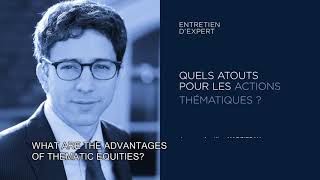
Speaker Series - Jacques Marcireau

Jacques Marcireau manages the Edmond de Rothschild Big Data Fund, betting that data abundance is a durable investment theme. He sees AI as overvalued in the short term, argues that only some chip and software winners will sustain earnings, and favors companies with proprietary data in insurance, healthcare, and vertical software.
Chapters
Foreign.
Thank you, everyone, and welcome to this week's speaker series. I'm happy to be joined today by Jacques Aurelion Marsero. Did I pronounce that correctly? Jacques?
It was perfect. Was it?
Okay, I. I hope you're just not being generous with that, but thank you. So thank you for joining us today. I know you're joining us from Europe, so I know that it is a bit late for you, but still happy that you were able to join us. So it's. Jacques is the portfolio manager of the EDRF big Data fund. Jacques, you want to give us a very high level what it is that your fund is invested in and focused on.
Sure. So, first of all, thank you very much for having me. So I've been covering tech for the last 14 years, and a bit more than eight years ago, I did create a fund which is about capitalizing on the potential of data, big data. And as you know, everything today runs on data, especially all the algorithm we talked about. So this is what we did eight years ago and with some success. And we believe this is just getting started as far as this thematic is concerned.
Exactly. So we're just getting started here. Now, why data as a thematic? Because it seems to some observers might say, well, at some point this is like saying, you know, this is going to be so pervasive that how can you just segregate a whole theme around data when it's going to become so pervasive? What's your, what's your answer to that?
First of all, I would tend to agree with you. We use the term big data to describe the fact that we went from data scarcity to abundance in just a decade. But our children and grandchildren, they will never talk about big data because it will be everywhere and they will have all of the development that come with it. But if you think just for one second about Google and Facebook, two of the most powerful companies on earth, what do they do? They just organize the data. Then you and I and the people listening to us create. Google didn't create the web, just organize a link between website. Facebook did not create. Your friends just organize content they create so that you spend a lot of time. And the more data they get, the more powerful their service. The more powerful service, the more you use it, the better that data, the more powerful, etc. You see, there's a virtuous cycle at play with data that of course works for Facebook and Google, but could work for many companies. So to your point, yes, data will be pervasive and we are learning to Create value with it. And of course Google, Facebook, we are the pioneers. But much more to come, I believe.
Okay, so, so let's, let's quickly jump to what's perhaps the most obviously talked about part of your world right now, which is artificial intelligence. We know that ever since GPT4 came out late last year, there's been a, a plethora of money that has poured into this space. Everyone is trying to bend over backwards to say artificial intelligence as many times as they can in their earnings calls, hope, hoping that it gets them the, the, the, the right amount of investor support. So what, what give us, give us your overall view of artificial intelligence? Is it, do you see immediate gains in productivity? Do you see immediate sort of gains in, in profitability for some of these companies? What are some of the winners? Besides the obvious names that have done very well this year, what are some of the secondary and tertiary winners? Are there? So kind of give us your brief overview of the space.
Sure, that's a great question and we try to answer in a few minutes and not talk hours about it. AI has been around for a few years, but AI really came to the public eye thanks to ChatGPT. So it is more evolution than a revolution. That did happen just a few months ago, a few quarters ago. So that's maybe my first point. And my second point is as human being we tend to always overestimate in the short term, underestimate in the long run. And this is exactly what is happening with the markets. Meaning that everybody is thinking that AI is tomorrow, it is today and it will continue to happen, but there will not be a big bong in just a few quarters. Just think about autonomous driving for people that listen to us. In 2015, 15 we also YouTube video of self driving car in San Francisco, in Shanghai, whatever. And in 2017 even very respectable companies like for General Motors or even Lyft, which is, you know, Uber competitor in the U.S. they told us we will mass produce autonomous vehicle by 2021. Where are they? And where is Elon Musk autonomous driving features? It is progressing, it takes more time but autonomous driving will be there one day. AI will be there. We need to be patient. So to your point, maybe it's a bit over excitement. This is why when it comes to investing, people have to be very like down to earth and care about valuation, what the true state of the technology is. And one last point, maybe you can talk more about that is that all these models that we heard about like ChatGPT, Google, Bard, Entropy, Coil et cetera et cetera. They are never stronger than the data they are trained upon. Meaning that at the end of the day, this is a limiting factor and this is where most of the value will be.
Okay, so, you know, there is, especially at the beginning of the year, there's obviously a high concentration of performance and attention on, you know, six or seven names. You know, the big companies that have access to big data, that have access to the money and capital that's required to run these large language models, which as you all know, requires billions of dollars in invested capital because these GPU clusters are very expensive. So names like Nvidia, Microsoft, Google, those have been the, the main beneficiaries up to this point. Do you continue to see this sort of winner take all, let's say, investment process kind of working stuff out, or do you think that this is going to be expanding to secondary and tertiary players as well?
Sure, I mean we, we need to, to make a difference between Nvidia, Microsoft, Google, etc. Together they all benefited from a dual trend. Which is the first one is of course they are perceived to be beneficiary of AI. But this alone does not explain the rally year to date. If you look at the rally, it really started in March. Why? Because investors were looking for safe haven and tech is considered to be a safe haven. But if then you tell investor you can have a Safe Haven and AI in the same stocks, haven stocks. This is why 1 plus 1 is not equal to 2, but to 3 or to 4 and to 5. And this is why all these names are up 44, 0 to 50% 50 year to date. Because this is combination of safe haven and perception of AI. But not all of them will benefit equally from AI. And not all of them are truly safe haven at the end of the day. This is why we need to draw a distinction. And Nvidia for now is a real beneficiary of AI with tangible earnings to speak of. And Nvidia is living an interesting moment because maybe Nvidia is the next Apple because of their vertically integrated approach where they control everything, the software, the hardware, the networking, everything. Maybe it will work. But Remember Apple had two timing story that the MacBook where they were like 5% of the whole market with their vertical approach, and the iPhone where they are more than 50% of the market in value. So the jury is still out, but clearly Nvidia has a head start and the others are more benefiting from, let's say, people thinking that they will win, but they have still a lot to prove. So I would draw a distinction between Nvidia and the six others. Right.
And from your vantage point, when do you think, let's say other companies that don't derive direct revenues or earnings from either the use or build out of generative AI, when do you think that other companies can start seeing some of the productivity and profitability enhanced, enhancing aspects of the adoption of the technology?
Sure, sure. Just before I answer your question, I'd go back to the previous one to tell you something that I believe is important. More than eight years ago, when we started the fund, Nvidia was a top five position of ours and it was trading at a PE of 1.8 18 times. But at this time, all the most respected sell side analysts on earth would tell you that intel was going to tell to kill Nvidia and integrating a GPU into the cpu, meaning that the graphic card would be like a commodity. This is why it was cheap. And look at what happened eight years later. Nvidia is 10x, the market cap of Intel 10x. Which tells you that people don't really know. At the end of the day. This is why we need active management and we need to carefully monitor development. So I would guard investors thinking, okay, I buy Nvidia for my grandchildren because in eight years things might be quite different from today. Even though Nvidia is a head start. Sorry for the digression, but I totally.
All right. I think it's a very valid point. I'm glad you brought it up because the future is truly unknowable. Right? So it's good that you bring that up because you're absolutely right. Most people thought that intel would swallow up Nvidia and it's been quite the opposite.
Right.
At some point Nvidia might just take out Intel.
Some people speculate this might happen because the only thing Nvidia doesn't have is manufacturing.
Correct.
And this is one of the last asset of intel is manufacturing footprint. So it could be a real possibility. But I don't want to spread the rumor here. That's right, it's just one person opinion that it could happen. But back to your question about AI. Of course everybody wants to invest in companies that will directly provide the tools for AI, like the database, like the gpu. But one should think about the fact that at the end of the day, since the algorithm is only as strong as the data, if you invest in a company that has a unique data set that is proprietary, maybe with a strong domain expertise, like, I don't know, a specific subset of insurance, then you have data that are not in the web, ready to be scrapped. This is the data that are unique to you, that if you use the algorithm and the gpu, right. That you use AI on your side, you can create a lot of value for yourself. So today the market is only looking at the obvious, meaning the one providing the technology, but the one adding the data and leveraging the technology might create even more value down the road, but will take maybe a few years to play out. Three, five years. But this would be one, one investment horizon.
No, you're absolutely right. So, so let me ask you this apart from AI, because I don't want to, I mean we could, like you mentioned, spend the entire call on this topic. It's, it's that important. But also that perhaps misunderstood I think too, right? Because you know, I, I've heard people say, well, are we a generalized artificial intelligence? And no, not quite there yet, but perhaps that could happen at any moment. Right. We don't know. But apart from AI, in which sectors do you see potential in this space? Specifically your sort of big data basket of companies?
Sure. So if I talk about tech first before going outside of tech, what we love the most today is verticalized software, meaning companies that do provide software, but not for everyone, software for a specific industry that the software provider really understand. For example, people that would be the leader in software for restaurants, they understand the business model of a restaurant, so they can really improve their CRM, their warehouse, all their management system and create a software that is really extraordinary. This is a bit the opposite of a salesforce that would create the same software and try to sell to everyone. So we like people that really have domain expertise and will be able to leverage this data down the road to improve even further. So we are big believer in this trend in software outside of software. We believe that insurance, especially insurance.
You said, sorry, insurance.
Yes, I said insurance. Because insurance, especially property and casualty insurance, is all about assessing a risk given the data you have and then you mutualize the risk on your injury base. So this player, their business is to use the data wisely. So AI and all these technologies can help them make their business even better, more efficient and structurally more profitable. And I mean this is not something widely told, but I believe this is maybe one sector that will benefit the most from a lot of what is talked about today in tech. So insurance we like in the longer term, maybe more, five to 10 years. Healthcare is really the sector where data will make a big difference both from, let's say, business model. Standpoint but also from a quality of life standpoint, meaning that if we can get to this predictive medicine that everybody has been talking about and personalized medicine, we will all be better off and only data and AI will lead us to that. But today we are still in the early innings. We see already some application like in radiology. We have been invested in a company which is not a startup. The founder is 80 years old, 8 0. He has the largest centers of chain of radiology centers in the US more than 300. And he bought a few AI startups saying, okay guys, you have the talent, I have the data, let's work together. And he's getting algorithm FDA certified for breast cancer recognition because if an algorithm can recognize a cat, why couldn't it recognize a cancer when seeing enough images of it? So we see some area of healthcare where it's starting to happen. It will take time, but we are really enthusiastic as on insurance and health care in particular.
Yeah, no, and, and that's funny that you bring that up because healthcare is one of our sort of preferred sectors here precisely because it has such a high exposure to quality as a factor, as a, you know, fama, French factor, you know, they tend to have high return on equities, high return on equity, low leverage and debt. So that is excellent. So before we jump into some questions from the audience and I'd like to remind everyone that if you do have questions for Jacques, please submit them via the chat or to me directly. I'd be more than happy to address them with him. Now, before we get into that, can we dive a little bit into your investment process? How is your team organized? How do you, how do you figure out which, which stocks fall under your investment universe, what sort of decision making steps you take? And then maybe you can end it with a couple of sort of key metrics of the fund over time. Sharp, a return, volatility, those types of things, maximum drawdown, those types of issues.
Sure, sure, I will do that in a few minutes. And just before, on your comment on healthcare, I strongly agree with what you said. And most of the time people think healthcare is a sector to hide, a defensive sector, but it is also a growth sector and an innovation one. So I think this is one that deserves maybe more respect from investors that sometimes consider healthcare just through the biotech angle or even more specialized angle, where healthcare should be seen as a galaxy and not just one planet. But to your point. So the way we do run the fund, two things. It is a thematic fund, but this is a core fund Meaning that the fact that we look at data and not only the pure tech names make the fund resilient through cycle. And history has shown that in 2016 bad year for tech or 2022, we did outperform MSA world. Not only tech, but MSA world. So we were really different because we are data fund, not a tech fund. And this fund operates with Rothschild DNA. Meaning that we are not here to be the best in any single year. We are here to sustain over the long term. So this is what we've been trying to do over the last eight years and this is how people should see us. And a metric of that to come to your point. 95% of companies in portfolio make money real earnings. Which is not the case of a lot of tech companies. Correct? Right. The P of the fund which is then representative because company make money is around 16 which is even slightly below global market. So we are very careful on free cash flow generation valuation while still having some good growth because the fund has been growing 15% give or take per year. So this is what we strive to achieve. It's not explosive growth. It's being a good steward of on this thematic with our DNA. And we are talking about what Roadside is as far as equity is concerned is concentrated portfolio less than 50 stocks holding for the long term three to five year on every name we have in average and fundamental analysis is core. And to answer free your question on the process, one thing I would highlight in a few minutes is we spend a lot of time and energy getting alternative data and meeting with experts on the ground. Meaning that I might not be the best to judge of a cybersecurity product or firewall, whatever. But if I can talk to 10 guys selling firewalls across the world, I can get a really interesting feedback that then I can cross with financial analysis and make a good decision out of it. So we have three people in the team with the help of 17 equity PM on the non tech part of the fund. So quite a collaborative work and we use these experts quite extensively to make sure that all risks approaches and is a strong one.
Excellent, Excellent. Okay, Jacques, I think we can go to a couple of questions here. The first question is what do you think about CDNs and Anet?
Thank you. Sure. These are two good questions. So I believe that CDNS is a company you can keep for the long haul. This is an oligopoly. It will always be needed. The only thing to care about is valuation because these tend to be cyclical names at the end of the day Even though their investor basis has broadened over the last few years. For me, CDNS is just a matter of valuation and how stretched you want to be with software names. But intrinsically it's a very strong company. Arista is a bit different. Arista relies a lot on two big customers and they are quite expensive. And you have some Taiwanese alternatives that are quite strong out there thinking about people like Acton in Taiwan. So I would say this is one where people have to be careful. And the stock has run up a lot because now it is perceived to be AI beneficiary, which it is. But it's not the end of the story. It doesn't rule out competition and more complex stuff down the road. You saw this morning there was a news where Google wants to get rid of Broadcom as a supplier for their chips for data centers.
I saw that, yeah.
I mean if kind of the same news happened to Arista where maybe Facebook or Microsoft want to get a bit more on their own, the stock would be under pressure. So this is one people need to monitor carefully because it is a well run company, good technology, not cheap anymore and you have this risk. So I would be more careful on this one.
Excellent.
And we don't own any of these two names by the way.
But you don't.
Okay.
Okay, good to know. So. So there's a bunch more questions have been coming in here. So let's get to it though because otherwise we're gonna run out of time. So what are your favorite stocks in the portfolio? Looking forward.
So one of my favorite stock, which is not a cheap stock by the way, is Guidewire software. So basically it is a global leader SaaS software as a service in PNC insurance sector. So basically this is a software that is the ERP of insurance. And because there's this global leader, it's a 5 billion market cap, so more of a mid cap. They see all of the data from insurers and they are the trusted partner for the long term, trading at 6 times sales, give or take. So quite cheap for a vertical leader. We believe this is a company that is well run and has a very long, let's say Runway of growth in front of it. So we like it for the very long term, not as a trade, more as an investment. It could be an attractive M and A target though. But that would be my favorite stock today.
Okay. Okay, next question here is how do you see the cybersecurity industry position in terms of growth and valuation?
Sure. So cybersecurity is, let me tell you one thing. If you take the top 10 names in cyber security that are listed, they make up, give or take 150 billion of market cap. So it's quite a big chunk. But most companies don't make money even today if you account for stock based compensation. So cybersecurity is a great sector, but it's an even better sector for the management team that makes a lot of money and employees. Right, right, right, right. So I think that's so great for shareholders, right? Yeah, it's not as great for shareholders. That's the issue. So we have some cybersecurity exposure. Especially last year we had two companies that were bought that were in cybersecurity, which name were Sailpoint and Forge Rock. Right now in cyber we are very careful. We prefer company like Booz Allen Hamilton in cyber defense that we own in portfolio are companies like Akamai, which are not pure play in cybersecurity, but it's more than 50% of their business 50 rather than the high flyer that are very expensive and not making earnings if you take them on GAAP accounting. So cybersecurity is a very tough sector because the trend is here, everybody can see it. And this is why a good trend is not necessarily a good investment. One need to be very careful. So we would maybe avoid the name too, let's say too visible. And I'm not mentioning company which name looks like a place in Silicon Valley. This one we would avoid.
Okay, okay. And I think we have time for one more question and we'll go over a little bit in time, but that's okay because we had some technical difficulties at the beginning. But sector wise, apart from healthcare and insurance and what other sectors are you exposed in your portfolio? Can you give an example?
Sure, sure. So we have also exposure to some banks, we have exposure to logistics because we believe this is an area where big data can bring big benefits. So clearly we are not like a three sector type of fund. It's much more diversified. I would take maybe the question the opposite. The only sector that we don't find, let's say opportunities to invest against as we speak is materials, utilities, staples and energy. We have one company in energy, but only one which is from Berger. So these are sectors that are underrepresented in the fund. And the way we invest we can do across the spectrum. We can go big cap, mega cap or even small cap, as long as liquidity is sufficient to run the fund properly.
Okay, and now the last question. Do you invest only in big caps? Are there any size limits? In the portfolio.
Sure. So I partly answered it, but there are no limits in term of market cap, even though all strategy is more than 2 billion euros as we speak. So a bit more in US dollar. So this is quite still this more in the great scheme of things. But we are careful not going into let's say 200 million market cap company now we are, we are very disciplined on liquidity but if we find opportunities even in small mid, we go for them provided they generate cash flow and we have a strong conviction on their path to profitability.
Excellent. Okay. So unfortunately we've run out of time, but we've also run out of questions. So it actually works out perfectly. So Jacques, thank you so much for joining us this evening. For you in Paris. Afternoon here, still with us in the United States, but still it was great to hear from you. So just you all know, just a recap, this is the Edmund de Rothschild Big Data Fund with Jacques has been managing since 2015. It is on the platform. Take a look at it. If you were interested in some of the topics and themes that Jacques was talking about. Jacques, do you want to leave us with some final thoughts or comments?
No, I think you got all the right questions. So thank you very much for and I'm happy that my daughter didn't wake up during the interview.
So excellent.
That's great. Everything was perfect, perfect, perfect.
All's well that ends well, as Shakespeare once said. So thank you so much Jacques. Have a good evening and take care everyone.
Insignia Financial Group, LLC comprises of a number of operating businesses engaged in the offering of brokerage and advisory products and services in various jurisdictions, principally in Latin America. Brokerage products and services are offered through Insignio International Financial Services llc, headquartered in Puerto Rico, and through Insignia securities llc, headquartered in Miami. Both are members of the Financial Industry Regulatory Authority FINRA and securities Investors Protection Corporation. Investment advisory products and services are offered through Insignia Advisory Services, llc, an investment advisor registered with the securities and Exchange Commission. In Uruguay, advisory services are offered through Insignio International Accessores de Emersion Uruguay SA, Insignio Accessores de Emersion LATAM and Insignio Accessores de Emification de Uruguay SRL in Argentina and through Insignia Argentina Argentina SAU and in Chile through Insignia Accessorias Financieras SPA. Collectively, these eight operating businesses make up Insignia Financial Group. To learn more about the broker dealers, including their conflicts of interest and compensation practices, please go to. Www.finra.org. to learn about Insignia Advisory Services and any conflicts related to its advisory services, please see its form, adv and brochure, which can be found at Investment Public Advisor Public Disclosures website HTTPs advisorinfo Sec.
Gov.
More from Jacques-Aurélien


Bulles, disruption, valorisations, l’approche d’Edmond de Rothschild sur les actions internationales


Entrevista al equipo de gestión de Renta Variable Europa de BBVA Asset Management

BIG DATA: UNA TENDENCIA MUY RENTABLE 💻 Jacques-Aurélien Marcireau (EdR AM) en Finect BIOS V