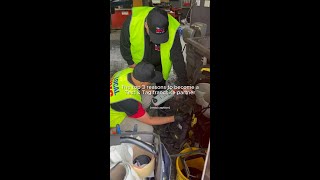
EP #28 - How a Cleaning Franchise Changed Their Life For the Better

In this episode, host Jarrad Goulding interviews Kim and Eva, a married couple who launched a Local Guys cleaning franchise in Auckland in May 2025. They share why they left retail jobs for franchising, the early nerves of their first month, and how they built a diverse client base that includes evening office cleans, laundromats, domestic homes, end‑of‑tenancy turnovers, and Airbnb short‑term rentals. They explain why end‑of‑tenancy jobs are their favourite, describing the pride of transforming lived‑in spaces. The conversation covers practical business habits – pre‑inspection visits, personalized quotes, time‑blocking admin, and using a “Would you like fries with that?” mindset for upselling. They discuss work‑life balance achieved through flexible scheduling, the importance of trust‑building gestures such as folding toilet‑paper, and how they generate recurring revenue by scheduling repeat domestic jobs and leveraging referrals from real‑estate agents, property managers, and Airbnb hosts. Revenue is now roughly 50‑60 % repeat business. They recount a challenging abandoned tenancy clean‑up and share two cleaning hacks: a mold‑treatment spray with cold water for shower doors, and Selleys cleaning gel with heat for oven interiors. The interview ends with gratitude and a promise to test the tips.
Chapters
Well, Kim and Eva, thanks so much for joining us.
Much appreciated.
I know we had a little bit of technical difficulties there, but we're good to go. You're obviously a married couple from Auckland in New Zealand in our cleaning division. Started in May 2025. Did you want to kick off by maybe telling us a little bit about yourself and what you did previously to joining The Local Guys?
Yep, no worries. So, um, Back in the beginning of 2025, I was working in retail at the time. The company I worked for went into receivership. So basically took the decision to work with the Local Guys, which has been an absolutely amazing experience so far. Great.
Great. No worries. And why did you decide to get out of sort of working as an employee and go into business for yourself?
Time I was working 70, 80 hours a week with two jobs. And basically, yeah, I wanted a change. And basically my wife and I looked at franchises that were out there and we chose The Local Guys. Great.
No worries. Did you have any sort of, do you remember what your first month was like? Do you remember that first lead that sort of came through and how you were feeling at that time?
Absolutely. So a bunch of nerves from the beginning. I think basically after that first job, we were away. We just lost all the fear and anxiety. So yeah, it just took that one first job. And then after that, we were, we were on fire.
Yeah, that one's always the scariest one, isn't it? I remember my very first job and it's like, I kind of had that big thing of imposter syndrome going out and doing a job. And I'm just like, I've got no idea what I was doing, but I knew more than the client and somehow you fumble your way through that first one and then you get in the car and you go, oh, it wasn't too bad actually. And then I think you look back and you go, oh, I probably could have done this little part better or I could have done that little part better or whatever. And then you just try and get 1% better every day and kind of go from there. What's been one of the biggest sort of challenges from the early days to getting up and running, do you think?
I think just maybe the system or the process, remembering, you know, what sequence to do everything. But as you get more practice and the nerves, you know, you're not feeling so anxious, I guess. But yeah, we're very cool, calm, and collected now. Yeah, no more nerves.
So what would you say the main makeup is of your different types of clients that you have? What's the majority of them or what are they broken up of?
So we have a mixture of office cleans, which we do in the evenings. So we have 3 clients for evening cleaning, which are basically, you know, workstations, kitchen area, bathroom areas, a little bit of laundry. And yeah, that's basically is keeping us busy about 4 nights a week.
Okay.
Yeah, then we have also some laundromats as well, which is basically 6 nights per week.
Wow.
That we do that.
Yep.
We have Sunday off. We celebrate our Sunday off by treating ourselves to a nice dinner somewhere.
Lovely. I love that routine. That's fantastic.
Yeah. And so you—
And then what about during the day?
You, we've got the end of tenancy cleaning and the domestic cleaning.
Yep.
Which is either the leads that we source or the leads that come through the call center.
Sure. Yep. And what would be the split on domestic versus end of tenancy? Is it 50/50 or tend to be more domestic or?
I'd say more, a little bit more than domestic. Possibly once a week we would get an end of tenancy.
Sure.
Yep.
Yeah. And what's your favorite type of client out of the 3 different categories?
Recently, actually yesterday, our neighbor that is moving out basically contacted the call center because my sign outside my house is actually working. Information from the sign and made contact and then we completed that job yesterday.
Wonderful. That's great. Good little bit of advertising there.
Yeah. So that worked very well.
Well done. Well done. So, and that's a domestic clean or that's a commercial clean? What one's that?
That was an end of tenancy.
End of tenancy clean, right? Yep. So is that where you prefer to be spending most? Do you enjoy those ones the most out of them or is it commercial? End of tenancy.
End of tenancy is probably my favorite.
And why?
Yeah, I think it, you're just spending more time on the sites. You get to meet and greet the client. It's just a little bit more involved. And yeah, I'd say that the rapport that you build up with the client for an end of tenancy, it's just more fun.
Yeah. And I think it's that pride factor as well, isn't it? You know, you've taken a home that might be, you know, doesn't look amazing because it's been lived in for a number of years and then what you hand back over is this beautiful, you know, sparkling clean home. There's a real pride factor in being able to give that. And then the, you know, them coming through and just the wow factor as well, I think is fantastic. Plus I like the idea of as well, you've got the place to yourself generally. So, you know, you might be doing it over a day or whatever. You can put the music on, you can listen to, you know, whatever you want to do and just work your way through there.
Yeah, definitely music definitely helps.
Yeah. You're, you're, you do that, do you Eva? Yeah. Yeah.
Yeah. Beautiful.
I enjoy something. Motivation.
Yeah, it's a motivation.
I know, I hear you. Absolutely. You gotta, you gotta do it. Okay. Well, that's great. That's, that sounds like a nice bit of like variety in the week in there. I think that if you're doing end of tenancies all day, every day, you know, I guess it's the same as doing, you know, commercial all day, every day, or domestic all day, every day. It gets a bit cumbersome where if you've got that nice variety, it mixes it up a little bit more. That's great. What sort of advice would you give to someone maybe starting off business in their first year? Is there anything, little nuggets that you've learned through going through this process for nearly a full year now that you think, geez, if I was brand new again, I would have loved to have known this thing earlier?
Yes, I think just be patient, number one.
Yeah. Yeah.
Just spend a lot of time talking with the clients when you first, you first meet them. Don't rush that because I think, yeah, you invest more time into the initial conversation and you get more back. You get a lot more nods. An agreement from the client if you are in a hurry to leave their house.
Yeah.
Doing like a pre-inspection, that kind of thing. And that always works better than just, um, maybe off the bat doing a random quote without actually offering to go and see them. For us recently, we've been finding that's working a lot better.
Yep.
Than just sending a blind quote out there. To actually ask in the initial conversation or emails, hey, would it be okay if we come and have a look at your property? That way we can give you a tailor-made package that suits you, that kind of thing. So yeah.
I love that. I really love that. And I think that, you know, conversion rate-wise and even like just the human connection-wise of having a customer long-term. I think that you've got a much higher rate of winning that job and maintaining that client for a long time if you physically go out there and you've taken the time to do it. Because so many people these days just send off a blind email, here's a quote, here's my pricing, and it's very soulless. Where if you're physically out there and you're having a chat to them, and as you say, you're comfortable enough to actually, you know, not rush out the door and just go, oh yeah, it'll be this and walk off. Spend the time with them because there'll be little nuggets that will slip through from them that is just worth their weight in gold. And it's a lot easier to ask for the sale as well when you're already there and you say, I do have some time available on Tuesday next week. I've got one slot left. Is that something like, would you like to get that booked in?
Yeah.
Most people are going to say, you're here now. No, you've done the hard work. You've come out here. As long as the price is around the mark of, you know, what we've sort of seen, then it'd be crazy not to book in with yourself. So I think a lot of people try and shortcut that. And I think they actually do themselves a disservice massively on the conversion rate. So I think that's a really, really great tip. Yeah. Yeah. Yeah. The connection. Exactly right. Yeah. No, I couldn't, couldn't agree more. Is there any, what about sort of work-life balance-wise? I mean, I'm assuming that was part of the reason for wanting to get into business. Yourselves and not having to work all the crazy hours that you spoke about earlier, do you feel like you're starting to get a lot more comparably to working 70 hours a week for an employer? Especially getting to work together as a team, you're very much like myself and Stacy, we worked together for many years together and we loved that. Has that been something that's been, been something that has been a real benefit?
Absolutely. Yeah, I think, um, it gives us the opportunity to be in control of our time together during the day. Um, yeah, just, um, yeah, work when we want to work. Uh, yeah, absolutely. You know, if we prefer to not work in the mid to late afternoon, we don't have to because we can do early starts.
Yep.
We can do these things. We don't have to have that traffic headache, which of course in Auckland, New Zealand, you can spend quite easily an hour driving to a job if you don't time it properly.
I've never gone to a city where traffic is so bad as it is in Auckland. It is just, I know, I remember when I first, you know, I first started going over to Auckland and stuff like that. And speaking to franchise partners and everybody's saying, oh, the traffic's terrible. The traffic's terrible. And I'm like, how bad can it be? You know, we have peak hour here and all the rest of it. Oh, it is really bad. So I completely subscribe to that. I used to, you know, when I used to be on the tools, I would start at 10 and finish at 3. And, you know, I enjoyed being outside of those peak hour traffic and then I could go home and do some paperwork and stuff like that. And the Adelaide traffic is nowhere near as bad as the Auckland traffic. So I completely would be doing exactly the same things as yourselves for sure. Yeah, that's great that it's given you some of that flexibility where, as you say, when you can work when you want to work and if you really want to pump it that week, you can pump it that week. And if you go, you know what, we want to book ourselves off for a few days to go away, we can do that as well. So that's great. What sort of habits or routines do you think that you've sort of set up? Have you started to work on some success habits and routines in the business? That you have now that you feel like just help you do things? Like, I guess one of them was going out to see clients when you're quoting up the job and all the rest of it. Do you have anything else like that that you just do in your weekly routine or your daily routine or your monthly routine that you feel that's helped you to be successful?
Yeah, I think after we've scoped out a job and we've had that initial, you know, conversation with the client, we can get the opportunity to drop that little seed where we can view the property and see, ask the client, you know, do you need an oven clean? Would you like inside and the outside of the windows done? Because that's something that we can take care of for you.
Great.
You know, but do you want your blinds included in that?
Yeah. So just— That's great.
I guess add-on. Yeah. Yeah.
And that was my next question actually, is how are you adding more value? How do you—
what's your—
would you like fries with that? You know, and it's really important. I was just talking with a couple of our pest controllers yesterday on a podcast and, you know, they were sort of saying, oh, they hate asking, you know, for upsells and stuff like that because they feel like they're taking money off of clients and they thought it was going to be X price. But now I'm, you know, saying it's going to be this, this, and this. And I said, I think you've got to think of it in a different way. I think you need to think of it as I'm a problem solver and here is the menu of items that are problems that I can solve. And you tell me if any of them add value. You don't have to, I'm not putting a hard sell on you here or anything like that. Here's just the menu. And if there's anything on the menu that you're interested in, please take that item. But if they don't know what's on the menu because you haven't told them about it, Yeah, it's very hard for you to add that value. So I really like how you're explaining it and that you bring those extra items that you can add value to them on there. So I think that's a great mindset and a great way to explain it.
You gotta have the fries and the salad with the steak.
Yeah. Yeah. I don't think I've ever said no to, would you like fries with that? Unfortunately, that's a very easy sale with me. And so what sort of, what do you do to stay motivated in running your business? I know it's like it can be very busy, particularly in that first year when, you know, you're learning all these new skills and you're learning all these different systems and, you know, all these new relationships with new clients and all the rest of that. And you're working with your partner as well, and there's a lot going on, and then you're busy at home as well. What sort of stuff do you do to stay motivated? I love the idea of the little reward at the end of the week with the dinner. I think little habits like that are a really good way to do that. Do you do anything else along that sort of regard or?
So yeah, I guess it's keeping us motivated. So time management's a big key. So setting up the day where you maybe spend the first hour doing some admin to get that out of the way. And then, you know, set up with a nice breakfast to give you the protein and the energy for going out there and conquering the, conquering the cities. You know, if we're out doing a job on the way home, If we need, need something, we can stop in and pick it up. More cleaning supplies or just that kind of thing.
Yeah. Great. Yep.
Yep.
We spoke a little bit about, you know, increasing your ATV, your average transaction value. You would, would you like fries with that? What about the recurring jobs, getting those repeat customers? Obviously recurring revenue is a, is a really important part of any service-based business. How do you talk about that with your clients and your new clients in regards to making sure that you're continuing them on? Obviously an end of tenancy, unless it's a real estate agency, is generally a one-off. But when it comes to our commercial clients or whether it's our domestic clients, how do you tend to ensure that you get those on a recurring basis?
So we'll start with the domestic clients. I think, you know, most of the domestic clients that we currently service, which are repeat jobs, we've got quite a lot of repeat jobs. And so every domestic, every new domestic client that we get, before I leave them, I always ask them, would you like me to reschedule that for you in 2 weeks or in 4 weeks' time? Um, and Yeah, I'm getting, finding that that's a lot of success recently. We've had, you know, we've had great success being able to do that. And commercial clients, we've got a couple of real estate agents.
Great.
Constantly are handling the sale of properties.
Great.
One, another one is an example of a property management company. They also call us or email us on a regular basis when they've Got new clients that are either moving out of a rental, that kind of thing.
Yep. And how did you win those clients?
Yeah, just so basically give them a call, find out the job, whether it's a 4-bed—
sorry, was that a, was that a lead that came through the support center or was that from somewhere else?
No, that was just basically local area marketing.
Yeah.
Yep.
Not even that. Just existing jobs that we've done through—
Okay.
Referrals. Estate agent.
Yep.
She basically refers her clients onto us.
Beautiful. So already starting to see those referrals come through.
All about.
Great.
And just basically creating a new, in KickServ, a new opportunity. Yep. Not using the existing the existing ones or the old ones, because obviously the information's all different.
Yeah. Yeah, absolutely.
And lastly, I guess we've been growing the cleaning for Airbnb.
Yep.
Which is short-term accommodation, the people that have stayed 3 or 4 days and then they move out. They basically move on to, I guess it's called vacation cleaning. You could call it, you could call it that.
And that would be very regular turnovers, wouldn't it?
I just, I just don't like making beds. That's not where he makes up.
That's me.
He was joking, is it? Yeah. Not so much. That's all right. You play, you play to your strengths, don't you?
Don't like housekeeping.
Yeah. Yeah. But we do it. Yeah. Yeah. Well, Airbnbs, they're great as far as recurring revenue because they just keep turning over, don't they? Every few days. And once you get in with a landlord that does that, it's just constant ticking over. Yeah.
That's great.
Yep. Yep. Well done. And is there anything that you do during a job that sort of helps you build trust with a customer? Do you have any little sort of tricks? I know some of the guys will leave, you know, a little lolly behind or, you know, a pen or whatever. Do you have, have you built anything like that into your business where it's just those little nice one percenters folding the toilet paper over or, you know, just little, uh, smell, the nice smell of the—
Yeah, there's, there's something that Eva does, which I think is amazing. Okay. We started doing this for Airbnb and now we do this for every client.
Okay.
It's basically with the toilet paper.
Yeah, it's an egg carton.
You fold it like they do in the hotels.
Yep.
And then using a tap, you press with a little bit of water.
Yeah, like a, um, yeah, like a, um, kurian, you know, like a triangle. Yeah.
Or diamond.
Yeah.
Oh, so that's the little bit of water on there, is it?
But yeah, the, the lollies and the pins might be a good idea. I'll, I'll consider that as well.
I've seen another one where they burn the wax on there as well. So it almost, it pushes like a little emblem or whatever onto the toilet paper on there and it molds the wax onto there. I've seen another one and I think we need to get them on the store, but it's like the toilet paper, sorry, not the toilet paper, the toilet seat strips that say cleaned and now hygienic. I might have the local guys on there or whatever. And it's just that nice thing when people walk into their homes and it feels like they're working, walking into a hotel room and it's just got that nice sort of, you know, as you say, the toilet paper folded over or whatever. It's just that wow factor. Exactly. That people walk into. Yeah. And as you say, you do that now with every client, costs you nothing. And all of a sudden, you know, it's just that nice, nice feeling of when you're walking into the, your bathroom, it's like, wow, it feels like I'm on holiday. So as far as the business goes now, what sort of percentage of your revenue would you say now comes from repeat clients rather than new stuff? I would say with you saying that you've got your existing commercial clients And then you've obviously got some domestic clients as well. And then your real estate agents and stuff like that. They'd probably be, what would you be here at around? You'd probably be like over 60%, uh, existing clients, right?
Yeah, I'd say that's probably pretty accurate. 50 to 60%, maybe.
Yep. Yeah, which is great because obviously once they already know you, like you, and trust you, um, it's a lot cheaper to maintain a client than it is to bring on a new client. You've got to pay lead fees. You've got to win the client over. You've got to get them to know you, like you, and trust you and all the rest of it. Much, much cheaper, much, much more profitable just maintaining existing clients. So that's amazing. That obviously goes to show that your clients are very happy with the work that they're receiving and that they're continuing to book it back in. So that's feedback from the market that you guys are on the right path. And it's just a matter of just keep pumping out the days and the weeks and the months now. And it just keeps organically growing and growing and growing because you've got that system in place where you're asking for the repeats, referrals, and reviews, and, you know, doing the nice little things by, you know, folding the toilet paper over, adding value. And it just expands and expands and expands. And then you just got to make sure you don't get in your own way because you're on this trajectory. And that's why I like the scorecard so much because you see the trajectory of the business heading in the right direction. And as you said before, Now it's just a matter of just the waiting game of it expanding, expanding, expanding. And I think that's where people struggle, especially in 2026 when everybody— we're in an instantaneous society when everybody wants everything in 5 seconds. And it's, it takes time to build something long-term. But I think the good thing about it is, is once you've built that thing that's long-term, it's very hard for it to go away. You build up a really strong moat around your business. And then even if 5 clients decide to randomly leave you, you've got plenty of other clients built up around the place where it's like, oh, we can get 5 new clients pretty easily. So, you know, you build that big moat up around your business. So I guess it's no different to the local guys, you know what I mean? It's like, um, you just keep ticking along and ticking along, ticking along, and then you build up enough of a brand presence and all the rest of it that it's very hard to sort of knock that off its perch. So that's what I try and do, no different to what you guys are trying to do, is just pumping out the days and pumping out the weeks and pumping out the months and the years. And as long as you're looking at the fundamentals like you guys are and making sure that you're providing value to your customers, then generally it should head upwards and to the right, which is fantastic.
We have one elderly couple that are in their 80s and they're on a fortnightly schedule. Okay. And, um, their house is very, very old.
Yep.
They are hoarders. So every time we go there, there's something new that's in the way, or you, you will find boxes full of newspaper clippings or plastic containers or glasses, like nothing gets thrown away. And every time we go there, it's like we haven't been there 2 weeks ago. It's like that, but wow. They just like to spend the first half an hour, I think, talking to us.
Yeah. Yeah.
But yeah, we, um, we've been, we've had those clients for quite a long time now, haven't we, Eva?
Really? Wow. And that's the thing. Sometimes it's about the human connection, isn't it? Yeah. Yeah. Yeah. That's, that's correct.
Even though we're spending like just an hour there. You know, it's that scheduled job that, you know, it's every, every 2 weeks.
Yep. Yep. And you just build up a bunch of those types of clients and, you know, it keeps it interesting as well. And you end up building a genuine relationship with these, with, with these clients and, you know, you see them going through, especially over when it lasts for years, you know. And they're inviting you into their home. So you generally see, get a window into their world. And yeah, it's, you almost become an extension of their family, which is great. What's the, I'm sure that you've seen some crazy situations. What's probably, have you got an interesting story for us? Is there a sort of a worst house you've ever seen or a very interesting situation that you've come across?
Yeah, worst house we've ever seen was today.
Really? Really?
We went to do a pre-inspection the inspection and yeah, I've uploaded those photos onto the Share With Support Center.
Right. Hi. Okay.
Let's have a look. Yeah, it's in St. John's, the suburb.
Yep.
And it's been rented out, but abandoned. So on the door is an eviction notice ending the tenancy, terminating the tenancy. So yes, that I looked through the window. I've got the photos, but I looked through the window. And it is an absolute bomb site. It's a mess. Really?
So is that an end of tenancy clean?
It's a job that would probably, even though it's a one-bedroom flat, it would take the amount of 4 hours, uh, rubbish and stuff that's just been left there.
Yep.
Just to clear the space before you even start a cleaning would take a good 2 hours. Wow.
And you share that in the WhatsApp group. Sorry, can you share that in the WhatsApp group? I'd love to see that.
Yeah, no problem.
Yeah. Yep.
That's, that's, that'll, that'll be, uh, there'll be a lot of, uh, comments on that. I'll post the photos as well. That will be, uh, yeah. Okay. Sorry.
All right. Before we let you guys go today, I have to get a cleaning hack off of you. You must have a trick of the trade, something where people struggle with, whether it's, you know, cleaning glass or whether it's, you know, some special cleaning trick or tip that you've got that I could use at home tonight that can add value coming from a professional cleaner. Have you guys got something that you could give us?
Many. Okay. I think, yeah, there's two that come to mind that Eva is just amazing at doing and the results It helps. Always very, very good. So we'll start off with the, uh, the sh— glass shower door cleaning.
Yeah.
Yep.
So we use, use a product from Bunnings called, um, okay. So it's a mold, a mold treatment and a spray trigger bottle. Okay. So we use that, um, plus the little agitating, um, brush. It's kind of like what you'd use to clean pots and pans.
Yep. Yep. Sure.
Soft, but it's, it's, it works well enough.
Oh, I know. 30 seconds. I reckon I've got a, I reckon I've got some of it. It's, uh, normally used outdoors, right? Yeah.
Yeah.
Yeah. Yep.
Yep.
For outdoor, um, mold and wood and all that sort of stuff.
Yeah. So the Mold and Moss 30-second product. And they make one, Bunnings in New Zealand have got one called Mold Treatment. Okay. Yeah. So that one works very well on shower doors.
Okay.
We used to spend, I think maybe double the time cleaning glass shower doors. Tried many, many different products, steam, products from Rapid Clean. Yep. Um, but now we are doing, um, not drenching the shower door with water. Um, we don't do that anymore. So we do more of a polish.
Polish and cold water. Cold water.
Hot water is a disaster. Really? So don't use hot water on cleaning glass shower doors. That makes it worse.
Okay. So the 30-second outdoor one, some agitation, and then cold water.
Yeah.
Yeah.
All right.
What's the second tip?
To polish it off. The other, the other thing is oven cleaning. Another one of Eva's specialties.
Yep. Cause I take everything.
Um, she takes the, the glass sections of the, the oven door.
Glasses and memorize, have to very good memorize for, um, yeah. Do it.
Yeah.
And for not broken.
Yeah. Cause that's the trick with that one, right? It can, they can break easily. Yeah.
Yeah.
I take everything.
Yeah.
Yeah. The bowl, the glasses, everything.
Actually yesterday's client, the guy came back. This is our neighbor that we cleaned for. End of tenancy and we were doing the oven cleaning and, and, and we'd just finished doing it. And he said, he said to Ivan, wow, that's amazing. That's like, it's never been that clean. And we've rented this for 3 years, but we've never ever seen our oven that clean before. Wow.
What chemical are you using on it?
Um, yeah.
Uh, Selly's cleaning gel.
Yep. Yep. Yep. Yep. I know the one. Yep. So you use, use the gel with the, the brush.
Yeah. But I know, what is the name when I do?
You're coating it onto the racks and the rails and these kind of things. Yeah. Just patting it.
Yes.
Yeah. It's that technique.
Hot oven.
Yes.
Yeah.
We heat it up about 60 degrees.
Yeah. Yeah. And then just leave it on for what, 10 minutes or something?
Yeah, 10, 15, 15 minutes.
10, 15 minutes. Yeah.
30. Depends how bad it is.
Yep. Another one I've been told by Rapid Clean is you get a fish bin. I think that's what they call it in New Zealand. Just like any sort of tub, non-porous tub. And you put everything into there, all the racks, all the rest of it into there, fill it with hot water. And then put in a couple of dishwashing tablets.
Oh yeah.
Yep. And then leave that in there for 30 minutes, keep going off doing your whole thing and all the rest of it. And apparently it all just melts off of it.
Okay.
Yeah.
So we, for the, the rails of the oven and the racks, baking dishes and containers, we just basically coat them with that Selleys cleaning gel. And put them inside the oven and leave them in the oven for 15, 20 minutes.
Yeah.
Once they get hot and then that kind of seems to work quite well.
Chemical heat, agitation, and time. That's all it takes, isn't it? Yeah.
And glasses and masks.
Of course, all the PPE. You need it, don't you? Very, very strong chemicals. Yeah. Yeah, absolutely. All right. Wonderful. Well, I want to thank you both very, very much for spending the time with me. I think it's given a window into Your Guys' World, as well as some great tips and tricks there on how to start a successful business over the first year and beyond. And also some great, great cleaning tips there. I've been writing down a couple of tips on there for myself. So I'm going to test a couple of those out. So thank you so much for that online. I'm going to say she's going to have a very clean shower screen and also oven. So much, much appreciated. Thank you so much, guys, for spending the time with us. I really appreciate it.
No problem. Thank you so much.
No worries.