I Wasted Months on OpenClaw (Here’s What Works)
The presenter breaks down why AI agents like Claude Code fail and outlines six components for reliable results: context-window management, reusable skills, iterative planning, feedback loops, task decomposition, and an overall harness framework that moves from research through implementation to testing.
Chapters
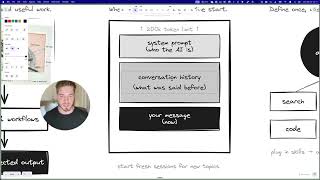
Your AI is not as good as you think it is. Everyone is using these new tools like OpenClaw, Paperclip, and there's so much hype in this space right now. But I guarantee you that if you could learn what I'm gonna show you in this video and really grasp these fundamental concepts that are not going to change in the next few months or in the next year, you will have such an edge over everybody else. I've been working with AI for the past 2 years and I have really tried so many different things. I've gone down many rabbit holes. There's been times where I was completely vibe coding from my phone, just talking over WhatsApp voice notes. And I thought that I had figured it out, but what I eventually realized is that AI is not as good as we think it is. And if you are not aware of how to best use these tools and how to really make them work for you, you're going to fall behind and you're not gonna have the leverage, which is ultimately what everyone is trying to get when it comes to these tools is like, how can you set up the agents to run? So when you walk away, you can trust that they are gonna finish and, and execute in the way that you want them to. So I'm not gonna talk about these in extreme depth, but I wanna give you an overall understanding and I will go into more depth on each one of these incoming videos. Now the first tool and the first idea and concept that you need to be aware of is harnesses. Now harness is just a fancy way of saying how you direct your agents to do useful work. And the beauty with this is there is no one-size-fits-all kind of way of working with AI. It is kind of, it is a wild, wild west at the moment. Like there is a lot of different competing ideas and methodologies, but the truth is Everyone is still figuring it out. And what I can tell you is that there is some fundamental kind of principles that people are using, such as one of the most common harnesses is research, plan, implement, and then you test. And there are a couple of problems with this, which I'm going to get into with the other concepts I'm going to mention today. But if you don't know what a harness is, that's something you need to know because it's going to make a huge difference to how you think about working with AI. So understand AI is raw power and a harness is how you can direct that towards useful work. If you look at this harness for horses, you can see it's just a bunch of different straps that allow you to control this extremely strong beast that, you know, and direct this beast that is basically just raw power, right? AI is the same way. Now, as I said, I'll get into this in future videos, but just understand that you can set up harnesses in many different ways. It's like how you break down the task, how you think about your context window, All of that is encompassed in the harness. The next thing is your context window. So this is something that people just don't talk about enough. And the truth is it's just, it's not going to go away for the coming, for the coming few years. I don't think that we're going to reach a point where the AI just has infinite context window. And for that reason, even if you had 10 million context window, it's very important to understand how you manage that right now. You know, Claude recently just got upgraded, has a million token context window, and within that there is a hidden system prompt. So it's telling the AI how it should behave. And that generally takes up, I think it's around, you know, 30,000 tokens right now in Claude Codes 1. It's massive. And then there's also your Claude.md file where you're defining exactly the instructions that you want for it, as well as the conversation history. So all the messages back and forth are part of that 200K or 1 million K or 1 million context window. And we want to just understand how that actually works, because what happens is that when your context window is good, your AI can do an amazing, amazing amount of stuff. But people often make the mistake of just jumping on a new session and they think that it already has the knowledge from the previous session. They think that it's already going to just do what they, what they, what they, they had done the day before. The truth is you have to understand how to guide the agent towards the goal, the outcome that you want. Right? So we'll get more into this in a future video. Now, skills. Skills is by far the best thing that ever happened to Claude Code. And it's not only in Claude Code, you can define skills for really any CLI, any, any sort of, uh, coding agent that you want, but What it is, is it's reusable abilities that you define for your AI agent. And this can be as advanced as you want. It could be browser automations, it could be how it works with other applications and types of, uh, ways that you wanted to think about doing research for you. These are all skills and you can program them so that you can reuse them across many different sessions. So for example, like you have skills for search, for memory, for code. Whenever I am working with AI and I notice that it's making mistakes, or I work with it to debug something and we get it working, I will immediately turn that into a skill so that I can learn from that and never have to repeat myself again in the future. The next one is planning. So again, this is a huge concept from Harnesses, but when you're working with your agents, like most people, they just, they go to Claude Code, they turn on plan mode. And then they just type in a few lines and they, then they let Claude plan and they think that it's just going to give them what they want, but they're gonna be unhappy with the result because Claude is gonna go in a lot of different directions and it'll make a lot of assumptions if you are not leading it and guiding it through the planning process. I would say that planning is the least sexy part of working with these agents, but it is probably where you should be spending the majority of your time. You going back and forth and iterating with the agent is what's gonna allow it to have the right context to ensure that you actually get the result. And we're talking about speed, right? How can you get the fastest outputs and like get the, get what you want built as fast as possible so that you can just get momentum and move on to the next things. So if you plan correctly, then you can build once and you don't waste time going back and forth, trying to fix something because you started it on the wrong foundation. And then let's talk about backpropagation. So this is again, another fundamental concept from Harnesses. What it is, is understanding how to get the agent to review its own work. And in order to do that, you need to have what's called an evaluation function. So this is a concept from mathematics and from, from machine learning. You want to be able to, show the agent what success actually looks like. And it doesn't just have to apply in coding. It could apply to any sort of task you want to give it. You need to be able to clearly define a set of criteria you want the agent to go through in order for it to know what success looks like. And if it doesn't get the criteria met, then it needs to go back and iterate and you can adjust the prompt to solve it. Now, the dream with this, with, with setting all of this up is that at some point your agent is smart enough to go through the entire process with the harness where it will, it has the skills, it will do the planning, it'll test, implement, and it'll test its work. And yeah, and basically get you out of the day, like get you out of the management of this so you can just start to have high-level goals. And yeah. And so with the last one is implementation. So breaking the big tasks that you have into subtasks. Again, this is how, how you understand your context window is going to affect how you think about this. The agent needs to be able to keep one context window while it's working on the task at hand so that it doesn't get distracted and doesn't get confused. So if you want to give it a task like building out an entire feature set or building a new project for you, you don't just start by like one terminal and just say like, hey, build it all out because you're not gonna get the end result. That's where the harness comes in. You wanna be able to break down the task into multiple chunks and then assign to-do items for each one of those chunks. And eventually actually have like Git work trees where you have multiple parallel agents that are able to work on tasks in parallel without overwriting each other's work, communicating with each other. And that's really the goal. Like that's what I'm busy working on for myself. And I will be making more videos on that. But there you have it. So these are the 6 skills. These are the things that are fundamental to working with AI agents. And if you understand how these work and you can, you can research each one of these, there's a huge body of knowledge from all the major labs on how to think about these. You will get further ahead and you will actually be on the cutting edge of this technology, which is where you can get the most leverage to actually get the outputs and the outcomes that you want and improve your life. All right. That's it for this video. Thanks for watching. And I'll, I'll, I'll, I'll be making more videos in the future, going into depth on each one of these. So if you haven't already hit the subscribe and I'll see you in the next one.