How to stop sounding like a scammer
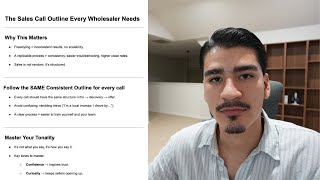
Jesus Gabriel Mendez teaches wholesale real estate salespeople to follow a structured script with three stages: introduction, discovery, and offer. A repeatable process with disciplined tonality and probing questions replaces improvisation, which sounds like a scam and doesn't scale. Track metrics and analyze calls to find bottlenecks and close more deals.
Chapters
Sales call outline that every single wholesaler needs. This is going to be the only video you're going to need to watch to understand tonality, to understand what questions to ask, to understand what not to do, and to understand how to portray a message and how to get somebody qualified for your service in the wholesale real estate industry. A lot of you guys don't know what the fuck you're doing on the phone, and that's why you can't close a damn deal and you're still doing Uber Eats. So let's change that. Now let's go into the presentation. Why this matters: a lot of you guys are freestyling with Which, yes, it might work in the beginning. You might be a magical sales master, a sales wizard that just happens to know how to talk to sellers without needing a script. The problem with that is that if you want to grow your business, you want to scale the wholesale company, you need a scalable system. You need something that's replicable. You need to be able to teach this to somebody that doesn't know anything about real estate, has never done a phone call with somebody ever before, and you can copy and paste whatever you're doing to them. Natural ability, you cannot copy and paste.. So that's why you need to follow a proven process. Freestyling, inconsistent results and no scalability, as I just explained. A replicable pro— oh, can't talk. A replicable process, consistency, easier troubleshooting, and higher close rates because you're doing the same thing over and over and over again. Imagine freestyling 10 calls, you might get one contract. But if you freestyle— if you don't freestyle every single call and you do the same thing over and over again, think about how good you're going to have that script down. Think about how good you're going to have these objections. And how more— what's the word that I'm looking for— prepared you're going to be for every single call. You're going to start really projecting what people are going to say. You're going to know, all right, around this time the seller starts saying this. When I say this number, the seller is going to start coming up with objections. You're going to be so in tune with the way that you're speaking and how consistent your process is that you'll know if you're doing something right or wrong. And then when it comes time to look over KPIs, look over numbers, you'll be able to tell, hey, all right, my problem is not the way I'm speaking on the phone because I've been doing that and my numbers check out. The The problem's maybe with, with the marketing. The problem's maybe with the underwriting. The problem's maybe with the market, right? From there, we can troubleshoot and solve all these bottlenecks that you're going to have in your business and that everyone does have. Sales is not random. It is a structured approach. Follow the same consistent outline for every single call. Every single call should have the same structure: introduction, discovery, offer, right? That's not the specific outline that we use, but that's just an example. If you want to watch my other videos, I literally break everything down step by step. Avoid confusing and rambling intros. Be direct and straight to the point. When I start off a call, number one, my tonality's there. I sound like I know what I'm talking about. Not only because I do, but also because that's the character I need to play in for these people to believe me that I'm a real estate investor and I can help them solve a problem. So a lot of you guys are starting off with, uh, uh, uh, is this the owner of 123 Main Street in Dallas, Texas? I was reaching out 'cause I'm an investor, I'm a cash investor, and I wanted to see if you wanted to sell your house. Nobody's gonna fucking trust you. And if you don't think you sound like that, go back, listen to your call recordings, which I know you probably don't do, and you'll see how close you sound to that. I can tell you from my personal experience, when I first started, I was not the best. But now, after years of practice and talking to a bunch of sellers, talking to a bunch of buyers, listening to a lot of call recordings and seeing other people speak and what they do right and what they do wrong, I now have a pretty good approach to the point where I know my system works. This is how I start calls, straight to the point. Hey, is this Joe? Hey Joe, this is Jay. I was reaching out about your property on Main Street to see seen if you ever thought about selling it. And then from there, I continue on, right? I sound like I know what I'm talking about, so it's very hard to question. Obviously, you're going to have some people with the guard up, but that's around 50% of the time. From there, you can handle objections because you sound like you know what you're talking about. Every call should have the same structure. Avoid confusing and rambling intros. I'm a local investor. I drove by this. I checked out the property. I did all this. You always want to be aligned with everything that you're saying on the call. A lot of you guys will start the call saying, hey, I'm a local investor. I actually drove by the property. Yeah, I checked out the property the other day and now I'm giving you a call. The thing is, you're shooting yourself in the foot because when they say, hey, I don't wanna talk on the phone anymore, how about you just come look at the property and we can talk in person? Yeah, we can sign this agreement in person. You said you were local, right? And then you're stuck in a loop where you pretty much cooked yourself 'cause you said you were local. You always wanna defer responsibility, always with the underwriting, always with being local. You always wanna have a loophole for you to not be responsible. A clear process, easy to train yourself and your team. Again, something that is replicable. Having SOPs in your business will greatly scale it, right? SOPs are systems of operation. Pretty much you can sit there and watch a 7-minute presentation and be able to replicate something that you've done in the past that maybe you only know by memory, right? Master your tone, your tonality, your tonality. Master your tonality. It's not what you say, it's how you say it. The same way that when you're speaking to a girl, you got to say something a certain way. While you could be saying it the exact same words, if you say it the wrong way, she's gonna get mad. You gotta treat it the same way. Key tone is the mastering tonality. You need a confidence tone, right, where you sound like you know what you're talking about, where you're coming in with energy. If you're coming into these calls being monotone, sounding boring, nobody's gonna want to talk to you. The same way that I've sit here for this If I sit here in this video for 30 minutes and sound like this, yeah, you're gonna need to master your tonality, and then you're gonna be able to close more deals, and then blah, blah, blah, undirect, nobody's gonna wanna sit through the video. Everyone's gonna click off and watch something else like MrBeast where it's consistently giving you different things, different dopamine hits, right? As far as confidence, you need to sound confident, curious. When you're asking very hard questions and you're asking deeper level questions that most people don't ask on the first conversation that they have with somebody, asking about a tough situation, asking about financials, asking about problems that they're currently going through. You have to have a curious tone, otherwise these people will take it as you trying to take advantage, and you never want to come off that way. You always want to come off from a place of, I want to be curious about your problem so I understand it and I can offer you a solution. As far as conviction, this is when talking about testimonials, this is when talking about social proof, when talking about other sellers that you helped, when talking about properties that you own in a specific area, when talking about situations that you've been in that maybe they're going through. Having that conviction in your voice to have these people understand you outside of the words that you're actually saying. Again, don't sound monotone, don't sound boring. Sounding clueless— if you sound dumb, nobody's going to trust you with their property, especially because these people only sell their property and buy a property 2 to 3 times in their whole lifetime. We're over here looking at properties every single day, running numbers, calling, marketing for properties, talking to buyers. We do this every single day, day in and day out, for hours. We've become normalized to the sale of a property.. We've become normalized to getting a contract signed. We've become normalized to processing these fees of $10,000, $20,000, $30,000 at once. This is normal to us. This is not normal to a regular seller that's been working for the past 25 years in corporate America to save up for the property that you're trying to sell, right? You guys have to understand that and have some empathy with these people. As far as being overly challenging early, this is a big one. A lot of you guys will say things of, Hey, what's the lowest price you're going to give me? Hey, what pain are you going through? Hey, what motivation do you have? Hey, how quickly do you want to get rid of the property? Stuff like this where it sounds like you're just trying to take advantage, right? You can't have that. That's called commission breath. When you feel— when people can feel that you're just doing this for a separate purpose, when you have an agenda— obviously we have one, we're trying to make money, but we never want to come across that way. We help these people solve a problem in their life. We're adding value to a seller's life, we're adding value to an investor's life, and And that's where we're making a profit because we're adding value, right? And you have to come off that way. As far as digging deeper, don't stick, don't have calls where you're only speaking on the surface level, right? Oh, what color is the house? Oh, what's the bed bath count? Oh, why do you want to sell? Oh, just because you want to, you want to have the money? Okay, okay, that sounds cool. And then what's the condition of the property? Oh, it's a 9 out of 10? Okay, cool, I'll give you an offer. You're gonna fucking be more confused after you're done with that call than just information you would have gotten on Zillow. You need to get off that call with every single point on how to handle an objection if they come up with one, on if they're the only decision maker, what's the actual condition of the property, what are the majors, what are the minors, right? How long they've owned that property, do they have a tenant in there, what's the relationship with the tenant, how often are they paying, do they like the area, do they not, are they looking to move houses, right? Do they live in the property? Is it just a rental property? How much money do they make? How much money do they owe? How much money do they want to profit after the close? Right? What are they gonna do with the money after they sell the property? What happens if they don't sell the property? All these things, and this is just off the top of my head. I could probably list like another 30 or 50 more that you should have at the end of this conversation and in your notes for your CRM so you come fully equipped. You have ammo to shoot from. If you don't have any ammo, you're cooked, right? The way to get ammo is to ask deeper level questions. Sellers give surface level excuses like, I haven't gotten around to it, I don't know, I've never thought about it, you tell me, you called me. To avoid responsibility. We avoid responsibility as far as the wholesale side, they responsibility in their own life. And that's the reason that a wholesaler is the person that's helping them in their situation. Not a real estate agent, not themselves as an investor, not themselves as just a single-family homeowner, right? If you accept that and move on, those are seeds that are planted by the homeowner where they're gonna grow by the time you underwrite the property and give them an offer on that sales call. And you're not gonna be able to close them because that objection has grown, right? In the beginning of the call, they're gonna tell you so many things. This is why it's called a discovery call. You discover every single problem, you discover the situation, you discover how you can actually help them. And during that discovery call, you're gonna have little phases, little things that they will say. And if you let that slide, that will be a future objection. Like them saying, man, I haven't gotten around to it. Yeah, I've gotten other offers, but I never said yes. Man, I was gonna fix the property, but I didn't. I was gonna sell the property to a family member. All these things will come up as an objection on that sales call if you don't handle it on that discovery call. Don't let shit slide. This is your conversation. This is your call. You paid more for the marketing. You paid for the systems. Act like it. As far as if you accept that and move on, you'll hear the same objection on the offer call as I just explained. Instead of asking, oh, instead, ask why questions. Label them. Reframe what they're saying if they're giving you a very vague response. Oh yeah, man, I haven't gotten around to it. Well, I mean, why haven't you gotten around to it? I feel like if this was my property, I would have tried to stay on top of things. Did something take place? I mean, I understand life happens sometimes. I mean, is there something else that's taking your attention? Ask it in multiple different ways. One thing that one of my students in Marion told me is he names it this: chopping the tree from different angles. If you keep hitting the tree from one side, it's going to take you way longer to chop the damn tree down. But if you hit it from multiple different angles, maybe you try different saws, maybe you try a chainsaw, maybe you try a fucking butter knife, maybe that works the best, but you don't know until you try it, right? The tree is probably going to fall down way easier. Label them, uncover the real reason why they haven't sold. Every single person has some sort of motivation if they're entertaining you on that phone call. And if they don't have a reason, they're just tire kickers, they just wanted the highest offer possible, get them off your phone. They're not motivated, they're not the person for your service. As far as pre-objection handling, like I told you, these seeds that these people will plant, the discovery call is the foundation of the deal. It is the most important part. If you fuck this up, You don't ask enough questions, yes, you can go back, fix it, but it makes the whole system longer. It's not replicable. You need to be asking the right questions on the first conversation. But yes, it is the foundation. Train and guide the seller from the start, identifying objections early and handling those, address the concerns before underwriting in the offer stage because that is when the time is to make a decision, right? You don't want to have them questioning how your process works, what it's gonna look like after they sign the agreement, Who's going to collect earnest money? How quickly is the property going to close? What title company are they going to use? All these things they should already know the answer to before signing the agreement, before you giving them an offer, because now it's clear, right? It's clear on what's going to happen. The guy's not just going to sign this agreement with question— questionably, and then who knows, maybe you're going to scam them with this property. They never need to have that train of thought. They need to understand exactly what they're going to go through step by step, and you need to let them know that. That way they're comfortable and you're educating the actual seller to be the best seller possible. Otherwise, you're gonna have a guy that's not gonna be interested in selling a week after you get him under contract. He's gonna go and go under contract with a different wholesaler, and then you're gonna be cooked because we don't tell you guys to follow memorandums because I think that's pretty sketchy if you're not consistently closing deals. Identify objections early. We talked about this. And if you don't, you'll spend 90 minutes on numbers and you'll only hear, "I have to think about it." You don't want to hear that. How to build trust through curiosity. Again, tonality in the questions that you're asking. Seller will open up when they feel that you are genuinely curious. When you feel that they actually— when they feel that you actually care about them and how you're gonna solve their problem. Show interest in their situation, show personal examples, try to build that rapport and relate to them, right? If I have a guy on the phone that loves Trump and hates black people, I probably won't say the second part, but I'll tell them that I love Trump. Goddamn it, I've been voting for Trump for the past 10 years. I haven't even been able to vote for 10 years, but on the call I damn near have. Show interest in their situations. Let them share personal motivations without pressure. Trust. The stronger positioning when you have to make the offer. If you implement this plan, this framework that I just showed you, calls will stop feeling random. You'll stop feeling lucky when you get properties under contract and you're closing deals. You'll avoid wasted time with dead leads, which you thought were good leads in the beginning, but in reality they weren't serious people. Sellers will trust you more and your closing ratio will skyrocket, which will make you more money in the end. If you like this type of video, like, comment, subscribe. If you want to get coached by me one-on-one to close your first wholesale deal or scale your wholesale business, click that first link in the description, in the description. And I'll see you in the next video.