Church & Trauma Series: Interview with Jeremy Smith
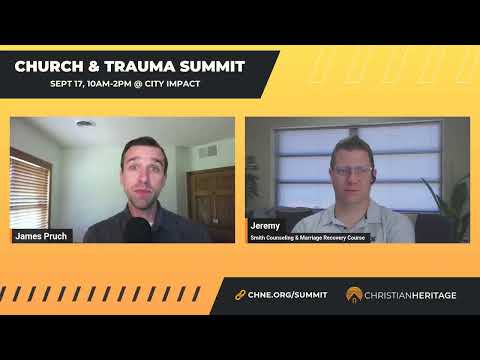
Jeremy Smith, a counselor and co-founder of Smith Counseling, discusses how church systems often perpetuate trauma by suppressing pain rather than engaging with it. He explains systems psychology and the concept of an "invisible third party" in marriages and communities, and argues that leaders need curiosity over confident answers to help people heal.
Questions this video answers
September 17, from 10:00 to 2:00 (location: City Impact).
chne.orgsummit
$29, includes Chick-fil-A lunch.
About 14–15 years ago (after earning his master's degree).
19.
Chapters
Hey, everybody. Welcome back to our podcast. We're continuing our series as we talk with some of our panelists at the church that are going to be at the church and Trauma Summit. As a reminder, if you're watching, you can see it on the screen. Our summit is September 17th from 10 to 2 at City Impact. It's just 29 bucks, and that includes lunch to Chick Fil A. So if you don't want to come to hear anything else, you can pay 29 bucks for a Chick Fil A lunch. And hopefully you get some good content, too. We have a special guest today, Jeremy Smith, and he'll introduce himself in a minute, but just wanted to remind you that you could go to our website, chne.orgsummit to register and you'll get to meet Jeremy and our other awesome panelists. And you probably heard some of the interviews that we've done. And we have a few more coming after our one with Jeremy here today. So, Jeremy, thanks for joining us, man.
Dude, I am honored and excited about most of these questions. A little bit nervous about one or two.
So Jeremy and I just met a few weeks back, I think probably maybe six weeks or so. I can't remember. We had a blast of a lunch together, and I just want to. I'm going to let Jeremy introduce himself, but I don't know if he'll mention this, so I just have to say this. So we're at lunch and you knew the waitress.
Mm.
Remember this? So how. Tell me how. How did you know the waitress?
Well, when I used to teach at a local school.
Okay.
I taught ballroom dance, and she was one of my students.
You taught ballroom dance?
I did.
And now you're a counselor, your therapist. You help people with their mind, their heart, spiritual stuff, trauma, all that stuff. But you used to teach ballroom dance.
Mm. Someday we can do dance therapy for marriage.
Yes.
It's a thing that most guys don't like.
This will probably be the easiest question I ask you. How did you get into ballroom dancing? And then so much so that you taught it.
Yeah. So my family were musicians, so I grew up playing music all the time. And then my parents took us to a Renaissance dance and a Victorian dance, and I absolutely fell in love with it. So it was like line dancing, group dancing type things. And then when I went to Germany for a year as an exchange student, found out that it's cultural to take ballroom dance lessons in Germany. Didn't know that at the time. Once I found out you can get ballroom dance lessons five days a week, I'M like, I'm in. Sign me up. So then I attended for ballroom dance, like two or three times a week I'd go take ballroom dance lessons. So by the time I was 19, starting college at UNK, I'm like, I love dance so much, let's just open a dance studio. So I started teaching dance at the age of 19 and I've been doing it ever since.
I love it.
I love it.
And then you also taught German and Japanese, if I'm not mistaken, right?
Yep. German, Japanese and physics were my three degrees to teach.
So if nothing else, you're a very well rounded person, which I don't know if that qualifies you for the church and trauma summit, but you, you are qualified in other ways, which we'll talk about here. So why don't you just introduce yourself, tell, other than your background with teaching and all the stuff you taught, kind of tell us a little bit about what you do. Now your wife's been on this podcast and so we met her before, but why don't you, why don't you tell us a little bit about you and what you guys do with your counseling practice?
Okay. Well, in a prior career path, I was the educator of all those different things. And at some point during that process, I realized I wanted to get my master's in counseling specifically, and realized that's going to be the long term career shift for me. But what was interesting is once I became a counselor, I found that I was still doing teaching just in a different format. Helping individuals, helping couples, helping people become healthy individuals takes a lot of teaching. That's a psychoed, but it also takes a huge amount of trauma awareness and trauma healing. That is like a third order change which we may not want to get into. But the idea is like there's first, second and third order changes, and trauma is a third order change. So getting my degree as a counselor, I'm like, I absolutely want to do this. And because of my background in porn addiction and having been through porn addiction recovery myself, and then watching so many marriages fall apart, my passion for marriage paired with addiction recovery instantly became a win for counseling and that I'm going to be a counselor for. Not just the run of the mill anxiety and depression and trauma recovery, but I need to see how this all fits together for taking care of marriages. So we're going to have to deal with the trauma of the addict, the trauma of the betrayed spouse, and the trauma of the marriage system. Wow. So it all came together. So now I do the teaching at Marriage recovery course, and I do the therapy at Smith Counseling.
Nice. I love it. So what was the. What was the thing that got you interested? I mean, you. You were. You had this one career path. And I know I asked Sarah about this. Like, you guys were kind of like both going to do counseling together. You both did your master's degree at the same time. But what was the thing that said? Like, yeah, I. I want to do this, like, with my life. I want to leave one field and kind of mid career shift. And like, what spark what. What did God use to spark that interest?
There's the good answer and then there's the real answer. And the real answer is moving up on the pay scale as a teacher. So let's just be honest. Like, I was looking at all these master's programs, and I'm like, I can go up on a pay scale, and LPS says I got to do this and this to get pa like, yep. And every one of those never really resonated with my spirit. So the more deeper, honest answer is all of them. I said no to all the options I could have gotten masters in until I saw counseling and the Holy Spirit just stirred, saying, you know what? This is going to be impact for generations. And the picture, there was one evening specifically, I was journaling, and I got a picture where it felt like the Holy Spirit was saying, I am inviting you. And I saw a picture of him inviting me into the darkest, deepest, nastiest storm you could ever imagine. And it's like he was drawing me, pulling me into it, saying, this is where I'm leading you. Yep. So at that point I knew, like, I can teach kids to conjugate verbs, but that doesn't mean their lives are changed and the trauma is unaffected. I can help men and women learn how to ballroom dance, which is great. But if I don't help the marriages deal with the underlying issues of miscommunication, not trusting, not following, being triggered by their own background trauma, they can't connect. Well, it's a nice, fun event, but it doesn't actually help generations to come. So that's when the picture was very clear. I'm going to go into the hellstorm of whatever it takes to help people become healthy. So that's what was sold. So I'm going to be a counselor. And it's hard work going into that dark stuff. But the couples that do the work experience a taste of the gospel and healing and freedom that 99.9% of people never experience.
Yeah, I love it. Well, thank you for doing what you do. How long have you guys had Smith Counseling?
I think we got a degree, like 15 years ago, 14, something like that. And then immediately launched Smith Counseling LLC so we could provide therapy. Not together, but it's a career path together. That's kind of. Kind of unique, kind of fun.
Yep.
Great.
Okay. All right, well, let's get into the questions you're nervous about and maybe some that you aren't. You know, you're going to be a part of this event called the Church and Trauma Summit. And so when you think about the words church and trauma from your lens, through your particular perspective, what comes to mind when you hear those two words?
If you see me glancing over here, because I got notes. Yeah, you're good. I'm not missing anything. No. When I think about the words church and trauma, I think of my own trauma with church. And I think about the hundreds and thousands of stories I've heard of men and women sitting right here on this couch and in this chair, telling their own stories of trauma from being a part of a church community. And a lot of it comes at the hands of church leaders. But it's not just church leaders. The trauma is from the system. So when I think about that question, like, what comes to mind? Church and trauma, the very first thing that I think of is people and their stories and their wounds. And my stories and my wounds. But the second thing right on the heels of that is systems psychology to understand this is a complex system, and people are part of a system. And if they're not aware of the things they're doing in the system, they will repurpetrate the very wounds of the system onto others. So what you wanted to know?
No. Yeah. So let's talk about the system, because I don't think that's come up yet on the podcast here. And it's, you know, it could be a touchy subject. There might be somebody that's listening that is like, I don't know what you mean by that. Sometimes, if we're honest, if I'm honest, like, Christians are like, we're just like fish and water, Right? And somebody's like, hey, it's wet. And the fish is like, what do you mean? What's wet? Like, what's just my life? We don't know the difference. We don't know what we don't know. So let's kind of double click on that. What. What do you mean when you talk about there's some system dynamics happening that cause some of this trauma?
I'm going to start small, and then I'm going to expand to something bigger. So the small is this because I work with marriage specifically. I teach this and I'm going to see if I put my fingers where people can see it. So there's basically. When you work with an addict and a betrayed spouse and a marriage trying to recover from an affair or from porn addiction or from discovering the, the infidelity, what I teach is that there's a betrayed spouse, there's the addict, but there's this invisible third party called the system. So I'm starting small with like a marriage unit. So there's very just. There's three. Eventually. This principle applies to any system anywhere. But there's him, her and her stuff that has nothing. Her and her stuff that has nothing to do with the system or him. That's her backstory and that's where her trauma lies prior to the relationship. There's him and his backstory and all of his trauma and his wounds and ways of seeing the world and medicating that have nothing to do with the system or her. But what's ironic is you get two people together and look, there's the ring finger. It creates a system of interpersonal habits, dances, ways of engaging unspoken rules that basically take on a life of their own. And that's the invisible third party that I talk about with clients, is that you can get therapy for the betrayal, you can get therapy for the addiction. But if you don't specifically learn to address the interpersonal dynamics of the habits y' all have developed over the course of your marriage. And you don't learn better communication, you don't learn better dance, you don't learn rules of engagement. You are blind to the system that's pulling the strings behind the scenes.
Yep.
Now that's just in a marriage recovery context. But that's why the approach I use is so much more effective, because it takes into account the invisible party. So that's just marriage. Now let's zoom out for a second when we talk about church systems. Anytime you have more than one person in a relationship, there are rules that guide the way they engage. Then you add more people to. So now we have a hundred person community. There becomes a norm, expected norms and standards, ways of fitting in, ways of communicating, things that are taboo, things that are expected. And if you violate any of these rules, the system, now not just a two person system, but a hundred person system has consequences, repercussions, and it's almost like group think steps in. Yep, trying to think of another word for it, it's like almost drinking the Kool Aid. So depending on what the system is and how strong that system becomes its own rules, it grows bigger and bigger. But to be a part of the accepted by the system, you must comply, you must fit in. And when you don't, that system now has a set of reactions to the individual that doesn't quite fit in. That's the essence of systems psychology. And that system works as long as there's more than one person. You now have a system.
Yep.
So I think of, like, Christian Heritage. There's going to be a culture at Christian Heritage that is the Christian Heritage System. And unless all the members of the system recognize and see that individual power of what the system has learned to do and think, you will all be a part of it. It's kind of like the matrix. Like, unless you unplug from the matrix, you are part of it. So learning complex system psychology unplugs you from the system. So you can see all the invisible rules that are going on.
So when it. So, like, when it comes to trauma and adversity, and I should say for our listeners. So, you know, we have, at the, at the summit, we're gonna have two different panels, and one is looking at how can the church be the answer for vulnerable people outside who are not a part of the church yet? Jeremy and his wife and another guest will be on a panel that really has to do with how do we look in at the family of God, at the church, at your local church in particular, so that we can experience healing from trauma and adversity on the inside, so that. So that helps set the context. So you guys know what Jeremy's going to be part of. So now, Jeremy, as we look at the inside of our church communities, you know, let's just look at leaders for a second. I didn't prep you on this, and I know you're good on your feet, so I, I don't think I'll throw you. But, like, how does a leader, whether it's a pastor, lead pastor, associate pastor, children's minister, whatever, somebody on staff, somebody who's an elder, a deacon, whatever church calls their leaders, like, how do they humbly step outside the system to say, I'm going to look at this honestly, and we can maybe get into some examples. I think for those of you who pay attention to church stuff going on, like, the sbc, right, is a great example of there's a system that allows and perpetuates abuse of children, of women, of vulnerable people. Right. There's the whole all that stuff has gone on, and you could look that up if you have no idea what I'm talking about. But it's a system that allows and encourages and perpetuates that. But how does a leader step outside the system while they're still in it? And yes, we only have like 40 minutes for this podcast, so.
This is part of what makes me nervous and also breaks my heart is because when you're in a system, you can't step out of it and really, truly see the system for what it is. It's not until you get stung by an excise from, excommunicated from, slandered, attacked, withdrawn, ripped out of the system and rejected by it that your eyes will finally be open to see the system. Case in point, I want to give a testimony here. Yep, I grew up in the Midwest. This was my system of thinking. It wasn't until I left the United States and lived in Germany for a whole year that I went through the withdrawal symptoms of like, well, this is not my system. This doesn't make sense. And it was called culture shock. It's not until I get unplugged from the matrix, so to speak, the American matrix, and go live in Germany. Then I was forced to see and my eyes were open to the system, but I could not voluntarily see that system while I was living in it. Came back to America. Well, what happened? I had enculturated the German system, so now I came back to America and I'm like, oh, this doesn't make sense. You Americans are just like, what? Wow, I can't believe you. Because I was then seeing the German system for what it was. Same thing happened when I went to Japan. It was even worse because they're a totally different culture. So now it's like, oh, my gosh, I see the American system through a whole new set of eyes. But wait a minute. I thought I saw the system the first time. Well, I saw part of it because of the German lens, but then going to Japan revealed so much more about the American system I didn't even see. So I'm sorry, James. It's awkward because in some ways, leaders want to be able to see that system, but you can't until you get stung by it, until you get rejected by it, until you are literally excised from it, which sbc, that's kind of what happens is once all the poop hits the fan, then you're forced to see the system.
So, I mean, so how does, how does a, you know, some Pastors even are like, hey, I want to see change. I understand the value of justice and being a voice for the vulnerable and the hurting. Did they, I mean, we're probably getting ahead of ourselves in terms of application and stuff, but did they just say, okay, I got to quit, I got to go to a. I gotta, I need some time alone and then I can re. Enter and maybe go back to a different church? You know, what would you say? Even hypothetically, and maybe you've had that conversation with pastors, you know, what do you say to the person who's like, I want to see change, by golly, God's call in my life is to make, you know, to be a prophet. Do they have to quit? What do they do?
Thanks for asking that. I'm glad you're going direct. Ideally, no. The biggest hope that I see is if a person is a part of a system, they want to see the system, want to change the system. They can't help others and can't help that system if they haven't dealt with their internal system. And this is where I think of that, like song from Age. You can't help me. If you can help yourself, you better make a laugh. It's like, if I want to change that system out there, I have to first learn to change my system in here. Now it's going to be a forced change. Booted by the system and attacked by the system. But I have seen like one in 100, one in a thousand pastors that I know and work with. They say, I personally am struggling with so much junk in my own world, I want help to deal with me. And as we expo. Pull out of the suitcase all the pain, the traumas, the wounds, we find out that their family was a system, that their growing up church was a system. All of these systems that they have since exited and now can look at differently. It's the closest thing without having to like quit your job and go to a different church. Even that doesn't necessarily show you the system, but dealing with the internal world and my own personal traumas, seeing those pastors work on their own maladaptive coping mechanisms is the very closest thing I can see that gets them set up to actually help with their external church systems. How's that sit?
Thanks. No, that's good. That's helpful. Yeah, no, that, that's good. I don't think there's a perfect. And I wasn't looking for a perfect answer. I don't think there is one because. Yeah, you don't like, what if Like, a hundred pastors in Lincoln were like, all of a sudden had this revelation of, like, hey, we need to. This is what the church is meant to be. Obviously, we wouldn't want to see every church lose their staff.
I would want to see every church in every system start moving in a direction where their staff and leaders start focusing on their own trauma.
Getting emotionally and spiritually healthy. Right. Okay, so let's. Let's think about this in terms of then trauma. And the vulnerable people in our congregation, some of them feel lonely. Some of them feel like the church doesn't really understand their life, the language they speak, some things that churches say from the stage, the pulpit, whatever you call it, it can make people in the church feel isolating or, excuse me, isolated. So, again, from your perspective, your lens, you know, what can leaders do? You know, what is that first step, that first question? Because a lot of them might not do what you just said is, hey, you got to address all your junk. Maybe you go see Jeremy or you go see Sarah or another counselor that you can trust, but what is that thing to kind of get a leader's attention to maybe put themselves maybe not in the full shoes of. Of somebody in the seats, but maybe one foot in a shoe so that they're open to looking at themselves and looking at their congregation from a, you know, their own. The congregation's perspective and not their own, you know, church leader. You know, church leaders live in a different world. Like, I used to be one. Like, you live in your own world, and you're, like, reading theology books. It's like, nobody's nobody living this way. Nobody thinks like you, you know, and people are not worried about, you know, the finer points of Christian theology, as important as that may. They want to know how to not be angry at their spouse or their child. You know, they want to know, how do I not worry so much about money? So. So how do you. How do you move a leader just one step forward so that they're willing to lean into trauma even if they're not ready to go in full bore? I didn't prep you for that one, but it just came to me.
So that's a hard question. And I guess the first thing that comes to mind, James, is the fact that you cannot lead the unwilling. And as much experience as I have, I have only seen that it is the broken and the humbled and the crushed, that experience, the power and the wholeness of the true gospel, not religion. And sometimes some of those humbled, broken, and crushed are pastors who were Crucified, in essence, by their church system. When they finally started getting emotionally healthy and saying, this is actually not a healthy system because of this. Can we address it? And they booted the pastor. That was the crushing experience that forced them to do the work.
Yep.
We can invite. We can ask. So I think the summit is a great idea. But if I could remind church leaders of anything, it would be, you and I are all victims of trauma and abuse, and we all have addictive tendencies. And addiction is not about the drug. Addiction is not about the drug of choice. It is about the way that we handle the pain. And we can use church systems, the Bible, we can use God as a soothing mechanism to numb and dissociate from our wounds and pains. But what I notice is the pastors, the rare few that I have met who actually face their pain head on, become emotionally healthy and broken of their own accord. They start to realize I'm an addict just as much as that person sitting there. I'm broken, if not more than that person that's sitting there, because my addiction is preaching. My addiction is power in the church. I'm an addict. And what's interesting is when that mindset shifts, everything else falls into place because it's a journey of emotional health. But if I don't see that change initially of I'm broken, if not more so because my addiction is my power in this system, I don't see the hope for the change.
Yeah. Oh, that's so good.
And, you know, coming through, because I'm not sure that was.
No, no, no, that's good. Like, I think when. When I think of, like, a biblical parallel or. Or an example, like, I think of the. The Pharisees, and I'm not calling specifically pastors Pharisees. I think it's in general, they used God to hide from God. Like, we see that over and over in the gospels, where. Where Jesus, like, you think you know the scriptures and you have no clue because you're using God to hide from actually what God requires, which is love and justice and mercy and forgiveness.
Amen.
And, you know, so I. I think what you're saying is spot on. I agree. And I'm.
I'm.
I think it's a. You know, are you willing?
I think.
I think with so many things in life, it's like, are you at least willing to question yourself? Are you at least willing. Are you at least willing to say, hey, maybe I don't have all the answers, and I'm open to changing my mind on how I view abc, X, Y, Z. And for so many leaders, it's how you do ministry, or what ministry is for you.
What denomination is the right? Denomination? What interpretation of the Bible is the right.
Yep. Yep.
We actually, in the mental health world, there is a phrase that might be helpful for some of your viewers. Listeners. We call it the confidence mindset versus the curiosity mindset. Yep. The confidence mindset is that of I have the answers or I have to have the answers, or I need to pretend that I have the answers is that I have to be confident that this is right.
Yeah.
But what's interesting is as I work with men, women, husbands, wives, marriages, they all, as they get healthier, exit this confidence mindset and move over into curiosity that says, I think I know now. I'm not going to say that I'm totally incompetent, that I don't have any confidence. It's just that I have a whole lot more curiosity about myself. I question my thoughts. I question everything. Not in an insecure way, but actually an emotionally healthy way. And I'm curious about you. I'm curious about your story. I'm curious about your wounds. I don't presume to know that this is the way you should navigate your life, because I've never lived the things you have. That's a curiosity mindset. That's so polar opposite of the confidence mindset.
Yep. I love that. And in our first episode in this series, we Talk with Trey McGruder, who runs a human services agency. Here's an here in town. And eventually we got to the point where we were like, so many Christians are taught to be right, not loving.
Yes.
And. And it's not that being right is bad. Like, oh, my gosh. Like, and I think that's what a lot of Christians hear is, you know, you're saying we can't be right. It's like, no. Like, I had a friend who's an elder at the church I was a pastor at, and we were elders together. And he very lovingly once, you know, I was younger than him, and this is, gosh, 10 years ago now, where he just said, you know, it's not about being right, it's about getting it right. And I think a lot of times getting it right for Christians, we will mean love, compassion, curiosity. I want to get this situation right, not be right. It's like, you could be right in the wrong way and push people away from Jesus and ever entering into their own stuff and experiencing healing. And so I just think that's spot on with how, as A community we approach our life and the life of others. It also makes me think of Ted Lasso. Right. Be cure. I don't know if you watch Ted Lasso. I can't.
I can't.
Whatever. I might edit this out of the podcast. Right. Be curious, not judgmental. And it's one of my favorite quotes from the show. But. Okay, we need to move on. So I want to talk a little bit about your history of working with churches. And maybe this is what gets you nervous. It does keep going, you know, without specifics. Right. And, and sharing personal details. Just tell us a little bit about, you know, how working with churches has shaped your understanding of trauma and healing and really the, you know, how, how that impacted you and the people you were able to help and how it impacted them. So I know you've done a lot of work with churches and even churches you've been a part of, and people come, you know, you, you, you help people in Lincoln. So just talk a little bit about kind of your history and really what you've learned through that process of. And you've gotten into it. I mean, you talk about the system of the church, but, but maybe there's particular aspects of the church system that you've really leaned into over the, you know, the 15 or so years that you've been, you know, doing this.
I will affirm that I have worked with many churches, both in Lincoln and actually churches across the state who have people who wanted help to figure out how to navigate their own church breakdowns. Probably one of the most recent is you mentioned the Southern Baptist Convention. There's a similar fallout that's happening right now in the two by two ministry, which is kind of a no name Christian ministry, and they're under federal investigation for child sex abuse for decades. But it's interesting that you can. I have worked with church systems overtly, publicly. I've been a part of worship teams. I've been a part of counseling ministries at multiple churches. I've been a part of collaborating with pastors. And if I think about the efficacy of the work that I've offered and help, I notice that there's always an invisible glass ceiling where the aid to the system is received, so long as it in no way upsets or ruffles the feathers of those in power at the system. So if they have a ministry for, for instance, a ministry for men who are struggling with pornography, many churches do. And they call me and consult with me and they ask for help. What's interesting is they like the affirmation they will take advice so long as that advice in no way challenges their current confidence schema that we have the answers and no, there's not the curiosity then. And that's the point where the helping the church comes to a grinding halt. Similarly, I noticed that there's churches that have a variety in town that have ministries that are counseling, like care ministries. And similarly they love to provide assistance and care, which is a good listening ministry. But when I have in the past questioned them on at what point do you hand these issues off to people who are more qualified for trauma, for sexual abuse, for these things? What's interesting is there is usually a strong pushback of we have the answer, we know what we're doing. And that's my concern. And that working with churches is the confidence mindset and the system has become so stuck and lack of curious and lack and so I guess prideful that they're oftentimes not willing to actually explore the deeper issues. Like I mentioned the first, second, third order change. First order change is changing just behavior. So we have a quick fix, we make things look good. Yeah, I just want to make it better right now. Yep. But second order change is helping people think different. And already in a system that's going to be a very difficult undertaking. And that's what I'm hoping the church and Trauma Summit is going to do. It's going to help promote the thinking that's different, not just doing different. We're going to think different. But even if we start to think different, I notice it's only the Rare people, the one 100, one in a thousand staff members, that realize I have personal trauma. I have personal maladaptive, addictive coping mechanisms that I'm manifesting in different ways even in this church system that I need to work on me, deal with my trauma, my junk, my maladaptive coping mechanisms for me to even show up in a way that truly helps the congregation, the people that are coming for care. Like if I don't deal with my stuff, I'm just reperpetuating the superficial changes that are being condoned now by the church system. So it's sad because I love the church when we're talking not a church system, but the body of believers and I see them hurting and I see well intentioned, well meaning church staff and church leaders trying to help. But if they've only experienced first order change, the best they can offer is first order change. If they've only experienced second order, the best they can offer second order. It reminds me of the Phrase, you can't lead someone somewhere you've never been.
Yep.
So that's what I think about, James, when you ask a question. That's my history of helping. I have helped a lot. And oftentimes it comes to a grinding halt the moment I invite them to a deeper change. So for the first orders, I invite them to second, we're done. Second order they got. But third order, you're done.
Yep. Well, I mean it really, from my, from where I sit, you mentioned it earlier, it comes back to the what is going to challenge my position of power? And I know that most American Christian leaders would never voice it that way. They wouldn't say that I'm in a position of power because Mark 10:45, right. Jesus said, I, I came to serve and not not be served. I am a ransom and I lay my life down. I know a lot of leaders, they take that approach, and they say that I'm a servant leader, and yet I'm like, okay, what are you doing? I know that you believe that. I know that you say that. Are you behaving in a way that lines up with that? Would the people in your congregation say, oh, yeah, he is really not about power. He willingly gives it away over and over, or she willingly gives it away over and over? You know, I, I, I know what it was like to serve in ministry. And giving that away is hard because the allure of it, like you were talking about earlier, the addiction is like, well, man, it feels nice to call the shots. It feels nice to be in charge. And, you know, I think that that's the part about that system. I just, I love the way you were describing that because, like, how do you, how you do, how do you lead and minister in a way that aligns with the way of Jesus? Because very diff. That is very different than what we've set up in the North American church system. It's very different. Almost impossible to do it inside the system, which is why you had said, short of leaving, it's how do you do it? But I think it goes back to that is, is what's going to question, you know, what's going to question or rub up against my position as a powerful person in this congregation, denomination, whatever, you know, missionary organization, whatever it is. And I think you, man, you gotta, you gotta be honest with yourself. I, I don't want to give up my power. Okay, thank you. At least we know where you stand, you know, like, at least we know where you stand. So I think my encouragement, if a minister is listening Is, you know, man, ask yourself that question and don't be afraid to have the real answer come out.
And then I think Robert Palmer. Do you remember the song Robert Might as well face it, you're addicted. Remember what he said?
No, no. I don't know what you just did there, but I don't know what.
That's a guitar. That's a guitar.
Well, I know that. I know what you're. The song. I don't know the song.
The song. The original Robert Palmer. Like, man, I seem really old right now. Well, no, I know my face. You're addicted to love. But the thing. Yep. Okay, now love, you literally put in anything and what you're talking about is the power.
Yep.
And here's where I want to be gracious and compassionate. That I do understand when we talk about. I'm wearing glasses right now. So if I've only experienced first order change, I'm going to take these glasses and I'm going to look at the world through my first order change. So I am being loving.
I am a server, products of our system too.
Yeah, exactly. So what I'm doing to serve is serving through a first order change. Order change. But that's the lenses that I have. Once I've experienced second order change. Now my lenses are the second order change. So you said you don't know what you don't know. And it's not until you experience the deeper level transformation that you can actually offer that and lead that way.
And that is so important. I'm glad you said that. And I know Roy, our CEO and I, we've been on this podcast before. We've talked about some hard things for the church, discipleship and other stuff. And I just think none of this. We look at ourselves first, like man, as an organization. What you know, how do we contribute to the system and where are we at fault as well. But we all have to say, like, I didn't create this system. Jeremy didn't create this system. We were born into it.
Exactly.
We didn't choose what we look like. We didn't choose what we sound like. I didn't choose that I was born in Omaha, Nebraska, and. And that I'm a Midwood, like you said, I'm a Midwesterner. And my eyes were open when I left and went to Africa for a year.
How so?
And lived in South Africa. And you might think, oh, South Africa is not that much different. They're really developed. No, it's pretty different, you know, so like we didn't choose this. And yet I think God still calls us to ask the hard questions and do the hard change that we need to do to be the people of God. So that. That leads me kind of to our last question.
Mm.
The church has notoriously lagged behind in understanding trauma, its impact, and how to help people heal. I feel like they have. I went to seminary, and I never, you know, two and a half years, two years of seminary, never heard the word trauma. I probably knew what the word was, but I never heard it in a class. You know, most of my education was learning how to interpret the Bible, preach sermons, teach classes, write curriculum, that kind of stuff. Why do you think the church is so far behind? And then part B will be, you know, kind of, what are your hopes and aspirations for the future of the church? Just right here in Nebraska. We'll just, you know, keep it local. But let's start with that first one. Why? Why do we lag behind? Is it just the system? Is there more? What perpetuates that? What's keeping us behind? The secular world that seems to be even more empathetic and more compassionate sometimes.
If I could boil it down to one word, just that question. It's how we respond to pain. And remember how I said that we all have addictive tendencies. The point of addiction is not the drug. Similarly, I'm going to talk about trauma in a second. Like, what do I want people to know about trauma? Like, that's a different question, but it's correlated. It's how we respond to pain that either embraces it, engages it in an emotionally healthy way, works through it, or learns to suppress it. That suppression action can be done through cocaine, meth, heroin, pornography, masturbation, affairs, shopping, eating, and religion. Religious practices. So what's interesting is 99% of the time when I have couples come in here and work, we have to. At some point, I'm going to say this word. Please don't take it wrong. Deconstruct. Oh, yeah, I got you some. Not all. Some of their religious practices that have taught them to suppress their emotions. Let's use the word pain.
Let's use the word unlearn so no one freaks out that you use the word deconstruct. But we know what you mean. Just so if you're listening and you heard that word and you freak out a little bit. Unlearn and kind of unhinged. Kind of unhinged. Untether yourself to those harmful religious practices that you learn when you were a toddler and you saw your parents do such and such and Then it happened through elementary and middle and high school and then into college. And you just thought it was normal religious practice to do A, B, C, X, Y, Z. And you got to learn, unlearn those things.
Platitude is like, well, it's just God's will. God will take care of it. Don't.
Oh, God. It's all good.
It's all good. Well, no, part of that system is avoiding the hard work of emotional engagement of pain. Yeah. And thus we use the religious system to suppress it. So why are we so far behind in understanding trauma? Because trauma requires you understand pain and you engage pain and you learn how to process pain. And if we don't know how to process pain and we're using our religious practices to avoid the work of engaging pain, we have no chance as a religious system of actually meeting people where they're at in their pain because we don't know how to handle our pain. So the best we can offer is teaching you how to suppress yours.
I mean, we could go off in a whole tangent about theologically how we do that in the church. And I mean, just want to share a thought quick is, you know, I think a lot of leaders have been taught to say, well, it's God's will. God is sovereign. You'll be fine. You'll get through it. But what the person who's suffering hears is, well, God must really hate me because he made that happen. And I was sexually abused as a missionary kid in the field by another missionary kid. That's not my story. I'm just saying, like, and then. And then, you know what happens when they're 25 and they're faced with a crisis? They walk away from Jesus because the people in the church say, well, God is sovereign and. And you'll be fine.
Because that Jesus was unempathetic. He was attuned to their emotions. So why would I want to be with that Jesus? That's not the Jesus I know exactly. But yet that's the Jesus that has been embraced by religious systems who don't want to deal with their emotional.
I mean, I love the way you say that. Like, not being able to deal with your emotions or that's what. That's kind of what we embrace. And I think as a Midwesterner, you would say the same. Like, I was a Midwesterner growing up in the church and it was just like, you just didn't go there. And it wasn't just you didn't go there. We didn't know how. There was no model There was no template, in a good sense, for me to, like, okay, this is how I enter in. And I'm almost. I'm almost 40 years old, and I'm. I'm not. I don't know how to do time. I'm learning how to do it. CH has been helpful for me to learn how to do it, but, man, it's not second nature. And I know other cultures have their own issues. I get that. But, you know, let's be honest. Midwestern, North American. North American. Midwestern church culture. It works against that entering in when trauma has happened.
Because you dropped the word trauma there. Can we transition for a second and talk about what trauma is? And from a mental health perspective, how we get that wrong right off the bat? Do it so often. Our societally, culturally, we view trauma as one massive incident that is horrific, and that is like the cultural definition of trauma, which means none of us have trauma except for a rare few folks. What's interesting is being a trauma specialist, being trained in emdr, understanding ifs, emdr, eye movement desensitization and reprocessing. IFS is internal family systems. Both of them are modalities to deal with trauma, pain, wounds. These modalities make it exceptionally clear that definition of trauma is totally off base because trauma isn't about what happens. Trauma is about the way it's stored in the brain. So, for example, I love this example. Like, think of a chart here. A little kid has a capacity to handle, like, this much emotion. So when their pet dies and that's this intensive an emotion, their brain will code that as trauma. Yep. Not because of how bad the event was, but because it was bigger than they had capacity to deal with.
Yeah.
And if mom and dad aren't there to help fill in the gaps and help the kid process through that, that becomes a traumatic event that forever, the rest of their life affects the way they respond to the world because it implants beliefs. There's actually a course atmarriage recovery course.com on transforming trauma, if you want to go deeper on this. Yep. But the very fundamentals is that whether it's a kid losing his lollipop here, losing a pet here, or a boyfriend losing a girlfriend, girlfriend losing a boyfriend. All of these things are just experiences of life that have pain. And if the person has the emotional skills to process that level of pain, it is not coded as trauma. If their skill set is below that and the pain is bigger than their skill set, it is forever coded as trauma in the brain, which then affects how they see the Whole world. That is a very different way of understanding trauma, which is now a whole lot more relatable for everyone, even church leaders, to realize. If I can understand that I do have trauma, I'm carrying trauma that affects the way that I see everything. And I now work on my trauma. It doesn't matter whether my trauma was sexual in nature, physical in nature, drug related in nature, loss in nature. I understand trauma and can connect with and empathize with this person in my church who has trauma that I've never experienced. But dang, my heart has empathy because I know what it takes to work through trauma. Because it's not just getting your leg blown off in Vietnam.
Yeah, yeah, we, for those listening to dig into that. We've done a podcast episode on trauma and you could go back and listen to that a lot of times at CH here. Like, the way that we simplify it is we kind of just say like, you know, trauma is whatever impacts your ability to cope. Kind of like what you're talking about. So if I am emotionally healthy, like you're talking about, I may have the ability to cope. So, I mean, I'm in a situation where, like, somebody not too long ago, like, they kind of ripped me to shreds. But I had been through so much in my previous life and ministry, like, not previous life. I'm not reincarnated.
I don't mean it that way.
I just mean in my life where, where, you know, I had, you know, horrible interactions in ministry context, I was able to more quickly recover from that. And so I don't, I don't have, you know, kind of a PTSD experience when something happens now because, like, I was emotionally stable enough to hear that, understand what was true and what was false and the context around it and then move on. But 10, 15 years ago, when some things happened, like, that's why sometimes I'm still a little shaky when I walk into a church building or when I see another, you know, or I hear a sermon that's about a certain topic or whatever is. And so, yeah, we, I love that like, you know, the event is not, not like, oh, like, I had a traumatic event. Yes, okay, but, like, are you able to cope? Are you able to work through it? Or are you paralyzed and haunted and scared and you can't. And like, that's where now you, you are traumatized, you have trauma. And it is, it is impacting your ability to relate, to go to work, to go to school, and everybody has those different capacities. And I think that's what sometimes you know, we ministers can struggle to remember is, yeah, okay, God is sovereign, but that's not the world they're living in. They're not sitting reading theology textbooks. They want to know how to get out of bed.
Today I have a thought from a complex systems perspective. I want to tie something back in that may be a good end or close, or maybe you want to edit it out. But when you mentioned the idea of having that unsettled feeling when you're in a church system, I want to point out that that that's the trauma response, that unsettled feeling, that discomfort because of prior pain, that is still coded as trauma. And when you also earlier in the podcast talked about the fact that ministers oftentimes, whatever positions of power, high, medium, low, whatever their power level is in the church, oftentimes, what I see this is compassionate, that the difficulty letting go of power is triggering trauma. There is usually, as I've done this with a handful of pastors in the past, one of the things that I notice is that the power is the addiction because the holding the power is necessary to cope with the personal trauma. That's good because the idea of giving away any power isn't about that moment in that ego. It's about the internal need to protect the wound from way back when, when I didn't have power, I lost power and I was hurt and wounded because I didn't have power over something.
Yeah.
Now I want to keep it.
Yep.
Yes. And I'm keeping the power because of this past issue. I'm not keeping the power because I am a jerk or a narcissist. I'm keeping the power because I'm scared as he double hockey sticks because I'm still five years old, seven years old, when I didn't have power. How's that sit?
No, I mean, so that's good. So it helps. It helps us build empathy for people. I mean, helps us build empathy for people in power who then go on to perpetuate and abuse people. Not. And it's not saying, oh, it's okay, but it reminds me this question. It's a book we've most of us have read here at ch, where, you know, the book is called what happened to you? And if you can ask the question, not what's wrong with you, but what happened to you? Which is, tell me your story. What happened when you were 10, tell me about it. Rather than, oh, you did this as a 35 year old, what's wrong with you? Like, that is not going to build openness and Community and healing. Right. It's actually going to stand in the way. And you just think, well, you just. You hate me. You think something's wrong with me. This is how I've always been. Instead, how do we enter in and say, hey, can you tell me your story? What happened? There had to be something that happened, because that. That response, that reaction, those words. I've never seen that side of you. That's so. Yeah, I love that. That's good. No, that's good.
Can we flip that on the other side for just a moment? As a word of invitation and encouragement for any guy or gal that's going to attend the summit, I want you to know and hear that you can start by yourself changing that statement from what's wrong with me to what happened to me.
That's good.
And similarly, if you can start that. And James and the summit are going to help setting that tone to realize this is where it begins. If you want to have empathy and compassion and help trauma in your congregation, you got to have empathy and compassion and work on trauma in self. And I think James nailed it there with the idea of what happened to me as opposed to what's wrong with me.
That's good. You should host this podcast.
We're gonna.
We'll end it there. We could go on and on. This has been so great. Really grateful for you and for being on. Not just being on this episode, but for. For coming to the summit and being there and excited that you and Sarah will be together and get to do. Get to minister together on the panel.
So I'm thrilled that you're doing this, and I'm so for you and so for this, and I'm excited to see where Christian Heritage is heading. So thanks for inviting me.
You bet. Well, everybody who's listening or watching out there, we appreciate you. Thanks for joining us, and we will see you.