
Weight Loss Surgery vs. Ozempic | The Truth No One Tells You
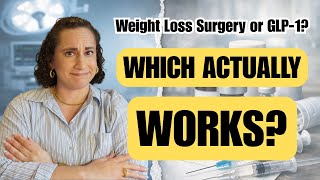
Jessica Lawson, who lost 140 lb after bariatric surgery, compares surgery to Ozempic and similar drugs. Surgery maintains 20% weight loss in 72% of patients at 10 years; Ozempic users regain two-thirds of lost weight after stopping. Neither addresses the psychological habits that drive weight gain in the first place.
Chapters
Which one actually works better, bariatric surgery or Ozempic? Look, here's the truth: both of them work, but both of them fail. Let me explain. You're seeing GLP-1s everywhere. People are losing weight, celebrities are talking about it, and maybe you're wondering if you took the harder path by getting bariatric surgery, or if there was an easier one waiting around the corner. And if you had surgery and you're dealing with regain right now, or food noise, or emotional eating, you might be wondering if you just should have taken Ozempic, tirzepatide, semaglutide, one of the GLP-1s instead. Or if you haven't had surgery yet, you're just figuring out your options, maybe you're trying to figure out which one is better, but that's actually the wrong question. And by the end of this video, you're going to understand why. So before we dive in, if you had bariatric surgery and you're dealing with regain, I want you to go grab my free masterclass training and go watch it right now. It's going to teach you why regain happens, how to stop it, and how to start rewiring your brain after bariatric surgery, which we'll talk about more in the end of this video. The link's in the description below, and subscribe and follow for more videos just like this one. What I'm about to show you is gonna make a lot more sense after you watch that masterclass. Here's what we're gonna be covering today. I'm gonna show you what the actual research says about surgery versus Ozempic, why both approaches have the same fundamental limitations, and what that means for you if you've already had surgery or you're on Ozempic, or maybe you're just trying to decide which path to take. But here's the thing, there's a lot of debate out there, but nobody's asking the question that actually matters. Matters, and you deserve to know what that is. This is your body, your life, your health. For those that don't know me, and if I'm completely new to you, I'm Jessica Lawson. I'm a certified nutrition coach and bariatric coach, and I had bariatric surgery myself. I've lost over 140 pounds, and more importantly, I've kept it off while building a completely different relationship with food, myself, and my body. And I've worked with hundreds of bariatric women. And here's what makes me different from a lot of people that talk about this topic: I spent the last 2 years working specifically with bariatric patients, both men and women, and I've seen what works. I've seen what doesn't, and I've heard every single question and concern you can imagine about surgery, regain, and yes, whether Ozempic would have been easier. And a lot of my clients have come to me when they were on Ozempic or on tirzepatide or semaglutide or any kind of different assistance. I've also done something that a lot of people haven't. I've actually read the research, talked to professionals. I'm not a doctor, so this is not medical advice at all. I haven't just read the headlines, not just the marketing, but the actual long-term studies that are comparing these approaches. Now, there's new studies coming out all the time, especially on GLP-1. So this video is being recorded on December 29th, 2025. So when I see this conversation happening everywhere and I see the confusion it's creating for women who made a thoughtful decision about surgery, I knew I had to address it with actual facts. And I know what you're thinking right now: Jessica, I went through surgery, I physically amputated my body, I dealt with the recovery, I changed my entire life, and now there's a shot, an injection I can take that could have done the same thing? And that question is completely valid, especially if that's what you're asking yourself. If you're feeling some regret, some FOMO, some what-if, that's completely normal. You're not wrong for wondering, but let me walk you through what the studies actually show because the picture is very different from what you're seeing on social media or marketing, et cetera. So first, let's talk about how these actually work in your body because the mechanisms are completely different. When you had surgery, let's say gastric sleeve like I did, here's what happened. Your stomach was reduced in size. Yes. But more importantly, the part that produces ghrelin, your hunger hormone, that was largely removed. Your body also started producing more GLP-1, which which is a hormone that helps you stay full. Now, if you had gastric bypass, even more happened. You got all those hormonal changes, plus your food absorption was rerouted, creating additional metabolic changes. Now, Ozempic, on the other hand, works completely differently. It mimics one hormone, just GLP-1. That's it. It's essentially replicating one piece of what surgery does naturally. They're working through completely different pathways, and surgery creates multiple biological changes, while Ozempic creates just one, just one biological pathway. So one versus multiple. But now how do they compare long-term? And here's where it gets really interesting, because for surgery we have decades of data. For GLP-1s, we don't have decades of data. So the longest studies on gastric bypass show that 72% of people maintain greater than 20% weight loss at 10 years. Now for gastric sleeve, we have less long-term data since it's a newer procedure. Same with the Switch. But here's something that I need you to also know is that 76% of people, 76%, regain weight within 5 years. That's a lot. That is a lot. And no one talks about this. Now, let me be clear about what that means. It does not mean that 76% of people go straight back to their starting weight. Most don't. What it means is that most people regain some of their weight from their lowest point. Maybe it's 15, 20, 30, 40, 50, 60, 70, 80 pounds, but they're lighter than they were before surgery. But it could be not by much, it could be by a lot, but they're not at that lowest weight that they hit in year 1 or 2. So if you're experiencing regain right now, you're not alone. You're not broken. You're actually in the majority. Now let's look at Ozempic. So in clinical trials, people lost up to 15% of their body weight. And that sounds good, right? But here's what they don't tell you in the commercials too. A major study called STEP 1 followed people after they stopped taking Ozempic, and within 1 year of stopping, participants regained 2/3 of the weight they had lost. That's a lot. And here's the kicker. Real-world data shows that only 47% of people are still taking Ozempic at the 1-year mark, less than half. And here's what that means in practice is that the STEP 1 extension study found that 1 year after stopping Ozempic, participants maintained only about 5.6% of their weight loss from their original starting weight. Yeah. So let's put this together. Surgery, better long-term outcomes, but 76% of people still experience some regain. Now, this is based on the studies that we have access to today. Ozempic. Based off of the study that was done, the participants on average regained two-thirds of the weight that they lost after stopping Ozempic, and only 47% of people stick with it for more than a year. Different tools, different mechanisms, but here's what I want you to see. Both have the same fundamental limitation, and that limitation, that's what we need to talk about next. But first, let me quickly address cost because I also know that's probably on your mind too. Now, Ozempic. Without insurance costs between $900 to $1,100 per month, every month. If you do it forever, if you have good insurance or qualify for manufacturer programs, that can come down significantly and sometimes to $10, $25, $50 a month, $100 a month. But that's not everyone. And insurance coverage can also change. There's a lot of regulation shifts going on right now. And let's say you're one of the lucky ones that's paying $25, $50 a month. Over 10 years, $25 a month, that's $3,000. Over 20 years, that's $6,000. Remember, you have to take it forever to maintain the results. Surgery is a typically a one-time expense. If you have insurance that covers it, which many do for qualifying patients, your out-of-pocket might be minimal. And even if you pay entirely out-of-pocket, it's a one-time cost. But here's what I want you to understand. I'm not making a financial argument here. The costs vary so dramatically based on your insurance, your location, your specific situation, that it's really impossible to make blanket statements. What I am saying is this: with surgery, you pay once and the biological changes are permanent. With medication, you're paying monthly to maintain an effect that disappears when you stop. But then there's also something way more important than cost that nobody's talking about. Here's the truth that changed everything for me, and it's what I see with every single client that I work with, because Both surgery and Ozempic are legitimate medical tools, and I want to be really clear about that. I'm not here to bash medication or make anyone else feel bad about their choices because I had surgery. Here's what nobody wants to say a lot: neither surgery nor Ozempic fixes the real problem, the real reason why you gained weight and needed surgery or Ozempic in the first place. Because surgery patients regain weight not because their surgery failed, not because they're not disciplined, But because surgery just changes your stomach, it doesn't change your brain and the reasons why you gained weight in the first place. Ozempic patients regain weight when they stop, not because they're weak, but because the medication mimics hormones. It doesn't change your stress responses. So let me break this down. Surgery just changes your stomach and that's it. Ozempic just mimics hormones. Surgery doesn't change your stress responses, how you regulate your emotions, your daily routines and systems, how you recover from slip-ups. Your identity and relationship with food doesn't change any of those things. Ozempic also doesn't change your stress response, doesn't change how you regulate emotions, doesn't change your daily routines and systems, how you recover from slip-ups, your identity, or your relationship with food. Do you see what I'm getting at? Different tools, same missing piece. And the research shows that surgery provides superior long-term effectiveness, and the 10-year data is stronger. The biological changes are more comprehensive, but even with surgery's advantages, 76% of patients still experience regain because the Biological tool cannot do the psychological work. Ozempic works, but it works temporarily for most people because when the medication stops, nothing has changed in how they think, react, or cope unless they do the work they need to. And most people do not because doctors aren't trained on how to do that. The people who succeed long-term with either approach and then the deeper work of changing how they think, how they respond to stress, how they structure their days, how they see themselves, the people who struggle. They're still waiting for the tool, whether it's surgery or medication, to do the work that only they can do. Here's what I've learned from my own experience and from working with hundreds of women and bariatric patients in general. When you have surgery, especially in those first few months, you're forced to change. You're forced. You physically cannot eat the way that you used to. It's not comfortable, and it creates a learning period where you develop new skills, and you know what skills to build. With Ozempic, you need those same skills— portion control, mindful eating, dealing with emotions without food— but you have to develop them while the medication is working. And here's what I see happen most often: surgery patients lose weight rapidly in the first year, and they gradually start regaining as old patterns creep back in. And the biological changes are still there, but the behavioral systems were never built. Ozempic patients lose weight while taking it, but then they regain quickly after they stop because they never developed the skills they needed. Neither path is easy. Neither path is easy at all. Both require the same essential work: rewiring your brain, building new systems, and transforming your identity. Individual factors matter enormously, and your healthcare team should guide your specific medical decisions, not a YouTube video. This is educational information, not medical advice, but If you choose surgery, here's what I want you to know. You made a choice backed by decades of research showing superior long-term outcome. You didn't take the easy way out. You took the way that as of today has the best long-term success rates and the biological changes that surgery create in your body, the hormonal shifts, the physical changes. Those are real advantages that research confirms work better over time than medication alone. But here's what surgery really gave you. It bought you time. In creating conditions that make the real work that you need to do easy. Okay, surgery didn't fix your stress eating, but it made it harder to binge, giving you space to learn new coping skills. Surgery didn't change your relationship with food, but it forced you to eat smaller portions, teaching you what appropriate portions really feel like. Surgery didn't transform your identity, but it created visible changes that let you start seeing yourself differently. Surgery gave you the biological foundation, but the real transformation The brain work, the habit work, the identity work, that's still yours to do. And if you're regaining right now, it doesn't mean that you failed. It means that you're in the 76% who never learned how to do the deeper work that makes surgeries' advantages permanent. But here's the good news: you're ahead of the game. You have biological advantages that make this work a little bit easier. You've already proven that you can make hard decisions and follow through. And the real opportunity now is building the systems that maximize those advantages. Because surgery gave you tools that most people do not have. But tools are only as good as you know how to use. That's exactly where I focus my work. If you're ready to do that deeper work and maximize what your surgical investment can give you, I'd create something specifically for that because this is exactly what I teach in my coaching program, the Bariatric Success Academy. So how to do the brain work that surgery cannot do. But first, I want to give you something free that will help you right now. I create a masterclass training that walks you through exactly how to stop regain, why it happens, in my method that I teach my private clients. So go sign up for that at the link in my bio or in the link in the description down below. You're gonna learn the systems that separate women who thrive from those who struggle in my proven framework for rewiring your brain to support permanent success. This is the exact method that I used to maintain my 140-pound weight loss. And whether you ever work with me or not, this training will give you tools that you can use immediately. So click the link below if you want to learn about the Bariatric Success Academy. After that, There's information about that too. So you made a smart choice with your surgery. Now let's make sure you can get everything it can get you. I'll see you in the next video.
More from Jessica

Why You Lose Control With Food The Second You Get Home From Work After Bariatric Surgery




Why You Keep Reaching for Food After Bariatric Surgery, Even When You Know You Shouldn’t #bariatric

Why Food Takes Over When You Get Home From Work After Bariatric Surgery #bariatricsurgery




What no one tells you about regain after Bariatric Surgery #bariatricsurgery #bariatric

She Spent $15K on Bariatric Surgery and Still Couldn't Stop the Food Noise (Until This)