Threat Or Challenge? Responding To Stress
In this live YouTube session, Jim Katsoulis explains how the way we respond to stress—either as a threat (fight, flight, freeze) or as a challenge—directly influences our eating habits and long‑term weight. He argues that the natural threat response diverts blood and mental energy away from the brain, prompting people to seek quick comfort in food, especially hyper‑palatable, high‑calorie options. By cultivating a "challenge" mindset—grounded, calm, and problem‑focused—individuals can make more strategic, long‑term choices that avoid the short‑term food fix and support sustainable weight loss. Katsoulis critiques conventional dieting, describing it as a short‑term, willpower‑driven strategy that fights against ingrained procedural habits and inevitably leads to weight regain. He emphasizes that true weight mastery requires reprogramming the brain’s automatic eating scripts, reducing cognitive load, and shifting from a diet mindset to a "goal‑weight living" mindset. He introduces his "Program Yourself Thin" system, which combines hypnosis, neuro‑linguistic programming (NLP), and habit‑stacking to create new automatic behaviors. The program offers free hypnosis sessions, daily 5‑minute audio tracks, and a structured 8‑week plan aimed at lowering stress, improving nervous‑system regulation, and embedding thin‑healthy identity. Katsoulis also discusses GLP‑1 medications, acknowledging their short‑term efficacy but warning that they do not address the underlying stress‑eating patterns and may lead to dependence and muscle loss. He stresses the importance of mastering stress without food, using techniques like deep breathing, relaxation, and mindset work. Throughout, he engages with live comments, shares anecdotes about seasonal changes, and reinforces the principle that sustainable weight loss is a lifestyle transformation rather than a temporary diet. Key takeaways: 1. Stress response type (threat vs challenge) shapes eating behavior and weight. 2. Diets rely on willpower, which is a finite prefrontal resource, and fail to rewire automatic habits. 3. Reprogramming procedural memory through hypnosis, NLP, and habit formation creates lasting change. 4. GLP‑1 drugs are powerful but not a long‑term solution without addressing stress and mindset. 5. The "Program Yourself Thin" framework offers a holistic, low‑cognitive‑load approach to living at one’s goal weight.
Chapters
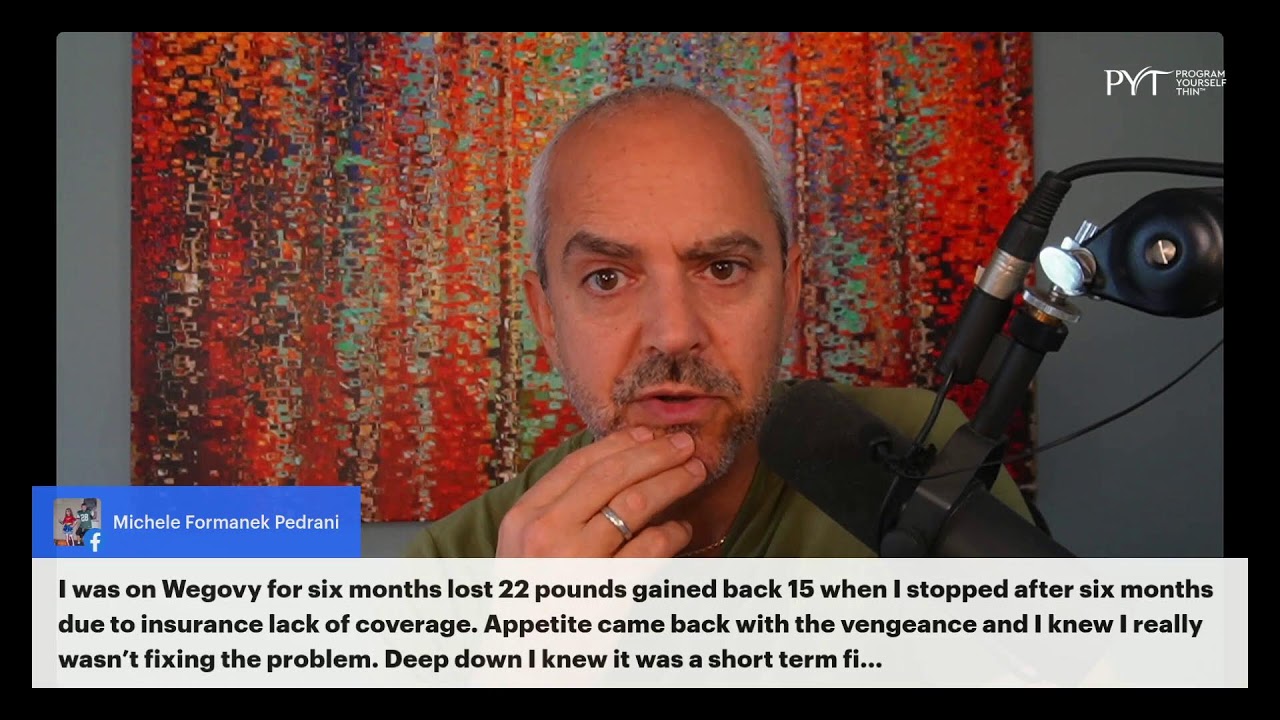
Or challenge. How do you respond to stress? Because the answer is gonna have a huge impact on your weight. Threat response is when we go into fight, flight, or freeze mode when we're experiencing stress. And to be honest, that's kind of our natural response, right? A lot of times. And when it comes to life, if that's how you're responding, kind of this fight, flight, or freeze mode, that is gonna tend to nudge you towards food. Right? Because when we fight, flight, or freeze, we're not thinking clearly. Please understand that. You know, we go into fight or flight mode. What happens is all the blood in our body, all our energy goes down to our muscles to fight or flight, to run away or to fight. And the energy does not go up to our brain to think about things calmly, reasonably, from a, you know, normal perspective. And so when we get stressed in the modern world, a lot of time there really is no reason to fight anything, and you don't have to necessarily run away. But that same system is getting activated. And a lot of times what we will do in the modern world is that will nudge us or make us run towards the food, right? Because the food is what we use in order to kind of re-regulate ourselves, to perhaps distract ourselves from the thing that was causing stress in the first place, um, and also kind of make our bodies feel better for the short term. So we start to feel, you know, not so fight-or-flighty. So that's one response to stress. The other response to stress is the challenge response. And this is the response that you really want to start developing in yourself. And the challenge response is really when stress visits you in life, that you have more of this bring it on mentality. Let's do this right. So you're kind of digging your heels in. You know, let's go right now. It's different than fighting because fighting is kind of more reactive and it's just this burst of adrenaline, this burst of energy. Um, but the challenge response is a much more grounded, neutral, kind of 360 approach to responding to this thing in the most effective way possible. All right. And so as you start to develop your ability to kind of deal with stresses in your life from this more grounded, calm perspective so that you can overcome it, right? So another big kind of shift in the focus here is is when we react in a fight, flight, or freeze mode, we tend to focus on the problem, right? We focus on the problem. We just want to get away with it or get it out of the way here by fighting it. But when we focus on it with a challenge response, we tend to have a much more kind of nuanced, subtle, um, long-term solution to it. And that's really what we're looking to do with the challenges in our lives, because most of the challenges in our lives, the stresses that we're experiencing in our lives, a lot of it's more mental than it is physical. You're not so much getting chased by a lion as you are, you know, stressing about the state of the world, finances, your job, relationships, things like that. And so the answer to those stresses typically in the modern world are more psychological. And so as you start to ground and calm yourself when the stress appears, you tend to have a much better chance of resolving it at the core. And that process doesn't lead you to the food as much. So that's one of the big differences that can really make an enormous difference in your weight, your eating, and ultimately your behavior. So give this some thought. Start thinking about stresses in your life and how you can start to respond to them in a more challenge-oriented way where you take it on instead of trying to just react, fighting and/or running away from it. And if you want to go deeper into this way of kind of thinking about it and increase your ability to stay grounded and calm In the moment so that you can be more likely to, um, deal with things with a challenge mindset, click the link in my bio or go to programyourselfthin.com. If you're on Facebook, you can just type mind, M-I-N-D, into the comments, uh, and it'll automatically come out. But, um, you'll get a free hypnosis session called The New Thin Me, and it will help you relax, go deeper into this calm state, and be able to deal with the stresses in your life in a much more effective way. Um, than you may have in the past. So go check that out. If you have any questions, feel free to ask them. I hope you are all having a nice day. My, uh, voice continues to be a problem. Oh, it's making me nuts. But anyways, hope you're having a beautiful day. It is literally epically beautiful today, I will say. Absolutely, um, a gorge out here in New England. It is just like, what What did I say? Peak, peak fall here. I suppose a lot of people in New England live here for this moment, you know, because it is really one of the most beautiful defining moments of the year, um, in New England, I would say. So yeah, I don't know if people, people come here. I don't know. I know that there's gotta be trees. They always say like trees don't really change like this in other places, but I don't understand that. Is that not true? Do other areas not get much colors of their trees and the leaves and all that? But anyways, it is beautiful. Bright colors every well, I don't. They always say it's muted, but to me, there's some trees are so bright; it's just hard to even believe how red and yellow they get, and orange. It's it's just insane. But yes, enough of that. Any any weight loss questions? Feel free to ask him. Any weight loss questions are welcomed. I did have someone write to me a little while ago asking. Well, yeah. Well, I'll get a big big five, Jackie. I see you asking your thing there. I'll get to that in a second. Um, what was I gonna say? Yeah, someone asked, they said, how can I get— excuse me. Oh my goodness, I try and do this before I get on. I just want you to know that I try and clear my throat before I get on here, and it's just something about talking a lot makes it just get triggered. Anyways, okay, they asked me, how can I get more addicted to whole natural foods? How can I get more obsessed with it? Because it's not happening. I keep preferring the sweets and the processed stuff. Uh, yeah, you're always gonna— I, I still deep down, I still prefer the processed foods, the sweet foods, the hyperpalatable foods. So that— I don't believe that's ever gonna change for me. I don't think it's ever gonna change. I don't think there's ever gonna be a day in my life where I prefer, um, the salad over the pizza. Like, I just don't ever expect that. So I think right off the bat, we got to change our expectations because I don't know how much I don't even know if there's enough programming on the planet to get you to the point where you would prefer whole natural foods over sweets. Now again, I prefer them. I don't want to say that, but at a base physiological level, psychological level, I'm always going to prefer the high-calorie, hyperpalatable foods. Typically, we all are. Okay, that being said, that doesn't mean you have to eat them all the time. You can still control your weight. But I think we have to get a real clear idea of what we're aiming at here, because if you're aiming at someday when you were just going to choose, uh, you know, the greens over the, you know, the muffins, that's probably never gonna happen. Okay, so, um, it is a process of getting obsessed with natural foods, but it really— it kind of comes back to what I was saying. I didn't go into too much detail with it just now, but this challenge response, right? So that we're met with some stress or we're met with a challenge, right? Something's going on, there's a problem. Um, a lot of times if we just react, and that's what dieting teaches you to do anyways, If you just react, you're going to fight against that. But if you are grounded, you can start to make more, much more strategic approaches. So, you know, if you love sweets and you want to eat less of them, it's not about— you can always like sweets more, but you can start to program into your eating, let's say, less sweets, more whole natural foods. And part of that process is also keeping some level of sweet that you really enjoy that you can look forward to. So, you know, once or twice a week, eat whatever sweet you like, your favorite sweet, have it, you know, have it out in front of you and eat it on that day and get as much enjoyment as possible as you can out of that. You know, that's how I kind of honor my desire for sweetness and my desire to weigh what I want to weigh. Right. It's kind of a balance. But it's not an exclusion. And I hear this all the time. I think it's one of the biggest diet mistakes people make is that they try and completely cut things out. So Debbie was on here yesterday talking about trying to completely cut sweets out. And I think the path of trying to completely— the path of abstinence, really, of trying to completely cut sweets out or whatever you may like a lot, I think is is hard to keep up, you know. So I think the balance— a balanced approach is usually much more effective. Uh, says it's hard because I want to get to my goal number, but I still want to keep eating my sweets. Um, just bought cookies and a brownie. Yeah, yeah, again, but that's what I'm saying. It's— it doesn't have to be mutually exclusive necessarily, but you know, they are related as well. But here, here's how I go about this, because I love food. I love food. I've always loved food. My dad was a foodie. My mom's a foodie. My whole culture was food. Everything has been food in my life, honestly. Like, I love food and I'm always thinking about it. I mean, I, I'm constantly looking forward to food, can't wait to eat it, all the rest of it. That being said, I've learned to moderate it. And so a percentage of my eating is really not about enjoying the flavors so much, right? So I make the distinction between fuel and fun. Right? Some some of my eating is focused, and the intention is more on fuel, just fueling my body because that's what food's meant to do. And part of my focus with food is on fun, just eating foods, and I'm making more the decision on me enjoying them. Okay? And um and I balance those two out, and I continually optimize and tweak them as I move forward. But nowhere in my mind do I want to live in a reality where I never eat. Sweets, right? So, so Jackie, for you, again, you probably never— in this— okay, so let me back up a little bit because this gets back to your goal weight. And this is a much deeper conversation. Your goal weight is a much deeper conversation than just looking at a BMI chart because your goal weight really is not just about a number on a chart. It's about your quality of life and what you want to do during that life. So every single person here can weigh what they want to weigh. Every single person, every one of us can weigh what we want to weigh. The problem is most of us don't really want to weigh that. So what I'm saying in a different way is that a lot of dieters choose a goal weight that is too low for them. Now, what does too low mean? It's, it's not healthy. Nope. I don't mean that. Let's just say you choose a number that's absolutely healthy. But for you to live at that goal weight, you would need to drastically restrict calories and/or never eat sugar or sweets again and/or never eat carbs ever again. And so we have to realize that when we're choosing a goal weight, we can't just look at the BMI chart or some number someone gives us because the other side of that equation is our quality of life. This is the main thing that stopped you from reaching your goal weight, because if all that mattered was getting to the number and that was what defined your quality of life and how happy you were, then we'd all be at our goal weight. But the problem is you start losing weight, or you've even gotten to your goal weight, but then you start to not enjoy living your life. Your quality of life goes down. What I'm trying to say bluntly is a lot of times people's weight goes down and so does their quality of life. How do you all explain 85 to 95% of dieters that lose weight put it back on? How would you explain that, right? They obviously have the plan, they have the ability, so why don't they maintain it? They know how to do it, they can do it, they did it. So what happens? I would suggest that their quality of life goes down, that even though their weight went down Never eating a pizza ever again, never being able to eat cake with their family at a birthday, never you know enjoying vacation meals ever again. If that's how they're getting their weight really low, they're never going to stay there, even if their weight goes up. Excuse me. I should just pick a different time to do this fucking live because it's like I'm telling you, like my throat is fine all day long. But anyways, so we got to figure it out, right? So again, folks, you're all picking the weight you're at. In essence, you know, you're doing it. You can pick a lower weight. You could live at a lower weight. You don't want to. Let's just be— let's just say it as clear as we can. There's no reason to beat around the bush. You weigh what you want to weigh subconsciously, right? And so what's happening is, yeah, I want to lose weight. I want to lose weight. Yeah, sure. You want to lose weight, right? Your want, your desire, your motivation to lose weight is right here. Your want, desire, and motivation to not change your eating or lifestyle is way up here. They ain't the same. This is why you're struggling with weight more than anything else. And you could have physical issues, you could have insulin resistance, you could have diabetes, you could have Hashimoto's, you could have all sorts of other things that are factors too. But I guarantee you all, anyone who's overweight or struggling with their weight, your number one problem to deal with initially is your motivation. You're not truly motivated. And a lot of dieters are not really motivated because in their mind it's a binary system. It's all or nothing. So if they're going to weigh what they want to weigh, they're going to have to give up everything. And they don't want to do that. You don't want to do it, right? You want to lose weight, right? So why do you think you're not doing this? Isn't rocket science. It's 2 big reasons. One is you think it's gonna be really hard, and 2 is you think it's gonna be really shitty. You know what I mean? Like, like it's hard work, like it's a lot more effort. You know, you're up to here already. You like, you got no more energy to dedicate to stuff. That's one part. But the other part is that it sucks. Your life's better now than it is on Monday when you try and stop eating carbs. That's how you internalize it. Never mind the weight that might happen, you know, in the future. And on top of that, then there's the, you know, again, you have a history of Not being able to control your weight. So even when you put all the effort and work into losing weight, in the back of your mind at this point, if you're in your if you're in your 50s plus, you most likely now just code. Even when you start losing weight, it makes you just more anxious because now you're just worried you're not gonna be able to keep it off. You know, but um so yeah, Jackie, I would consider you know what goal weight are you aiming at? You know, I would suggest for most people. Adding a couple pounds to your goal weight is a smart decision. And, uh, I, I— most of my clients end up adding pounds to their goal weight because your goal weight's too long— too low. And, and the goal weight, I don't know, it's just a fascinating thing. I'm gonna switch topics here because it's like I talk about this all the time, but— oh, okay, Carolyn. Yeah, Quebec. Okay, I know you're up in Quebec. All right, I gotta get up to Quebec. I've not been to Quebec. I've been to Montreal and I've been north of Montreal. I actually did my yoga teacher training up north of Montreal. Um, so awesome, so beautiful up there. But yeah, I haven't got up to Quebec. I'm gonna do it. Maybe I'll go this winter. I know they always say, um, Quebec in the winter is just gorge, but they got foliage. That makes sense too. Yeah, yeah, Vermont, New Hampshire, Massachusetts. Oh my God, the leaves. Unbelievable. What's up, Lois? Raining up there. Hey, Vicki, how's it going? Uh, Lois says the idea of really enjoying a sweet once in a while is great. I buy mini single-size candy, make mug cakes, reducing the sugar and adding pure pumpkin or applesauce in place of oil. See, that's just— that's exactly what I'm talking about. That's exactly what I'm talking about. Nice job, Lois. Yeah, that's, that's so beautiful. I love that. I love that. That's like layered. That's layered strategy. See, that's what you do when you're calm and relaxed and you approach a challenge in your life with a calm, grounded mindset. And look for solutions that really fit your life and your personality. Tell me when that path isn't gonna, you know, be better than a diet path of just cutting everything out. Yeah, the puree pumpkin or applesauce in place of oil, brilliant. Cutting the sugar down, brilliant. Making your own sweets is definitely one of the smartest ways. I mean, now again, everything's got— everything's good and bad, right? So if you make your own sweets, you can reduce the sugar a bit. You can replace oil with some other things. You can do that. But then a lot of times you got a lot more, right? So then there's that challenge, right? So again, though, just strategy. You either make really small quantities or you make bigger quantities and get rid of them real quick, you know. But, um, yeah, when you start cooking for yourself, that is almost always a really one of the easiest ways. I know it's not easy to start cooking for yourself necessarily, but if you develop the skill of being able to prepare foods for yourself— and believe me, I am as lazy as it gets with cooking Um, but I look for the easiest things I can make, and so now I make the easiest things. So when I say I don't mind cooking, it's— yeah, because I cook the easiest shit ever, and I've done it a million times, so it's just automatic now, right? But, um, yeah, cooking for yourself versus eating out or eating pre-processed foods is one of the fundamentals, I think. I mean, I'm not saying you can't lose weight if you eat out a lot and eat a lot of processed food. You know, but it's a lot harder, a lot harder because those, you know, restaurants, processed foods, fast food, all of these companies, they make their money off of you eating their food regularly. And we know that what triggers overeating, what triggers repeat, you know, eating patterns— salt, sugar, fat. And so anytime you're going to a restaurant, prepared foods, processed foods, fast foods, junk food, All of these things, they're, they're cranking up the salt, sugar, fat, and other factors that get you to overeat it, you know, that get you to be addicted to it, that get you to be, you know, struggle with your weight because they're high-calorie foods. And yeah, almost guaranteed every time you make food yourself, you are, um, you are saving so many calories. It's so funny, I watched a video a little while ago about Um, a guy goes, how come the restaurant vegetables always taste so much better than yours? And, uh, you know what the answer is? It's not a trick question, but sometimes we don't think about this. It's that restaurants use tons and tons of butter, you know, tons and tons of salt, tons and tons of sugar. Because these things, A, you know, for a lot of places, they kind of make up for lackluster ingredients, okay? They kind of COVID it up. Um, but the most important reason is that humans are addicted to these things. You know, those 3 substances trigger more eating typically, you know. So yeah, they're putting lots of that in the food, you know. Anyway, it was funny watching them make the vegetables because it was like, it was like, I mean, it was, it was like a serving of vegetables and it was like 3/4 of a stick of butter, you know. He's doing just like he did at a restaurant. It was like, you just don't think about it that, you know what I mean. And so if you cook the vegetables at home, you know, A, you may steam them. B, you may use some oil or some butter, but it is a fraction, you know, for most of us. I know some people out there use a ton of butter at their house too, but for the majority of restaurants using way more, way more, way more, way more. Carolyn says, agree, listening to Christmas Carol hypnosis might have to be a daily for me. Yeah, the Christmas Carol hypnosis. I forgot about that. I forgot about that video. That was kind of a fun one. I forgot I did that. Uh, it's funny. Um, but yeah, if you have any questions, feel free to ask them. Any weight loss questions are welcome. How everyone's doing? This is typically, you know, and I say this to my clients, that I would suggest that the next, uh, 6 weeks or so you kind of lock in, you know, focus in for the next 6 weeks. And then enjoy your Thanksgiving. And then, you know, program yourself thin world. We will be, um, in December we'll be focusing more on rest and renewal and enjoying ourselves. You know, that's a part of living in your goal weight too. You know, it can't just be all this strict bullshit. I know you think it can, but it can't. You know, you can only be strict for so long, and that's not a That's not a commentary on your character. It's just that's just being a human being. And so I don't know. I mean, that's what diet diet's giving you. See, I always talk about the diet mindset, you know, and the diet mindset is this mindset that you're gonna just change everything tomorrow, right? You change everything on Monday in some drastic way. You're gonna completely. Uh, completely stop eating carbs. You're gonna— from now on, you're drastically cutting your calories down. Oh, we're gonna go to the gym, uh, 5 days a week, whatever you do. You make this plan again, and it's not your fault. I mean, dieting's just trained you to do this. You want to lose weight, what are you going to do? You do something drastic, you do something extreme, are you not? And it's all extreme. Weight Watchers is extreme. Paying attention to every fucking food, every single thing you put in your mouth every day. Are you telling me you don't have enough to think about in your life? But now, I mean, it's estimated we make over 200 food decisions a day. You know, do you know about cognitive load, right? The amount of, the amount of stuff we're kind of carrying. Cognitive load for me has become really one of the central things I monitor. Um, and you know, honestly, one of the main things I monitor is energy, my energy levels. And then that's kind of the big umbrella, energy. And then I look for cognitive load, which is kind of my cognitive energy I'm using, emotional energy that I'm using, physical energy that I'm using, right? I'm kind of tracking those things. And I'm looking— for me personally, now again, in Program Yourself Thin, we follow the goal weight pyramid. So it's not just about the eating piece of it. We follow this goal weight pyramid where it's mindset, lifestyle, eating. Right, and whoops. So so again, it's a it's a holistic approach, right? But so so when I look at all these things, right, so we got these three categories and we break them down other categories. But when I look at these things, the way I've always approached them is that I want to get them to a point where I got my nails. Um, I want to get to a point where I don't have to think about them so much. I want my— these habits here, all these different things that we break it down, I want to be able to do them as automatically as I brush my teeth, right? So you all brush your teeth. This is a habit that you weren't born with. You practiced it over and over and over and over again, and eventually it just became pretty much automatic, right? Because now you get up and you kind of have your toothbrush routine. You go to bed, you brush, and any other times you do it as well. But you're not thinking about it. You don't have it written down your planner. You just do it, right? Because you programmed it in, and I think understanding that is really important for setting yourself up for success because dieting is the exact opposite of that. Dieting is the opposite of how you brush your teeth, and if you want a real apples-to-apples comparison, dieting would be like if you said, "Ah, you know what? From now on, I'm gonna brush my teeth." 2 hours later in the morning and 2 hours earlier in the night, and I'm going to use my other hand. So again, even though you don't even care, you wouldn't really miss anything necessarily. What would happen is you would stop brushing your teeth nearly as much. Why? Because to remember to brush your teeth 2 hours later, to remember to brush your teeth 2 hours earlier, to remember and then actually, actually do brushing your teeth with the other hand feels weird. It's uncomfortable, takes a lot of thought. And so if you try and do that, it's going to take— it's going to increase your cognitive load, right? If you try and change your toothbrushing routine in the ways I just described, your cognitive load goes way up because right now you brush your teeth on near autopilot. So there's not— it doesn't take much energy. There's literally a part of your brain, it's called procedural memory. And so it's just this behavior that's there now. And how it works is You have a procedure, right? The way you brush your teeth is it's— it follows whatever precedes it. You know what I mean? And then as soon as you brush your teeth, something follows that. And so that procedure is kind of ingrained in you and you just do it automatically now. Well, guess what? Your eating is the same thing. The times you eat, what you eat, the amounts you eat, who you eat with, where you eat, right? All of these things are in your procedural memory. So you automatically are eating the foods in the ways That keep you overweight. And so what dieting has taught you is that you have to consciously change all this. You have to consciously fight against it all. But now we're right back to the idea, if you try and consciously change your toothbrushing habit, good luck. No one's going to succeed with that either unless they use a strategic approach to reprogram their mind to brush their teeth differently. But willpower alone is not going to do it because you're just going to forget. You're going to get distracted. And isn't that what happens to every time you try and lose weight? You can do the plan, you can follow the plan for a little while, and then you can't anymore. Next thing you know, you're not doing it. And I would like to give you the kind of concept that the reason you stop doing it is because your focus and your conscious energy kind of wears out. Life grabs your attention again. You forget about the thing you were focusing on, that the carbs or the Calories or the working out or whatever it is, it just kind of disappears from your life. And you what? You go back to your normal routine. And that is what you have dealt with your entire history of dieting, is that you diet for a little while, then you always go back to what? Your normal routine. Well, your normal routine is the programming that you have now. And in my opinion, the only way to change your weight is to reprogram yourself with new routines. So that you naturally and automatically do the things that get you to your goal weight and keep you there. But we do not want to rely on conscious willpower. Your conscious willpower is actually part of your prefrontal cortex. It's the newest part of your brain evolutionarily, and it is a finite resource. Again, there's literally a book called Willpower by Roy Baumeister. You ought to read it. It's very eye-opening. And to some degree, to let you off the hook, you know, because you're blaming yourself for the wrong reasons. I always say metaphorically, you're blaming yourself because you don't have the willpower to follow a diet is very similar to someone who blames themselves for not sprinting the entire marathon. You know, they had said, I'm going to run this marathon, I'm going to win, I'm going to sprint the whole thing. And you start out and you're way ahead when you're sprinting, but then every time, every single marathon, you run out of steam. And you collapse. Why? Because you can't sprint a whole marathon. You have to pace yourself. You have to have a different kind of energy in it. You have a different strategy. You can't just be 100 miles an hour in a marathon. If you do, you're going to be ahead for a little bit, and then you're going to always collapse and not finish the race. And is that not a good description of what diving's felt like to you? That you're able to start off 100 miles an hour, and then you kind of run out of steam. You run out of gas. It's no different than trying to sprint a marathon. It's just it's the wrong strategy for the wrong race. So you know again dieting has done this to you. Dieting is not your friend. Dieting is a concept that's owned by the food processing company. Weight Watchers was owned by Heinz. Jenny Craig was owned by Nestlé. Slim Fast owned by the same company owns Ben and Jerry's ice cream. These companies do not want you to lose weight. They do not want you to have mastery over your mindset, your eating, and your weight so that you don't eat their foods. So they fill your head with bullshit. These diets are bullshit. There's not even one single diet. There's not even one single diet that rises to the top. Think about that. 100 years of diets, not one single diet rises to the top of being effective long-term in any really statistical significant way. But that's because they're not meant to. Diets are not meant to keep you thin. Uh, yeah, Carolyn says, name of the author please. Uh, Baumeister. Roy Baumeister. B-A-U-M-E-I-S-T-E-R, I believe. Been a little while since I read his book. He's great though. It's just, I mean, good Lord. You really ought to read it, folks, because again, if you think about it, I mean, you're, okay. So virtually anyone who's gonna try and lose weight on their own is gonna try dieting, you know? And even if you're not gonna try a specific diet, you're still doing the exact same mindset. This is the problem. See, the problem with diets isn't the philosophy, right? So I'm not gonna sit here and argue which is better, low carb, low fat, low salt, low, Whatever, you know, each diet philosophically, if you follow it, you'll probably lose some weight. You know what I always talk about with the mindset of dieting is how you're thinking, you know, the mindset of it. And if you really think again, regardless of what you're going to do, whether you're going to be a vegan, whether you're going to be a carnivore, whether you're going to go low fat, whether you're going to go low carb, whatever you choose is almost irrelevant. Because you're going to approach it as a dieter. What does that mean? Well, it means that you're thinking about this as a temporary process. This is something you're going to do until you lose the weight. Then you'll figure out that— you'll figure that rest out later. Let me just get to my goal weight. Okay. And you're going to take drastic action. You're going to start Monday or whenever you start, 100%, 100% no carbs, 100% no sugar, 100% tracking calories, 100% restriction. You're jumping right into 100%. Well, how do you jump into something 100% when you don't have the skill? You don't have the skills to eat the right foods, the right amounts. You don't have that skill. If you did, you'd be at your goal weight. And it's not a— it's not a judgment, okay? Just a statement of fact. You don't have the skills to live at your goal weight right now. So what are you going to use to get yourself to do the right thing? It's not your skills. You don't have the skills. So what are you going to use to get yourself to follow the plan? Willpower. Use your willpower, right? You're going to force yourself to do the right thing because that's what it's all about. Just do it. Just fucking do it, right? What am I doing? You know, that's it. I'm going to lose this weight. I'm going to do it. I'm going to make— I'm going to make the right decisions. No, you're not. Not for long, unfortunately. And the sooner you realize that, the better, because then you can find a better plan that actually works. But again, what every dieter is relying on is willpower. And unfortunately, most dieters don't really understand what willpower is. Willpower, again, is a prefrontal cortex process. It is a finite resource. Think of it like a muscle. That's what reading Roy Baumeister will teach you, is that your willpower is like a muscle and it's finite. I'll give you an example. One of the things he did in one of the experiments was they had That a group of college kids come in and they had them do math puzzles, math problems, math puzzles. And so they had them do that for like an hour. Okay. And then they went and offered them dessert. And wouldn't you know, after they did the math puzzles, they ate a lot more dessert than before, or if they didn't do the math puzzles. Why? Because your prefrontal cortex handles your executive functioning. So doing high-level math work or high-level thinking work And willpower come from the same muscle. And so when you deplete the muscle through, this case, math problems, you simultaneously just deplete the overall willpower muscle. And so if you use the willpower muscle to do math problems, you're gonna have less willpower muscle to make the right choices. So relying on conscious willpower is a very bad strategy for long-term weight loss. So again, it's the difference between willpower versus skills. Skills is just another word for programming. It's what you do naturally. What you do naturally is eat in a way to keep yourself overweight. That's just what you've learned. It's not a character. It's not a judgment on your character. You have just been— you are a person who's been in the environment you've been in, around the people you've been around, the food you've been around, and you have learned to eat a certain way. You've developed the eating skills, the ability to think, live, and eat like an overweight person. If you're overweight right now, it's because you have the skills, the programming to think, live, and eat like an overweight person, and that's why you're overweight. And you occasionally diet And use your willpower to fight against all your skills, right? You want to eat ice cream after dinner? No. You want to have that second helping? No, no, nope, nope, nope, nope, nope, nope, nope, nope. But dieting never gives you new skills; it just fights against your old skills. Problem is you can't get rid of old wiring, so you can fight against those skills for weeks, months, sometimes years. And the second you stop fighting against them, what happens? What has happened to you? The second you've stopped fighting against your eating habits, your thinking habits, your lifestyle habits, the working out, the second you stop fighting to do it, fighting to stop yourself, what happens? You go back to what you always do. You go back to normal. Normal for you right now is overweight. You can't just fight against that with your conscious mind. It's not up for the task. Reprogramming yourself is training yourself to naturally and automatically do the things that get you your goal weight and keep you there. And you'll never convince me that that's not a better strategy. And it's pretty obvious. I mean, who would even argue with me? I mean, like, at this point, 74% of the population is overweight or obese. Dieting doesn't work, and the GLP-1s—I don't think they're the answer. I really don't. You know why? Because most people—it seems to me—that are on GLP-1s, most people. Now some people again. Now you know what I've noticed? This is anecdotal, right? I'm not an expert on GLP-1s, but one thing I have noticed: if someone is using a GLP-1 because they. Were severely, you know, diabetic, some other kind of metabolic disorder that was intense. Let's just say intense. And I'm using a very general category. But if someone had kind of like a physical issue going on, they seem to be a lot more open to the idea that they'll be on this forever. But people that are doing it just for weight loss, I've kind of noticed that they talk about GLP-1s the way they talk about dieting, and that is Temporarily. They think to themselves, I'm only going to do the GLP-1 for a little while. I'm going to use it to get my weight down and, you know, I'll figure something out between now and then, and then I won't need the GLP-1 anymore and then I won't use it. And I think that's really interesting because I think that's what's going to do GLP-1 in more than anything else. I think it clearly, for the majority of people, it is helpful to Like a miracle in terms of losing weight when they're doing it. But I think what we're going to start to notice over the next few years is we're going to see people that do not want to stay on it for whatever reason— cost, quality of life issues, just don't want to be on it, don't like the side effects, miss food the way it was— but they're operating under the delusion just like a dieter, because dieters always operate under the delusion that they're going to get to their goal weight and then figure it out. But again, it's estimated that 85 to 95% of dieters that get to their goal weight put the weight back on. So statistically, 5 to 15% of dieters that get to their goal weight— this is the successful ones, the ones with the plan that worked for them and the motivation to follow it all the way through. We're talking about the, the, the winners of dieting, the successful people. Out of the successful people in dieting, Only five to fifteen percent are able to maintain it. So to me, this is a real big indictment of dieting in general, and I don't know how much more proof you would need to know that dieting is not built for long-term success. I don't know if you would argue with me about that. I don't know if you just believe people just need to try harder. I don't know what you think about that. Dieting is a bullshit. Plan and strategy for you to manage your weight long term. I think on top of it not being effective, I think it's intentionally deceptive. I genuinely think dieting— if I am a hypnotist, if I was going to create a plan to pretend that I wanted to help people but actually sabotage them, I don't think you could come up with something more effective than dieting. Honestly, dieting is so ineffective for long-term weight loss. It's almost like it was planned to be that way. And I've kind of come to the side to really believe that. I've genuinely put my tin hat on. I don't give a shit. I genuinely believe dieting and the concept of diet is put there by food companies to sabotage people. And I'll only send this back to you with the question. How do you think you're going to be able to live at your goal weight? Have you ever lost weight before? Were you able to stay there? If not, why? Why? And if you're really honest with yourself, you probably— I got bored, get tired of it, got off track, couldn't stick with it. Again, this illusion, delusion that a dieter is gonna get themselves their goal weight and then they're gonna figure it out how to stay there. Because losing weight on a diet is a completely different process than living at your goal weight. When you're losing weight, you've got the weight loss to motivate you. What's going to motivate you once you get to your goal weight? I'll be at my goal weight. Everything will be amazing, Jim. Well, I got news for you. You already been at your goal weight. What happened the first time? You've been at your goal weight at least once. If it was so incredible, why didn't you just stay there? Why didn't it fix everything? And this is what we have to realize: being at your goal weight does not fix everything. And that's why I think people are not going to want to stay on GLP-1s long term because I think they're going to get to their goal weight or close as close as they're going to get to it because. Again, you only lose weight for 16 months on a GLP-1, and then they're going to have their life to live with, and there's no weight loss to look forward to. There's really no food to look forward to, not the same way. And now you might be on this thing forever, paying for it, injecting yourself, living it forever, and there's no more excitement with it. Excitement's gone. You know, it's 3 months in, 6 months in, everyone said you look great, no one says it anymore. There's no more weight loss to look forward to, and I think a lot of people are not going to want to stay on GLP-1s. But the big problem between a diet and a GLP-1 is that a diet—the weight loss is relatively slower and less extreme. And so when you get off the diet, you put weight back on, but you didn't lose as much muscle the first time. With GLP-1, the big issue—you can't do this a lot, and you got to realize this going into it. You only get one or two rotations on this GLP-1 train before you start substantially changing your body composition. And I know you women are all worried about your muscle. You've been listening. You have protein and muscle importance as you get older drilled into your head. So if you're gonna go on a GLP-1 and you lose a lot of weight, you lose a lot of muscle, and you come off of that and you put a lot of fat back on, not a lot of muscle. That's something you've got to consider. That, and no one's going to tell you that, you know, because even the doc— doctors don't know shit. Doctors don't know shit about weight loss, I'm here to tell you. Unless they're really obsessed with it on their own, it's just like a personal, you know, interest. Um, doctors are not trained about weight loss. They don't know shit about it. You already know this. How many times your doctor told you you should lose some weight? Oh yeah, well, what should I do? You know what they say. They say the same shit your aunt will say. Eat better and exercise. Holy shit, 2026, huh? You know, so doctors, they're not going to tell you the big picture of the GLP-1, you know, and they're just going to focus on the next month, the next 6 months, what your weight's going to do. But I'm always looking long term because I'm— I don't care if you lose fucking weight. I don't give a shit if you lose 30 pounds in a month. I don't care at all. That doesn't impress me in the least. I'm not really impressed with anyone's weight until they've been at their goal weight for a year or two. Now you can start talking. Now I want to hear what you got to say. And that is everyone I've studied. The reason I'm here is because I lost over 50 pounds over 30 years ago, but I did it differently. And I'm just— I'm not taking credit for this. I was just so fortunate to, you know, get in contact with information that changed my life. And a big part of that was a thing called neuro-linguistic programming. NLP for short. And basically, you know, it's, um, it's the science of role model. Let's keep it simple. And it basically says if someone's getting the results you want, you can get the same results if you're able to think like them, behave like them. And so I wanted to lose the weight, but I began talking to people that had lost weight and kept it off. Again, I say this all the time, a lot of them are at the Y, I'll let you know. And so as you begin speaking with people that have lost weight Right. So they had to lose weight, not just people that were thin their whole lives. I didn't find that much value there. They didn't seem to know a lot of shit there. People that had been overweight and had lost the weight and then kept it off for at least 2 years have a lot to teach you. And what I quickly realized is the way they spoke about weight loss and what they did was way different than how other people around me had been talking about it. People have been struggling with their weight, and I realized they focused a lot more on mindset, on their lifestyle. Um, on long-term changes. And the way they spoke was completely different than dieters, and it was very eye-opening. And again, I got my results by following that plan. I got even more obsessed, studied even more people, and then I got to put it into a system, and then I got to use it with all my clients. I've done over 6,000 private weight loss sessions. I've been doing this for over 20 years. But what I think makes different what I'm doing here than what you get a lot of, um, in dieting Is that I'm focused on you living at your goal weight. I wrote a book about it. I mean, I'm so obsessed with living at your goal weight, not just getting there. I'm not impressed by doing something drastic to get to your goal weight for a day and then start putting the weight back on. The Tao of living, living at your goal weight, not the Tao of getting to your goal weight. I don't give a shit if you can get to your goal weight. I would say, well, you got to get your goal weight first to live there. I get it. But there's two different ways to do that. You've done it. You've done the extreme shit. What are you gonna never eat a carb again? Really? You're never gonna eat a carb again in your life? You're never gonna have birthday cake, pizza, bread? Never again? Is that— that's really what you think? How's that working out for you then? You know, so again, the goal— the goal of living at your goal weight is a different goal that requires a different strategy than dieting, and that's what we talk about here. Um, Lisa says, I was at or below goal weight for well over 2 years. I am up 20 pounds from my lowest weight. What happened, Lisa? Again, when something like that happens— and that's really— I was thinking that that's most of what coaching is, in my opinion. Um, and I've done over 6,000 private weight loss sessions. I've done a lot of weight coaching. I would dare say I've done as much weight loss coaching as anyone on the planet. I don't know. I would love to know. Someone who's done more one-on-one weight loss coaching than me. I mean, it has been a lot of years talking to a lot of people. But what it always comes down to, or it starts with anyways, is breaking down what's going on. See, because the way Lisa describes that, it's as if the weight has a mind of its own. You know, and we have to watch out for that kind of language. I was, and was was all capitals. I was at or below goal weight for well over two years. I am up 20 pounds from my lowest weight. I'm up 20 pounds. There's no— there's no cause there. There's only effect. Does that make sense? It's as if this 20 pounds magically came to her somewhere along the way and just got on her body. And this is, to be honest, this is a lot of times how dieters think about things. But I can almost guarantee that something happened for Lisa. Almost guarantee it. That I can almost guarantee when you were at your goal weight for 2 years, And then you put 20 pounds on. What happened right where you were at your goal weight for 20 years? Right around here, right before when the weight starts going up. What happened there? Oh, I started eating what I wanted. That's what happened. Well, there you go. But, but why did you start eating what you wanted? Did you not enjoy being at your goal weight? Something probably happened. Something in life probably stressed you out. Relationship issues, finance issues, stress issues from life. Something probably happened. And again, I started eating what I wanted. Again, that that's that's kind of a in the in the biz we call that a presenting problem. So I said I started eating what I wanted. That's what happened. I didn't care. Well, something must have happened because for two years you ate in a way that captured your goal weight, and then all of a sudden you said fuck it. I'm gonna eat what I wanted. Something happened there. That's the motivation piece. Something happened. I'm going to guess bingo on life happening. There you go. I'm going to assume that means that life got tough, right? And that's fair, you know what I mean? But again, to me, it's like, this is why the weight's not enough, folks. See, so here's Lisa, right? So, so Lisa, if being at goal weight was so incredible and made everything amazing that no one ever put the weight back on. But the weight doesn't dictate our quality of life. Being at our goal weight does not mean everything's going great. We all know this logically, but for some reason we kind of forget this, you know. So again, what really happened is something in something in Lisa's life actually happened, right? And whatever it got her off track. And so to me, it's like it's not an oh she just start eating right again. Well, she don't want to. You know, I mean something flipped in our head. We said, "I'm gonna eat what I want. Fuck it." And it's not just I'm gonna eat what I want. Do you understand? At some point, I don't value being at my goal weight as much anymore. I value eating more. It's let's just let's I'm gonna now I'm just imagining things here. But let's just say life happens, and all of a sudden some big stressful thing in life happens. So now we liked being at our goal. We felt really good about being at our goal. But now this big stress in life comes. And we don't know how to deal with it because being at your goal weight doesn't mean you know how to deal with stress, right? You never learned how to deal with stress just because you lost weight. They're two totally different things. So I would suggest, and this is a very general description of probably what happened because this is very common, is that some stress came in life and you didn't know how to deal with the stress genuinely. You only knew how to manage it With food, and so it's not that you just started eating what you want; it's that you started using the food or the food became very important to help you manage the stress. And this is a huge trigger for a lot of people, and this is why learning how to manage stress is so important. Learning to manage stress genuinely without food because please understand in this culture we've been trained to use food to manage our emotions, and so a lot of times when the stress comes, we don't know how to deal with it genuinely. We know how to manage it with the food, get through it, put the weight back on, but at least we still got the food now. At least we're still managing the stress. See it happen all the time. Nice job, someone I can't read their name. It says, I lost 17 kilograms and kept it off for 5 years. That's great. Now I just want to give you an example though, and I think that's amazing. Okay, 17 kilograms, kept it off for 5 years. Nice job. Awesome. I would suggest though that you start to frame that differently. See, a lot of times we'll define our weight loss as the defining factor. Oh, I lost 50 pounds, right? But in your mind, I hope you more think about, for 5 years I've lived at my goal weight, whatever that may be. But in your mind, you can start thinking, I've been the X amount of pounds, the X amount of kilograms person for 5 years. I would look at in a bigger way, because when we just look at the weight loss, we really We miss a lot of the other benefit we're getting from it. And so I'm gonna guess if this person lost 17 kilograms and has lived at that weight for five years, they probably made some other pretty substantial shifts in their life and their identity and their body. And there's probably more benefit they've gotten from that 17-kilogram weight loss and now living at their goal weight for last five years than just what the scale shows. There's psychological benefits. Right? There's emotional benefits. There's obviously physical benefits, and I think articulating our goal in terms of the weight we want to live at versus the weight that we lost, I think is also helpful. What's up, Jane? Jane said every evening at bedtime, I evaluate whether or not I can hang in there on Ozempic. For me, it's the reflux that is horrible. Ate a whole carton of ice cream last night. Yeah, well, yeah, I got you. I, I hear you, and I appreciate, I appreciate you sharing that, Jane, because again, I say, I've been saying this, you know, it's funny. My, my son, he goes— I, I said the other day, I go, hey, the best time to plant a tree is 20 years ago. The second best time is— he was— you said you stole that from me. I said, are you crazy? That it's not good to me to have me a father like that way, because I said, I can literally— I can look at the transcripts. I've been saying this shit for— since I got everything transcribed, I said I can look it up 2 seconds. But anyways, I, I've been talking about GLP-1s for— since, you know, they started up. And, um, I, I've always said the GLP-1— and we're still in it, we're still in the honeymoon phase. We're in the honeymoon phase because the only one defining GLP-1 up until now has been the pharmaceutical companies. There weren't even big-scale studies of GLP-1s on a population that wasn't diabetic. So you know the control, the the study's happening now with real people. But it's not it's not always this rosy thing if you don't know. And honestly, even people that say it is a rosy thing when people are losing weight, they don't give a shit what the experience is. You can never listen to someone who's actively losing weight, whether they're on a diet, on GLP-1, on surgery, on workout, whatever, because they're so happy and so focused on the weight loss that they don't give a shit about any of the rest of it. But yeah, the acid reflux for sure. There's physical— see, I don't think people realize that, you know, part of the GLP-1, it's not that you just feel full. It's— that's partly it, but what it does, it activates your, um, aversion system. Meaning, you know, like, like when you get nauseous, that's, that's your aversion system with your hunger. And so the goal of GLP-1 is to be right underneath there. You don't want to be nauseous. That's unpleasant, right? It's a bad quality of life. You'll be right below it because right below is when you're not hungry. So you have to understand this. GLP-1 is a very, very powerful medicine. It's a very powerful substance in your body. Your body's a system and it creates different effects in different people. It's not just the big shit that we hear sometimes, you know. It's the acid reflux. And then it's eating a whole thing of ice cream. So I know for Jane, she shared this, but I mean, there's still, you know, sugar craving issues, you know, with it. Says, lost, got close to goal. Atkins was way too restricting. Quick gained so much and kept gaining years. Yeah, Carolyn, I get it, I get it. Atkins, I know, I feel I get on every day. I mean, Atkins is goofy, paleo's goofy, keto's goofy, carnivore is the goofiest. Um, they're all goofy. Jesus Christ, the, the, the paleo diet, the keto diet was made for epileptics. It's not a lot. It's not— there's no fucking society in the world. There's no society that you can point to that eats a keto diet and is thriving. Jesus, the protein thing. My God, don't even get me started. But I get it, Carolyn. I— I get it. But again, it— it's a response, right? So it's a reaction to the— the over-restricting ridiculousness of the Atkins diet. And, um, you know, you white-knuckle yourself down. I always say metaphorically, like, a lot of diets feel like this, but especially the ketos and Atkins and all that. But it's like you're holding a ball underwater. And, you know, again, the bigger the ball, the harder it is to do that. But you're holding a ball underwater. You know, have you ever done that? And it's like you can do it for a little while. But the deeper you try and push it, the longer you try and do it, you know, the harder it gets. And eventually it always pops back up. And I always think of dieting kind of like that. There's always that rebound effect, you know? Um, and it's like, it's like just this white-knuckling forcing, holding the ball. You get tired, you get bored, you get sick of it. And then the weight comes back on, you know? This is why I say, you know, start slow, relax, calm down. There's no rush. This can be enjoyable. You could enjoy the process of losing weight and staying there. Do I look miserable? I don't know, maybe I do. But it's like, I, I love the way I live. I love the way I eat in my life, and I love that I can live at my weight that I want to be at, you know. But I do it in a way that really feels good. That's what I'm trying to say. Dieting doesn't feel good and it doesn't work. That's what I try— I guess I'm out here every day saying dieting doesn't work. I'm not saying dieting doesn't work for the short time, okay? I know you can lose weight on a diet. I know you could do keto today and, you know, lose a number of pounds by next week. I know you could do that. What I'm saying is you can't do that for very long. How long have you done it for? God, hit me with your— what do you say, something really long like 6 months? Something super long like, like a year, a year and a half? I, I was just talking to a previous client a couple weeks ago. She's Better going for 11 years. I was reading through my stories. I asked a bunch of clients to write me stories. I'm saying 3 years, 5 years, 7 years, 3 years, 2 years, 4 years, and feeling better the whole time. That's the thing, not just at goal weight but feeling better. I think you got to demand more from your weight loss plan. It can't just be about losing weight. You might as well make it about feeling better too. Well, it says, I love not having the diet mindset, having the mindset of living at my goal weight. All or nothing just doesn't work. I make mistakes, but I don't beat myself up and get back on track. Yeah, right. Of course you're gonna make mistakes. It's kind of like I always say, like, imagine you're gonna take up golf, you know, you never golfed before and you start learning how to golf. Do you get mad every time you make a mistake? What? Why would you get mad? You don't know how to do it. You're learning how to do it. Just enjoy the process. Relax, calm down, learn from your mistakes, have fun, you know. Just get out there, find the things you're good at, get better each time. But dieting, it's like, I gotta do great, I gotta do great. Every miss I make, I'm beating myself up. Kim, Kim said, I think when you said we— yeah, we gotta calm our nervous system down. Nervous system's the stuff, you know. If you start paying attention to your nervous system, I, I think doing that, that, that would just point you towards the right way. I believe this. I believe this is why I think hypnosis is so effective. One of the reasons I think— one of the— I think there's 2 big reasons hypnosis is so effective. One's physical, one's mental, right? So physiologically, hypnosis is so helpful because every time you do hypnosis, you're relaxing, you're breathing more deeply, you're bringing your attention inwards, you're calming down. So every time you listen to a hypnosis session, you got to think of it like meditation. It's not just a mental thing. It's a physiological thing first. The very first thing we do on every session in my program, and in my program there's over 100 sessions you listen to, right? They're 5 minutes, don't worry. Um, they're 5 and 10 minute ones, but it's like you start every session by relaxing your shoulders, your chest, your stomach. Take a deep breath in, slowly let it out. Well, if you did that, do you not feel a little different? If you keep practicing, you feel a lot different. And so that's half of it. Half the benefit of hypnosis is the physiological relaxation and calm. The other half of the benefit of hypnosis is you're getting all these good ideas put into your mind that you are never getting. You've never gotten these good messages about how to eat well, how to make good choices, how to love your body, how to enjoy the process, how to live at your goal weight in the easiest, most enjoyable and comfortable way possible for yourself. You've never once gotten messages about those things. And, uh, so if you've never gotten messages about them, how the hell are you ever going to actually do them? That you'd have to explain to me. I, I don't know. But so, and that's what makes hypnosis so amazing. And I sit here, um, on top of the, the best hypnosis program on the planet for managing your weight. There's no program like it. I was doing a deep dive into hypnosis programs just yesterday, and there's nothing even close. A, no one has the experience I have. Even Mr. Paul McKenna and Marissa Peer, I love them, but they have not done thousands of hypnosis coaching sessions individually. Okay, I spent a lot of years doing that, a lot of years seeing what works, what doesn't, directly with my clients, right? And then I've put— that's the reason why my program's so different. No one out there has an 8-week program where each day you're getting a different 5-minute hypnosis session with a different weight loss mantra. It's built around being pounded into your brain. None of them have a 10-minute weekly session that you focus on and re-listen to in order to put core weight loss mantras into your brain. so that you naturally and automatically start to think like a thin, healthy, happy person. So it's really, I think, a key, key factor. Uh, Lois says, are you working on your next book? Um, I am kind of working on it. I, I— it's a little bit on the back burner. I got a couple, um, things I want to take care of, uh, first, but it is one of the next things Um, one of the next things I got it. I've started the outline of it, and I can't wait. Carolyn says, "Did she stop a diet?" If you're talking about my eleven-year person, yes. What's up, Michelle? Michelle says, "I was on Wegovy for six months, lost twenty-two pounds, gained back fifteen when I stopped after six months due to insurance lack of coverage. Appetite came back with a vengeance, and I knew I really wasn't fixing the problem." Deep down, I knew it was a short-term fix for a lifelong issue that I needed to figure out. Michelle, thank you so much. I'm gonna screenshot that because that is really the best summation I've heard of it. Again, this is a GLP-1 safe space. I have a lot of clients in the program on GLP-1s. Um, you're not going to hear me demonize them, but I am going to talk about them honestly too. I take the no bullshit oath, and I think there's real questions that should be asked about GLP-1s, real things that should be recognized. It's not a miracle. It's a miracle in the sense that it's the most effective medical treatment that they've come up with. So I'll give it that. But it's not a miracle compared to the success stories of Program Yourself Thin. I'll take— I will— I've got— I just got a whole collection of them. I just went and asked a bunch of my clients to write me some stories about their successes. I will put every one of those against any GLP-1 success story. And you, you pick which one you want. Do you want the one that gives you a lifelong plan to live at your goal weight that makes you feel more relaxed, comfortable, And loves yourself more, or do you want to inject yourself for the rest of your life and know that you haven't gotten to the core issue? Well, the answer is obvious. You know, so I appreciate you saying that, Michelle, and I hope, um, you know, here's your chance to again. Well, I hope you know show up here. I don't know if you're in the program or not, but at the very least, go get the hypnosis session I give you. And everyone understand that I give you a free hypnosis session. Go grab it. If you're on Facebook, you can just type mind M I N D into the comments, and it'll automatically send it to you. If you're on TikTok, you click little picture me up right over here. Then you'll see the link in my bio. Go get it. It's free, and I give you a training reprogrammed how to live at your goal weight. So it is there waiting for you to to go watch it. It's completely free. Listen to it. And again, Michelle, if you keep at it now, you know now you know there's no quick fixes. There's no quick fixes. You know just put the work in. Master this area of your life because it's the most important area of your life to master. Do the work, put it in, get yourself, you know, so you master this and, um, everything gets better that way. What's up, man? All right, I gotta get out of here again. If you're not in my world, please click the link in my bio or go to programyourselfthin.com and, uh, go get that hypnosis session, that training I give you. Uh, if you like this, I'm here every Monday through Friday, uh, at noon Eastern, uh, to do the lives. And if you can't make the lives, I'm also, uh, it's a podcast, so you can search any podcast platform, search Program Yourself Thin. It'll pop up. You can listen anytime you want. Um, replays are also over on Facebook on the Program Yourself Thin page. Um, put the replays up there, and I put a bunch of other stuff up there as well. So go check that out. Go follow me over there. And, uh, yeah, have a super day, and we'll talk soon. Bye.
More from Jim

Think Like a Thin Person, Not a Dieter #programyourselfthin #weightlosshypnosis

I Am Thin: Weight Loss Hypnosis Session #programyourselfthin #weightlosshypnosis
The Nutrient That Reduces Hunger and Helps You Lose Weight #programyourselfthin



Weight Loss Visualization: Wake Up in Your Dream Size #programyourselfthin #weightlosshypnosis

