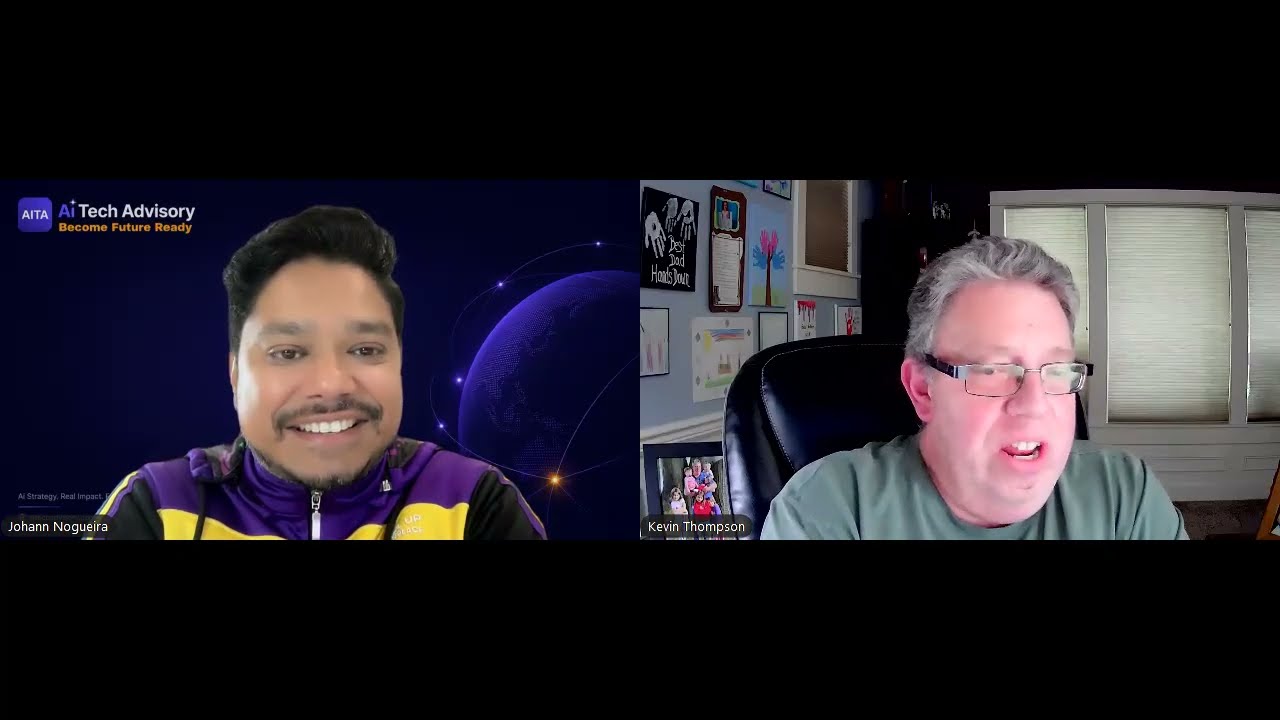
How AI & Technology is Creating Exponential Business Growth with Johann Nogueira - EP250

In this Business Grow Show interview, host Ethan Cassiotis talks with entrepreneur and tech investor Johann Nogueira about his 25‑year entrepreneurial journey and how artificial intelligence is reshaping business. Johann recounts his early ventures—eBay arbitrage, affiliate and CPA marketing, building a white‑label digital agency, and later acquiring and integrating dozens of companies into Comet Suite/White Label Suite. He explains the strategic rationale behind white‑labeling, the “test‑drive” partnership model he uses for acquisitions, and the importance of leveraging existing networks rather than doing everything in‑house. The conversation then shifts to AI: Johann describes how tools such as ChatGPT, Perplexity, Bolt.new, Lovable.ai and low‑code/no‑code platforms compress months of work into days or minutes, enable “AI counterparts” for every corporate role, and allow tiny teams to build products that previously cost hundreds of thousands of dollars. He shares concrete examples—building a mobile app in a week, re‑positioning a $3k rewards product into a $1 million advertising platform, and automating fuel stations—to illustrate cost reductions, speed, and new business models. Johann also touches on security and IP concerns, the decreasing cost of compute, and the future where every company employs an AI specialist. Throughout, he stresses that despite technological advances, real human connections remain the core driver of lasting success, ending with the advice: “Connect with people; nothing can replace real experiences.”
Chapters
People who are adopting AI, their results are, they're growing exponentially. They're leaving the rest behind in spades. What used to take, what used to take 6 months, we can now do it in 4 days. You literally can build an autonomous organization that's growing exponentially with the hive mentality of hive knowledge of the entire world and the most successful business leaders in the world. Business is about people. So you can automate everything, you can make life simple, you can systemize everything, but at the end of the day, it's about people.
What one key piece of advice would you like to give to all of the entrepreneurs watching and listening today?
Connect with people. Nothing can replace real people, real experiences.
Hey, and welcome to another episode of the Business Grow Show. I'm your host, Ethan Cassiotis, and today I have an awesome guest. His name is Johann Nogueira. Nogueira. He is a visionary entrepreneur, tech investor, and speaker specializing in scaling businesses through systems and technology. And with a track record of working with national brands and global companies, he has founded multiple ventures, including Comet Suite, an AI-powered lead generation platform, and Business Authorities, a community for entrepreneurs. And his journey began during his PhD at the University of Melbourne, where he discovered the power of leverage and passionate about innovation. He teaches business owners how to compress time, create scalable assets, and build lasting legacies. And his mission is to empower entrepreneurs to achieve freedom, impact, and long-term success. Welcome, Johann Nogueira, and thank you for being on the Business Growth Show.
Thank you so much for having me, man. It's a, it's an honor to be here.
Yeah, awesome, mate. I'm sure it's going to be amazing for everyone watching and listening today. And you are a successful entrepreneur. So for those people that know who you are, just, yeah, introduce yourself by telling us a little bit more about you and your journey.
Yeah, man. Uh, so started off as, as you just said, Melbourne University doing secondary biofuel and climate change. So that was what the PhD was in. Absolutely nothing to do with what I do right now. Um, from there, discovered— so back in 2004, so over 2 decades ago now, discovered eBay. And so that's where I started my first business, was on eBay, making money buying and selling, just arbitrage, buy low, sell high on eBay, and that was in the niche of gold and diamonds. So went into that, used to buy from a United States website and then sell it on eBay over here. Very simple, easy. Went into affiliate marketing. So this platform that I was buying this stuff from, they decided that they were going to launch an affiliate program, which is, hey, you get 15% of the commissions. At this exact time, Facebook was launching, and so on Facebook I could go in and go look for males who are in their relationship for 3 years and show them my ad. My ad said, hey, thinking about getting engaged? Here's diamond rings, 90% off. They'd click, they'd go to that website. Now I don't have to stock any more jewelry or anything. It's all done. And so affiliate marketing for a couple of years and then that evolved into CPA marketing. CPA is cost per acquisition where you generate leads for a business and you get paid. So Commonwealth Bank, we all know the big banks. If you went to Google and typed in Commonwealth Bank credit card application, my ad would be at the top. You'd click, you'd sign up, we get paid. That's cost per acquisition marketing. Then I had the great idea to build a digital agency. Hey, we can generate leads. Let's generate leads for other businesses. That was, in hindsight, it's hilarious because I'm like, dude, what were you thinking? But anyway, went down that path. We ended up having 100 employees, 10 teams of 10 employees, and we white labeled it. So we had about 36 agencies that would send us work all day long. digital agencies. And so we were just, we had a sausage factory. We'd be pumping out projects, projects, projects all under their brand names, etc. So that happened. And then we ended up building hardcore technology, more, more complicated systems when you've been through to Melbourne Airport and you scan your passport and the gates open up and all those sorts of things. So we started getting asked to build more complex solutions. And so that's how we went into that. Then buildings in Melbourne, I moved into a building and they said, hey, you know, It's a long story, but I'll cut it short. And we ended up building the technology that does the communication inside a building. So mobile apps for the buildings, building management systems, etc. Sold that business back in 2019. In the meantime, started another company, a business education company called Business Authorities, which was so much fun. When we started with 150 people, by the time 2020 came, we had 3,000 members. So That's pretty cool. And then COVID came. So I, I'm a person who likes to meet people and press the flesh. And, you know, everybody was saying, hey, let's do it on Zoom. I said, no, no, no, you can't do this stuff on Zoom. So anyway, so that, that's been on pause and hopefully we revive it in 2026. Um, there's just so much going on right now. I wish I could do it now. I miss all the people, our community. We get members saying, hey, when are we having the next event? I'm like, soon, soon, another year, give me another year. Because there's so much other stuff happening. 2021, we bought a whole heap of companies, put them all together, created Comet Suite. Comet Suite evolved into White Label Suite. And now here we are at, you know, at the inception of the AI technology that we've had for the last 2 years. And every week it's just leaping and leaping and it's crazy what we can do right now with the power of AI. You know, I'll give you a quick little story. We were just we were getting a new module built into our software and this thing was gonna cost us $90,000. And there was 3 companies we tendered it out to. Our dev team's full, they're running at a million miles an hour. I said, let's, let's go get some quotes. They all came back with 3 months. It would take 3 months. One was $90,000, one was $70,000, one was $60,000. And I was telling one of my friends about this and he's an AI, I call him an AI junkie. He's an AI junkie. And then he's like, Dude, give me, give me the brief. So I give him the brief and he puts it in into this platform and literally in 5 minutes, 80% of the work is done. And I'm sitting there going, what do you mean? And he shows it to me and I'm like, wow, I can click, I can play with it. This is what I had in mind. And then 2 days later, our devs finished off all their work. So compressing time with artificial intelligence, it's the coolest thing that you could be doing right now in your company because there's so many cost efficiencies that you can implement. Yeah, it's changing the way we do business. So here we are, my friend. We're a couple of minutes in and you have a whole history of the last 25 years. Yeah.
Awesome, Johann. What an amazing history there. There's so much change and it's funny, I can see a similarity where we started. I was in the waste management industry, you in agriculture. That sustainability space is very interesting. But now we expanded to business and tech and other things like that from there as we expand and grow from just an industry. So I love that. There's a couple of key things that I took from that here that I just want to expand on because I think it would be valuable for everyone listening. You talked about starting an agency and then you white labeled it, right? Where you were able to do work for others. And I know some people, whether they don't know what white labeling is, but obviously you're doing it for other brands, but I may be hesitant about white labeling. So what was your reasoning around white labeling at the time? So as a business, I guess, strategy, you know, to do white labeling.
Yeah, for sure.
Benefits.
Yeah. So in the digital agency space, there's so many different things that happen. One, you build websites. 2, you do social media. 3, you're doing video creation. We were doing banners, brochures, physical collateral, books, all of this kind of stuff. So there's all these things. We were really good at building websites and even inside websites back then, there was all this different technology. There was WordPress, Drupal, Magento, all of these different technologies. And you had to know all these different things. Plus there's so many different layers of it. And so we were really good at websites, social media. We used to send it to another company, you know, Google Ads. We used to send that to another company, the Facebook ads, send it to a different company, video production, et cetera. And so just on that, we used to send it to other companies, but we would get a 20% affiliate commission. So now profit margins in the digital agency at this, at that point in time, so we're talking 2008, is about 20% you'd make on that agency anyway. So now here we are, we don't have to do any of the work and we're still making 20% just for the referrals. That's a great little business model which to this day has served really well. So something to keep in mind when you're talking about affiliates and relationships. Now back to the white labeling. We were really good at websites. So I went to these guys and said, hey, you've got a team of— I remember this one company, they had 12 people in their team. I said, 8 of your team are developers and you've got 4 salespeople. What would it look like if it was flipped around and you had 8 salespeople and 4 developers just in You needed something, but outsource it all to me and I will take care of it. And to show you my processes, here, the first project is free. Have a go, understand how we do it. And by the way, whatever money you make from that first project, you get to keep. So immediately, what we're essentially offering them is $10,000 for free. No one's gonna say no to that, right? So they sent us the first project and they were like, wow, this is amazing. Like, the process is very streamlined and easy. So then they go, all right, we'll send you another project, another project, another project. 6 months later, guess what happened? They did have 8 salespeople and only 4 developers because they didn't need them anymore because they were outsourcing it to us. So that's, that's, that's how the whole white labeling thing happened. And then our team, and we didn't have 100 staff at the start, we had 100 staff by the end of 6 months. But every day, the new agencies that we brought on would send us 1 project, 2 projects, 3 projects. And so that's how it filled up our pipeline. And now we've got tons of deal flow happening. So we needed management systems. So as you start a business, you need systems in place. So now we had customer service talking to them. They were our customers, making sure that all the management, the workflows— back then we didn't have cool tools like ClickUp and stuff like that. We were using Trello, you know, and everything was on Kanban board and all those sorts of fun things. So yeah, I hope that answered the question around why we decided to white label. It's because we were really good at one thing. But being an agency, you had to be good at so many different things. So if we were just a white label agency for one thing, it made life much more easier for us.
Yeah. Awesome, man. I love that. So powerful on what you shared there with the white labeling. Hey, you got it. And it's about giving something for free, right? That's what I tell to a lot of my clients and people. It's like when you offer and it's like a no-brainer, like keep the money that you do as well. It's like give us a shot and then once you do it, you're like, wow, you guys are great. And then bang, all of a sudden the floodgates open and you do that you know, tens of times, hundreds of times, it's, um, yeah, massive for business growth. So, um, I think very valuable in the way that you, you structured that, uh, for everyone listening here, right, on, on what, um, Johann did that you can apply to any business, not just obviously that one, um, there on what he, he, he did there. So I love that. The other, the other thing that you mentioned, um, about the current business, you know, um, you know, what Label Suite we're doing the, you know, with the AI and lead gen stuff, is you mentioned about You acquired many companies, right? Um, I noticed there. So I'm big on buying and selling businesses as well, acquiring companies. Um, and some people think it might be a bit challenging. What was the strategy around going, okay, um, we want to create something unique? Is it, um, you know, there's not— there's nothing that really does this in the market, but if we get a few different pieces of different things, we put it together, it's going to be much more powerful. Give us a bit of the thought process that sort of, you know, went behind creating that company.
Yeah, for sure. So my business partner, he's an absolute genius and he's been building software for 13 years. And when he showed me this software, the lead generation one, my jaw was on the floor. I was like, nah, this can't be. And I asked him, what's the history? 13 years ago, he used to sell this thing on CDs at trade shows, right? That's how old it is. But old, of course, redone with today's technology. And so, but just showing you, it's not something we just decided to do overnight. It had been an inception from 13 years ago. And it's evolved every day since then. When he showed it to me, my jaw was on the floor. I couldn't believe how amazing it was. And then I started trying it out and testing it. And I said, this is incredible. And he said, do you want to be my business partner? And I said, no, but I had so many things going on. I go, no, no, no, but I'm just telling you, this is incredible. He goes, okay, cool. But, you know, if you did, what would you do in there? And I go, well, I'd do this move, this move, this move, this move. And he goes, comes back 2 weeks later. He's like, I did what you said. And it's freaking incredible. Let's be business partners. I said, no, no, no, no, no. And then this is April 2021. And I said, all right, cool. You know what? Fine. Let's go. Let's give it a go. And there's another rule that we have in our house now. We don't do business partnerships because if— and we'll go into whole values and all that kind of stuff. If you're not balanced, that business is going to fall over. There's too many issues that happen. So I said, look, I'm going to show you what I'm made of. I'm going to work with you until December. So April till December. I go, I'm going to let you See, I'm gonna earn my keep because he's spent millions of dollars building this software and here he is, you know, handing me 50%. It's a, it's a big thing. So I go, cool, you get to see what I'm made of, you get to see how I work. Let's go. And we did. And then that was 4 years ago. He obviously didn't kick me out of the company. I gave it to him in writing. I said, if by December I don't prove my worth, you can kick me out. No, we'll be friends. It's all good. So here we are and we're building, growing, scaling the company. And yeah, it's Pretty, pretty impressive with what's been achieved in 4 years. You asked me about what's— why did we buy businesses? Well, there's tons of businesses now. Anyone who's been in business long enough knows that 90% of businesses fail. They don't make it to the 10th year mark, you know, but they build a lot of good infrastructure. They build— there's a lot of thoughts that go into this. They build customer bases. I want to talk about this one right now. I'll talk about one previously. So I bought a digital agency. Now this digital agency, again, so this was, I told you there was 36 agencies that we used to supply. One of the agencies, I looked at the books and saw that they were stopped, you know, their orders were so low. So I called him up and I said, dude, what's going on? You don't like me anymore? Why are you not ordering from me? He said, no, no, no, it's nothing to do with you. He goes, my business partner is terminally ill and I'm just running around doing everything. And so the business has slowed down to like 10% of what it was. I go, what are you gonna do with the business? He goes, I'm gonna shut it down. I go, what are you gonna do? He's like, I'm gonna go get a job. I said, oh, I go, you know, you've been in business for 18 years. You know, you're unemployable, right? He's like, what do you mean? I go, you can't go and get a job after being in business for 18 years. It's not possible. I go, look, how about I buy the company? I'll buy the company and you stay around for 6 months. And if you wanna be part of it after that, we can discuss that. But this is, these are my terms. So we did a managed buyout. And this company has been in existence for 18 years. We serviced the company, so we knew the levels of clients that were in there. Now, the clients, I think there was 4,000 clients in that business, of which 800 of them were blue chip companies, what we consider blue chip companies. Blue chip is names that are, you go to the supermarket, you see their names. So those are the types of companies. So this guy goes, all right, cool. We agreed to it. And Found out later that all the money that I gave this guy, he paid, gave it to his business partner. So he didn't even take one cent from it. I was like, wow, that's, that's pretty cool. Anyway, that's a whole nother story. So we were on day 1, day 1 of the 6 months. Day 1, we walk in and I said, here's our 4,000 new clients that we've just acquired. And then we're part of the transition was 800 of these, he has to transition, hand them over to me so that we have a relationship, all that kind of stuff. Stuff that, you know, so we're doing the handover process. Day 1, we're meeting a car parts manufacturer company. And so we go in, we're talking to them about what they need and they go, cool. We walk out of there with a mobile app build. So this is what, 2015 around there, mobile app build. It was $200,000. And so that's deal number 1, meeting number 1, deal number 1. Second meeting is with a mining company. We walk out of there with Google Ads, website rebuild, video shoots, all of this stuff. Anyway, it added up to be $300 grand. So we finished 2 meetings and we walked out and we've done $500 grand worth of deals. This guy's like, holy shit, did we do $500,000 in one day? I go, nah, that's 2 hours. We still got another 6 to go. I joke, but it was showing him because he was an inexperienced Like a business person. Yes, he'd been in business for 18 years, but he'd never played at a certain level. Now there's different levels of business. So here, what he had sold them before was a website for $10,000, some other stuff, which his total expenses to those guys was— or billings was between $20,000 to $25,000 for each of those companies. And then here we are, we go in with a different mindset of how can I help you? Not, um, here's, you know, For example, he used to do websites, so he'll just sell them a website. Whereas I knew all of these people, I said, what do you need? Where do you want to go to? What is your next level look like? And they described and I go, cool, we can do this, this, this, this, this. And I have friends, connections who can get all those things done. So it's not about doing it all yourself. That's another big lesson. So knowing the right people and being able to funnel work to those people and get it done. And again, my credibility, my reputation is on the line here. So they have to perform. Otherwise, there's going to be issues, right? Um, because you don't wanna lose that trust. So you can get so many things done when you have, uh, when you go in with the right intention. The intention was, how can we serve you? Not, we have ABC, we're gonna sell you ABC. Yeah. I know that was a very long, long, long answer to your question.
Oh, good, man. That was, there was so much gold in there for everyone listening. Just to like recap a couple of points that Johann said, he said, you know, he added so much value to the original business guy, right? And, you know, improved the product very quickly, wanted to give him half of the company, said, well, let's test it because it's important for partnerships to have a values alignment, right? Because if there isn't, then the partnership, you know, a lot of partnerships fail, right? So he gave a test drive basically for 6 to 8 months to do that and then get out. And obviously they were gelling and then, you know, obviously exploded from there on what the, you know, the opportunity happened. And then from here, you know, saw an opportunity where a partner, you know, there was going down and where a lot of businesses fail, going, well, let's do a better deal. Let, let us be part of the deal. Let us partner together with, with an option of seeing how it goes as well. And, um, and doing that. So it's almost like a risk-free way of partnering, testing that out, but also knowing that you have a network of people that you don't have to do it all yourself. Uh, it's a really good book, um, Who Not How. you may have heard of, is, is a great book. And that's basically what Johann was doing. Right? It was going, who can help me with this? I don't have to do it all myself. And, you know, really powerful there. So, so much gold, man, that you just shared in that that is translatable. Right? To anybody here, man. So thank you for that. Thank you. So let's talk more about AI now because I know you're big on this and, and AI is changing the game. Right? It's, it's evolving rapidly here. So So let's maybe just initially talk about where you see it going, right? Like, you know, business, you know, over the next few years or whatever as it's—
Yeah, man, for sure. So, so, so back in the day, you know, people used to say, I have a website and it was a nice to have. Now, if you don't have a website, you're not really in business. In the future, like now we're 2 years into the, into the AI adoption, people who are adopting AI, their results are They're growing exponentially. They're leaving the rest behind in spades. What used to take us 6 months, we can now do in 4 days. Now with the new tech that came out 2 weeks ago, what we could do in 4 days, we can do in 30 minutes. So literally you are compressing 6 months worth of work into 30 minutes. It's, we've never had access to technology like this before. And the whole world and everybody does have access to this. So there's no excuses about it. Whether you adopt it or not, that's up to you. It's the same as when we first got the internet. Or I'll go a little bit after the internet when we when we got YouTube, right? A lot of people when we got YouTube, they either sat there and watched cat videos or watched comedy and just entertained themselves. Whereas the others went, I can get access to the brains of the smartest people on the planet. I'm going to go learn from them, and they exponentially grew their brain capacity and their learnings, which allowed them to do better business. So with AI right now, the amount of tools that are coming out every I think every week there's like a thousand new tools that are coming out. You cannot keep up with it. It's so. I, I can't keep up with it, right? I was out of it for like 3 days and my friends are like, dude, did you see this thing? I'm like, no, what's that? They're like, it's a new one. I'm like, goddamn it, another one. And it's, it's really hard to keep up because there's so much amazing excitement that's happening. But at the same time, people's businesses and lives are changing with it because now humans can literally— anything that you can think of, you can type it out, create it, prompt it, And now it's building it. You know, there's a couple of platforms that I have, they're killing it right now. So for example, Bolt.new, Lovable, I think it's lovable.ai. You can, they are doing to programmers what Canva did to the graphics industry. So Canva, when it came out, it wiped out all the graphics artists because I no longer needed to, we used to have 5 graphics artists on the team. By the time we briefed the graphics artists, Canva would finish it just with the brief, right? Yes, you need graphics artists. Yes, they can polish it up and make it look better. But we would just, the managers would get it 80% done just by the brief that they had to do. So that's why Canva is so successful in a billion, I don't know, they're more than a billion dollar company now. They wiped out an entire industry of graphics artists because you could get nearly the same amount of thing. Same thing with these other programs where, yes, we used to charge $200,000 for a mobile app. Now you can have that mobile app built in a week with a 15-year-old who actually can prompt it properly. Yes, there's business acumen and stuff that you'd have to understand and infrastructure stuff, but that comes from the person who's asking for it, not the person building it. So I believe that every company will have an AI specialist in the company. It's just going to be like your financial controller, your marketing person. You're going to have an AI person. You need that person to optimize business operations and that's gonna help your company grow and scale. We're seeing companies now popping up which have small teams, 20 people, 30 people. Again, these 2 companies that I mentioned just before, they've reached $100 million in revenue in like 3 months. It's, we've never seen companies grow at this scale before. So AI is changing the way we're doing business. We, I was having a conversation with another friend of mine. Again, he's an AI geek just like me. What he's done is he has built an entire— so you tell him who is in your company, and he will then have an org chart of your company with their counterparts, their AI counterparts. So you got a CEO, you got an AI CEO, you got a marketing guy, you got an AI marketing person, you got your product manager, etc., all of these things. And then what happens is when they're having meetings, they bring in their counterparts. So they will have, hey CFO, I'm thinking of doing this campaign. And then the CFO's in there and he brings his AI in there too. And then the AI will say, great, based on this campaign, we have 3 different scenarios. If we change the prices, we're going to get a 15%, 10%, 5% on these scenarios. Hey marketing guy, what's it going to take to launch this thing? The The AI comes in and it documents everything that needs to be done. They then put those 2 AIs into a room and say, come back to us with a plan. While they're having their staff meeting, the AIs come back and present it to them. This stuff is mind-blowing, like compressing time. That's where the compressing time part comes. We've never been able to— you literally can build an autonomous organization that's growing exponentially with the hive mentality of high knowledge of the entire world and the most successful business leaders in the world. If I wanted to, I could jump on a phone right now with Jeff Bezos, the AI version, and talk to him about my business. When has that ever been possible? It's never been possible until now. You know, whenever I'm talking to ChatGPT— now everybody knows ChatGPT, but there are some other technologies that are so much more advanced In the way that they are built. Again, you won't know until you actually deep into into it. I'll give you a quick little example. I know I'm jumping around, but it'll all make sense. One of my friends, we go out for dinner, and he we catch up once once every six months or once a year. And he says, Johan, dinner's on me. And that's a statement, right? I'm like, oh great! What are we celebrating? So this guy was selling. $3,000 rewards programs to restaurants. Simple digital agency kind of stuff. You know, you can— a rewards program, nice and easy, $300 a month. Then he goes to Perplexity and he tells Perplexity, this is, this is my product. This is what I'm doing. Da da da da da. And he types to it and he literally locked himself in his room and didn't come out for 2 days. In there, Perplexity reframed his entire business. Same product, exact same product. But now that product is in his contracts that he's doing now, million-dollar contracts, and he's got 10 of them, and he's gonna do an exit of $50 million by the end of this year. It reframed his entire business, showed him who to target, how to target them, what to say, how to communicate with them, and developed all the collateral that was required. So just this Just one man with his AI in a weekend reframes his entire business, comes back, and instead of charging $3,000, he's charging $1 million. How much of a value proposition change is that? Because basically the AI showed him he wasn't a rewards program, he was an advertising platform. And then when he was able to articulate this, boom, it's all there. So yeah, man, I know I jumped around there a bit, but I'm sure— I hope you got the story.
Yeah. Definitely. So much value again of where AI is going and the possibilities. That's what I loved about what you shared there, Johann. It's like thinking bigger, thinking 10x, 100x, like much more, right, about what's just ChatGPT. Right? You know, with what a lot of people think is out there. Right? It's, it's like, yes, that's a good start, and you gotta know how to prompt things, but there's so much more, like you said, about how it's growing. And I guess there's, there's probably 2 things that come to me that I'd like to ask you, because a lot of people out there don't have that level of thinking just yet necessarily, right? Is one thing from a simple sense of what we can do now to like start doing some AI in our business. And I know you've got a lot on that very easily. That's simple, right? On how we can use it. And then maybe from a secondary part is if we wanted to create something, right? Like ourselves, what would that look like and where we would begin on thinking about creating? So what could we use now? It's very simple. Then where will we start if we wanted to create something of our own.
Yeah, for sure. So what will we use now? Everybody needs to learn how to use ChatGPT. That thing is super, super, super powerful. And only once you know how to use that, then you can upgrade into the other ones. But ChatGPT is where it all starts. The easiest thing to do is to get it, get on the $20 program. They charge $20 a month and you press a button and you can talk to it. So I use this. So it's the little headset button on the app. Click on that. And then just go for a walk and just talk to it. And sorry, man.
Oh, good.
So when you start talking to this, then it starts ideating with you. Now, I went for a walk for 2 hours with this thing and it showed me how using my current infrastructure and everything that I have, we can add an extra $10 million into the business. 2 hours. Is that like, that's a significant amount of It, it couldn't— there's no amount of consulting that could have given me that outcome so quickly. It also created all the collateral for me. Now, I know I'm talking about big, big numbers, but it doesn't have to be big numbers. It might be $100,000, right? Whatever number you want to tell it to do, it can do that. Just give me one sec, man. I'm sorry.
All good, man. It's, uh, very powerful here with, uh, what Johann's telling us here, right? So, um, I love it. No matter what the numbers are, just, just keep adding zeros. That's what I always say. It's
It's all a numbers game. When I started my company, I was selling websites for $500. About 4 years later, we were selling websites for $50,000. So it's all a mindset thing, you know, there's every, yeah, anyway, that numbers, it doesn't matter. The numbers don't matter. It's about upgrading, competing yourself and beating your high score. So you said, what can we use? ChatGPT, 100%. That's pretty much all you need to learn how to use right now. Start with that and then upgrade from there. You said what, What can we use to build? Using the technology to build, it depends on what you want to build because right now you can build anything. We're in the software game, so we can literally build anything. I went into bolt.new and I said, build me a Spotify clone with all the improvements that are mentioned on Reddit, right? Reddit's just a forum. So it went through it and understood everything that was on there, and then it rebuilt Spotify for me. So, you know, and so now I can have my own version of Spotify that I can control, that I can now make it into a business training platform with all of my stuff if I wanted to have it, whatever. The technology is no longer the barrier. Technology creation was the barrier. Building a mobile app for $200,000, big barrier. You know, only big business could afford that. Now that same mobile app, We could probably rebuild it in a week and cost less than $5,000. That's the, that's the effect of what technology is having. With your business, we're launching some business intelligence tools, which basically you can go in there and you can say, here's my business, here's who I serve, here's what I'm doing. And it will then analyze that business and tell you different ways, different scenarios that you can go. And then what it's gonna take to do that, give you a checklist, make sure that you've, you've got the right team members in place, make sure you've got all the right technology in place. And literally, you could, with, with a team of less than 10, you could build a very significant company depending on what business it is. Of course, I can't, I can't build a significant company being an electrician if I don't have, if I don't have, you know, many electricians around. Yeah.
Yeah. But from a, from a tech perspective especially. So, yeah, I love that, man. So, because, because one of the other things a lot of people think about is around the security side, right? Like, don't just chuck all your valuable information into ChatGPT normally, right? Or anything like that on the free versions or whatever. There. So I guess the, the security side about what you're using, and this is maybe the, the paid version, that's, that's the, the corporate version that you can get. Obviously, that's a little bit more potentially on ChatGPT where everyone's under the same banner is one part. But it's also maybe from an app creation perspective, right? About having something about where you're storing this, like from Bolt or wherever, right there. And then how is that built on what architecture and then how that sort of scales from there? Do you wanna maybe touch on a couple of Yeah,
for sure. So again, it goes back to back when the internet came out and first time we had to put our credit card into the, into the computer, right? What do you mean put my credit card into a computer? Who knows who's gonna access the computer? Now we don't even think twice about putting our credit cards into the computer. When ChatGPT first came out 2 years ago, there were tons of security risks because the, the biggest example was Samsung. I think they, they uploaded all of their schematics, their engineers uploaded their schematics of their new products, their R&D. and said, make this better, except there was a way that everybody could get access to it and they didn't realize they were releasing it into the public. Depending— and so that, that was back then. Now with the new paid versions and stuff, it tells you it will not release this into the, into the ether of everyone else can access it, nothing is identifiable, etc. So I used to be concerned about that. Now I don't have concerns about that because the level at which it's thinking It outthinks what I can think, and it's helping me ideate. But there's a million other people who are ideating as well, who then it's all, it all helps each other. So if we're using tools like Facebook and Instagram and stuff like that, you're giving away all your data anyway. I understand that with the stuff that we do, there's tons of IP. IP is valuable. But at the same time, that IP can be recreated and vetted 10 times over within a few hours on ChatGPT. I sat there and I literally just typed into it, uh, mergers and acquisitions blueprint, and it wrote out like 12 chapters of how to go about it. And I read it and I went, Jesus Christ, I was, I had to learn all these things the hard way. I would never have thought about, and here it is. I just typed in 3 words. Mergers and acquisitions, M&A blueprint. And here is the blueprint of doing mergers and acquisitions. I said, I just went, oh my God, you know, if I had this 10 years ago, it would have been, it would have saved me a lot of heartache because, you know, not everything is just sunshine and roses, right? So that's, that's where we're at right now with AI.
Yeah. Awesome, man. Love that. Very powerful to, yeah, keep our minds at ease now that the upgrades have happened. Let's talk a little bit about computing power now because my understanding is, right, is that, like, let's say we wanna create, you know, you're, you're in tech, right? You're creating a lot of these solutions. I see a lot of these, like, low-code, no-code solutions, whether it's Bold or these other ones, right, where you can easily create stuff, which is great. But there's, there's a level of hosting with security and computing power depending on how much is being used is then, like, costs over time, right, for these platforms that they could increase. So do you wanna share a little bit more about that because it's not just the build. It's actually how much, you know, it's using type of thing in the system and how that sort of works for everyone as well.
Yeah. So, so are we talking about things like ChatGPT? You're talking about the actual software that we're—
I'm talking about, like, yeah, custom, custom AI solutions or custom software.
Yeah. Yeah.
Yeah. Being built now.
Yeah. For sure. So cost goes down over time. I understand that, you know, there's running power and all those things. But With, so ChatGPT, we've got DeepSeek. DeepSeek is 1/25th of what ChatGPT is. And over time, cost goes, cost goes down. They say that cost is gonna go up in terms of energy because of the computing power that's required to run if everybody's on these things. But it goes back to, hey, we all have access to YouTube. What are people watching? Cat videos, comedy. There's only a certain percentage that are really crunching this thing. And so that's why we have the standard deviation curve where you've got the people who are not using it and the people who are maximum using it. You know, I'm a probably— I spend a lot of my time using it, a lot of my friends do. But then there's people who are just discovering what ChatGPT is. I don't think that it's gonna, um, yeah, it's, it's not going to increase that much. It's going to keep getting cheaper. And the more solutions that we are seeing, the cost price is actually getting cheaper. So What used to cost us, yeah, I've, I was, I had a platform which used to cost me $500 a month. Now it's been replaced by a platform that's better for $97 a month with the $97 a month one having 10 times more functionality.
Yeah. So powerful, right? It's, it's like, yeah, because it's so much easier, more efficient, right, to create and you can play the game where it's lower because you don't need 100 staff running the thing anymore. So it becomes very powerful. So I was thinking about headcount doesn't matter anymore, right? It's just about how you're running the business. And I love the AI employees thing that you were talking about and everything. Really powerful, man.
Yeah. Man, just a real-world example for people. I went to fill up my car yesterday. Now over here, I'm in Melbourne. The petrol price is about $1.78 per liter. And then there's a brand new petrol station that's opened up that's fully automated. There's no humans. You walk up to it, you You you punch it onto the screen how much you want to fill in, pump the gas, put it back. Now this was so a dollar seventy-eight versus at these guys is a dollar fifty-nine, twenty cents difference per liter. There was cars backed up to this thing like everybody wants to get filled up by it at this place because it's twenty and there's no humans at all. Everything is they've got cameras and everything. Why can they have that much of a difference in the price? Everywhere is seventy-eight cents, a dollar seventy-eight, and here's a dollar fifty-nine. It's because their headcount is low, as you said. They've got technology doing all the hard yards. Somebody drives off without paying, great. They've got the license plate. It's reported to the cops. Anyway, everything is systemized, so therefore the price can go down. So once we have more systems in place, the prices come down of everything. We're talking about robots and stuff like that. Tesla's robot, and there's a couple other companies that are rolling out robots. These robots, they started off They said that the price was gonna be $30,000 per robot. And then with all the AI that we're building, we can put that into the robots. Now the other companies are saying it's gonna be $16,000, US dollars. But still, we, they haven't even launched these things yet and they're $16,000 for a robot. It's crazy.
Yeah, definitely, man. I love that. What a great world example. You remove the labor costs, right? Everything goes down, especially with automated systems. It's, it's a no-brainer, right? So So whenever I'm thinking about this is how can you translate that to your business, right? Having a more nimble model or scaling 100 times more or whatever because you have this power behind you of automation and AI or whatever that looks like, right, in your business model. So love that, man. I haven't seen that one there yet. Maybe they're going to add robots to it, so they're going to fill it for us in the end and you won't even have to fill it. You won't even have to get out of your car. That could be the next level, right, at these petrol stations, which will be a cool combination. So yeah, man, love it today. You've shared— You know, so much gold with us, tech, you know, the way you think about things, the AI side, you know, there's so much potential there and everything. And I guess, I guess as we're starting to wrap up, yeah, here today, what one key piece of advice would you like to give to all of the entrepreneurs watching and listening today?
Connect with people. Nothing can replace real people, real experiences. I sit down, I spend a lot of my time with AI. But when I can sit in a room with— the other day I was sitting in a room with a guy who, he was a business coach. He helped another entrepreneur get to a billion dollars. And I was like, wow, I cannot— I do not know what to ask AI in order to have that type of relation. And then he went through, you know, how they did it, what they did, and all those things. There's lessons. Yes, we, we have the answers of everything that we could ever want at our fingertips, but it comes down to building real relationships with people. And that's— business is about people. So you can automate everything, you can make life simple, you can systemize everything, but at the end of the day, it's about people.
Yeah, love it. Completely agree, mate. And one partnership, right, or one, you know, something that you can get from somebody else or help each other out could be a game changer, right, in your life, in your business and everything
else. We have a saying, and the saying is you're one deal away. That one deal That one connection, one interaction that you have can actually change the entire trajectory of your business.
Exactly. And one thing that I always say is make it like, especially if the person is at a higher level in whatever that is, right? Then make it easy for them, go to them or whatever like that, right? Even if it's traveling overseas, right? As well to then create that relationship because you never know where it's gonna lead, right? From there as well.
Yep. Yeah, man. But buying your way in into the room is so awesome. So you— there is a price to pay. I remember when I was, I think I was 20 years old, and I said, wow, look at that Ferrari, it's so expensive. My mentor at the time went, it's not expensive at all. You think it's expensive because you don't know how to, how to afford it yet. Figure out how can you make it, how can you make it cheap? I went, wow. And he goes, the, the money in your bank account is just a reflection of the value you're adding to the marketplace. So if it's low, guess what? You need to add more value to the marketplace and it's gonna become bigger. I went, ah, cool. So just keep adding value.
Yeah. Love that analogy, man. All about adding value and watch it all come back to you, right? In, in spades from there. So love it, man. We, we connected, yeah, through our networks, learned about your awesome journey from, from the PhD to various businesses, being a visionary entrepreneur, doing all this tech and AI stuff. You're changing the game, which is awesome, man. And shared so many amazing lessons. Awesome guy. you know, with us here today. I'm sure you continue to help businesses scale through systems and technology. Very grateful that we connected. Look forward to partnering with you as well, mate. So, Johann, how can people find you and get in contact with you as well?
Yeah, man, for sure. Facebook is probably easiest to get me. So just look up my name on Facebook. That'll be easy. LinkedIn, it's there, but I don't really use it well. But yeah, send me a thing. I'm gonna start using it better. And whitelabelsuite.com, come check us out.
Yeah, awesome, guys. Definitely check out Johann there, Facebook, LinkedIn. We'll have the links in there in the chat as well as White Label Suite, the business, to check that out as well. Some game-changing areas there in terms of leads and marketing and stuff that Johann's doing in that company among all the other amazing things that he's doing as well as you can hear today. So it's been a pleasure interviewing you, mate, and thanks for being on the Business Growth Show.
Thanks, Ethan. You're amazing.
Thank you everyone for watching and listening to this show where we talk about everything on business growth. And please like, subscribe, and leave us a 5-star review. You can find me on LinkedIn, Facebook, Instagram, YouTube as Athan Kasiotis, or visit my website athankasiotis.com. If you wanna grow and scale your business, you can reach out to me on any platform to see if we're a good fit. I completely agree with you, or do I? The only way you know is if you tune in next time. So until next time, remember that our business grows when we learn skills and take action using them in spite of fear. So remember to design your growth and results.
More from Johann


"Best of breed in the world" | Greg Cassar on Johann Nogueira #aitransformation