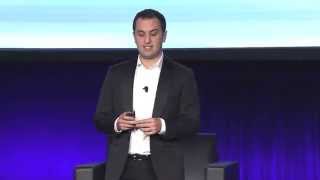
In this keynote, Lyft co‑founder John Zimmer reflects on his lifelong fascination with cars and uses that personal narrative to illustrate how modern car ownership has diverged from childhood dreams. He highlights the inefficiency of private vehicles—low utilization rates, high personal costs, and the massive time spent in traffic—especially in Los Angeles. Zimmer points to demographic trends: younger generations are obtaining driver’s licenses at historic lows and increasingly reject car ownership in favor of experiences. He frames this shift as an opportunity, describing Lyft’s rapid growth (a $1 billion run‑rate, 7 million rides in October, and the success of Lyft Line, which now accounts for 50‑60 % of rides in major cities). Zimmer introduces the concept of a “city operating system” (City OS) that unites software, hardware, and network carriers to deliver on‑demand, shared mobility that restores the freedom once promised by the automobile. He paints vivid future scenarios—watching TV or sports in a self‑driving car, meeting friends or business partners during rides—and argues that widespread shared mobility will free up parking and road space, allowing cities to reclaim land for parks, housing, and community spaces. Citing Henry Ford’s democratization of the car and Bill Ford’s investment in Lyft, Zimmer calls on the auto industry to collaborate on rebuilding cities around people rather than around private cars.
Chapters
Alright, so I'm really excited to talk with you today about the future. We're gonna talk about the future of cars, the future of transportation, and most importantly, the future of our cities. I remember when I was a kid and I first fell in love with cars. I was a young kid growing up in Connecticut, and Micro Machines were the coolest new thing. Everything about them was fast and exciting. Even the commercials had the world's fastest talker in them. I loved them. And when I was in my basement, I would use the lines and bumps of my carpet to make roads for these cars and build Lego cities around them. And it was this tiny version of cars that I knew and loved as a kid. And when I turned 12, my dad and I began an annual father and son adventure to New York City for the International Auto Show at Jacob Javits Center. I always loved taking the trip with my dad and imagining the future through the lens of all the new concept cars. Today, I watch my 5-year-old nephew, and he loves cars just as much. There's something almost magical between the connection of a, of a kid and, and those cars. And, and like my nephew and I, many of us establish this incredible relationship with the automobile. Our imagination creates a beautiful, beautiful vision But what our 5-year-old self does not daydream about are the parking lots, paved landscapes, and the hours and hours spent alone in a car surrounded by thousands of other people alone in their cars. As I look at where we are today, the honest reality of using a car in the real world falls drastically short of our childhood dreams. And I'm guessing no one feels that more than the people of Los Angeles, which makes this city the perfect place to have the conversation. LA is a place where people come to chase their dreams. It's also a place where traffic sucks. The average American household spends $9,000 every year on cars. That's more money than they spend on food. And yet the car is utilized only 4% of the time. And— oh, someone's playing with the slides. And when it's being used, the car, the seats are only 20% occupied. So as a student of hospitality, as Brian mentioned, if you think about transportation like a hotel, it's not operating where it needs to be. And as a result, residents of LA spend more than 250 hours a year in commuter traffic. That's 250 hours not with their family, not with their friends, not pursuing their dreams. Simply put, owning a car today is not enjoyable. So let's rewind the tape to a place where we got off track, a place where somewhere, somehow, we started building life itself around cars instead of building cars and car infrastructure to fit our lives. Let's imagine Los Angeles in 1897 when the first car rolled onto the scene. Before that, we had very few roads and many more trees. Now in your mind, click forward 10 years, and another 10 years, and another 10 years until you arrive at our present-day situation. Today, roads and parking lots have paved 60% of Los Angeles. And this is the same pattern happening all over the world where we are literally paving paradise and putting up a parking lot. And thinking about paradise, imagine your favorite vacation. You're probably imagining a much different scene. And this is a really helpful reminder that our cities don't need to and shouldn't be this way. The best experiences of our lives should be where we live, where we spend most of our time. And I'm not the only one who feels this way. Even while every year billions and billions of dollars are spent marketing cars as symbols of freedom, open roads, adventure, and hair blowing in the wind, the reality is quite different. And there's a growing movement of people moving to cities and away from car ownership. You don't need to take my word for it. There's a lot of great numbers that tell this story. In fact, the percentage of 16- to 24-year-olds with a driver's license is below 70% for the first time since 1963. In 1984, the year I was born, young adults were almost 40% of new car buyers in America, a record high. Today, it's just 27% and heading south. About a third of us don't ever want to own a car. Why would we? Just ask any millennial, when was the last time owning a car was liberating? When you have piles of student loans and you enter the job market during the Great Recession, what could possibly feel liberating about the burden of $9,000 a year ball and chain that keeps you from spending money on the experiences you actually value? Today, millennials live their lives on social media, and each Facebook page and Instagram account reflects the thing they care about most. Not material possessions, but travel, food, family, and friends. In short, we value experiences and connections. They're human, meaningful, and fun. And this new consumer doesn't think that traditional car ownership is any of those things. When was the last time you saw someone tweeting a photo of them sitting in traffic on the 405? This is a big deal, and this is the new transportation consumer. Yes, car sales at an— are at an all-time high. But a massive shift is coming. By 2017, the generation born between 1980 and 2000, 92 million millennials, will have more buying power than any other generation. And they're telling us that the days of traditional car ownership are over. We value experience over ownership. And this trend will continue to accelerate rapidly, especially in our cities, as more and more alternatives are invented. Next month, I'm having my first child, a baby girl. There's so much I can't wait to teach her, but I won't teach her to drive. I won't buy her a car on her 16th birthday, and this isn't because I'm cheap. It's because she won't want to own one, and more importantly, she won't need to. By then, we will have solved the fact that for far too many, the dream of car ownership has become a nightmare. By then we will have realized that we can start fresh. We can change transportation. We can stop building our cities around car ownership and start designing them around people. We have to do this, and we have to do this now. In the last 100 years, our nation's population has virtually doubled. By 2050, the current population of the world's cities is going to double again. And we can't continue to build our way out of this problem in the same way with more roads. We have to do more with the space we already have. We have to develop new mobility solutions that increase both efficiency and occupancy. And here's what's so exciting. Cars are a big part of the solution. My co-founder and I didn't start Lyft to replace cars. We're here to reimagine and reinvent how people use those cars. We're here to eliminate traffic, eliminate the need to park. We're here to reconnect driving to the promise it began with: freedom. And if you want to remember how fast this can happen, check out the smartphone in your pocket. In just 30 years, the evolution of a phone took us literally from being stuck in one place attached to a landline and has evolved to give us complete freedom to roam and yet stay more connected than ever before. Today's phones give us freedom. Cars will give us back our freedom too, and they'll also give us back our cities. So how is this going to happen? I like to call it city operating system, or city OS. Together in the future, we will build a harmonious relationship of network carrier, operating system, and hardware. At Lyft, we're building both the carrier and operating system. And will work closely with all of you building the connected car. The future harmony created between software and hardware will unlock the most incredible new transportation experiences without the burden of today's ownership. So, so what will this future be like experientially? Imagine tapping a button to order your transportation experience. Say, TV Lift, where you watch the latest episode of Homeland on your way across town in the comfort of a self-driving car. Or imagine Sports Lift on your way home enjoying a drink and sharing the game with other Clippers fans. Better yet, what if you met your future spouse in a car? Your future business partner or lifelong friend? What if your ride to work became a meeting, a conversation? Now, these last few examples are not hypothetical. They're happening all the time in Lyft rides and Lyft Line rides across 190 cities across our country. And these serendipitous moments can become the norm in a world where transportation brings people and communities together. And this change that we've all been talking about is happening a lot faster than expected, and it continues to accelerate. Only 3 years ago, my co-founder Logan and I had the simple idea to find a safe way for people to share rides in their personal vehicles on demand for the first time ever. We were told it couldn't be done. I'm proud to announce today that last month Lyft achieved more than a billion dollar run rate with 7 million rides in October. We're the fastest growing rideshare service in the country and the most popular among the millennial demographic that I've been talking about. Just one year ago, we created a new service called Lyft Line, providing for the first time ever the opportunity for multiple people traveling along the same route to be instantly matched together. Once again, we were told, "You guys are a bit crazy." And now, just one year later, 60% of rides in San Francisco and 50% of rides in New York City are shared Lyft Lines. We have power riders taking over 100 Lyft Line trips a month, and for them, car ownership is over. First, they got rid of their DVDs for Netflix streaming, and now they've stopped owning cars, opting instead to use Lyft for transportation as a service. So what does this mean for Los Angeles? With the end of car ownership and the rise of new mobility, Picture just 30% more seats in cars that were previously empty filled, enabling a free flow of traffic. That sounds pretty good. Next, we can start taking away some of the clutter. We take away the parking garages and many of the parking lots. We lose a couple stretches of the freeway. In their place, perhaps a park. A playground, a concert hall, more housing and local businesses. This is our once-in-a-generation opportunity to work together to rebuild our cities. Innovation and change, even in the face of great skepticism, is an American tradition, and it's in the DNA of auto companies. Just think, 101 years ago, an incredible man from Michigan, decided to take care of his workforce while cutting the price he would charge for his product. They said he was crazy, but Henry Ford's decision to make cars a middle-class product, not just a luxury, is why we're all sitting here today. Thanks to his vision and the work that you continue to do, we have the convenience that cars give us. The important difference now is that it doesn't require individual car ownership. And that's one of the reasons why Henry Ford's great-grandson, Bill Ford, is an investor in Lyft. Cars are one of society's most important innovations. Let's work together. Let's take this once-in-a-lifetime opportunity to rebuild our cities and our cars around people. I really look forward to doing this together with you. Thank you so much.