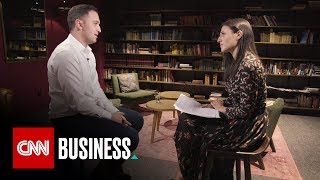
Life In The Fastlane: Lyft’s Big Bet To Change How The World Moves | 2022 Forbes Under 30 Summit

Lyft co-founder John Zimmer discusses the company's evolution from Zimride to a global platform, its bet on autonomous vehicles and electric cars by 2030, and how it survived a $3 billion funding disadvantage against Uber by prioritizing driver culture and a people-first brand.
Chapters
questions to our speakers via Slido. Simply scan our QR code or go to slido.com and enter event code #Under30Summit. For our next session, Life in the Fast Lane: Lyft's Big Bet to Change How the World Moves, please welcome John Zimmer, co-founder and president, Lyft. And interviewer Maggie McGrath, senior editor, Forbes.
Thanks for being here.
Thanks for having me.
You recently celebrated 10 years of Lyft.
Yeah.
Do you remember the original elevator pitch?
I do.
Can you give it?
Uh, well, the, the original idea was to get people to ride in other people's get into cars, which, you know, when you were a kid, your parents said never take a ride with a stranger and never take candy from a stranger. And in the early days, Lyft drivers had pink Starbursts, so we did both. But the biggest question we got is, is this legal? You know, because we take this for granted today, we do millions of rides a day now, but it was not normal to get into someone else's car 10 years ago.
So how did you convince them?
So we're incredibly passionate about what we're doing. The big, big vision is that our cities have been designed around cars, not people, and we think it should be the reverse of that. We think cities should be designed around people, not cars. But the infrastructure we've built, all the street parking, all parking in general, car ownership is kind of entrenched. And so we wanted to start changing that. The first product we had, which is, you know, an on-demand ride in someone else's car, was very affordable and has helped us get along that path.
We'll talk a little bit about where we are today, but I want to keep the trip down memory lane going. And while I do that, please submit your questions over Slido. We'll get to as many as we can. But Lyft was originally something called Zimride. Yeah, Zimride predates Lyft by a few years.
Yeah.
How did you decide to rebrand? 'Cause Zimride comes from your last name. It doesn't actually. That must have been an immensely personal decision.
It doesn't come from my last name. So my co-founder Logan Green was in Zimbabwe when he thought of Zimride. So everyone always thinks it's my last name, 'cause my last name is Zimmer. But I didn't know him when he named the company. He had been to Zimbabwe, and he had seen people sharing rides out of necessity. Many developing countries, people do that. He was super inspired, and the idea was basically to replace the college bulletin board that used to exist at colleges saying, you know, I went to school in upstate New York, saying I'm going from upstate New York to New York City. And it was a carpooling program for universities and companies. Then it worked. We sold many of these systems to universities across the country. We were profitable, smallish business. But that big vision we have to kind of redesign cities around people, not cars, was going too slowly. And so we had this second idea, which ended up being Lyft. And at first we were going to call it Zimride Instant, which is a horrible name. And I'm super happy we did not do that. But I had a headache for a month, because once Lyft started making progress, in the first month, you know, there was a waitlist for riders. We had a few cease and desists, which maybe also felt like progress. And we had to really say, let's move on from the first business we started. And that was quite painful.
I can imagine.
Yeah.
Let's fast forward to where we are today, because you had a really interesting announcement on Thursday around autonomous vehicles. And I have to imagine autonomous vehicles were maybe just a dream 10 years ago. But what are you doing with autonomous vehicles? How is it boosting Lyft's business? Business?
Yes, so we're now the first company to have commercial autonomous vehicles, meaning you can request and pay for an autonomous ride in 3 cities. So Austin, Miami, and Las Vegas. Those are with today a safety driver, but over the next year or 2, you'll start seeing those safety drivers come out as the car is fully safe to go without a safety driver. It was— one of the key inspirations was a course I took in college. In college called Green Cities. And the professor talked about the transportation history in our country going from canals to railroads to highways. And I started thinking about how we could create that next form of transportation. And I remember him actually painting a picture of what is now called an autonomous vehicle. But basically saying, imagine these little pods coming to people's houses and how you could redesign cities differently if that was true.
Oh, interesting.
Yeah.
Now, that's one evolution in Lyft's business. I know when I go on the app now, I see bikes, I see public transit options. Can you talk about the decision to start incorporating that? Because I would look at bikes and the MTA in New York as your competition. Why are you adding that to the functionality?
So with a customer-first mentality, we always want to think about what we can do, what the customers want, what our riders want. Um, and again, that broader vision is to provide you with all your transportation needs in one place. So when you're making a transportation— ground transportation, No plans to do air. But when you're making a ground transportation decision, we want to be there for you. We want to help you trade off time and money and put everything in one place. So we ended up buying the company that was behind Citi Bike. We now have the largest bike share network in North America. And so you can use your Lyft app to get a bike, to get a rideshare vehicle, to get a rental car, to get transit. And we have a few more things coming as well.
A few more. Can you share any of them?
Not yet. We're close.
One of the other issues— and I was ribbing you about this backstage— anyone who has taken a Lyft post-pandemic might notice that the prices are a little higher than they were pre-pandemic. A 15-minute car ride from the Upper East Side to Queens was showing as $60, which is a little bit higher than my price anchor for that ride. How do you respond to consumers like me who are saying, The rent is too damn high.
I mean, we, like any business, are experiencing inflation and things like insurance costs. But in general, the ride prices are coming down from their highs. In the pandemic, it was incredibly hard to manage the marketplace. Basically, our kind of day-to-day job is managing the number of drivers we have for all the needs that riders have. And when you had the COVID spikes, that the market was so, so difficult to manage. ETAs are now down, I think, 3 minutes since a year ago. ETAs, estimated time of arrival, is a good measure of that balance. As we get more balanced, prices will continue to come down.
I know I am giving you a little bit of grief. I know driver supply has been a challenge. We've seen that with yellow taxis in New York City. It's just labor shortages across all industries. How are you managing that aspect of the equation?
It's the, it's the same thing I said. It's just that normally when we were growing pre-pandemic at a constant rate, it was much easier to, to grow drivers and riders at the same pace. But when we had so many different spikes, it became more difficult. Driver supply, or drivers, uh, has improved dramatically. At the same time, drivers are earning all-time highs, and drivers have lots of choices now in the labor market, which I think is good for them.
I think the pandemic brought forth a lot of changes. One of them is in car ownership. There are more registered vehicles in the US now than there were before the pandemic. How does that affect your business? I was about to say help, but I don't even know if I were to buy a car, then I might not have my Lyft account. So does it help or hurt?
It's mixed. And when I talk about we want to be, be there for everyone and their ground transportation needs, we also have to look at car ownership. About 70% of Lyft riders' own vehicles. And that has maybe ticked up a few percent, but it's always been the case. And I think what's changed is people got into habits during the pandemic that were different. And I think that is both an opportunity and a challenge. The challenge is that maybe people got more comfortable riding in their own car because it was safer in the pandemic. But what we're seeing now is that kind of leading use case of an airport trip has really picked up. And people are getting retrained on Lyft, and we're seeing demand rebound.
I've definitely used it more this year than the prior few years. We have a really good question here, and I think it kind of ties into a lot of what we're talking about. What was your initial strategy to fight your biggest competition? And I imagine your biggest competition isn't the same today as it was 10 years ago, but how have you navigated that?
Are you talking about car ownership or someone else? No, I'm just kidding.
Yeah, well, I don't know.
I know who they're talking about. So in the early days, so we started peer-to-peer rideshare before the other company, which I won't name. And they added a product with an X next to it that was a response to what we were doing. It was incredibly difficult. They already had a larger operational footprint. And I remember waking up one day and they raised $3 billion. This was the largest amount of money, I believe, ever raised by a private company. They raised it from the Saudi government. At that point, we had 5 months of cash left. And everybody, including someone on our board, thought that it was game over for us and that there was no way we would survive. And while I do not like that team's prior management, I did respect how good they were at entrepreneurship and how capable they were. So it was a— dogfight. It was incredibly difficult. We led with our mission. Our mission is to improve people's lives with the world's best transportation. We built a phenomenal team. We fought against the odds. We ended up raising our own large amount of money, and we took care of drivers. I interviewed every driver in the early days. I drive myself still to this day. We have more of a focus on, on the people behind the business, drivers and riders. We led with safety. We had a fun differentiated brand. If you remember in the early days, there were pink mustaches on cars. We were trying to get people to both get around and, and enjoy the ride.
There's a really great question here that I'm gonna interrupt our conversation. How do you think the rise in electric vehicle adoption will impact Lyft, given that recharging can take longer than refueling?
Yeah, good question. So we committed to all electric vehicles by the end of the decade, so we have a lot of work to do to get there. Quite excited about this because in our mission to improve people's lives, one of the biggest challenges is that the environmental footprint of transportation is quite bad. And so we see a big opportunity as a big player in transportation to, to proactively address that. We're seeing more and more drivers bring EVs to the platform, and we're building tools to help them know where they can charge and also to optimize when they can charge based on demand for rides.
You alluded to it very quickly a minute ago, and I don't know if you caught this, John interviewed every driver in the early days of Lyft. And this blows my mind as someone who's obsessed with time management, and I know a lot of entrepreneurs in this audience have a lot of demands on your time. How did you decide that that was worth it? And do you still today say that that was worth the time investment?
It was absolutely worth it. And my background's in hospitality. I went to hotel school. I didn't study tech. If I wrote a line of code, it wouldn't be that good. But I knew that the business we were getting into was really a hospitality business. One that if we took better care of the driver community, they would take better care of the rider community. And in the early, early days when there were questions around— this was a huge behavior change to get in other people's cars. We did the criminal background check, the driving record check, but I wanted to infuse a sense of hospitality in every ride. So I'm super happy we did it, both myself and my co-founder. And I think it set the stage for the brand that we built.
And you still drive today?
I still drive every New Year's. So it's become my tradition to drive every New Year's because it is not the easiest time to drive. You have some drunk passengers. And so since there are many— riders that need safe rides on that day, and since many drivers are making sacrifices to not be out and be with their family, I want to be there with them, and so I do that every year, and it's been a really good experience.
Do you tell people who you are, or do you put on a disguise and pretend to be, you know, John Doe?
I don't say anything until the end. Sometimes I say, "Hey, like, this ride will be free today," And they say, why? And I say, I work at Lyft. And then if they say, what do you do there? I typically tell them.
There's another good question about technology platforms. In the early days, how did you know which technology platform would be great for growing and scaling the companies? And what did you look for in building the technology side that perhaps our audience should keep in mind?
Yeah, I think the important part here is that my co-founder Logan Green is the technical co-founder. He's the person that can write. He built the first— the Zimride website when it was Zimride and used to write code. And so I think it's, you know, something I've learned a lot about entrepreneurship. The person I've learned the most from throughout this whole experience has been Logan. He thinks very differently than me, and we both trust each other completely. But I really relied on him for that side of the business, and He continues to teach me how things work.
I imagine you teach each other. It seems like a real partnership of equals.
Yeah, it's been really good.
As you reflect on 10 years, we've talked about what you don't regret, interviewing every driver.
Yeah.
What would you have changed about those early days?
My own psyche. I think mentally that, you know, going back to that 7 or 8 years ago when everyone told us we wouldn't survive, that the competition would crush us, there were times where I psyched myself out. There are times where I, you know, got in my own way with my thoughts. And so it's really, really personal, actually, is what I would change. The focus on the basics as an entrepreneur, sleeping well, exercise for me is like a difference maker. Working out at least 3 times a week changes me having a very good week to one where I obsess about all the worries.
It's amazing, isn't it? It's so simple, but it completely changes your outlook. We have a minute left, and I normally ask for what's next for you, but I also like this audience question. Besides being the co-founder of Lyft, what other accomplishments or goals would you like to achieve?
In life— it sounds like a life question, so I'm really happy. I'm a father. I have two daughters, two young daughters. I'm really loving watching them grow up. One is 6, one is 3. The next one is 3. So excited for that part of my future. I really want to see, and to the point where people wonder why I'm so obsessed, I really want to see cities and neighborhoods built differently so that people interact more. There's this amazing book by Sebastian Junger called Tribe, and it looks into kind of the humanity of society. And I think technology has brought us far into screens and into digital interactions. I recently joined the board of a private company called Culdesac that is rebuilding neighborhoods. They have a community in Arizona that where you can park on the outside, you can get a Lyft on the outside or a bike, but there's no cars in the interior. And there's plazas and open spaces, and they're just starting to open up over the next year. So I'm really passionate about seeing through the vision of Lyft is going to enable cities and neighborhoods to be built differently, but I want to make sure that then cities are built differently.
More from John

Lyft Founder: The Uber War, the COVID Collapse, and the Robotaxi Threat | John Zimmer



Interview With Lyft's President John Zimmer On Community, Driver Pay, New Features And More!


Lyft Co-founder on the Future of Rideshare | How I Built This with Guy Raz | NPR

LYFT Co-Founder John Zimmer: Ask Me Anything with Aaron Samuels | AT Main Stage Talks