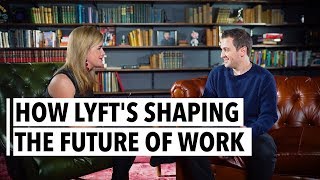
Lyft co-founder John Zimmer says the company doubled rides in 2017 and grew market share from 20% to 33%. He projects Lyft could eventually handle 80% of U.S. vehicle miles, still requiring millions of drivers. Autonomous vehicles will complement rather than replace them, he argues.
Chapters
2017 was Lyft's biggest year yet. Total rides doubled while passengers grew by more than 90%. The company prides itself on its driver-first mentality, with more than 70% of Lyft drivers being the primary breadwinners for their households. But with self-driving technology around the corner, what does that mean for the 1.4 million Lyft drivers using the platform today? We're at their office in downtown San Francisco to speak with co-founder John Zimmer and find out. Well, John, thank you so much for joining us and having us here at Lyft.
Thanks for having me.
You mentioned Lyft's growing market share, and you've said in the past that you do believe that Lyft can be the largest ride-hailing startup or company here in the U.S. What leads you to believe that? Are there any metrics that you're super confident about or anything in the business that makes you bullish?
Yeah, I think the growth last year going from 20% to 33% nationally, expanding in that same time to now cover 95% of the population, seeing big markets tip over to more than 50% Lyft. So while our national share is at about a third, we have specific cities and markets over 50% share, multiple cities. And so we've done it, we know how to do it, and over the next few years, we'll, we'll continue to do that.
So it is the beginning of 2018, and Lyft has already deployed several self-driving pilots across cities like San Francisco and Boston and Las Vegas. Are riders really ready for this technology? What are you seeing on the ground?
Yeah, so I was recently in Las Vegas at CES when we had the autonomous pilots. I took two rides. It was very smooth. I think people are ready. We saw behavior change in the beginning when we got people to ride in other people's cars with Lyft when we launched. In 2012, and now it'll be about creating a great experience, a safe experience, and one that, that helps people save money.
And at the moment, I think there are more than 30 companies that say in some way that they're working on autonomous vehicle technology. That's a lot of companies. How do you feel like Lyft is thinking about this technology differently than, say, some of the competitors?
As I mentioned, we do over a million rides every day already. We're building relationships, with customers to be that alternative form of transportation for them versus driving a car. You know, we're testing things like passes so that ultimately I imagine you'll be subscribing to Lyft as a service and you'll say, "Hey, I want the 1,000-mile plan." Instead of the minutes plan, you'll get a miles plan and you'll subscribe to that and then we'll provide you with all your needs. When people think about autonomous, sometimes they think, "Oh, when is that magical autonomous car gonna drop out of the sky and do everything?" We don't need it to do everything. We don't expect that will happen immediately or even in the, in the middle term. I think what will happen is an autonomous vehicle can do 100% of certain rides, and our driver community will continue to do a large portion of rides that an autonomous vehicle can't do. And as that scales, we'll be, you know, one of the only providers that can provide you with both. And therefore fill out all your transportation needs.
Because Lyft is so driver-focused, where does that focus shift in a world where there is self-driving cars? How do you guys maintain that brand of being so focused on the driver?
Yeah, it's critical to me and to the company that, that we do. It doesn't seem there'll be less earning opportunities on the Lyft platform in the future than there are today. And so I don't think there'll be as many hard decisions as people think. And the reason I believe that is because today the industry ridesharing does just 0.5% of miles traveled, uh, in the US. That's moving, in our minds, to the far majority of miles being traveled as people subscribe to a service like Lyft. And if we go from 0.5% of miles traveled to, say, 80% of miles traveled, and of that 80% of miles traveled, only a few percent are done by drivers, That's multiples of how many drivers we would need today. And so we have that momentum. We're going to continue to need more and more drivers. We're going to continue to need to take great care of that driver community. And if there is a state 20, 40, whatever, how many years from now where 100% of all rides are done autonomously, there would still be service providers in many of these vehicles because the vehicle is going to change. It's, it's not going to be necessarily a car. It's going to be more like a room on wheels where you'll get all different experiences. And for ones— for these rooms with higher occupancy, you're going to need service providers. And I believe that number will always be greater than, than where we are today.
Right. And you and I both know the many safety benefits of getting humans out of the business of driving cars. But currently about 3% of the American workforce is employed in some sort of driving capacity. How much of your time is really thought about the economic impact of some of the technologies that you're Lorraine, when it comes to self-driving?
Quite a bit. We just released an economic report where billions of dollars are being spent in local economies because of Lyft, because people can get around more easily. I think, you know, as a user myself or yourself have experienced, like, hey, I'll go out to this restaurant because it's easier. I'll go to this other part of town that I couldn't have gone to before because public transit didn't reach it easily. And so it is creating local economic activity. That's really important to me. I wouldn't be working on this if I didn't believe that was true. But if you zoom out a little bit on what, what's happening, I believe what we're going to see with this shift is the largest physical environment change to our cities in our lifetime. And over the last 100 years, unfortunately, the city has been designed for car ownership. And now our cities are paved. The majority of Los Angeles and New York and many other cities are paved over. With car infrastructure, not people infrastructure, car infrastructure. That sucks. And we are going to have an opportunity to redesign our cities around people and not cars. And in doing so, in doing that infrastructure work, that's going to create a lot of economic activity. In making it easier and more affordable to get from point A to B, we're going to create a lot of economic activity. So that's critical. That's like why we're here. And I think we can have a big play a big part in that.