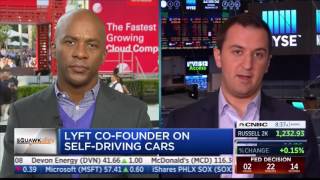
Lyft co-founder John Zimmer says the company is not for sale and trip volume is up tenfold in New York year-over-year. He projects that within five years most Lyft trips will use autonomous vehicles, and personal car ownership in major cities will be largely obsolete within ten years.
Chapters
Lyft co-founder John Zimmer says autonomous driving with a human could be a reality in the next 5 years. But will Lyft still be operating independently then? I asked him earlier this week. Take a listen.
Lyft is not for sale. Uh, you guys are responsible to our shareholders. We have to review any opportunities that come our way, but we're focused on growing the business, and we've done that 3x year over year across the country and 10x year over year in New York alone.
So in the near term, while we're still talking about people driving cars, what is the real lever toward profitability that you have? I mean, volumes have gone up dramatically, but there are still losses no matter what company you're talking about in this ride-hailing, ride-sharing market. When does that tip and actually start to show the profitability that investors, longer-term investors expect?
Yeah, everyone right now is investing in the massive opportunity at hand. Every year, $2 trillion is spent on car ownership in the United States. And as that transitions to transportation as a service, that's going to be a massive opportunity where people purchase transportation like they do Netflix and Spotify on a monthly plan.
But even once that happens, if we're in fact moving to autonomous as, as the method for people getting around, doesn't that entail even larger costs? I mean, I imagine you don't expect drivers who won't exist, in fact, to be buying the cars that operate autonomously on the road? Won't that be a capital cost that the company itself has to assume?
Yeah, I mean, actually, that's one of the advantages that being a transportation network has, is that we have the ability to monetize this asset instantly. And so that would likely be through more normal financing rather than through, through equity financing.
So through debt then?
Yeah, through debt. Or you could imagine a third-party kind of bank financing these mega fleets, or it could be us paying, paying a finance fee. So I think there's lots of different structures that you've seen in other industries too. When you have an asset that's being paid back in such a quick period of time through something like Lyft, you're going to see lots of different financing options.
So do you then end up with a situation where the traditional business model of drivers and the cash flow coming in from that is paying for the model of actually financing these autonomous vehicles that are putting the drivers out of business?
Well, on the financing side, absolutely. You'll be able to finance the new opportunity, the new business. On the driver side, look, this is a 10-year transition. 80% of our drivers drive 15 hours or less. 20% of our drivers drive full-time. And we're going to be able to manage that transition responsibly over that 10 years.
And you said that between 5 to 10 years we'll see this transition take place. What sort of movement have you seen as far as regulation, both at the local and national level, that gives you confidence that we're going to get there? Because it seems it'll take a lot of help from politicians up and down the chain.
Yes. So, so first, just to make sure we paint the vision you have, 10 years from now, we believe personal car ownership is all but over in major US cities. And about 5 years from now, the majority of our trips, we believe, will be in autonomous vehicles. On regulations, if you think back just 4 years ago when Lyft got started, people thought what we were doing was crazy. And now we do over 1 million rides every 2 days. And we worked with regulators then and we're going to be able to work with regulators now. to create a whole other form of transportation as we did last 4 years.
And finally, how do you characterize this rivalry with Uber? People tend, perhaps just in the media, tend to view it as a death match, only one will survive. Do you think that there's a future profitably for multiple car services in the US and globally?
Yeah, as mentioned, there's a $2 trillion opportunity here of spend every year on car ownership. And we think about this like a transportation network. In, in phone carriers, you have AT&T and Verizon, and there's likely to be— once you hit a 3-minute ETA, which we now have on average across our major cities, it's similar to 3 bars of coverage. And then what sets us apart is the experience that we offer our customers by treating our drivers better than any other company. Passengers are getting better service.