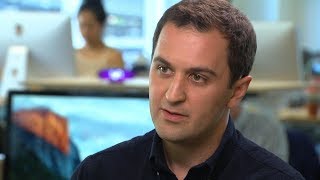
Lyft president John Zimmer says the company served 80% of Americans with 162 million rides in 2016, a 142% increase from the year before. He's betting on subscription plans, autonomous vehicles developed with Google and GM, and a future where fewer people own cars. Zimmer emphasizes that caring for drivers and passengers drives business success.
Chapters
While the ride-hailing giant Uber battled chaos and a whole lot of controversy this year, competitor Lyft made some big gains. The company has added service to 150 U.S. markets in 2017, so that makes it available in more than 350 areas across the country. More than 80% of people in the United States can now hail a ride on their phones. John Blackstone got a lift from Lyft's co-founder and president, that's John Zimmer, to learn his keys to success.
Traffic is a plague in cities across the country. Morning, John.
Morning.
When I went for a ride in San Francisco with Lyft president and co-founder John Zimmer, we got stuck in a typical jam.
Look at all these cars. They're individuals driving themselves and no one else sharing the ride with them.
Whoo! Ride-sharing has propelled Lyft and its larger competitor Uber into multi-billion-dollar companies. Both launched in San Francisco just a couple of years apart. Around the same time you were starting Lyft, there were some guys across town starting another company.
Yeah, I heard about that.
It's actually grown a lot faster than yours.
So they, they actually started with private cars, limos, a couple years before us, so they had a footprint. But before them, we launched a peer-to-peer transportation, which is kind of people using their own personal cars. And we're now the fastest-growing rideshare service in the United States and are taking market share from those other guys.
Those other guys, Uber, have spent months dealing with a series of scandals that led to the recent ouster of CEO Travis Kalanick. A study of credit card transactions shows Uber losing market share as Lyft gains. Lyft says it now has 30% of the U.S. market. What's been the biggest challenge that you've faced?
There's always been doubt behind our set of values. Taking care of our drivers, taking care of our passengers was really important. And many people said that's going to hold you back, that other competitors are too aggressive. And we said these are two different things. We're aggressively pursuing our values of taking care of people. And that is actually good for business. And I think finally people are starting to realize that.
In 2016, Lyft provided more than 162 million rides, 3 times more than in 2015. Growth this year is up 142%. Recently, you've told the people here, "Don't gloat." Yeah, I think it's important.
Look, anything that's happening with a competitor doesn't have an impact on our drivers, our passengers, and the people here. Upstairs we have the product and engineering team.
We first met Zimmer in 2012 at his startup called Zimride.
We're trying to make history by building a new form of transportation. You know, there was canals, there was railroads, there was highways, and there was Zimride.
In 2012, Zimride had a couple of dozen workers. Now Lyft has 1,700 employees and more than 700,000 drivers. As Zimmer sees it, the drivers are making good use of cars that would otherwise just be parked.
We have 250 million cars in the United States that are parked 96% of the time. This is completely inefficient.
The city of San Francisco says that one of the impacts of Lyft and Uber has been to create more traffic in the city.
Yes, we, we, we've seen that, that reporting. I think that the opportunity here is to make traffic go away, and so we believe we are doing that in instances. And if there are cases where we're not, and that's based on data, then we're going to work with the local government, we're going to fix it.
Both Uber and Lyft see self-driving cars in their future. Lyft is developing technology in partnership with Google, General Motors, and Jaguar Land Rover.
We think that in a few years you'll be subscribing to a miles plan on Lyft the way you would subscribe to a minutes plan on AT&T or Verizon or T-Mobile.
You've already disrupted the taxi industry. Are you going to be up against the automobile industry in a way now as well?
We're really focused on the customer and what customers want. And providing that experience. If that means we can provide a better experience than the alternative, then we're gonna do that.
And Zimmer practices what he preaches. When he gave me a Lyft, he borrowed a car.
I currently don't own a car, and I carpool to work with my co-founder in the mornings.
So you can get along in a major city like San Francisco without a car?
Absolutely.
And that's the future that you see?
Yeah, I think so. I think it's going to free up a lot of space within our cities. It's going to save people money.
There's no doubt John Zimmer is a ridesharing visionary. But for now, just like the rest of us, he can still end up in gridlock. For CBS This Morning, John Blackstone, San Francisco.
Ridesharing visionary and appears to be a really good guy. I love his no-gloat policy, don't you?
I was going to say, yeah, absolutely. With all the difficulties Uber and Calendly have had, just focus on what you're doing.
And just do it well. Like aggressively pursuing our values of taking care of people. You go— All about the customer, right? Nicely done.