A trader shares eight years of lessons: stop chasing strategies and pick one ticker, one timeframe, one routine. Most traders fail from FOMO and overtrading, not bad setups. Stick to strict risk limits, keep a journal, and expect slow percentage gains, not quick wealth.
Chapters
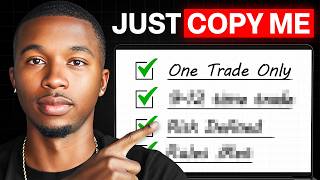
I'm going to share with you 8 years of trading knowledge in this one video. When I first started, I had no idea what I was doing. But fast forward over 8 years of trial and error and having made millions of dollars trading, I've been able to build my dream life. So if you're someone that's struggling to get consistent or just want to skip the years that it took me to figure this out, then pay attention to this video because this is everything I wish I knew when I first started. First things first, you need to stop watching every single YouTube video, watching every single strategy that you can find on the internet. Now I know this might sound a little bit contrary or contradicting because I'm obviously a YouTuber, but the problem is that you watching all of this content and consuming all this content on the internet about trading is just going to confuse you because profitable traders are very, very boring. You have to have one strategy that you trade consistently. You have to have a specific time window that you trade from, and you have to trade one symbol if you actually want to see consistent results in your trading career as fast as possible. And that's contrary to what a lot of people think. They think the more trades that you take, they think that the more time you put on the charts, the more money you're going to make. But that's not the truth. A lot of people have that mindset, but in reality, that's the mindset of a gambler. They're treating trading as if it is the casino, and that is what makes sure that you stay unprofitable. You need to treat trading as if it is a full-time job. You need structure. It needs discipline and it needs accountability. And all that comes in when you have and stick to one specific strategy, not jumping from strategy to strategy to strategy. You have one time frame that you're trading from. You're not trading at 3 o'clock in the morning because you're bored or just want to show your friends you making some quick money or something. And you also have to stick to one specific ticker, because when you stick to one ticker, you learn how it moves, you learn what time it moves, you learn the strategy that you should trade with it. When you should trade it. You learn all these things by focusing on one specific ticker. Now, the real reason that you've been unprofitable for weeks, months, even years is not because of a strategy. It's not because you didn't find a golden indicator or anything. It's literally because your execution and your discipline makes it impossible for you to become a profitable trader. Yes, you might have one winning day, you might have a good week, maybe if you're lucky you'll have a good month,. But being able to keep that consistency over years and years and years is not feasible, and it's not going to happen if you focus on just having a strategy. Now, you've probably heard this hundreds of times, but when it comes to trading, actual looking at the charts and breaking down candlesticks and looking at patterns, that's the easy part. The hard part is the mental part, the psychological part of trading that stops you from following your trading rules, that makes you overtrade, that gives you FOMO, that makes you move your stop loss because you're scared of losing, that makes you scared to enter into trades, that makes you do all these stupid stuff repetitively. And those are the exact reasons why you keep being unprofitable, why you're giving money back to the markets. So the main thing that you need to focus on to become profitable as fast as possible is mastering your mind, creating discipline, forcing yourself to have discipline by having a solid plan, by forcing yourself to stay disciplined no matter what. Because on the opposite end of discipline when it comes to trading is your dream life. Now, the best way to force yourself to be disciplined when it comes to trading is building out a solid routine, a set routine, meaning every day you come to the markets, you scan the markets the same exact way, you mark your charts up the same exact way, you're looking for the same exact setup and strategy every single day. You're trading the same exact ticker every single day. You're keeping it as structured as possible. You're having your trading plan as structured as possible that forces you to become as disciplined as you can. Now, we all got into trading for a couple reasons. We got into it for obviously the financial freedom that you get because we can make a ridiculous amount of money once we get good at this skill. But it also comes with time freedom and location freedom. But having all this freedom for most people leads to them being undisciplined because they have nobody to hold them accountable. They don't have a boss that's making sure they do this, this, and this. They don't have co-workers. They don't have anybody looking over their work. It's literally just you and the charts. And if you're not disciplined to hold yourself accountable, you will end up consistently losing money trading. So that's why you need to structure it as much as like a job as possible. Once you do that, once you structure yourself, once you have a set set solid routine and set trading plan, you know exactly what you're looking for. And I'm going to admit it to you guys, it gets very, very boring. But when you start getting bored when you're trading, that's when you'll realize that you are extremely profitable. I look for the same exact setup every single day. I look at the same exact tickers every single day at the same exact time every single day. There's no variations, there's no changes. I do the same thing very repetitive. It's also very, very boring, and it's not as exciting as it was when I first started off trading, when I was taking 30 trades a day and entering buy here, sell here, and going crazy and losing all my money. But now it's boring yet extremely profitable, and that's the point that you want to get to, where it's so structured that you barely think anymore. You're just following the exact thing that you follow every single day, and you're reaping the benefits from Now I've helped tens of thousands of people become profitable traders, and one of the main things that people get stuck on in the beginning of their journeys is that they're getting hyped up by these YouTube videos, real or fake, that are $100,000 getting turned into a million dollars in 30 days, or $1,000 getting turned into $100 billion in 30 days. And realistically, that's not realistic at all. The chances of you doing that are— you might as well go try the lottery. It's really not gonna happen. If it does happen, you are top 3 luckiest people in the entire world. It's just not realistic. And the reason being is if you start with $100 or $500, it's very, very hard to flip that to even $1,000. In order to flip that to $1,000, you have to leverage a large amount of that account. Like with that $500 account, you have to risk almost all $500 to get it to $1,000. Then to get that $1,000 to $2,000, you have to risk all that $1,000 to get to $2,000. Then $2,000 to $4,000 and so on and so on and so on. And the chances of you continuously flipping your account to reach these huge numbers on a consistent basis is extremely, extremely rare. And in the beginning of my trading journey and a lot of people's trading journey, we think that we can start off with $1,000 and that $1,000 will set us for life and we'll be able to flip that and compound that 'til we're at $1 million. Realistically, that's not gonna happen. I hate to burst your bubble, but it's very, very hard to consistently flip accounts. Instead, you have to come into the markets with the mindset of percentages. Now, the reason why you do that is because let's say you make 10% on your account every single month. Instead of you looking at the dollar amount, because if you have $1,000 inside of an account and make 10% on that in a month, You only made $100, but that's because you only had $1,000. Imagine if you had $100,000 in your account and you made 10% on that in a month. You made $10,000 in a month. Now let's say you had $200,000. You would have made $20,000 in a month with that same 10%. It's the same trades that you took on a $100 account or a $1,000 account. You took those same trades that got you to 10% profit at the end of the month, but you just had more capital behind you. Now obviously we don't all have $100,000 or $200,000 to put into a trading account, and that's why I personally love prop firms. Prop firms have been able to help regular people— you don't have to have a whole bunch of money— be able to pay a small fee like $200, $300, $400, and then these prop firms or these funded accounts will actually fund you with $100,000, $150,000, sometimes even $200,000 to trade with. And the reason why I always suggest for someone to go the prop firm route is because of that analogy that I just talked about. If you had that $500 that you would have spent on a funded account and you just traded that $500, making 10% on that, even making 50% on $500, it's $250. And it's very hard to make 50% consistently month after month. I'm not talking about a luck streak where you had a good week or a good 2 weeks and you end up making 50% or even 100% on your account. That's not sustainable over months and years. And with trading, we didn't just get into this to make money this month or next month. We got into it to be able to consistently generate income month after month, year after year, and being able to flip accounts consistently to generate income, it's not going to happen. So that's why I do love funded accounts. I do suggest for traders to actually get into funded accounts. If you don't know what funded accounts are, I've made multiple videos about them, but in simple You basically pay a small fee, like I said, $300, $400, $500, and you're able to get funded by these prop firm accounts for $50,000, $100,000, or $150,000. And the profits that you make on top of that account, you actually keep a large percentage of it, most of the time like 80 or 90%. So in that example, let's say you make 10% on a $100,000 account, you made $10,000. They would keep $1,000 and they would pay you straight to your bank account $9,000. I literally did this with a prop firm. As you see right here, they paid me out $18,000, and that's just in 2 weeks of me trading. Now, most prop firms force you to take these challenge phases first, which basically means you pay that $500 fee, and then they basically put you through a test to see if you can actually trade. And that's good and all, but most of the time, a lot of traders don't make it to that challenge phase. And me being able to help thousands of people learn how to trade, I've noticed that I didn't like that. So I decided to start my own prop firm called The Edge Funder. Basically, we are a prop firm that will fund you from $25,000 to $50,000 to $100,000 up to $150,000 for you to trade with. You keep 90% of the profits that you make on top of the account. You follow our rules, you get paid out, sent straight to your bank account, and there's no challenge phases at all, which means you purchase an account, you start making money on that account, and if you follow our rules, you can get paid out that money right away. You don't have to go through a whole challenge phase. If you guys want more information on that or to get funded instantly, hit the link inside the description down below. You can also use code START20 for 20% off to get you instant funding with just a few hundred dollars. And that is how you can leverage small amounts of money to make a lot of money. You don't need to try and flip your accounts every single day to be able to make a substantial amount of money. You also don't need to start off with a whole bunch of money when it comes to trading. Risk the prop firm's capital utilizing your skills that you have learned. And that's how you can generate these $10,000, these $20,000, these $30,000 months consistently by just making 10-20% on your account every single month, which is very, very doable over a long period of time. Now, before we get on with the rest of the video, I want to let you guys know about my recommended Forex broker. So I mainly trade futures, and that's because most Forex brokers have extremely large spreads, which basically means if you press buy right here, they will get you in all the way up here. And that was an issue for me. But with the Forex broker that I recommend to people now, it has extremely small spreads, extremely fast withdrawals, which means you can get your money really, really fast. And it allows you to trade other assets outside of the futures space. So if you want to use the Forex broker that I recommend, hit the link inside the description down below. And when you use that link, you actually get 10% off of all the commission fees, which is huge. Now let's get back into the video. Now, I wish when I first started off trading that I realized that risk is everything. Now, you've probably seen YouTube videos that talk about the fact that risk management is key and you have to focus on risk management. You might not understand what that means, or you might not care, but I'm here to tell you, as someone who did not care and did not know what it meant 8 years ago, that now I understand that it's extremely vital. I'm going to give you guys a quick example. So let's say you have a 50% win rate when it comes to your trading strategy. I want you guys to go grab a coin, or we all know how coins work. When you flip a coin, you have a 50% chance of landing on heads or 50% chance of landing on tails. But what ends up happening is if you flip 10, let's say, quarters right now, you're not going to get 5 times it lands on heads and 5 times lands on tails. It's probably going to be something like 7 times landing on tails, 3 times landing on heads. Now let's say you flip it 20 times, it's going to be 13 times on tails and 10, 7 times on heads, even though we know that it's a coin that's two-sided, so we have a 50% chance of landing on heads or tails. A true percentage-based opportunity does not present itself until it reached a— reaches a large enough sample size. What I mean by that is you have to keep flipping that coin until it gets to around 200 to 300 times that you flip that coin, and that's when you'll start noticing that things even out and you'll get closer to that 50% chance of the coin that you're flipping landing on tails or heads. And the reason why that example is so important when it comes to trading is that you could have your 50% win rate strategy, you can even have a 60 or 70% win rate strategy, but that's over a long period of time, a big sample size, which means you have to get to 100, 200 trades to be able to actually realize and see that 60 to 70% win rate. Because in the beginning, you could be you could go on a losing streak out of 10 trades. You could lose 6 out of those 10 trades and only win those 4 out of the 10 trades. But we know over a long period, over 200 trades or so, you actually have a 70 to 80% win rate. Now, why that's so important is most people never make it to those 100 trades. That's because their risk management is shot. They have no longevity when it comes to risk management. They're risking their entire account because they're trying to flip their accounts. Well, they're risking a huge amount of their account every single time they're trading, which in turn forces them to never actually be able to stay consistent to see their 60% or 70% win rate because they blew their account before they can get to those 100 trades or that big enough sample size to see their true winning percentage. So you have to have proper risk management. And what that looks like, depending if you're trading on a live account or on a funded account, is you have to be very strategic when you are trading, giving yourself limits for how much you can risk per trade. Also giving yourself limits for how many trades you could take per day, forcing yourself to not be able to go over a threshold or go on tilt one day, blowing your entire account. The game is to be able to stay alive long enough to keep playing. That's how you become a consistently profitable trader over a long period of time. Now I'm going to be honest with you guys, in the beginning of my trading, I lost over $60,000 in about 2 or 3 weeks of me trading, and that's simply for the fact that I rushed the process. The truth is, trading has been here before I was even born, and it's probably going to be here after I'm long gone. I'm saying that because you have time. A lot of people get into trading and they just want to rush it. I was that person. I was on the demo account for about 4 days. I thought I was the next Warren Buffett. I was the best trader in the entire world. And a lot of new traders get this same euphoric kind of new trader luck where they go on a luck streak and they're using crazy high contract sizes and making $100 million and they think they're the best trader in the world. So they load up a live account, and that's literally what I did. I loaded up $10K, $15K, $100K— $10K, not $100K, sorry— $10K, $15K, $20K, then another $10K, and then another $10K I believe after that, and I blew all of them specifically because I got my head gassed up after 4 days of trading on a demo account. So what I tell people now is you have to be on a demo account for at least a month, but preferably 2 months if you are a new trader, because you need to learn and make as many mistakes as possible with fake money before you hop into real money. The goal is to make money. The goal is not to make money as fast as possible. Remember that when it comes to trading, because the more you try to make money fast, the longer it's it's going to take you to actually make money trading. So the route that I suggest for all of my traders is a demo account for 2 months, then a small live account. Using a small live account is something like $200 to $300 and trading the smallest contract or smallest trades possible every single week. This is on real money. This is just to get you used to actually trading real money, and you're doing this for 4 more weeks. Once you do that, then you can venture off and look at getting prop firm accounts or funding a larger funded account. I do suggest for new traders to go the funded account route because funded accounts, prop firms, they limit your downside. Like I said, you pay $500 and that's all the money that you have to pay out of hand or out of pocket. If you load up a live large account, like let's say $5,000 inside of an account, you can lose that $5,000 very, very quickly. So, um, after you go through that demo account and after you do that small live account, then you choose either the prop firm route, which is what I recommend, or go to the large live account route, and that's where you actually start making money with your trading after you made majority of your losses and your lessons in that demo phase. Now, a lot of people ask me what was my turning point, what made me go from being unprofitable to profitable. And the one main thing that forced me to become a profitable trader is when I started journaling my trades. Now again, I know you've probably heard this multiple times, I know you've probably seen this on YouTube 100 million times. I'm I'm telling you, I was the same way. I ignored it for years and years and years until I finally decided to give it a try. And the month after I finally started to give it a try and treat it seriously, that's when I started consistently making money in the markets. The reason being is that trading is all about data. Trading is all about knowing if this happened, this is probably going to happen. If this happened, 90% of the time this happens. It's all about data, and we need to gather that data, and we can't do that just inside of mind. I promise you, if I asked you what 5 trades you took 2 weeks ago, you would not be able to tell me. But that's a huge problem because that means we can't learn anything about the trades that we took 2 weeks ago, or whenever we stopped remembering the trade. So you need to journal every single trade that you take. You need to journal why you entered into the trade, the strategy that you used, if you think the trade was good or not, why you think the trade was good or not. And the reason being is you need to take that data and be able to look over that journal data to make your decisions for the next couple trades. And you keep doing that, and after a while you're going to have hundreds of days, hundreds of trades worth of data to be able to feel confident about your strategy, but also know exactly what you should and shouldn't do and what gives you the best outcome versus times when you should avoid taking a trade. So journaling is literally going to save your trading career. There are multiple different journals out there that will automatically track your trades. I use Wagme Trader. I'll leave a link for inside the description down below. It's the one I've been using for a few years now. Wagme is super simple, uh, super easy to use, and realistically it's all I personally need to be able to journal my trades and look over them to make the decisions that I need to make to become a better trader. Now we mentioned in the beginning of this video that discipline is the most important thing that you need need when it comes to trading. And we have no accountability as traders because, like I said, it's just me and the screen. It's just you and the screen right in front of you. One of the main things that helped me with my trading and actually helped trading become real and feel real and actually be able to hold myself accountable to certain standards and certain trading rules is by joining a community. That community could be you linking up with your best friend. That could be you linking up with some dude on the internet that also trades, and you just talking to them and you guys sending each other your trades that you took you took for the day, trades that you took for the month, your journal that you have been going through so that you can— he can look over your trades or she can look over your trades. Just having an accountability partner, whether it's one person or you join a whole community of other traders, it's just surrounding yourself with people who are like-minded and people who understand the journey of becoming a trader, because not everybody can do it. I remember when I first started off, uh, well, when I first started talking to my girlfriend— wife now girlfriend at the time, and I was talking to her about trading and I was having a bad trading day or whatever, and I would go to her and she would just tell me I should have closed my trade out as soon as I saw a little bit of green. And that's not good advice, but that's why you need to be around people that actually trade and understand trading, whether, like I said, you're DMing a random person, you're joining a community, you're paying for a community to be a part of with actual real traders inside of it. It's very important that you surround yourself with like-minded people that can hold you accountable and you can also hold accountable, because that will force you all to become a much better trader. Now, you don't need 8 years of mistakes to figure this out. You just need the right process. So if you want help applying all of this faster, I highly suggest you try to join my inner circle. That's where I coach traders to actually become profitable. I trade live, I send all of my trades out, I break down my strategies so that you're not relying on me to trade for you. You can understand how to do it for yourself, and I give one-on-one mentorship every single day. Being a part of my inner circle forces you to be inside of a community of not just traders, but serious traders who are actually profitable and are working very hard to become profitable, that'll hold you accountable to becoming a better trader. Now, if this clicked for you, if these lessons actually made you realize where you were going wrong, then watch this video right here where I show you exactly how you can start with just $500, you can scale that to $100,000 a month using the same exact principles. It's probably the most crucial next step. I'll see you there.