Becoming A Profitable Day Trader Is Easier With These 7 Tips

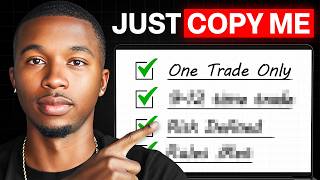
Seven rules for day trading profitability: trade one or two instruments, stick to a specific time window, use one or two strategies, cap trades per day, set a hard risk limit per trade, use an entry checklist, and punish yourself for breaking rules.
Chapters
So a lot of people always ask me what are the exact steps that they need to take to be profitable. So in this video, I'm going to break it down for you guys step by step. I have 7 rules that you guys need to follow, that you need to stick with to be profitable. If you can stick with these 7 rules, I guarantee you, you will be profitable. So let's hop right into this. I'm going to be writing here, and I don't need you guys judging my handwriting. I'm a day trader, I'm not a freaking English teacher. But I did want to have it written out for you guys. With that being said, let's get on to the first one. So these are rules that you guys need to be strict with. These are things that you guys need to follow, guidelines that you guys need to make. I'll give you my suggestions throughout the video. That's why I suggest you stick through to the entire video, so I'll give you suggestions for each and every one to help you form them correctly. But ultimately, it's going to be up to you to hold yourself accountable, and I'll give you my best kept secret on how to hold yourself accountable to these trading rules at the end of this video. So stick around. The first one that you're going to need to have in your pocket is what pairs you're allowed to trade. The reason why this is so important— I ain't gonna lie, that's crazy, that looks like Paris. Anyways, why this is so important, why this is so important is because a lot of people like to jump around. If you've been a new trader trading for over 3 months or so, you've probably went from 20 different pairs. You'll, you'll trade NQ, you'll lose 2 trades in a row, so you're like, oh, maybe I should trade YM. You trade YM, you'll lose 2 trades in a row. Now you're like, ah, let me trade natural gas. You You lose 2 trades in a row, you switch to something else. The reason why that is so detrimental to your trading is 'cause you never get the chance to actually master one pair. And the reason why that's so important is I like to compare pairs or instruments, whatever you're trading, whatever you wanna call them, to people. Say you're dating, right? And you have 100 million girlfriends. You're gonna forget the favorite color of every single one of them versus if you have one girlfriend and you focus on this one, you're gonna learn what she likes to eat, what she likes to do, her favorite color, her middle name, her dad's middle name, her mom's middle name. You're gonna learn everything about them. Same thing when it comes to trading. So you'll see all these pairs, you'll see NQ, you'll see ES, you'll see YM, you'll see natural gas, and you think they're all the same, but they all have small patterns that they have individually. So for example, I'll give you guys one thing that I've noticed, and this is from me focusing on natural gas. You guys know I trade natural gas very heavily, but if you notice on natural gas, 10 o'clock Central Standard Time in the morning, price likes to reverse. NG, if it starts at 7 AM and it's going up, it'll probably go up until around 10 o'clock AM Central Standard Time. As soon as 10 o'clock hits, it likes to reverse. So knowing that, you're able to capitalize on that. And the only reason I knew that that was a thing is because I spent a lot of time focusing on just one pair. So this is why I tell people to clearly define what pairs you're actually allowed to trade. Now I suggest you max this out to 2 pairs max if you can. I would suggest 1 pair because you'll learn a lot more about that. You'll learn a pair you're trading is good with support or resistance, or it's better with breakouts, or it's better with supply and demand, or it's better with smart money concepts, or it's better with trendline breaks or trendline bounces or trendline reversals. You'll learn all that by focusing on 1 pair because you'll learn personality. So that's why I suggest, if you can, to stay under 2 pairs, 1 preferably. The pairs that I mainly focus on are really going to be NQ and NG. And you guys hear me talk about NQ and NG all the time. These are my top 2 ones. Now I will mark up ES, YM sometimes. That's just because in the Inner Circle a lot of people like to trade those pairs, so I'll mark it up just to kind of give them my perspective on it. If you look at my P&Ls, if you look at all my trades, you're going to see majority of them are just these two pairs right here. And that's why I've gotten to know their personalities and know how to trade them the best way possible. Next thing, which is extremely important that a lot of people do not pay attention to— I ain't gonna lie, let me pause real quick. I don't ever draw this bad. I'm just— I feel like I'm under pressure right now. I feel like it's about to be thousands of people watching me, and it's just not this. I've never drawn a 2 like this. This looks like a freaking hook. Anyways, you're gonna want to focus on placing yourself Let me redo this too. Just redo that whole entire clip at this point. So the next point that you have to focus on is giving yourself a time limit. The reason why that's so important is a lot of people will lose a lot of money by being bored. They'll end up taking bored trades or impulsive trades. So what I mean by giving yourself a time limit, and the reason why this is so important, is have a certain window for when you're allowed to take trades. For me, it's from around 7 AM— I ain't gonna lie, this is kind of crazy— through 12 30. This is wild. Through 12:30. Yeah, school— if school was my only option, man, I'd be on the corner. And the reason why I have this window is it stops me from taking impulsive trades. Sometimes in the beginning of my journey, I used to be playing video games at freaking 7 o'clock at night, have two screens and one is video games and the other is a chart. And I would just see something, I would just be bored. I'm like, dang, I'm playing video games, it'll be cool if I can make money while I'm playing video games. Not knowing what the heck happens during that trading session— that's Tokyo session if you didn't know— not knowing how markets move, what type of volume is in there, what pairs I should be trading at that time. And I would just hop into trades just because I saw something happening, and I would lose money, end up giving money back to the markets. So that's why I tell people to have a set time limit for when you're allowed to trade. Now that doesn't mean that you have to sit here from 7 AM to 12:30 PM looking for trades. That just means if a setup happens during that time, you're able to take the setup. But as soon as 1 o'clock hits— you guys have watched a bunch of my videos, if you're in my Inner Circle, you've seen me talk about this— where it's like, okay, setup is literally happening right now, but it's not during my time window. And the reason why I stick to that is because I've seen the results of going outside of my time window by trading at just random times whenever I feel like it. So that's why it's extremely important that you set yourself a time limit. The next thing in— it's Probably one of the most important things, and I try and really dig this into people for them to really get this and understand it, for it to get programmed into their mind, is strategy, right? I'm not gonna lie, maybe I just can't talk and draw and write. This is the reason why this is so important, is a lot of new traders are switching from strategy to strategy to strategy. They'll do good on a strategy for a week, they'll lose 2-3 trades in a row, they'll switch their entire strategy. They'll win $100 on a trade, they'll go on social media and see some random trader made $50,000 using a completely different strategy, so then they think their strategy sucks and they'll switch from it. Just set random setups happening, they'll see trendline bounces knowing that they have never backtested trendline trading at all. They're only trading support and resistance, but they'll see a trendline and they're bored during the day, so they're like, ah, let me just take this, and they end up giving money to the markets. So I tell people, please stay strict with the strategies that you're allowed to trade. I tell people max 2 strategies, and the reason why is because you'll learn how to trade those strategies in different market conditions. You cannot trade your strategy the same way in every market condition. You know, there are multiple market condition types. We have consolidating markets, we have trending markets, we have ranging markets, we have a bunch of different type of markets, and your strategy that you trade most of the time isn't going to be able to be traded through every single type of market condition. But when you're focusing on your 2 strategies max— and like I said before, I'd prefer you stick to 1 strategy because you'd be able to really master it, but a lot of people can't do that, so I kind of give leeway and say 2 strategies max— when you do that and you're focusing on these 2 strategies, you're able to see how you can trade your strategy in any market condition because you're sticking through to it. I want to emphasize small tweaks. This It's not where you're trading support and resistance and you're a support or resistance trader, then as soon as the market shifts, you turn into a freaking breakout trader. No, you make smaller tweaks, like maybe having a longer wait period. Instead of entering on the first candlestick, you wait for another one. Or you have a small tweak where it's like, okay, you added extra confluence in there. Like, okay, in order for me to hop in a trade, I need it to be above the VWAP, or I need this to happen, I need this to happen. Just small little things that are addition to your strategy, not completely changing your strategy. So an example of just pivoting your strategy just a little bit would be if you are a support and resistance trader. Let's say this is your support zone right down here. This is your resistance zone over here. This is price, this little squiggly line, whatever. Usually as a support or resistance trader, you'd come right here, wait for it to come to your support, and you buy off of here. That's how you usually trade it in a more consolidating type of market. But imagine the market is trending. And we all know what a trending market looks like. It's making higher highs, higher lows, higher highs, higher lows, higher highs, higher lows. A lot of the times it's not going to come back down to these support zones, so you're not going to be able to trade it the same way you traded it before. But how you could adjust is when price is coming here, making these higher highs, higher lows, higher highs, higher lows, higher highs, higher lows. Instead of taking regular support zones right down here at consolidation, you could be taking break and retest zones. Break and retest zones are simply when price breaks above your previous resistance zone, it comes back down and it turns that resistance zone into a support zone and goes back up. That's a small minor tweak that you could make in your trading of your strategy to still technically be trading support and resistance at the same time, making the tweak where you're able to capitalize on trending markets versus just trading it during consolidating markets and trading it like this. You need to be able to capitalize on when it's not consolidating anymore and it's breaking to the upside and trending, we'd be able to enter right there. And that's a great example of making a small tweak to your same exact strategy but being able to trade it in different market conditions. All right, y'all, I just opened up more spots inside of my Inner Circle. If you guys don't know what's included inside my Inner Circle, you get access to all of my trades, which means you can follow along and hop in every single trade that I take. Yes, the trades where I'm able to make $5,000, $10,000, $20,000, $30,000, even $60,000. You guys can take the same exact trades. You guys also get access to all of my courses, which will take you from being a complete beginner to a consistently profitable trader. It teaches you everything I know about trading that'll help you be a profitable trader. I'm also live every single morning in my inner circle, live trading, live market breakdowns, answering questions every single morning. I'm really just creating the place that helps you go from being an average person to a consistently profitable trader. It's always filled up, but I have opened up some more spots. So I suggest you click the link in the description down below right now and claim your spot in the Inner Circle. But let's continue on with this video. You need to have a max amount of trades that you're able to take. What is that? Max trades. A lot of people will take anything that they see. Same way if we bring it back to the whole thing of them as people. Type person that's friends with anybody, that will date anybody, is not going to have quality friends and is not going to have quality significant others. Being able to max out the amount of trades that you're able to take forces you to only want to take the best trades. If you say, okay, I'm only able to take 2 trades per day, every single time you see your setup happen, no matter what time of the day it is, no matter what pair you're trading, you're going to think in the back of your mind, do I want to waste my 1 of 2 trades on this trade that I'm looking at? Or maybe I should wait for a better setup, a more setup that is more in line with my exact trading plan versus something that could possibly be a good setup, but not really too sure about it. So that'll help you weed out the bad trades automatically because you know you have a limit. My suggestion for most people, and it's going to vary depending on if you are a scalper, which is someone who's in and outta trades very fast, versus an intraday trader, which is what I am. I mean, trades roughly between 30 minutes to like 2, 3 hours per trade. Or if you're a swing trader, this is someone who holds them for hours, days, even weeks sometimes. What I would suggest for scalpers realistically is to have a max of about 4 trades per, per day. Now, if you're an intraday trader, 2 is a great number to be at. I don't think you have to go past 2. I think 2 is a great number to help yourself stay selective, but also give yourself some freedom in case the first setup doesn't work out the best. You can still have a little bit of freedom to make your money back on the next trade after waiting for a perfect trade. And as a swing trader, I would then switch it to probably around 3 or 4 trades per week max. And that just helps you capitalize and wait for the best setups versus taking anything that comes across your chart. This one is extremely important for risk management and to ensure that you don't only become profitable but you stay profitable. Number 5, max out the amount of money you're risking either per trade or per day. Now there are two types of people. There are people who like to limit the amount of money that they're risking per trade, or the type of person that likes to limit the amount of contracts or lot size that they're using. Per trade. I'm personally the type of person that likes to limit the amount of money because I like being able to know going into the trade, okay, the max amount I can lose is $5,000. I'm not going to see anything more than negative $5,000 versus kind of having a max contract size that I use. But the reason why this is so important is because over the long period of time, no matter how high your win percentage is, if your max loss can be as big as you want it to be, you're not going to stay consistent. Profitable. You could have a winning day, a winning trade, a winning week, a winning month, and then throw it all away within 2 weeks' time. Now you'll hear a lot of people give percentages and things like that. I think it really depends on your skill level, how long you've been trading, and how confident you are on a specific setup. I don't really like doing percentages for the most part. It's good for beginner traders, but like me personally, I just have a set number and my account size just has to be big enough for me to risk that amount basically 10 times and not lose my entire account. That number is completely up to you, but make sure you have a strict number and don't allow yourself go over that number at all. That's what's going to hold you accountable to actually make you stay consistently profitable and not just become profitable for a week or a month or even 2 months. This one is super important. This is probably what saved me from losing a lot of money when I was bored. I made a video a long time ago, maybe like a year ago, where I talked about giving money back to the markets because you're bored. A lot of people, a lot of people are addicted to trading. They're addicted to that dopamine hit that they get as soon as they press buy or sell. They just want to see numbers going up or down on the screen. And the reason why that is such a huge thing is really because people just want to be in a trade, and that's out of boredom, and that's impulsive trading. Impulsive trading and boredom is a very, very expensive trait to have when you are trading. This 6th step right here of adding entry criteria to every single trade will stop you from taking those boredom trades. I'm not going to write criteria here because I'm actually running out of space, be frank with you, I don't want to have to look up how to spell freaking criteria because I'm not gonna lie, I can't just think of it on the top of my head. I haven't seen it that many times. Um, entry criteria is something important that you need to have. Now you don't want this to be too strict. You do not want to say, okay, I need to see this, this, this, this, and this to take a trade. You want a general rule of thumb that you need to see to take any trade. That general rule of thumb could be, okay, I want to see a bullish candlestick and it's above the VWAP. The reason why you don't want it to be too strict is because sometimes that could stand in the way of you just hopping into a regular trade. You should have at least some type of small entry criteria that stops you from, okay, I just saw a green candle, let me press buy. Okay, I just saw a red candle, let me hop in to sell. Something like that. Those are boredom kind of tactics that make you lose money. Forcing yourself to have just a basic and general entry criteria, no matter what strategy you're using, helps stop yourself from giving money back because you're bored or hopping into random trades because you're bored. Now the last and final one is the most important one. I feel like I said that about 3 of them already, but this one's actually the most important one. Because who cares if you write all these rules? Who cares if you go through every single one of these, put exactly what it is that you need to see? You have your time frames, you have the 2 pairs that you're allowed to trade, the 2 strategies you're allowed to trade, but you have nothing to hold you accountable. This is where this part comes into— you need to give yourself a punishment, a punishment for breaking any of these rules. What I've learned from literally coaching thousands of people, teaching thousands of people how to become profitable traders, is that most people don't learn from just losing money. Like, a lot of people, losing money is not punishment enough for people to stop doing the same stupid mistakes that they keep doing. I know you probably watching this video, if you've been trading for over 2-3 months, you've probably seen the same 2-3 mistakes that you continuously keep making that's caused you to stay unprofitable. And you keep losing this money, losing these funded accounts, it's not punishment enough to stop you from overtrading, to stop you from moving your stop loss, to stop you from overleveraging. It's just not punishment enough. I'm not gonna lie, I don't think punishment fits down here, but let's just write it here so everybody can see it because this is the most important part. Punishment. Boom. That's the most important one right there. One that works for majority of my students, believe it or not, is taking cold showers. No one likes to take a cold shower. Obviously it's up to you. It's what you don't like to do. Because I have people that I've told to take cold showers with, then I've told to take cold showers with— it's kind of crazy— that I've told to take cold showers when they break any of their rules. But they're like, oh, Joubert, that doesn't really affect me. I wake up and take a fricking ice bath every single morning. So obviously if you're that type of person, you don't really mind cold showers, think of something else. I have people that have to take a teaspoon of horseradish. I have people that go out, have to run 3 miles uphill. I have people that, it's really up to you. What is one thing to try and help them think of what their punishment should be is think of something that you wouldn't want to do more than 2 times. But these 6 rules right here will hold you accountable to make sure and help you stay consistently profitable. So as long as you can stick to these and using this punishment as the number one source of motivation not to break any of these rules, over a long period of time you will be profitable. So hopefully you guys got value out of this video. Hopefully you guys enjoyed my nice art, art, art stuff on my, on my drawing and stuff like that. If you guys want me to come to your schools and write on your boards, I got you too.. But in all seriousness, I really hope you guys take this information because this is literally life-changing. If you stick to this and you really implement each and every step in here, as long as adding a punishment to hold yourself accountable, even tell your family, your friends, or if you have trading buddies, tell them your trading plan, your set of rules, and your punishment, and help them hold you accountable to it. Because honestly, if you can do that, like I said before, I guarantee you over the long run you will be a consistently profitable trader. If you guys want more videos like this, please press the like button. And if you enjoyed this video, I really think you should watch this video right here. It'll show you how to draw the perfect support and resistance zones and get you on track to be able to not only draw the support resistance zones but make an insane amount of money doing so. I'll see you there.