You Need to Watch This Video If You're Not a Profitable Trader Yet

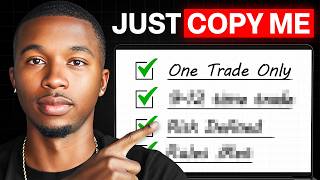
In this instructional video, Josiah Stewart (Instagram @juvra_) walks viewers through the creation of a comprehensive trading plan and a set of concrete trading rules designed to move traders from inconsistent or unprofitable performance to consistent profitability. He begins by emphasizing the necessity of a plan for accountability and discipline, then outlines a step‑by‑step framework: (1) identify your trader type (scalper, day, swing); (2) select a trading session that fits your lifestyle; (3) choose a limited set of currency pairs or assets that are most volatile in that session; (4) adopt a compatible strategy with an acceptable risk‑to‑reward profile; (5) define precise risk limits per trade, per day, and per week (either percentage‑based or fixed‑amount); (6) cap the number of trades you take each day to force quality setups; (7) codify “automations” – explicit entry, management, and exit conditions that remove hesitation and FOMO; (8) establish in‑trade rules such as moving stop‑loss to break‑even at a 1:1 R‑R point; and (9) attach personal consequences for any breach of the plan to enforce adherence. Throughout, Stewart intersperses promotional calls to follow his Instagram, join a paid signals chat, and watch related strategy videos. The core message is that strict, written rules and disciplined execution, not merely knowledge, are the decisive factors for trading profitability.
Chapters
I highly suggest y'all have a pen and paper and I have your full attention throughout this whole video because this video can literally change your trading career forever. What is goodie, my people? We are back again with another gem. Listen, today I have an extremely valuable video for a lot of you guys who are just not there yet. You're not a full-time trader, you're not a super profitable trader. This video and what I'm going to talk about in this video could literally be that one thing you need to switch from being a regular trader or being where you're at right now to being where you want to be. So I highly suggest y'all watch this video all the way through. Make sure you guys follow me on Instagram over there, or over there, I don't know, @juvra_, 'cause I be dropping tips like this all the time on my Instagram. And I'm always open to responding to DMs if you guys ask me any questions. And let's just hop right into this. So you'll hear a lot of traders talking about, oh, you need to have a trading plan, you need to have trading rules. Everybody says this, you've probably heard this a million times, but not a single person breaks down exactly what that means. And exactly what you need in it. That's exactly what I'm about to be doing in this video. I'm gonna explain to you why you need a trading plan, why trading rules are super important, as well as the fact that I'm gonna show you guys and take you guys through a nice little template so you guys understand what your trading plan should look like, what type of trading rules you should have to make sure that you can stick to those rules. 'Cause you hear all these YouTubers say, stick to your trading plan, stick to your rules, but you don't know what the heck rules are or what the heck your plan is supposed to be. So I highly suggest you guys watch this video all the way through because I'm going to break down and give you guys a great little template that you guys can go off of and kind of mold into your own trading plan and trading rules so you can therefore become profitable in your trading. So first of all, why is a trading plan and trading rules important? It's something that holds you accountable. It's something that keeps you in check. Also, when you have a trading plan, you have rules, you have boundaries. A lot of people, when they go off and become entrepreneurs or they go off and become day traders, which is a solo sport, they don't have anybody or any managers that's over them. And they're used to people, whether you work the job or whether you were in school, whatever it is, you're used to having people over you who are kind of like controlling what you do, whether it's what time you're coming in, what work you're doing for that day. But once you become a day trader, you have nothing. It's just all based off of you and doing whatever the heck you want to do. And that can be very, very, very, very, very bad for your trading if you don't have any set rules. So having a plan kind of sets in place, okay, If price does this, I'm hopping in the trade. If this is not my pair, I'm not trading this pair. If I would lose too much money on this trade, I'm not taking this trade. It's setting boundaries and certain kind of guidelines that you have to abide by, which will help you ultimately become more profitable in the future. So now that you understand exactly why having a trading plan and having trading rules is important, let's get into exactly how to create one. And keep in mind, this is gonna be different for everybody. I'm gonna kind of go over how I came up with my trading plan and my trading rules, but this is something obviously that you have to decide decide for yourself. There are a bunch of different things that we're going to dive into, so I highly suggest you guys watch this video as many times as you guys need and follow along with it to kind of help you build your trading plan, kind of build up your trading rules so that you have a set of guidelines to stick by that'll help you make sure you're not losing too much money and make sure you're maximizing as much money as you can make in your trades. So the first step you need to take, or the first thing that you should be thinking about when you're trying to create your trading plan and gathering your trading rules is figuring out what kind of trader you are. Now, there are multiple different types of traders and it's all based off of who you are as a person. There's some people who are more like, they want fast, fast, fast money. There's some people who are more laid back. They want the money, but they don't need it right now. There are 3 really different type of traders. There are scalpers, there are day traders, and there are swing traders. Scalpers, they're in the markets very, very short amount of time. They're like, I'm gonna be in the markets for a couple seconds. Maybe 10 minutes, max an hour, you know what I'm saying? That's what a scalper is. That's someone who just likes fast money. Now there's other people that are day traders. Day traders could be in a trade from an hour to 24 hours. That's usually where it ranges. Now keep in mind, you don't have to— there are certain times when you're— you consider yourself a day trader, but you only need to trade for an hour because you just— your trade just so happened to hit within that quick of a time. So it's not like, oh, if my trade hits too fast and I'm doing something wrong— these are just kind of guidelines and kind of like They're not set in stone. Um, but back to what I was saying, and then swing traders, they're more so people that hold trades longer. So they're more so like they gotta hold a trade for 12 hours, a couple days, maybe a couple weeks, maybe, maybe a couple months if you're super, super swing traders. So the first step is figuring out what the heck type of trader you are. Now right after that, you need to figure out what trading session you need or you're going to stick with. There are multiple different trading sessions and I don't suggest you try trading them all. I know You see the markets open 24/7, well, 24/5, and you think, okay, there's money to be made all throughout the day. That will get you very, very messed up. You know what I'm saying? You need to choose a trading session. You have the London session, you have the New York session, you have the Tokyo session, you have all the— whatever sessions it is. And it can be lined up with— you obviously have to choose like a trading session that lines up with if you're at work, um, or if you have school, or whatever, what time of day you wake up usually, or what time you go to sleep. So you want these sessions to kind of line up with your lifestyle, unless you want to kind of change your lifestyle. If you don't have a job or you're not in school and you wouldn't mind staying up till 2 o'clock in the morning to trade the London session, then that's you, you know what I'm saying? That's— it's just a matter of figuring out what trading session works for you. And once you determine what trading session you want to work with, stick with that session. Only trade during that session. And that leads us into the next point that we need to make in our trading plan: figure out what pairs you want to trade. The reason why we have to figure out what session we want to trade before we figure out which pairs is that some pairs move more during certain sessions. So let's say like GBP/JPY, that's gonna move the most during London session. So if you're not, if you trade the New York session, even though it does move in the New York session, it's not gonna move as much as it would inside the London session. So if you're thinking, okay, I wanna trade the New York session, some good plays, obviously you guys can Google them, go through them, 'cause I don't have the time to go through all the different pairs. But like some examples for someone who wants to trade the, The New York session, you can trade US30, NAS100, um, EURUSD. You can trade any pair that's really paired with the US dollar or any stocks or really anything like that. Those would be super volatile in the New York session. So like I said, once you figure out your session, then go and research and see which pairs are most volatile during those sessions and stick with those pairs. Now I don't suggest you choosing 3, 4, 5 different pairs to work on. That's just me personally. I only trade one pair. But I would say max 2 or 3 pairs, but really don't try and trade every single pair that you see because that would just lead you into chaos and taking a bunch of unnecessary trades for no reason. Now, once you figured out what pairs you want to trade, what assets you want to trade, whether it be indices, crypto, forex pairs, or whatever the heck it is, once you figure that out, now you need to figure out a strategy. Now, once we're kind of talking about strategy, now we're going to get more so into rules. As far as like your risk tolerance, how much you wanna risk and all that. But you need to find a profitable strategy. And what a profitable strategy is, you don't have to have a huge win rate. You don't need to have a 90, 80, 70% win rate. You can have a 30% win rate, but as long as every trade you take is like a 1:3 risk to reward ratio or 1:4 risk to reward ratio, you're gonna be profitable in the end over a long period of time. So you don't need a strategy that is just wins every single time. You have to understand that. You just need a strategy where you're winning more money than you're losing every single trade so you can make up for your losses. Now, how you find a strategy is another kind of, um, internal thing. You have to figure out what type of trader you are. There's certain strategies for supply and demand, support or resistance, trend lines, Fibonacci. So it's all just going through and figuring out what kind of strategy you personally want to use, and also strategies that go good with the pairs that you're trading, because not every strategy works good as it does for other pairs. Like supply and demand in my eyes works amazing for cryptocurrency pairs, but it might not work amazing for other pairs. Or support and resistance or trendline might work really good for forex pairs but not work good for crypto pairs. Whatever it is, figure out a strategy that you like but is also very compatible with your pairs that you're trading. Now the next step is figuring out your predetermined risk. Now keep in mind this number can vary or go up and down depending on your account balance and your risk tolerance. If you're someone who has a lot of money, um, and can afford to lose more money, then your risk tolerance would be a lot higher. But if you're someone who's more so like, okay, this is like, I'm not trying to blow this $1,000 account, then you obviously have to set that in play when you're thinking about your risk management. Now, when I say that, you want to have a certain amount that you're okay with losing every trade, every day, and every week before you stop, before you cut it off, you know what I'm saying? So let's say your minimum or your maximum you wanna lose every day is $500. Once you get to that $500 mark, do not trade anymore 'cause that's the maximum that you're willing to lose a day. Same thing with a weekly goal. So let's say, or sorry, I didn't even talk about the trade one. We have to start with the trade one. So let's say every trade you don't wanna lose more than 5% of your account, 1% of your account, 10% of your account, or a certain like fixed number. For me, I have fixed numbers. So I don't have certain percentages of my account. It's more so a fixed number. So let's say your fixed number is $100. You don't wanna lose more than $100 every single trade. Adjust your stop losses and your lot sizes so to make sure that you don't lose over $100 every single trade. And also, like I said about the daily one, set how much you want to risk every single day. So if you reach that minus $500 or whatever you set it at, don't trade again. Same thing with the week. Let's say every week you cannot lose more than $2,000. Let's say you have a bad Monday, Tuesday, and Wednesday and you're down $2,000. Don't trade the rest of the week. And these are trading rules that you have to stick with. You can't just say this and then you're down $2,000 and you revenge trading trying to make all your money back, and then you end up being down $4,000, and now you're, you're crazy below what your maximum drawdown you want to be for the entire week is because you didn't follow your trading plan. Um, so set a limit for how much you want to lose per trade, whether it be a percentage limit or an actual number limit. Set it how much you want to lose per day. Also set how much you want to lose per week before you cut it off. That'll help you save yourself a lot of money. Trust me, if you— if you're on a losing streak, you're always going to think that your next trade is going to bring you back, and then that next trade doesn't bring you back. So you're like, surely this next trade is going to bring me back and let me get all my money back. And then it never happens, and you just keep spiraling down until you lost all your money. You lost your college fund, you lost your grandma's money, you lost your papa's money, and now you're in jail because you robbed her a homeless person off the street for $3 and you lost it on one trade. Another rule that you also have to establish, that you should establish, is you should only take a certain amount of trades per day. And the reason why that is so good is because it kind of forces you to only take the best of trades. So like, let's say you can only take— and this kind of only really applies for either scalpers or day traders, because scalpers— I mean, swing traders, you're not really taking multiple trades every single day. But like day traders and scalpers, you just set a limit for how many trades you wanna take per day, whether it be you lost 3 trades or you won 3 trades, whatever number that is for you. For me, it's 2 trades only. And that's simply for the fact that it keeps you, it makes you, it forces you to only choose the best setups and only wait because you know in your mind, okay, I can only take 2 trades. And especially if you lose the first one, you know what I'm saying? You really go take that second one as a dang, let me make sure that this trade is a great setup that I wanna take 'cause this is my last trade that I can take for the day. That'll kind of force you to take better trades versus you saying, oh, I can take as many trades as I want and you'll be hopping into any trade that you see on that day versus you give yourself a limit where it's like, okay, I only need to take 2 trades, so let me wait for the 2 best trades of the day. You know what I'm saying? And that number doesn't have to be 2. It could be 1, it could be 3, it could be 5. I personally chose 2 because I would think in my head, If I chose and said I'm only going to take one trade per day, um, then I would think in my head, I would be— I would second-guess every trade to be like, uh, is this the best trade or should I wait for a better trade? And always waiting for that better trade would kind of leave me stagnant and paralyzed, um, into hopping into a lot of trades. So that's why I personally chose two. Like I said, this is all personal, um, you obviously have— you only know you. I know for me I can't be like I'm only going to take one trade a day because then in my head it'll stop me from hopping into a trade because I always think it's a better trade going versus if I hop it, if I have, um, 2 trades per day, if I allow 2 trades for myself per day, then I could be like, okay, if I lose this one, then I got one more to redeem myself, you know what I'm saying? I don't have to wait for that perfect setup. I could wait for a perfect setup, but not the, the best of the best of the best setup, you know what I'm saying? This next step is probably the most important step of it all. It's to literally set automations for your trading plan. And what I mean by that is if price does this then does this, and whatever is right here, I'm hopping into the trade. And what I mean by that, let's say this is your trading plan. Let's say you trade support and resistance. Let's say once price gets to a support area and then you see a reversal candle off that support area, and then your moving average crosses, um, above it, or you get a moving average cross at the same time, every single time you see that, you're gonna hop into a trade, you know what I'm saying? Let's say that's what you put in your mind. So now every single time you see a reversal off of a support or a demand zone, or support or resistance zone, plus the moving average crossover, you're gonna hop into the trade regardless. Because that, that stops you from having cold feet, that stops you from talking yourself out of hopping into trades, you know what I'm saying? You have to roll the dice when it comes to trading because trading is all a game of probability. We can't, we can't guess when a trade is going to go our way, but we also know a trade will never go in your way if you never roll the dice, you know what I'm saying? Um, so having a trading panel, like I said, it's for you. It's whatever confluences you want to see, whether it be an— you want to see an engulfing candle off of the trend line, um, bouncing off the Fibonacci with a moving average crossover. If you see all three of those hit, hop into the trade. There's no second guessing, there's no you have to think twice about it. You— this is what your trading plan says you're gonna do when price does this. So execute and follow that plan. Also, vice versa, if your trading plan— let's say you get that rejection off of the support area but your moving average doesn't cross, or whatever it is for you guys. Um, but let's say for this example your moving average doesn't cross, don't hop into the trade because you didn't get what your trade wanted you to do. Even if that trade hits and you would have made money, you should still not be, um, you should still not be sad about the fact that you missed out on the trade just due to the fact that, you know, it didn't follow your trading plan. You didn't get that moving average crossover, even if you got that bounce off of that support or resistance zone. So what this does, and having set rules kind of automating your trading, makes you not hesitate to hop into trades because that can make you lose a lot of money. It also makes you not FOMO into trades because you know in your head it— your trading plan did not happen. All the checkboxes did not click on your trading plan for you to hop into that trade. Every single day you should not be trying to be profitable. I don't know why people say this all the time. Every day you should try to be profitable. That's impossible. You can't guess what the market is going to give you. But every day you should follow your trading plan. As long as you follow your trading plan, you should be happy with yourself, guaranteed. As long as you said, okay, I took this trade because I was supposed to take this trade, you should be happy. Versus you took a trade that all your checkboxes didn't check off on and then you lost that trade, you'll feel absolutely bad about yourself. Versus if you lost a trade where you followed your trading plan to the T You're like, this was a good trade. The dice just didn't roll how I wanted it to this time. The other side of this is also having a trading plan for what happens during a trade. So like for me, when a trade goes halfway through to my take profit, I move my stop loss to break even. That's basically, that's what I do. So no matter what, as soon as price hits halfway through to my take profit, my trade is at break even. And that, that does not change. That is just my trading plan. So you should also have trading rules for what you do during your trade. So let's say when a trade hits a 1:1 risk-to-reward ratio, you could be like, okay, I'll take some profits, I'll move my stop loss to break even, and I'll let the rest run. Like I said, it's completely up to you and up to your strategy. You want to figure these things out. So you wanna have a trading plan and automations for when you're gonna hop into trades. You also need automations for what's gonna happen during the trade, if you do anything during a trade. You also need to have automations for exiting a trade. So that could be, for example, if you see you see 5 candles that go in the opposite direction of what you're trading in, you're just going to close out your trade. That could just be something like— these are things that you guys need to make up for yourself. These are not, um, things that what somebody else does might not work for you. So like, you need to figure that out for yourself. I'm just letting you guys know that you should have automations for hopping into trades, being in trades, and also exiting trades. Now the last step, which is the most important, important step— I know I said that about the last one, but this is the most important, important— step, you know what I'm saying, is to follow your trading plan and your rules. And a great way to do that is giving yourself consequences for if you don't. Now, a consequence could be every single time you don't follow your trading plans and trading rules to the T, you got to take a cold shower, or you got to give someone you don't like $500, or you have to burn $5, or you have to do 100 jumping jacks, 300 push-ups, whatever the heck it is. Give yourself a consequence for not following your training plans and your training rules, and that'll give you more incentive to make sure you're following it. You have to hold yourself accountable to following your training plans and your training rules, because you can have all your training plans and your rules mapped out, written nicely, a nice spreadsheet, whatever the heck it is. You can have it tattooed on you, but if you're not following it, it's pointless and worthless, and it's a waste of freaking time. But that is the end of the video. Hope you guys enjoyed it. If you did, I would greatly appreciate if you smash the freaking like And it's free. I gave y'all this whole free video. Now you got to give me something for free. Smash the like button and subscribe if you're not subscribed already, because I know a lot of y'all be watching and you ain't subscribed yet. So hit that subscribe button, because I promise you, the bangers I'll be putting out, you do not want to miss. And also, if you want more information on trading, whether it be strategies, whether it be psychology tips, whether it be anything trading, I have a whole course that comes included with my signals chat. There's a link for my signals chat inside the description down below. As well as inside the comment section down below. I send out every single trade I hop into it, when I hop into it, and all that stuff. But the best part about it is that the Signals Chat comes with a whole course. It's not a mini course, it's not a little small course, it's a whole full course. So if that's something that interests y'all, there's a link for it inside the description down below. But before you dip out, follow me on Instagram over there, or over there, @juvra_. And I highly suggest you guys watch this video right here if you're stuck on trying to figure out what strategy you should use. This is my main strategy. It's a super, super easy strategy that you guys can get started with and then kind of build off of there. Or even you can check my channel. I have a bunch of different strategies on there, but this strategy is super simple, super easy. So I highly suggest you guys watch this video and check it out. But that's really about it. I'm gonna see you on the next video.