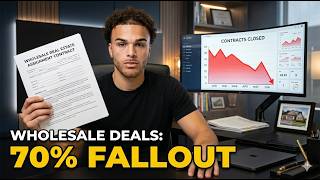
In this instructional video, Jackson Sudderth reveals that roughly 70% of wholesale real‑estate contracts fall apart after signing, not because of bad deals but due to preventable breakdowns in the disposition process. Targeting operators who have already closed at least one deal, he breaks down the failure points into five distinct stages: (1) the first 24 hours after a contract is signed, (2) the buyer presentation, (3) the pricing gap between the seller’s contract price and the buyer’s offer, (4) timeline management for a 30‑day close, and (5) title and closing‑pipeline issues. For each stage he outlines concrete, repeatable protocols—segmented buyer lists and phone‑first outreach, a detailed buyer‑presentation checklist, conservative comparable analysis and minimum profit thresholds, a milestone‑driven timeline checklist, and the use of specialist title companies plus backup buyers. He emphasizes diagnosing which stage caused each lost deal, fixing the biggest leak first, and iterating to drive the fallout rate from industry‑average 70% down to under 25%. The video concludes with a call to action for a free business audit and ongoing weekly diagnostic content.
Chapters
70%. That is the percent of wholesale contracts that die before they ever get to the closing table. Not because the seller backed out, not because the deal was bad, but because of what happens or what doesn't happen after you get the deal signed. You felt this. You get a property under contract, think you're about to get paid, and then 3 weeks later the deal is dead. All of your buyers were $5,000 to $10,000 below what you had it under contract for. Title issues came up, or the seller got cold feet and backed out, and then the deal blew up. And every time this happens, you tell yourself some version of, oh, the deal is just bad, and then you move on. Here's the problem you're not telling yourself is costing you a lot of money every month, and it's fixable. So today in this video, I'm going to show you the 5 stages where a deal dies from contract to close. So stay with me. For one, this video is not for people who have not closed their first deal yet. If you haven't signed a seller or got a deal to the closing table, stop here because this really isn't going to click for you. This is for operators who are already in the game. You're getting contracts, you're spending money on marketing, you have a buyer's list, and deals are still dying at the same rate. That just doesn't make sense. If that's you, keep watching because right now I'm going to map out exactly what you need to fix. Here's where I'm coming from. We ran the numbers on my own business, not a case study. This is actual closer data. Industry-wide, dispo follow-up rate is around 70%. We were also living inside that number until I built the system that I'm about to show you. Now our personal follow-up rate is below 25%. That— the 70% to 25%— that is not luck. It is a specific process that catches deal killers at specific stages so they don't destroy the deal. Here are the 5 stages. Let's go. Quick overview. Stage 1: The first 24 hours of a contract and why most wholesalers blow it. Stage 2: The buyer presentation and why sending it out to a list is not a strategy. Stage 3: The pricing gap and why the numbers that looked right on paper actually kill the deal when they get out to the field. Stage 4: The timeline problem and how the 30-day close turns into a 60 or 90-day death spiral. And Stage 5: The title and closing pipeline where deals disappear and nobody notices until it's too late. Stage 1: You sign the contract and here's the first 24 hours. You're pumped, so you go handle something else. That's the biggest mistake here. The first The first 24 hours after getting a deal signed is the highest leverage task in the dispo side. This is where the deal's the freshest. This is where you have the most momentum. This is where the seller's the happiest. And when the buyer is pitched the right way, it will move immediately. Most operators do one of three things in the first 24 hours: email blast the buyers list of the ARV, the repair cost, and the address, post it in a Facebook group, or text a few buyers who they've worked with before. None of those though are a dispo strategy. They're just hope. Here's what the first 24-hour protocols look like. One, you have a ranked buyers list and a segmented buy box— what property types they like, what market they like, and what repairs they're willing to do. Not a generic cash buyer spreadsheet. 2, you contact the top buyers directly. You are going to call them. You're not going to text them. You're not going to email them. You are going to call them and walk them through the deal step by step so they see the numbers. You're going to pitch the deal like it's Wolf of Wall Street. The ARV, how you got it, what repairs they'll need to make, how much money they can make on this, what's the timeline for them to get this thing flipped, what the return on investment would be, and paint the picture of a successful outcome. 3, you want to get a verbal commitment or a hard no within that 24 to 48 hours. Never let them say 'Let me think about it.' Either they're running numbers, taking action, or they are not a right fit. Operators with a solid 24-hour protocol close way more deals than those who do not because they're utilizing the momentum to get the deal done, unlike the operators who blast an email list and wait. They're feeding the 70%. Stage 2 is the buyer presentation, which almost nobody talks about. You've got the deal, you've got the buyers, but you're not presenting it the right way, which means the buyers who would move aren't moving. Here's what I see constantly: they send the property address, they send photos, they send ARV, they send repairs, and they send the asking price, and that's it. They're not selling the deal. You're Showing the deal to the buyers and hoping they do the work to figure out the unknown. But your buyer has 12 other wholesalers sending him properties today. The one he's gonna move on is the one he understands the best and has the most confidence in. Where the math is laid out. Where the wholesaler sounds confident. Where the pitch gives a reason to pull the trigger and take action. A real buyer presentation has this info: address, best use case, comparables to justify the ARV, a list of repairs, your price and their estimated profit by paying you your price, timeline and closing flexibility, earnest money amount required, and the scarcity aspect that shows them other people are also interested, like one open house or group show. And you want to get them on the phone while you're pitching them this deal sheet, and you want to get a soft verbal yes. As long as it looks like the pictures you sent, this is a good property for me. The last line is the most important thing in the pitch: getting a soft commitment so that they feel like they have responsibility to go see the property and make you an offer. You're creating urgency without being pushy, and you're filtering fast. The buyers who can't tell you a verbal over the phone probably don't have that much experience. Stage 2 fallout happens when wholesalers are just acting like they're submitting a form instead of pitching a deal to someone like an investment. You are making a sale. Stage 3 is the pricing gap. You ran ARV, you built your MAO, you left room for a spread. On paper, the deal looks great, and then the buyers come in, what, $5,000 to $10,000 below what you have it under contract for. This pricing gap happens for 2 reasons. Reason 1: the ARV that you calculated doesn't match what the buyers actually think it will sell for after it's repaired. You had good comps, but a buyer had different comps. It's a communication gap because you didn't really get them to truly understand why your comps justify that ARV more than theirs. The fix: always be prepared. Have your comparables be conservative and then walk them through those numbers exactly. And if you do a good job of this, they will see the exact same value that you do. 5 minutes of preparation can get you tens of thousands of dollars in added revenue a month. Or reason 2: your spread was just too thin. You didn't know it until the buyers started to push back. I don't lock up a deal that we don't think we can make a minimum of $20,000 on. Why is that? Because if you're expecting a $5K deal and then the buyer goes out to the property and finds out the HVAC actually does need to be replaced, that's an $8,000 HVAC HVAC and they're already $3,000 below what they could offer you. And you and I already know sellers lie all the time. But if you're expecting a $20K fee and then the $8K HVAC comes up, then you still make $12K. The fix to this is not having more buyers. The fix to this is making sure your numbers are solid on the seller side and that you're not just locking up a deal to lock it up. You're locking up a deal you are confident in getting to the closing table. Stage 4, which is the timeline problem. 30-day close, right? Simple enough. Except it's day 14. You have no offers from buyers. No one submitted proof of funds and the title company just found the lien. Day 22, you think you might actually have a buyer, but then you find out that he can't even get the funding. Day 28, you're calling the seller asking for an extension, but you haven't kept them updated this whole time. They're like, why are you just now telling me before we're about to close? Now the seller is nervous. A timeline issue is the most preventable problem on this list, but it's also the most ignored. A lot of wholesalers treat the closing date like a destination— 30 days or less. They don't manage it and convey it as a process to the seller. A real timeline system has 3 things. It needs a milestone checklist. Within 24 hours, the deal sheet needs to be made and it needs to be marketed to buyers. By day 7, you should have 5 offers. By day 10, you should have the title complete and be accepting offers by then. If there's title issues on the search, this is where you start to begin to try and clear those up before closing. And by day 21, you want clear title and a clear to close confirmation. But these are not optional. They are a system. So part 2, which is the DISPO process. If day 7 comes around, you don't have at least 5 offers from cash buyers, you have not done your job. But if you do have at least 5 offers from cash buyers and they're all lower than what you have done a contract for, you know, you priced it too high. So your job is to go back to the seller and do a retrade. And if you're transparent with the seller and they know what you're doing, which they should, you can tell them, hey, I have shown this to the top buyers in the area and here's what they're willing to pay. You don't actually tell them what they're willing to pay. You cake in like $15K, $10K to $15K below, and then you get them to accept the lower offer with a guaranteed closing date. The key to a successful retrade, though, is making sure the offer from your buyers are already set in stone. You do not want to take back a soft retrade, get it retraded, and the buyer says they have to be even lower than that. And part 3 of this is the escalation trick. If any parts of this milestone has slipped, you need to be on your A-game and you need to increase your urgency to be able to make sure that these deals are going to get to the closing date. Whatever milestone has not been completed by its scheduled timeline, we have to get it done instantly. Wholesalers who have consistent closings have milestones because their DISPO process is a system, not a "I'mma email this list and pray." Stage 5, which is the title and the closing pipeline, which is the quietest killer. Your deal survives all the last 4 stages. You're super excited. Contract is solid, buyer's committed, timeline's on track, but then something pops up on the title search within the last 10 days. Title issues that weren't caught, liens that surfaced late, judgments, a seller who got cold feet when they saw the HUD and realized what was happening and backing out. Here's the 3 things that reduce this stage 5 fallout. One, being communicative and transparent with the seller. The more honest you are with the seller, the more honest they'll be with you and actually trust you. If they know of any other liens, any other judgments, any other errors, they will tell you the more they trust you. And you want them to be honest with you because you don't want any hiccups at the closing table. And two, you want to use a title company that understands these transactions, how important certainty and urgency is. You don't want to use the cheapest one, you don't want to use the easiest one, you want to use the one that you know will get you to the closing table no matter how many liens they have to get figured out, no matter how many judgments No matter how many errors, they're going to get this thing done. And 2, always having a backup buyer, someone who already knows the deal really well, someone who did want it, but they just didn't have a high enough offer for you to take. Keep them ready to go, set in stone. Just make sure you have a little bit of profit caked in just in case your original buyer falls out. You can call up the secondary buyer and they'll close on the property. So here's where we are. 5 stages. The industry fallout rate is 70% and every single stage is fixable. That's why our fallout rate is less than 25%. This isn't about getting better leads. This isn't about getting better buyers. It is about building a dispo system that gets every signed contract, not just spraying it out online, praying somebody makes an offer. So here's what I need you to do right now. Go back to your last few deals that died. Write down what stage they actually died at. That's your data. This will tell you exactly which of these 5 biggest problems is actually causing your fallout and then which fix you need to make first. Don't try to fix all 5 at once. Find the biggest leak, fix that one, and then see how your fallout rate changes and then apply it to the next thing. That's how your income will change. It's all about treating this like a system. And if you want, I will personally audit your business for free. So click the link below if you want to have a one-on-one call with me where I break down all of your systems and processes, show you what you need to fix so you can become more profitable. I'm going to post more of this operator-level diagnostic stuff every single week. So hit that subscribe button, comment with what I can help you with next, and I'll see you in the next video.