I Bought NETFLIX & META Using The ONE Indicator Everyone Misses (200 EMA SECRET)
Kamilah Stevenson uses the 200-period exponential moving average on daily charts to spot buying opportunities when blue-chip stocks like Netflix and Meta dip below it. She buys gradually with dollar-cost averaging and explains tax strategies like borrowing against assets instead of selling them.
Chapters
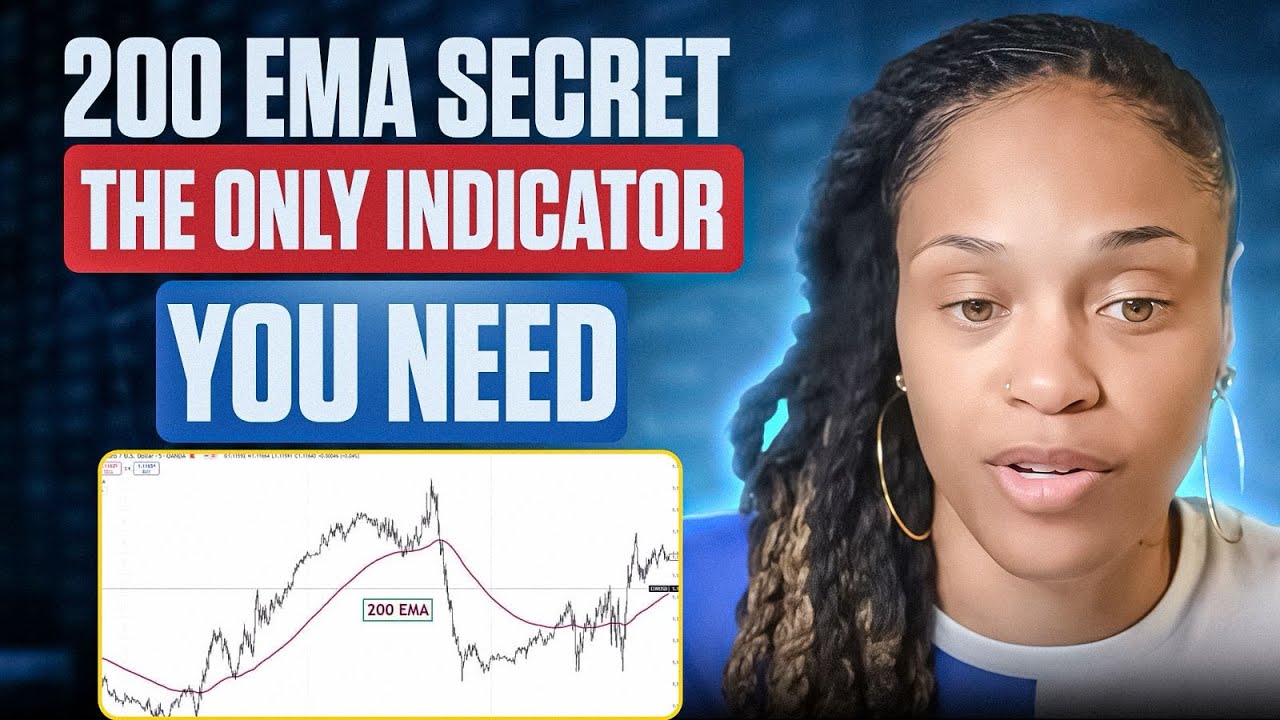
All right, what's going on? Okay, let's see, let's, let's, let's see where you're from. Um, I'm going to help you guys out really quick. I've been just doing a little bit of— oh, let me turn that off. All right, I've been doing just a little bit of shopping and I want to share that today. Um, trying to get back to this so I can see you guys. Where you from? What's going on, Dorothy? I see you in the place. I'm trying to organize my screen over here. All right, all right. Um, what's going on? Um, I won't be very long. I just want to share something really quick because I do want to um, see if, uh, um, I want to spend a little time with my, my members and do a little bit of Q&A. So I'm going to spend a little bit of time with them right after this. Um, so what's going on? Um, I see you guys. Hey Stevie J, what's going on? All right, so I just want to share something very simple. Um, I have a lot of different experiences, or people who are experienced at different levels in investing. And I want to just share something very, very simple with how sometimes I pick my, uh, when to purchase or when to start buying my blue chip, um, stocks. And so, uh, it's a very simple principle. I think you all understand it, and it is very easy. Uh, what's going on? I am so sore right now. Uh, I just realized that when I got up for a minute to get some water. Um, for some of you all who don't know, I do martial arts and we do sparring, you know, uh, sometimes once or twice a week. And man, does it have a— sometimes a toll on your body, uh, especially when you have to do two hard workouts in the same day. So y'all pray for me. What's going on from Columbus, Orlando? What's up, Texas is in the house. It's time to put my, uh, yeah, to put your ad puts to the game. I did a video yesterday, you can go back and check it out. You know, uh, we're having, you know, some pullbacks in the market, and honestly, we've been due a pullback. Um, you know, we've been due a pullback. Uh, even if, if we have a correction Um, yeah, I mean, that's all a part of a healthy market, you know. So, um, yeah, if we, if we have a correction— a correction is 10%, usually, uh, a recession is 20%. We're not looking for that. But, um, you know, some pullbacks, even if it's 6 to 8%, you know, whatever that looks like. Yesterday wasn't really, um, as bad, but I think we might see some more to the downside, of course. But yesterday we was only down, what, 1, 1 to 2% or something like that. Um, but listen, this is like, these are, these are sale days, right? And so, uh, it's so interesting because you got so many people who are— they love a sale day when it's time to buy shoes and technology, and you know, oh, that's on sale, you know. Um, but then when we get businesses that go on sale, we get so scared, and I don't understand it. Like, like, the stock market goes on sale sometimes, and I love that.. And if you're like Stevie J and you know how to do a little bit of option trading, you can make money on the way down as well. And so it's a good skill to develop under your belt. It does take some time. And again, I'm not— as I always tell you guys in every single video, I'm not telling you what to buy, hold, or sell. I'm not your financial advisor. Investing comes with risk. It's at your own risk. All right, you need to talk to your own financial advisor about that. But that's not me. That's not who I am. Everything I share is just for educational purposes only. Only. They're just my opinions, my ideals, my experiences, you know, and it's only for educational purposes only. So I do want to say that, um, but we do get a lot of people that starts to, uh, react to the stock market. And, you know, I want you to know that there's opportunity in it, okay? And, um, don't, don't jump so quickly because we again may see a little bit more to the downside. We got to look at that. Now, crypto took a, a beating yesterday, Um, and I'm in it long term, and I'll come back and talk a little bit more about that as well. Somebody else say, I'm from Columbus, Ohio as well. Hey, what's up from Columbus? Um, but we'll, we'll, uh, hey George, what's going on? Uh, I'll get into a little bit more of that. I'm just, uh, kind of looking at, uh, where crypto is at the moment. I mean, you know, it jumped, uh, jumped up just a little bit, you know what I mean? Like, it's not At the time of this recording, Bitcoin is just at $103, uh, XRP $235, Ethereum $3,400, around $3,400. All right, um, so yeah, like when we see these, when we see these moments where there's pullbacks, um, you know, we got to start thinking long term. We got to start thinking about, you know, generational wealth. Okay, and, uh, you know what's interesting today is what I was thinking about is, um, one, one thing that's always been interesting to me when I read the story of the children of Israel And some of you may know this, and some of you all may not know this, but— oh, smash that like button, I love that, thank you so much, I appreciate that— is, can you imagine, can you imagine being a, a community or group of people who wind up walking in circles, in the same circles, for 40 years? Okay, for 40 years, that the children of Israel walked around for 40 years and it took them 40 years to enter into their promised land. And I feel like— but, but that's not the— that's not the bad— the bad part isn't that they took 40 years, okay? Because if they were supposed to take 40 years, then it is what it is, okay? But do you know geographically that that journey, geographically, was a journey that should have only took 11 days? I mean Hear me out. An 11-day journey took somebody 4 years— 40 years. And not just somebody, a bunch of people. For the children of Israel, Israel, 40 years. 11-day journey, 40 years. I, I say this, listen, these— they were walking in circle, stuck in cycles, tied to fear and unbelief. Uh, you know, God was trying to prove to them, you know, by giving them manna for the day, you know, that they, that they could trust him, okay? But they were so fearful and full of unbelief. But I feel like that when it comes to wealth building sometimes. Like, I think that what should be taking maybe somebody 3 to 5 years of complete focus, complete indoctrination in their habits and life overhaul in their financial hygiene And I feel like sometimes it takes people 40 and 50 years because they, they, they're walking in circles doing the same thing over and over that's not producing them any results, you know what I mean? And that's devastating, y'all. What a tragedy. What a tragedy to have an 11-day journey end up being 40 years, 4 decades. That makes no sense. And that's the same with us. You know what I'm saying? Matter of fact, some people go their whole life and they could have like changed their circumstance, but they just keep walking in, in circles, in a cycle. You know what a cycle is? The cycle is the past rehearsed over and over and over again. It's like you walk the same thing over and over, and at what point do you say, man, I gotta make a shift, this is not working, okay, this ain't working? And I'm telling you, it's some people that's going to be You know, time moves fast. First of all, time moves fast. Bought a 285 bottom, $1.45, nice little trade swing. Okay, got it, got it. Get you going, get you going. I love it, I love to hear it. I love it, I love that the learning and the journey and the process of it all. But I, I think some people are gonna wake up 3, 3 to 5 years from now and they're gonna be like, man, either they're gonna say, I'm so glad I started back there, or they're gonna be like, I wish I would have listened to that. That lady I heard on YouTube. I heard her and she was telling me that I needed to do this and do that, and you ain't doing nothing. Okay, I've been, I've been coaching people for, for a very long time, so many people, and I've seen people who took action and it just completely changed their life, their financial situation. And I've seen people who just kept waiting, kept overthinking, kept staying in the same place. And I'm telling you, I'm telling you, you gotta do something. Make sure you hit that like button, and if you're not subscribed, go ahead and subscribe. I'm gonna, I'm gonna teach you one simple principle that could just really change the way you buy your, uh, your long-term stock. Um, and again, I'm not telling you what to buy, hold, or sell, but this is, um, for educational purposes only. I'm reading your— Roberto, uh, last time Meta was under the 200 EMA, it lasted 6 weeks under it and gave back 100% return. Just saying. And I just love that you're saying that because, uh, I really want to share that, um, this very simple, uh, tool, you know what I mean, that you can use on the chart, and you can buy some of your, uh, blue chip stock, Magnet, Mag 7. Um, I think it's a few more than the Mag 7 that I really love, but, uh, I will not overcomplicate this because y'all know me, I'm very simple. Um, I, I like systems that make sense, and here's what I do. He just said it, and I just put it up, is that when I'm looking for a long-term entry, um, for certain stocks And this isn't the only place I buy, but I mean, this is just a really good idea. This is again what I do. I go to the daily chart and I look at one thing, and it's the 200 EMA. Now, if you're new to this, um, you can— I use TradingView. Um, you can go to even Yahoo Finance and hit stocks, and, um, you can put the indicator on there. But anyway, I use TradingView.. And if you go to indicators, you would put the EMA, you would add that to the chart, and you would put 200 in there because there's different EMAs. You got the 20 and the, you know, you can use a bunch of them, the 50, you can use a lot of them, right? So, but you will put 200 and you can have a color. It'll show you a color that you want to have it. I always have it as a bold color. Mine is black, some people's is red, you know, whatever. And I make it a thick line so I can see it very clearly on my screen. And, um, that line, that 200 EMA, um, it is the exponential moving average of the last 200 candles. I look at it on the daily chart, okay? So think of it like a trend tracker that gives more— it gives more weight to, to recent, the recent candles, and less weight to the older candles, okay? If that makes any sense. So whenever the price drops, um, below that line, uh, or even sometimes it bounce off, but whenever the price drops on that line of a good solid company, it is a great place to buy usually. Okay, and, and it's not— and it doesn't mean because it just started, just like Roberto said like last time, because what you'll do is you can go back and you can look at all the times that this company was under the 200 EMA. How long did it last, you know? So right now you don't have to— don't, you know, I'm not going all in. I bought a little bit, okay? I just started just a little bit, okay? And I'm not necessarily trying to catch the bottom perfectly or anything, you know what I'm saying? First of all, I'm not that good to do that. Um, a lot of people, you know, you got some people who catch the bottom, but it's, you know, it's a hit or miss, okay? But I'm just buying when the price makes sense, or when it's— when it makes sense, it— I'll start to nibble on that. But like you said, after that, 100% return. This is a great company. Um, same thing with Netflix. Uh, it's underneath, uh, the 200 EMA, I believe, when I looked at it. Um, and, and I nibbled on that. And I'm not saying it can't drop some more. They're about to go through a, a price, uh, shift. They're going down to like $100 and something. So I know a lot of more people are going to be in on that next year because just psychologically, you know, when you lower the price or whatever, when you split the shares and lower the prices, that just means that if they split it in 10, you'll have 10 times whatever whatever the share is, right? And so I use again the 200 EMA, and I don't buy it all at once, okay? We not out here dumping everything in one red day, okay? That's not— that's called panic. You know how some people do panic selling? I don't do panic buying either, okay? I build very slow, a little here, a little there, and that's what you call dollar cost average, okay? Dollar cost average is the smartest simplest way, um, to vest without turning it into some, uh, emotional roller coaster. Um, thanks Roberto, she's correct. You don't need to get the bottom, uh, if it goes up 100%, you only need to get 50 or 40%, and that's a great return. Yeah, you know, so you're not trying to like knock it out the park and let me just— what, you know what I mean, to get to the bottom? Like, no. And you got to realize, I'm thinking long term. I'm not guessing or anything. It's using data and not the drama of it. Now if you want to get even more specific, but I won't get into any more technicals, uh, with this, but you can also watch the— there's indicators called the MACD and the RSI. Um, you can use those indicators. Some people buy it when it's overbought, you know, and, um, or when it's oversold, they'll buy at those points. Or you can wait for the MACD line to cross up over zero, and, uh, that's more of a safer, you know, play. But you can use MACD and RSI different ways. I won't go into that. But if you only remember one thing from this video, just let it be when a great company drops down near the 200 EMA or below it, especially pay attention, you know what I'm saying? Because that is again a good place to start dollar-cost averaging, you know. And I've never, you know what I mean, like anybody who buys there every time it goes there, I think they're gonna be happy in about 3 to 5 years. Seriously. Okay. Um, this works whether you're brand new, uh, you don't have to watch charts all day or anything like that. All you have to do, again, it's an indicator, it's called the EMA. And we, you know, when you're trading or when you're investing or whatever, you use it for different things. But for people who are just buying long-term, which is really easy when you're buying long-term, that's like easy. Like you just need good, good companies, fundamental values, like I heard somebody say this, and it was really, uh, what's up, Corey? Um, I heard somebody say this, um, and I was like, yeah, that's, that's kind of smart. He was saying, you know what, buy companies that you can— if you went into it now, I ain't speaking nobody into a coma, but if you went into a coma, uh, it, you know, in 2, 3 years you wake up and you'd be good, like your stock would be good or whatever, you know what I mean? Again, when you're thinking long term, and I'm not saying that for your— sometimes people have different accounts, so I'm not saying you can't take profits along the way, you, or you can't have like a swing trade account where you take the profits there, you know, do what you want. I'm not telling you what to buy, hold, or sell. I do have that. I have some swing accounts where, you know, I wait for a certain profit and I take profit on them. But don't let that replace your long-term plan, okay? Use those swing profits to feed your long-term portfolio. I always say this Like, people want to make money, but it ain't about that. It's like, what are you doing with the money? What are you doing? I was just listening to a video where the guy said, like, allegedly— so I'm not, you know, saying that this is true, but he just gave a story. Maybe it's a false story, let me just say that. Um, but it's a— it's definitely a story that's common to most people's stories, which, uh, one of the ladies, she got several million dollars, and, uh, she took her family and friends on like these fancy vacations all around the world, you know, going here and there and just splurging this splurging. I'm like, why do people get millions of dollars and then just start spending it? Why wouldn't they go put that in a high-yielding savings account, in the S&P 500, in some kind of asset where you can gain a yield, and then potentially maybe use the yield or something to like fund your events or whatever, or borrow against it, or come up with another strategy that makes sense? Like, why are you taking your profits and you're just gonna just eat it away. You just, you know, and honestly, in our community, in the Black community, there's this thing called the Black tax. I heard somebody say this and I'm like, that's kind of about right, you know, where you get a lot of money and here come your family and friends thinking that you're supposed to just now spend everything on them and they get entitled and stuff. And it's like, you owe us, you owe the Black community to do this, you know. And it's like But you didn't work for this. This is my money. Like, what do you mean I owe you? You know what I'm saying? Like, I'm a generous person. I believe in the gift of generosity, you know what I'm saying? In the spirit of generosity. And, um, but that's on my terms, not nobody else's terms, you know what I'm saying? And so we got to be careful that— because you're going to be rich, guys, you're going to be wealthy, okay? You got to be careful that somebody out the blue, some cousin from from way back in the day that you ain't talked to for 10 years don't come out the woodwork. And or the people who have been around you and just start making you spend all your money. Like, that's— we don't have a money, money problem a lot of times. We just have a spending problem. And we got to make sure that, you know, the, the people— because guess what? They'll be right there. They'll spend all your money until you just broke as a joke. And long story short with the story, them roaches come, right? That's what Corey say. Long story short, the lady blew all her money off in years, and it was— she had nothing left. And, uh, so allegedly she didn't even care because they was always poor for the most part anyway. I guess they just, you know what I'm saying? And I'm like, that is absolutely insane. You could have put that in a, an account and lived off of half a million dollars without even touching it for you know what I'm saying, the rest of your life, you know what I'm saying. So let's be wise. If you make money off a swing trade, off a day trading or whatever, you gotta still have a plan. What am I doing with this money? You know, you, you want your profits to go back into your long-term wealth because financial freedom don't come from one good trade. It comes from years of good decisions stacking on top of each other. Okay, and you can have a strategy for both, don't get me wrong. You can have a strategy to make it look quick money or whatever, but, uh, a long-term wealth portfolio, that's your foundation, that's your future. And if you want a swing— a swing trade portfolio, that's short-term, that's quick moves. But the goal is always to build something that gives you freedom, not just money. Freedom, we're talking about freedom. Okay, um And then George said something that is— and I was just having this conversation. I just got off a coaching session. Um, here's a gem, everyone. The IRS can't tax a loan. Please do your research on this and apply it to your wealth strategy, right? I know exactly what you mean, George. And I talk about this because it's called build, borrow, die. Build, borrow, die. And then get you an insurance policy that's gonna cover the debt when you die because your kids gonna have a clean slate and then you gonna teach them how to do the same thing. So you got to get your asset game up big enough, okay? I was just talking to somebody about this because we were talking about dollar cost averaging up, because you can dollar cost average up, and sometimes people don't want to do that because they looking at their percentage, okay? They looking at the percentage of their portfolio and, uh, and they don't want to change that percentage. And it's like, no, you gotta, you gotta, because the whole point is we gotta add to this, okay? We gotta get enough of this so that we can borrow against it in a, in a smart way with the, the loan to value, whether, where there's a smart loan to value ratio, meaning it's appreciating higher than the small percentage that you're borrowing against it, right? And if that be the case, then your asset is still increasing in value over time and you're able to take out a loan against it. You only get taxed on taxable income. Taxable income. Let me say that a third time: taxable income. Please hit that like button. Taxable income. And guess what? Debt is not taxable income, okay? It's the name of the game. And that's why you really want to borrow against it, and you want to create debt against it, because you will not be taxed on it. And at the same time, your asset will continue to appreciate, and you can cover, you know, what you're borrowing against it because your asset is appreciating at a faster rate than what you're borrowing. Okay, and so, uh, that's the key. Uh, you have to have enough money value in order to borrow. Okay, and this is why wealthy people don't pay taxes. Okay, this is why IULs— yeah, um, rate is typically between 4 to 5%. Um, and this is— this is why, uh, wealthy people don't get taxed as much. And then people get mad about it. Well, they don't have taxable income if they're borrowing debt against their assets. Okay, and so, and then they teach their kids how to do it. And like I said, you know, it's like, well, what happens when they die and they got debt? Well, they have an insurance policy. They tell the kids to pay off the policy, and there's, there's a, a, um, there's clauses in, in place where they can have a clean slate, and then they're going to do the same thing. Because, but, and just, this is how they get so, so, so wealthy. Because if you got an asset just growing and growing and growing from generation to generation to generation to generation right? But we gotta, we gotta start somewhere, right? We got— we spending everything, we spending it. We, we think we, we think we growing it so we can now take out of it and go get us a new, uh, some new shoes and some new this and that and a new car and all that. I'm not saying that you can't do all of that, but you got to know the end goal. Build. Where's the building stage? Borrow. Die. Like, oh, like, I'm trying to tell them, but this gonna fly over most of y'all heads. Okay, right. So most people don't get this knowledge for free, right? And so I'm trying to help you guys, and I'm not going into too much depth, uh, depth with it because I know some of you guys aren't even ready yet. But let's just start building. Let's start building. And I gave you just one simple thing. That's why I try to keep it simple in the beginning, like blue chip companies, solid companies, you know, solid ETFs and stuff. Of course you want to build your, your portfolio Um, under anything underneath the 200 EMA, you, you're not gonna— you, you're not gonna regret that, okay? And you're thinking long term, you know, and you got to be able to hold assets for a generation. For generational wealth, you got to be able to hold your assets for a generation. And so we're— I'm telling you, you're setting up your legacy, I promise you, okay? Hit that like and subscribe button, please. Please do that for me. It helps me, my channel, it helps the algorithm, it helps YouTube push this, uh, out to people who need to hear it. Now, um, I do have some members in my community right here on YouTube, and if you want to join, you can go ahead and hit that join button. It's only $3.99 a month, and, um, it helps to support the channel, and it's my way of saying thank you when I have my private live streams and Q&A and all of that. Uh, 44 Roddy says, uh, my favorite is the 200 EMA. I'm telling you, if you don't have that on your chart, go to TradingView or whatever chart you are, uh, that you use. And if you don't use a chart, hey, it's time to start at least looking at it. It's very basic. You just— the green, uh, candles mean that the price has went up for the day. Red candles mean the price ended lower than where it started for the day. And you can put that indicator to 200 EMA. And if you see at the daily, on the daily chart, because you can look at different charts, you can look at a 5-minute chart, a 15-minute, a 30-minute, uh 4-hour or 12-hour, whatever. I even love the 2-day chart. I love the 2-day chart. It's a little sneaky thing that I do because it kind of, you know what I'm saying, sometimes on the daily you get a fake out. So, but that 2-day chart, it helped a little bit more. So I even love the 2-day chart, okay? A lot of people don't use that. But, um, uh, and it— Roddy said it keeps me from bad trades too, okay? The 200 EMA. And the 200 EMA, it can act as a support, it can act as resistance, um, you know. So yeah, it's good to have on your chart. Okay. And on the daily, you're looking at the daily. I do want to stress that again because you can look at different timeframes. So I'm looking at the daily 200 EMA. And if a solid company like a blue chip company is underneath that 200 EMA or even around it, it's usually a good place to do dollar cost averaging. Okay.. And so, um, that's something again that if you're not familiar with that, then you should go ahead and put that on your chart. You should at least, uh, get a, get a, a, a head start with just learning the charts, whether it's starting with green and red candles. That's it. Okay. Very, very, very simple. Good place to buy. Good place to nibble on here and there. And I have just started some positions, um, in Meta and Netflix. Um, I did buy a little bit of Lyft today, but I've been just buying a little bit of Lyft here and there. Um, I do want it to come back down to like $18. Uh, I would love for it to come back down to $17, but I've been buying it when it was really low. So, uh, I am looking for a target to at least get to $30. It is a very slow— it's a long-term, okay? So it's a long-term play. Um, so, you know, again, long-term plays are easy because, you know, it's not like you're looking for it to pop up tomorrow, you know what I'm saying? So Uh, if you are borrowing against your portfolio or BTC, keep healthy loan to value. Yep, yep, yep, we just talked about that. Um, when you are borrowing against your asset, at the time when you do get to borrow, it has to be a healthy loan to value, okay, ratio. Um, well under 50% if you ask me. It should be lower than what the asset is appreciating, okay. So let's say you appreciating 20% a year, you know, 3 to 5%, like something very, very, very healthy. And that's why— and of course, like, some people will need to want to borrow more if it's not as much, because it's like, okay, well, what's 3 to 5%? But if you— that's why you really need a, a nice amount, you know what I'm saying, in order to really, um, make it make sense for funding your life or whatever. But here's what a lot of people do, um, and I'm gonna just spit this out real quick and then I'm gonna shut it down because I want to go over and talk to my, my members. And again, you can join for only $3.99. Uh, Android users are a little bit cheaper. But a lot of people will take loans against their assets to go fund another investment. So now you get an ROI on that, and that's appreciating in value. And then you got a loan, so you don't pay taxes on that. And then you're using that money to now fund another one, and then you might get an ROI for that. And then you could take out a loan, and you could— I mean, this thing can go in circles, okay? It can go as far as you want it to go. And if you smart and you intelligent financially, and you good with math, and you understand tax laws and stuff, like you can really set yourself up for a, a great, a great future. And then, you know, I've always— I've already talked about too, you know, um, cash life, um, insurance, you know. So setting up your own banks, basically when you do this, you're, you're basically able to— you, you're owning your own banks, okay? That, that's, that's as simple as it is, okay? That's as simple as it is, all right? Um, Well, uh, you, Nicole, you can't just borrow against any portfolio. I, I'm not suggesting that. I'm suggesting that when you build your wealth, you know what I'm saying, when you build your asset value to be high enough to be able to borrow against it, um, then yeah, you know, at some point you, you're, you're— that, that's what wealthy people do. Okay, if they have assets, um, that they own, they borrow against it. But we're in the building stages, right? And so, um, not that you can't— like, you know, I've had cash flow policies and stuff like that that I was able to borrow against for, uh, real estate investing. You know, I actually did do that. I borrowed against my, um— because remember, some people are thinking, I want money to be leveraged for another investment. I'm not talking about just going to spend it, right? So I, I had, you know, a cash policy. I borrowed money against it for a real estate project. I get the ROI. I was doing fix and flips, get the ROI, get the money back for that. I can fund that now. That asset is still appreciating, don't have to have taxes on it, you know what I'm saying? So it all works itself out. But right now we're in building stages. So, um, that was just, you know what I'm saying, that, that's the— that was an endgame thing that I was just kind of putting out there. But at the end of the day, we just trying to build. We trying to stay committed to the process and dollar cost average into good healthy companies, um, and you have a solid portfolio that you're building and you're becoming more of an owner and not a consumer. Okay. And as time go on, as you build your asset, yes, if you want to borrow against it at a— in a smart way where the loan-to-value ratio makes sense, where you're not, you're not stopping the appreciation process because you're borrowing too much against it, uh, yeah, that's the name of the game. And you won't be taxed because it's not taxable income. The people who get taxed the most are people who make earned income, uh, W-2 basically. Uh, so, um, if you don't want to pay more taxes, then you got to figure out how to offset your W-2 or your earned income, okay? By, you know, having a business, write-offs, all of those different things. I did a full video on taxes. If you go back and watch it, I guarantee you Um, you'll find a lot of value in it. All right, so, uh, if you want to join the community, like I said, you can hit the join button by the video. Uh, we go over there and we do some, uh, separate live streaming. Um, and, and those videos are not shown to the public. And again, it's my way, um, it's your way of saying thank you, and you know, because of the value, um, that I'm really trying to serve and bring. And it's your way of saying thank you and support, supporting the channel. And it's my way of giving back and saying thank you. I appreciate you for doing this. And please, if you don't do anything else, just at least like the video because it really does help the algorithm and it helps YouTube, like I say, send it out. Um, and then also, uh, again, I want to say I'm not telling you what to buy, hold, or sell. Everything I speak of is for educational purposes only. I'm only sharing with you what I do, my experiences. And, uh, you got to talk to your financial advisor because investing, uh, carries a lot of risk and you can lose absolutely everything, um, from investing. So, uh, yeah, you know what, I did a video on this, uh, Roddy, about— I did a video some time ago and I talked about all of the investments that King Solomon, um, had that there were in the Bible. And so, yeah, uh, all right, um, ETFs, I'll, I'll talk a little bit more about that. Um, Firmu, I'll talk a little bit more about, uh, ETFs and, um Yeah, thank you so much for the likes. I appreciate that, guys. All right, so I'm gonna jump off and, um, make sure if you're not subscribed, you go ahead and subscribe. I just started doing videos, pre-recorded videos as well. I'm going to continue with the lives, but I'm also doing videos to address also your questions. So in the comments, if there's any type of content that you want me to put out, go ahead and let me know. I will do that. Um, hey, so wave. I think I said your name right. I'm sorry if I didn't. Thank you so much. Uh, I appreciate all the love, guys. I appreciate it. I receive it. All right, um, HYS and brokerage account set up. I love that. I love to hear it. Love, love, love to hear it. If you don't have your HYS, make sure you set that up. You can put your emergency fund there, y'all. Okay, all right, ready to invest. That's what it— that's where it is. That's where it is. All right, take that first step. All right guys, I'll be back on to share a little bit more. I will be talking a little bit also in the future about cryptocurrency. I want to tell you where I am with that. I am, um, there's so many things, there's so many catalysts that are moving in the right direction. I'm not looking at the price, I'm looking at what could change the price tomorrow. Those are the things that I'm waiting for. I'll share a little bit more about that. All right, thank you guys so much. I'm going to get on with my members and see um, if we can do like some quick Q&A. And if there's anything that they want me to address, I'm gonna do it there. And I'll talk to you guys later. I appreciate all of you all. I'll be back soon. All right, bye.









