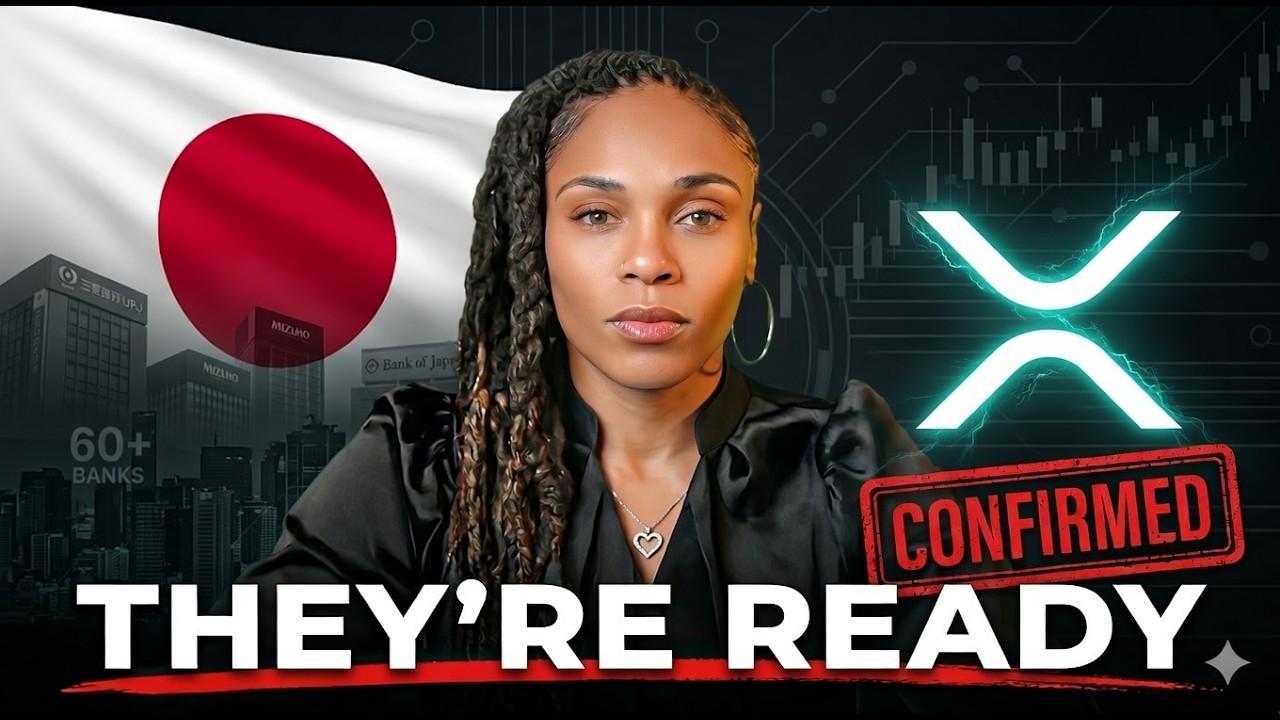
In this video Kamilah Stevenson argues that the next major catalyst for XRP will likely come from Japan, not from U.S. regulatory news or price movements. She explains that Japan has built up decades‑long pressure through a massive yen‑carry‑trade, borrowing cheap yen to invest in higher‑yielding assets abroad. As the Bank of Japan raises rates for the first time in decades, Japanese bond yields have hit 20‑year highs, making the carry‑trade unprofitable and forcing institutions to unwind positions simultaneously. This creates a sudden, massive cross‑border capital flow that the traditional banking system—relying on pre‑funded nostro/vostro accounts—cannot handle efficiently due to speed, cost, and liquidity constraints. Stevenson highlights that Ripple’s XRP infrastructure is already operational in Japan: SBI Holdings processes real‑world cross‑border payments using XRP, and more than 60 Japanese banks—representing roughly 80 % of the country’s banking assets—are connected to Ripple’s rails. Coupled with Japan’s acute energy pressure (high oil prices in yen and a weakening yen), the scenario accelerates the need for a fast, low‑cost settlement layer, positioning XRP as the path of least resistance. She frames this as an under‑appreciated pillar of the XRP investment thesis, urging viewers to consider dollar‑cost averaging, tax‑efficient holding (e.g., XRP in a Roth IRA via iTrust Capital), and broader portfolio diversification with RLUSD and precious metals. Stevenson also promotes her coaching community and calls to action, emphasizing financial freedom as the ultimate goal.
Chapters
The next major catalyst for XRP may not come from where you're looking. It may not come from US regulatory announcement or of course the price chart, but it may actually come from a country on the other side of the world that most people stopped paying attention to months ago. Now I'm Kamilah Stevenson and around here we do talk wealth and I want to say nothing that I share is financial advice. I want you to do your own research, like the video and subscribe if you have not already. We're going to talk about Japan. And I want you to drop in the comments, did you know that Japan had more banks connected to Ripple's infrastructure than almost any other country on the earth? Yes or no? Because what I'm about to walk you through is going to completely reframe how you think about what you're holding and why the timing of this specific moment matters much more than people realize. Now, let me start with this because there is a pressure building in Japan. Let me give you a framework for understanding what is happening in Japan right now, because once you see it clearly, everything else is just going to click for you. Now imagine a pressure valve system. When pressure builds gradually inside a system, the existing infrastructure can manage it. It can release a little here and adjust a little there, and the system holds. But when pressure builds faster than the infrastructure was designed to handle, it does not just create problems. It forces the entire system to find a path of least resistance. And whatever sits in that path, meaning whatever infrastructure is ready, available, and capable of handling the volume, that is what captures the flow. Now, Japan has been building pressure for decades, and here is how. For most of the last 30 years, Japan kept its interest rates at essentially zero, near nothing. And what happened when money is essentially free to borrow is exactly what you would expect. Institutions around the world— hedge funds, banks, investment firms— borrowed massive amounts of yen at almost no cost and then took that money and invested it in places where returns were higher, which is smart. So they invested it in US Treasuries paying 4 or 5%, global equities, foreign bonds, real estate. Uh, you borrow cheap in one currency and you invested in higher yielding assets in another currency., and then what you do is pocket the difference. Now that trade is called the carry trade, and Japan became the source of the single largest carry trade in modern financial history. So we're talking about trillions of dollars in borrowed yen sitting in assets all over the world. Now here's what's happening right now that is changing everything about this. Japan is raising interest rates for the first time in decades. The Bank of Japan is moving rates higher. Japanese bond yields just hit a 20-year high. And when interest rates rise in Japan, the cost of borrowing yen goes up, which means the carry trade that has been profitable for years starts losing its advantage. So that means the math is not mathing anymore. And when the math stops working, the institutions that built positions on that math have to unwind them. Here is what the unwinding looks like in practice. An institution that borrowed yen, converted it to dollars, and bought US Treasuries now has to sell those Treasuries, convert the dollar back to yen, and repay the original loan. Every institution that did this trade in the same direction now needs to do the reverse at the same time. So they need to sell foreign assets, buy yen, and repay the debt all at once, all moving in the same direction, all at the same time. Now that creates an enormous cross-border capital movement that has to happen fast. And here's where the traditional banking system reveals its fundamental problem. Right now, when a large institution needs to move significant capital across borders quickly, the system it uses requires pre-funded accounts. So before you can send value from one currency to another, your institution needs to have already parked money in that destination currency sitting idle in an account waiting to be used. Banks maintain these accounts called nostro and vostro accounts in dozens of countries all at the same time. So you have trillions of dollars sitting in accounts all over the world doing nothing, just waiting, just in case. Now that system was designed for a world where capital moves slowly and predictably, where also cross-border transactions were planned in advance, and where the volume was manageable. It was not designed for a sudden, all at the same time unwinding of the largest carry trade in modern financial history, where every institution needs to move capital in the same direction at the same time at speed. The traditional rails cannot handle this efficiency. They are too slow, too expensive, too dependent on prepositioned capital that takes time to move and creates its own friction. So Here's the question that matters for you. When a system faces pressure it cannot handle through its existing infrastructure, what happens next? Well, it's now going to have to find the path of least resistance. And the path of least resistance in a cross-border liquidity crisis is the infrastructure that settles in 3 to 5 seconds, requires no pre-funded accounts, charges a fraction of a cent per transaction, operates 24 hours a day, 7 days a week, and already has 60+ banks in Japan covering 80% of the country's banking assets running on its rails right now. That infrastructure already exists. It's already in place. It has been quietly building for years while most people are watching what? The price. And so this leads me to helping you to understand why Japan is XRP's most underestimated catalyst. Japan is not just any country in the XRP story. Japan is the most infrastructure-ready country on the earth for XRP adoption at scale, and most people have no idea. SBI Holdings, one of Japan's largest financial institutions, has been building XRP infrastructure for years. Not experimenting or piloting, but I'm talking about building. SBI already processes real cross-border payments using XRP as a bridge asset for actual customers moving actual money today. Not in a test environment, in production. Real transactions, real settlements, real proof that the infrastructure works at the scale Japan needs. Beyond SBI, there are 60+ banks in Japan currently running on Ripple's infrastructure. 60. And those 60 banks do not represent 60 small community institutions. They represent approximately 80% of Japan's total banking assets. These are the major institutions, the ones that would need to move capital quickly in exactly this scenario. So when the carry trade unwind creates pressure that the traditional system cannot handle efficiently, the alternative infrastructure is not something Japan needs to build. It is already there. It's already tested. It's already trusted by the institutions that would need to use it. Now, let me add one other piece that makes this even more urgent right now. Specifically, Japan is one of the largest importers of oil in the world. Virtually all of its energy comes from outside of the country. And right now, oil price in Japanese yen is at historically extreme levels because of the Strait of Hormuz situation. So the yen is weakened while oil prices have spiked, which creates a double pressure on Japan's energy cost that is unlike anything the country has ever experienced in decades. And I keep up with the yen and oil. I'm watching it every day, and I'm astounded by how high it keeps going. Well, that energy pressure forces the Bank of Japan into an impossible position, which is raise rates aggressively to defend the yen and control inflation, which accelerates the carry trade unwind and creates the exact liquidity crisis that we're talking about here, or they can hold rates lower to protect the economy and watch inflation run hotter while the yen continues to weaken and energy costs keep rising. There's no real clean path. Both directions lead to pressure on the traditional cross-border settlement system. Both directions also accelerate the timeline for when that pressure becomes too much for the existing infrastructure to absorb. And the Japanese government just confirmed that it's preparing citizens for strict energy conservation. Now, that's not a comfortable announcement for any government to make. It means the pressure is real and it's being felt at the institutional level right now. Now, I want to be honest about something because accuracy matters more than a viral headline. Okay, this is not a guaranteed overnight event. Institutional adoption of any new infrastructure happens in waves. The first wave validates the technology. The second wave scales it. Japan already went through the first wave. SBI already proved the infrastructure works. The 60 banks already have the connections in place. So what the carry trade unwind scenario represents is the specific pressure event that could accelerate the move from first wave validation to second wave scaling faster than anyone is currently modeling. Now that acceleration doesn't announce itself and it's not something that's in your face. But it will show up in the data for the people paying attention to the right signals. And right now, every signal pointing at Japan is pointing in the same direction at the same time. You have bond yields at 20-year highs, energy costs at extreme levels, carry trade pressure building, and institutional XRP infrastructure already in place. So the people who understand this before it becomes a headline are the ones positioned at a cost basis that reflects where we are now, not where this goes. And that's not to say what Japan will decide or not. I'm just showing you the chain of events that's been happening and what could possibly happen depending on which direction Japan wants to go in. But here's what I want you to walk away from the video understanding. Most people are building their XRP thesis around one catalyst, which is usually the Clarity Act or the price chart or the banking adoption story broadly. And those are real catalysts.. But the strength of a thesis is not built on one pillar. It's built on multiple demand drivers pulling on the same asset from completely different directions all at once. So you now have another pillar, and this is one that most retail investors have never even had explained to them clearly. Uh, I know there's a lot of people new to my page, and so I did wanna revisit this topic and let you know that this pillar is being driven by forces completely independent of US regulatory decisions or price chart patterns. Okay, this is one that is already infrastructure ready in a country with 80% of its banking assets already connected to the rails XRP runs on. So this is not speculation. This is the architecture that has been quietly built while most people were watching the price chart go sideways. And we know it is going sideways. We want to move. I know that. Okay, but I do want to help you to understand the potential of how XRP's price could be affected from more ways than one. My best wisdom to you is to tell you what I'm doing, which is dollar-cost averaging and developing patience along the way, and understanding the thesis and strengthening my conviction through education. Now, with that being said, I will let you know that the next major XRP catalyst is not going to send you a calendar invite before it arrives. So the carry trade unwind does not have to wait for a convenient time. The pressure building in Japan does not pause while you decide whether to get structured. And when capital starts moving through these rails at scale, the cost basis window that exists right now will close permanently. So what I do to help myself become more structured is I hold my XRP through iTrust Capital inside a Roth IRA, specifically because I want the structure in place before the catalyst, not after. I don't want to be scrambling to figure out the tax implications of a significant gain after the fact. So I want to already be positioned, already structured, and every dollar of appreciation tax-free from day one. And also, for the first time, you can now hold RLUSD, which is Ripple's own stablecoin. And this is the stablecoin that operates inside the same ecosystem as the bridge asset. Also do have silver and gold backed by physical silver and gold, and I have added some of that to my Roth account as well. The link is in the description, and there is a $100 funding bonus when you fund the account. So if you want to use that money to buy more assets, then that money will be available to you. Now, understanding Japan and the carry trade and XRP's position inside that story is macro knowledge. It tells you what is building. It does not tell you how much of your portfolio belongs in this specific catalyst or what your exit framework looks like if this plays out, or how to think about your overall position size relative to your timeline and your risk tolerance. So that conversation is personal and it is specific to your situation. And that's exactly what my community is for. I coach you every step of the way and I help you to build a game plan. There's accountability. I'm live with my members every single week and we are inside of a community and I'm helping you to grow and expand yourself as an investor so you can position yourself For freedom. At the end of the day, this is not just about money. What you really want money for is really freedom. So we're helping to get your life in order so that you can experience financial freedom. I believe that this is a once in a lifetime opportunity for the wealth transfer. I also do have my clarity calls and they are built to deliver your plan specifically for you. The link is in the description. I want you to like the video, subscribe, and drop a comment. Did you know Japan had 60+ banks already on Ripple's infrastructure before watching this? Let me know yes or no. I want to see how many people in this community were already tracking the Japan story versus hearing it clearly explained for the first time today. The catalysts that change outcomes are almost never the ones everyone is watching. They are the ones building quietly in the background while attention was pointed elsewhere. And as always, I want you to stay wise, stay wealthy, and I'll see you in the next video.