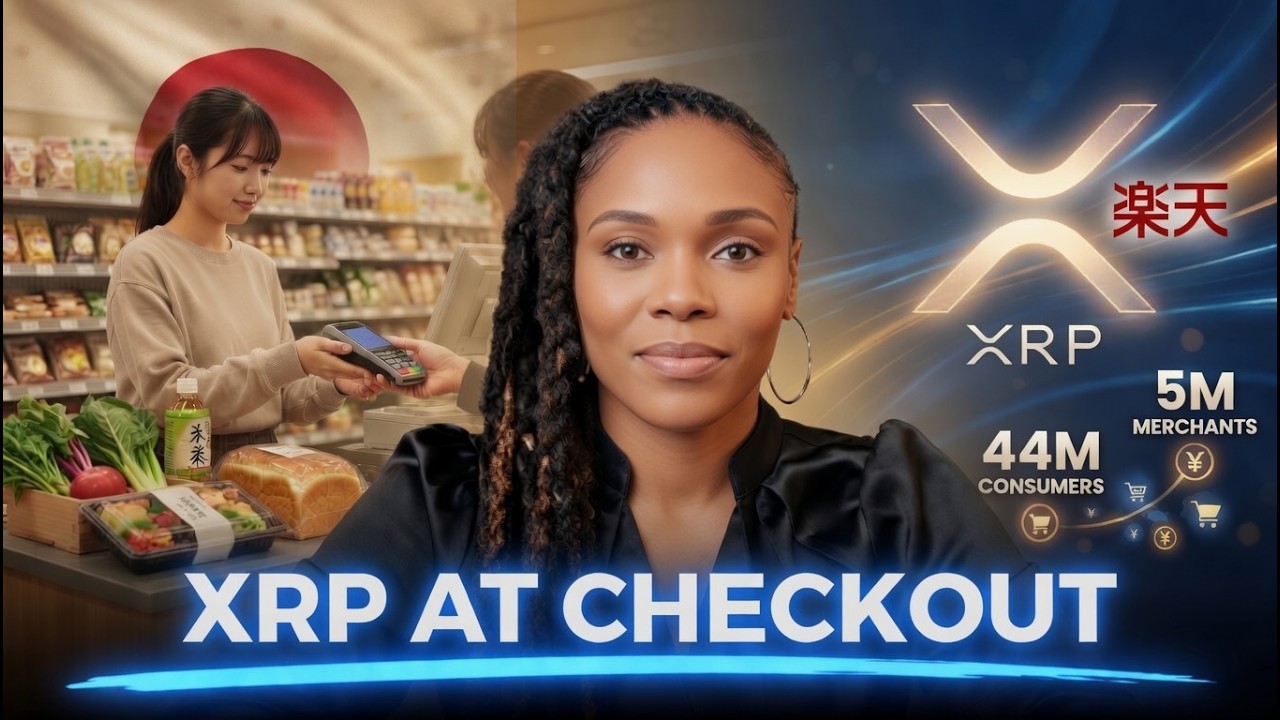
In this YouTube commentary, Kamilah Stevenson outlines two major developments in Japan that together demonstrate XRP’s evolution from a speculative asset to a functional monetary instrument. First, at the XRP Tokyo 2026 conference, representatives from Japanese banks and financial institutions presented live settlement data showing that cross‑border payments using Ripple’s XRP infrastructure settle up to 60 % cheaper than SWIFT and in under four seconds, with SBI Holdings operating this system since 2021 and Ripple adding 12 new currency‑pair corridors. Second, Rakuten – Japan’s integrated e‑commerce, banking, and loyalty platform – announced that its 3 trillion‑point loyalty program can now be converted directly into XRP, allowing 44 million Rakuten Pay users to spend XRP instantly at over five million merchants without changing their payment habits. Stevenson frames these top‑down (institutional) and bottom‑up (consumer) milestones as evidence that XRP is transitioning into a true monetary instrument. She also shares personal‑finance advice, recommending a Roth IRA held through iTrust Capital for tax‑free appreciation of XRP and other assets, and includes an affiliate link with a $100 bonus. The video ends with calls for engagement, comments on the biggest XRP milestone, and standard YouTube calls to like, subscribe, and share.
Chapters
Japan just had one of the biggest weeks in XRP history while everybody else was looking the other way, and I'm gonna share about it. Two things happened in the same week for Japan. One at the highest level of the financial system, one at the most everyday consumer level that you can imagine. And together they tell a story about what XRP is actually becoming that most people are not framing correctly. Now I'm Kamilah Stevenson, and around here we do talk wealth, This is not financial advice. Always do your own research. I am not telling you what to invest in, and I have to get that out the way. Also, like and subscribe if you have not already. Just look at the video and see if you're subscribed. I have some people who thought they were subscribed and they were not, so just hit that button if you're not. Also, drop in the comment right now before we get into this: do you think most Americans understand how far ahead Japan is in this space. Let me know how you're looking at this. Now let's get into it. So there was a conference in Tokyo on April 7th, and it was called XRP Tokyo 2026. And I want to be clear about what kind of event this was because this helps you to understand the data and what it means. So this was not a crypto conference where people get on a stage and talk about what could happen someday. The people in that room were from actual financial institutions and banks with compliance departments, with regulatory obligations, with legal teams that sign off on everything that gets presented publicly. And I need to say that so you can understand the context of this. They, in that meeting, presented live settlement data. This is real numbers from real payment corridors between real countries that have been running in production, not in a test environment or a pilot program, but in actual live operations processing actual transactions with real money. And the numbers were this: cross-border payments settling 60% cheaper than Swift and completing in under 4 seconds. Now, I know those numbers get thrown around a lot in this space, so let me give you some full understanding of why this matters. Swift has been the backbone of international banking for over 5 decades. When a business in Japan needs to send money to a supplier in the Philippines, it goes through Swift. So there's multiple correspondent banks that touch that transaction along the way. Each one adds time, each one adds cost. The whole process can take anywhere from 1 business day to 5, depending on the corridor and the institutions involved.. And by the time the money arrives, a meaningful percentage of it has been eaten up in fees at every stop along the chain. Now, what those Japanese banks showed is that you can take that entire process, the waiting, the intermediaries, the fees, and replace it with something that settles in the time it takes me to say this sentence at a fraction of the cost. SBI Holdings has been doing this since 2021. So this isn't something new. They are not testing this. They're really actually doing this, right? They're running live remittances on XRP Rails, starting with the Japan to Philippines corridor and expanding from there. What got shown at the Tokyo conference was not a proof of concept. It was years of operational data from a system that has been working in production the whole time people were debating whether it ever would. And at the same event, Ripple added 12 new currency pairs. That's 12 new corridors where this same infrastructure now operates. These are 12 new routes that institutions can use to move money faster and cheaper than anything the traditional system offers. The thing I keep coming back to with this is how it answers the question that skeptics have been asking for years, which is, show me a real bank, show me real money, show me real numbers with real transactions. Well, Japan showed them for sure on April 7th in front of a room full of financial professionals who would have immediately recognized fabricated data. These institutions have too much to lose to put fraudulent settlement numbers on a conference stage. The institutional proof of concept question is now answered. But here's where I find this even more interesting about what happened in this time frame, because the Tokyo conference was about banks and settlement corridors and institutional infrastructure, the kind of thing that will matter in a huge way, but that most regular people will never directly interact with. Okay, because these are institutions. So what happened later that same week was something that 44 million regular people are going to interact with starting right now. And so I want to talk about what Rakuten did. Let me tell you about this if you don't understand it, because if you're not familiar with it, the scale of what just happened doesn't fully, uh, help you to comprehend where this is actually going. Now, Rakuten is Japan's version of Amazon. But that comparison only gets you partway there because Rakuten is not just a place that people shop online. It's a bank. It's a travel booking platform. It's a mobile carrier. It's a streaming service. It's an insurance provider. All of it is connected under one roof through a single loyalty program that Japanese consumers use across every category of their daily spending. Every purchase earns points. Every flight, every grocery run with the Rakuten card, every subscription. And those points accumulate and people spend them on the next purchase. So it's woven into everyday life in Japan the way credit card rewards are woven into everyday life of America, except more deeply integrated because it touches more categories. So right now there are over 3 trillion points sitting on Rakuten wallets across Japan. That is 3 trillion. That converts to roughly 23 billion worth of purchasing power sitting in a loyalty program. So what started back on April 15th was that those points can be converted directly into XRP., and then that XRP can now be spent immediately at over 5 million merchants through Racketton Pay. So these are not held waiting for a price move or traded on exchanges. They are spent on the same groceries, clothing, electronics, and everyday purchases that those 44 million users were already making before any of this even happened. So here's why this is different from every other crypto payment story that you've heard in the past. Well, most of those stories require behavior change. So someone has to decide to use crypto instead of their normal payment method. So they have to go through extra steps and set up something and explain it to the cashier and deal with volatility and uncertainty. So most people never bother because the existing system is easier. And, you know, Most people are just on autopilot, so they do exactly what they did the day before. Well, Rakuten does not ask anyone to change their behavior. The 44 million people using Rakuten Pay are already using it. They already earned points. They were already spending through the app on things that they were already gonna buy. And so XRP just became an option inside of a flow that was already happening, if you understand what I'm saying. And that means the infrastructure was already in place, right? And the habit was already there. The only thing that changed was that one of the assets available inside that existing infrastructure is now XRP. And that is a fundamentally different kind of adoption— not people choosing crypto over their normal payment method, but people choosing XRP because it is the most convenient option inside something that they were already doing. Now, if you step back and look at what happened in Japan across those same 7 days, you have Japanese banks prove at the institutional level that XRP moves money 60% cheaper than SWIFT in under 4 seconds. And that is the top of the financial system validating infrastructure. Then a little bit later in that same window, Rakuten makes XRP spendable for 44 million consumers at 5 million merchants. That is the bottom of the financial system, meaning everyday people buying everyday things, activating the same asset. Now this is the top and the bottom in the same week in the same country, and this did not happen by accident. I don't think any of this stuff is by accident. Japan has been building toward this for years. SBI Holdings partnered with Ripple all the way back in 2016. Over 60 banks representing approximately 80% of Japan's total banking assets are already running on Ripple's infrastructure. The regulatory framework in Japan gave institutions clear rules years ago. So they already have their rules in place and they knew what they were allowed to build, and so they built it. This is not a surprise to the people in Japan who have been working on this. For them, this was just the next step in something that has already been in motion for a very long time. Even if you're just hearing about it, for the rest of the world watching from the outside, it may have looked like two big announcements in the same time frame or in the same week, but what this was was a reveal of what is already in place and what they're already working inside of. And so for Japan, this has been years of quiet, methodical construction becoming visible all at once. Sometimes things can be slow and behind the scenes, and then all of a sudden they start coming one after another after another. And what it reveals is something about the nature of what XRP is becoming that I think most people have not fully internalized yet. There is a becoming in this process, and if you're not paying attention to that expansion, you're going to miss what's right in front of your face. Now, we talk about XRP as an investment, as a speculative asset, as something people hold waiting for price to move, and all of that is real. Absolutely. There are people invested because they want that asymmetry movement to happen. But what Japan showed is that XRP is in the middle of a transition from something people hold to something people use, from an asset that sits in a wallet to a monetary instrument that moves through an economy. That transition does not happen overnight, and it does not happen everywhere all at once. It happens the way all monetary transitions happen. One country at a time, one use case at a time, one layer of the financial system at a time. And Japan just showed two layers activating at the same time. And honestly, there's going to be people from the sidelines watching in other countries watching. And sometimes you have the pioneers that step in first, and then you have the rest that gets a little bit more comfortable and watch the results and the data and what they're doing, and then they step in. Then you have a third tier that comes in on the back end. But as you see, this is all moving in one direction. Now, I want to express that Japan just showed XRP working at the institutional settlement level and at the consumer payment level. Now, that's a monetary instrument proving itself at both ends of the financial system together. When an asset makes that transition from speculative to monetary, the people who built their position inside the right structure before it happened are in a completely different situation from the people who scramble on the back end trying to figure it out. And they're gonna do the same thing with their taxes because their structure is not in place. Why? Because maybe they lacked understanding about this asset and did not position themselves in the right structure. And sometimes it's not about buying the right asset alone, but it's also about how you structure that asset in the right time frame before there is appreciation and asymmetry movement. And so because of this, in my understanding of this particular asset, I do hold a portion of mine in a Roth IRA through iTrust Capital so that every dollar of appreciation stays mine completely and there is no tax event. And if you're not structuring some of your assets around the ability to capitalize on taxes, that— I don't know what you're doing. But as for me, I do recommend using a Roth IRA to make sure that you do have some appreciation that is 100% yours and no percentage going to the IRS after everything that you built and all the waiting that you've done and all the sacrifice that you've taken time to participate in. And so this is a move again that I highly encourage. They also do have silver and gold in the same account and is backed by real physical silver and gold. So these are real assets alongside digital assets in one structure built for exactly this type of environment where again, no taxes are paid and 100% of that is yours. And also they do have a premium account as well, and that is a closed loop system to make sure that no scammers or hackers can take your asset from you. Now the link is in the description. There is a $100 funding bonus when you fund the account. And if you are sitting with bigger questions about your specific situation, How much should you hold? How should you structure it? What your plan looks like if this moves this year or next year or 3 years from now. That conversation is what we'll go over because again, you do want to be positioned early because there's a lot of work to do to adjust even along the way. And if you don't have a framework, then you don't have the clarity that you need. And a lack of clarity is very, very expensive. And so you need to know your numbers and your timeline and your plan. And that is not generic advice.. So if you want more information on that, the link to my community is in the description and my one-on-one calls are also there. Now drop in the comments after everything that we discussed about XRP, the banks proving it at institutional level and 44 million consumers spending it at checkout. What do you think is the biggest milestone for XRP as actual money? Let me know what you're thinking and what you're researching because Everyone in this community would love to know, especially me, because I do read the comments. And then also, before you head out, like the video and subscribe and share it with someone who still thinks XRP is just gonna sit at speculation. Japan just showed them otherwise. And as always, I want you to stay wise, stay wealthy, and I'll see you in the next video.