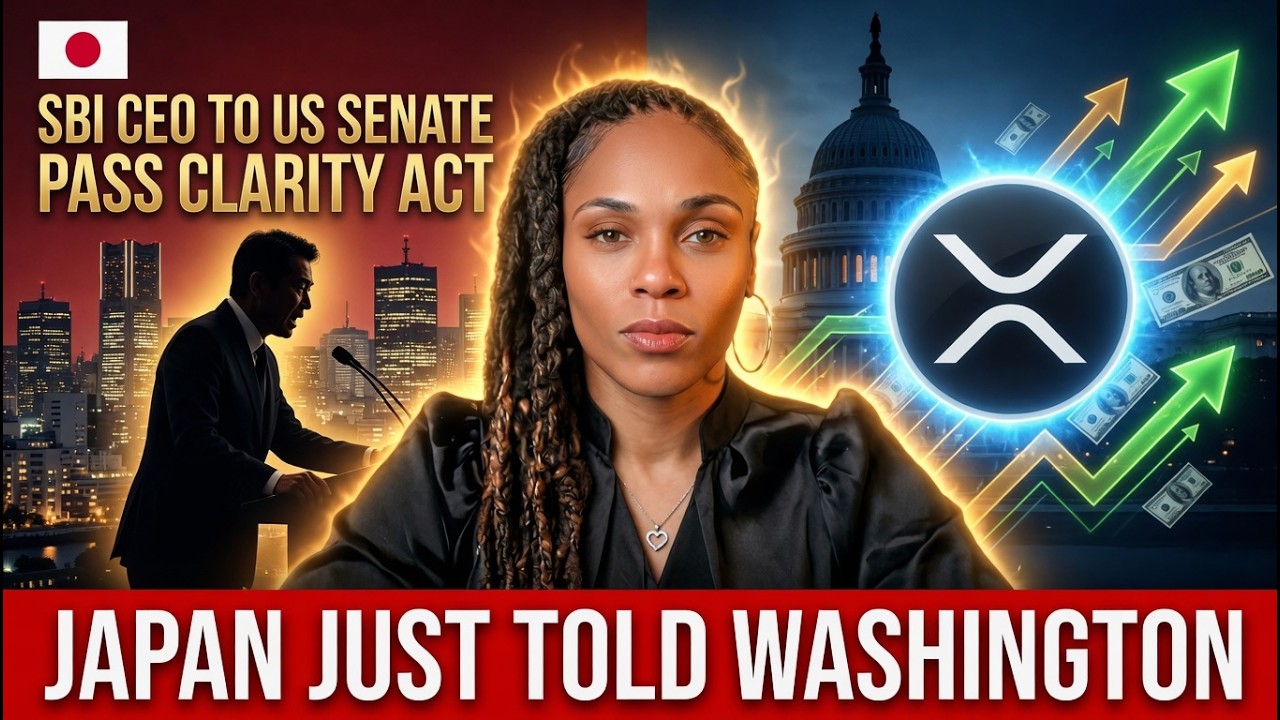
In this YouTube commentary, Kamilah Stevenson explains why the CEO of SBI Holdings—a major Japanese financial conglomerate that owns the country’s largest online brokerage, a cross‑border remittance platform, and a strategic equity stake in Ripple—publicly stated that XRP will become "very expensive" and that the United States Senate must immediately pass the proposed "Clarity Act" to provide regulatory certainty for SBI’s institutional expansion of digital‑asset settlement across Asia. Stevenson details SBI’s deep integration of the XRP Ledger (XRPL) into its operations, citing a 60% cost‑saving and sub‑5‑second settlement speed, and describes the joint venture SBI Ripple Asia that brings Ripple’s payment corridors to the Asia‑Pacific banking system. She contextualizes the CEO’s remarks as a corporate‑level policy signal rather than a personal opinion, emphasizing that the statement is intended to influence U.S. legislative timing and demonstrate the cost of regulatory delay for a major Asian ally. The video also outlines concurrent developments in the United States (Ripple’s National Trust Bank charter, OCC‑chartered RLUSD, partnerships with Neuberger Berman, JPMorgan, Mastercard, and Ando Finance) and Europe (Italy’s largest bank disclosing a regulated XRP trust), portraying a coordinated global alignment around XRP‑based settlement. Stevenson warns retail investors not to wait indefinitely for regulatory clarity, suggesting they begin accumulating XRP now, preferably within a tax‑advantaged Roth IRA using the iTrustCapital platform, and offers her paid coaching services and community for wealth‑building guidance. The video concludes with calls to like, subscribe, and comment on what “expensive” might mean for XRP’s price.
Chapters
XRP will be expensive, and I'll let you know why I'm saying that. And this is not just about a price comment, all right? This is something that is bigger happening. The CEO of SBI Holdings, who runs the parent company of Japan's largest online brokerage and one of the most important financial groups in all of Asia, said two things on record back to back. And that was one of them. First, he said publicly that he expects XRP to become very expensive. And that's the part that a lot of people are quoting. But then he also says something, uh, that a lot of people may have not mentioned, and that is that the United States Senate needs to pass the Clarity Act immediately because his firm's institutional expansion plans for digital asset settlement across Asia depend on US regulatory clarity to scale globally. So think about this. The CEO of a top-tier Japanese financial group just publicly told the United States Senate to pass a specific piece of American legislation. That is not, again, a price quote. That is Tokyo telling Washington to move so Tokyo can deploy capital. Okay. Now I do want to say I'm Kamilah Stevenson and around here we talk wealth. Go ahead and like the video and subscribe if you have not already and know that this is not financial advice. It's for educational and entertainment purposes only. Only. Do your own research. Your expectations belong to you. Drop in the chat if you have been following what Japan is doing with digital currencies. Over the last several months, they've been really integrating the XRPL into their economy, and they've been doing it for quite some time. They are very committed to XRP. They even came out with the Tokyo conference and stated how XRP has been saving them 60% and also very, very fast, meaning that they're able to use it and get the settlement in under 5 seconds. So they've been reporting what they've been doing, and I want to know if you've been following it. Now, let me explain who SBI Holdings is so that you can understand the weight of the statement that the CEO made. SBI Holdings is the parent company of SBI Securities, which is the largest online brokerage in all of Japan. They also own SBI Sumishin Net Bank, and I hope I'm saying that right. And they operate a cross-border remittance platform called SBI Remit., that already serves more than 44 million Japanese consumers and runs directly on the XRP Ledger for international, uh, payment. SBI is also a strategic equity shareholder in Ripple, and they operate the joint venture SBI Ripple Asia, which is the corporate vehicle that brings Ripple's payment corridors into the entire Asia-Pacific banking system. So that is who just spoke, and that's the level of institution making the public statement. Now, when the CEO of a firm at that level put something on record. You're not hearing a personal opinion about this. You are hearing a formally approved corporate position that has been running through investor relations and external counsel probably before saying anything to the public at that point. So, again, the CEO is one of the most disciplined, risk-averse corporate cultures in the world, in a company where executives at this level rarely make public statements about foreign legislation. And they just publicly aligned his firm with a specific piece of pending United States legislation. And so that kind of statement is not going to happen because the CEO had a personal feeling or opinion about anything. It happens because the firm has already made these internal decisions about where it's going to deploy capital and what infrastructure it is going to build on top of, and also what regulatory environment it needs to place before that capital can scale. So the public statement is the firm telegraphing its position to a broader market And what it is telegraphing is that Japan is ready to move forward, but it is waiting on the United States to clear the regulatory load-bearing brick that holds the whole structure together. Now, will these other countries move without the United States? Of course they will. They will keep moving as they please. Also, I want to point out that this statement didn't happen by itself. That's the part that we got to understand. Is that all of these things are happening inside the same window. The United States has been building out its own side of architecture. Ripple's National Trust Bank charter went live through the Office of the Comptroller of the Currency on April 1st. That's the OCC, which folds RLUSD inside the federal banking perimeter. And we have all of these other things with Neuberger Berman happening and JP Morgan and Mastercard and Ando Finance and Ripple coming together on the unified ledger. So that happened also. We are hoping that the Clarity Act will get passed. I'm praying for the Clarity Act to get passed. And then also Italy's largest bank disclosed a regulated trust position in XRP not too long ago. So there is a lot happening with different continents, the US corner, the European corner, the Asian Pacific corner, all converging on the same settlement architecture at the same time. And this is the kind of multi-jurisdictional alignment that never happens by coincidence. So I want you to understand it's not by coincidence. What I want you to understand for your own positioning is that the international peer policy alignment carries real weight inside US regulatory rulemaking. It shows up in Senate testimony, in Treasury and SEC briefing documents, and in political math senators used when deciding whether to support or block legislation. When the head of Japan's largest online financial group publicly states that his firm's expansion plans depend on US regulatory clarity, that statement becomes a documented data point in every conversation about the Clarity Act timing on Capitol Hill. It strengthens senators who already support the bill and it puts pressure on the moderates still on the fence. And it's documented, of course, as public record that further US delay has a real cost to a major Asian ally. So SBI's CEO didn't just speak. I think they understand what they doing. He moved the needle on the policy timeline itself. Uh, that doesn't mean that it's going to happen, but I think that, um, it needed maybe to be said. Now, everything that's happening right now is really a sign. It's a sign and it's a signal. You know, the institutional buildout is no longer a US-only story, and I think some people are still stuck there. They don't understand this is a global transition. You have the largest financial groups in Europe and Asia that are now publicly aligning themselves with US digital asset clarity, and the asset sitting at the center of that alignment is what? XRP. So you need to understand that there is a space to capture what comes after the convergence, or you're just going to sit and you're just going to watch everybody else hold their assets and get positioned while you play catch-up or either, uh, lack the confidence to be able to position yourself. Why? Because you're waiting on certainty. And most people are waiting on certainty. They're waiting on the Clarity Act. And I'm gonna say something, you know, hopefully you're not waiting on the Clarity Act to get your position, because again, you're going to be playing catch-up. And if you're not an institution, if you're retail, all right, um, it may take you a little bit longer to get that position in place. So I personally, uh, have been starting to accumulate even more, and I've been doing it for quite some time. And it is my a biased thought that it is the smartest thing that anybody can do at this point to capture some of the wealth from the wealth transfer that's going to exist, right? There's a lot of institutions that are going to get in and they're quietly and slowly and methodically getting their feet wet on this. They are again waiting on the Clarity Act to unload a little bit more and then we'll see what happens. The books are thin on the exchanges. So I won't go into that, but that's another thing that you have to understand is that if it unravels and it unravels quick, it might take off without you. So it is your choice. Also, it is your choice that if you do want to capture it, you want to make sure that you do not have tax leakage that comes, uh, with taxable accounts or taxable actions. If you sell, you're going to have a capital gain. You got to pay attention to taxes.. And so you also want to hedge yourself against taxes by opening up a Roth IRA, which is genuinely the only retail structure that lets your appreciation compound across the timeline without the IRS taking a cut at the exit. And so iTrustCapital is the platform that opens the door for you to hold this XRP inside a retirement structure and be able to capture the appreciation without paying taxes. They also hold gold and silver and other digital commodities. Um, they are also going to be adding ETFs and stocks in the summertime. I personally hold a portion of mine in a Roth IRA, and I try to max that out every year so that, um, I have more that I can keep with me. All right, because if you don't, then you're going to be converting it into the very currency that's devaluing, and then you're gonna have to pay it back to the IRS. They are your silent partner., and I think that you should think long and hard about how you're going to structure your assets for the future. Okay. And so the link is in the description for that. There is a $100 funding bonus when you fund the account. So that is more money for you to invest just for opening up and funding the account and doing something special for your future and your children's future. Right. And so also if you do want further investigation of how you should allocate your assets and how you should set it up for structure, and just really zoning into your specific needs, your accounts, your timeline. Uh, that's what my one-on-one calls are for. We get you very, very clear about how to organize everything so you have the right structure and you have the right game plan and you have the right action steps and all the resources needed for you to take action and to build out your wealth blueprint. Um, also I have my coaching community. It's open for ongoing weekly support, live coaching, and a room full of wealth builders that are moving in the same direction and winning at life and building out again their financial future together. And at the same time, we have a very holistic viewpoint because we understand identity is important, mindset is important. And if you don't scale those, you know, to the level of your resources, then there is self-sabotage that's often waiting for a lot of people, uh, who get resources that their mindset has not elevated to know how to steward and manage those resources. So both links are in the description for that. And also drop in the comments Uh, the CEO said the price will be expensive. What do you think expensive means? Is there an expensive price point that you have in mind? Uh, everybody's going to think differently about this, and I'm just curious as to what you're thinking expensive means. So drop that in the comments. I'd love to hear from you. Go ahead and like the video, subscribe if you have not already, hype it if you're extra kind today. And as always, I want you to stay wise, stay wealthy, and I'll see you in the next video.