JPMorgan And Mastercard Just Tokenized US TREASURIES On XRP... Most People Will Miss It
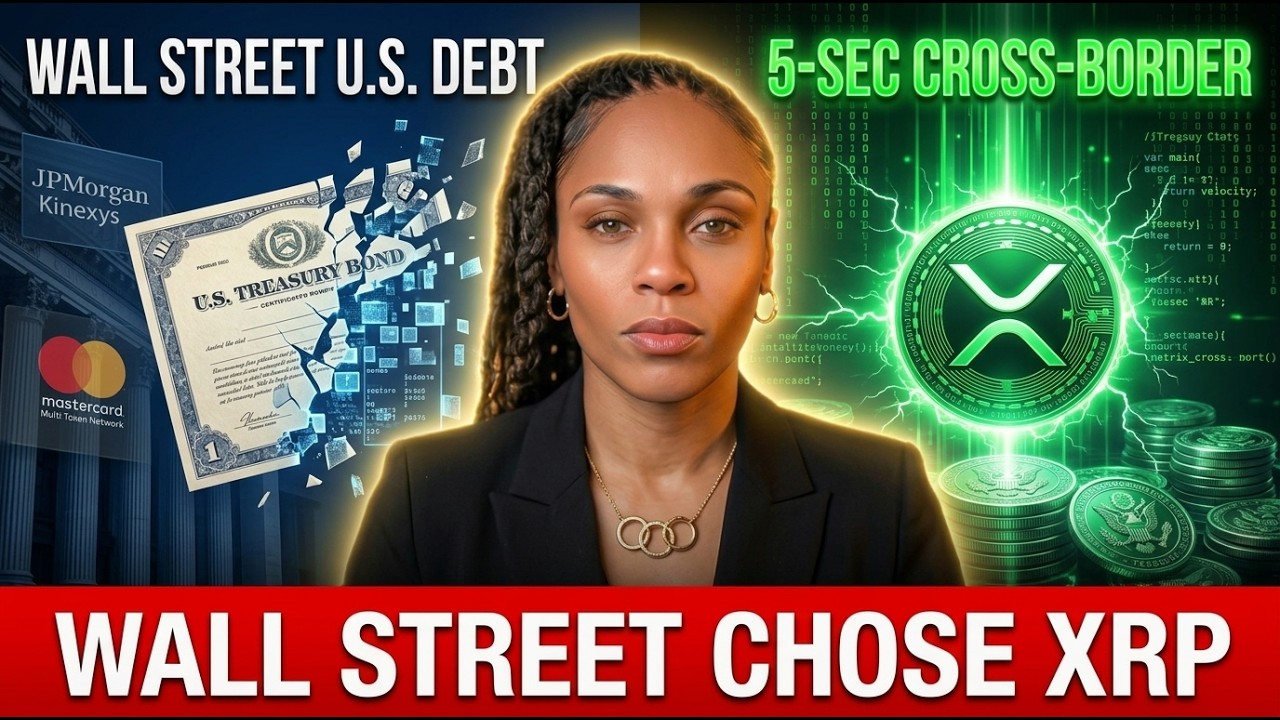
JPMorgan, Mastercard, Ondo Finance, and Ripple executed a tokenized U.S. Treasury redemption on the XRP Ledger, settling in 5 seconds instead of 3-5 business days. The tokenized real-world asset market is worth $32 billion, with $14 billion in Treasuries, and could reach hundreds of trillions over the next decade.
Chapters
I want to talk about real-world assets on the blockchain. A lot of people don't understand this concept of putting treasuries on the blockchain. JP Morgan Connexus, Mastercard, Ondo Finance, and Ripple executed a live cross-border tokenized US Treasury redemption on the XRP Ledger with settlement finality in approximately 5 seconds. I've talked about this, but I want to revisit it because I have a lot of questions about it, and I have a lot of people who still don't understand how a treasury, uh, can get on the blockchain, all right, and how that works. So I want to explain that a little bit and help you to understand that the largest commercial bank in the United States, the largest card payment network in the world, the largest tokenized treasury issuer in the digital asset space and the settlement layer that connects them all moved real sovereign debt across a public blockchain in less time than it takes you to send a text message. All right. And again, the way I talked about this before was the unified ledger. Okay. So you may have remembered that, but the legacy version of that same transaction would have taken 3 to 5 business days. 3 seconds versus 3 days is not an upgrade. That is the kind of operational gap that historically only happens once a generation when an entire category of infrastructure gets replaced by something fundamentally new. And most people are just not paying attention to the most important checkpoint of that entire institutional build-out. Okay, so we're going to walk through it. By the way, I'm Kamilah Stevenson, and on this channel I do talk about wealth. And I want you to go ahead and like the video and subscribe if you have not already, because we are going to get more and more videos out to you that can help you to understand what is going on with the economy so that you can make the right decisions for your financial freedom. There is a wealth transfer that is happening, and all of what is being talked about on this channel helps you to understand how you should position yourself and which assets you should position yourself into. Uh, I keep saying this, and I'm gonna say it again. I believe that the middleman is going to be X'd out. And what I mean by the middleman is the middle class. I believe that we're leaning more towards you're either going to be poor or wealthy in the future, and it is all determined by what is going to happen in this environment, what decisions you're going to make. All right, so you let me know where you are. Drop in the chats. Are you okay with a system that takes 5 days? Are you okay with using traditional finance that takes you 3 to 5 days to settle? On the other side? Or is it common sense for you to think that at some point we're going to adapt into a faster settlement system that takes under 5 seconds? What is your thoughts about that? Is this common sense? What do you feel like people are missing around you when you talk about this, when you explain this to people? I just need to hear from you. I have to find out what is really going on out there. All right, let me go ahead and explain what tokenized Treasuries are, um, because a lot of people still are confused. Now, a United States Treasury bond is a piece of sovereign debt. When the federal government wants to borrow money, it issues a Treasury. An investor buys it, and the government pays the investor interest over time before returning the principal at maturity. And so Treasuries are considered the safest asset in the global financial system because they are backed by the full faith and credit of the United States. Now, you may argue if you feel like it's safe at this point. I'm just telling you kind of what the culture has been on treasuries. All right. Now, a tokenized treasury is the same exact piece of sovereign debt, but the legal ownership and the settlement of that asset is recorded on a public blockchain instead of on the legacy bank settlement systems that were built decades ago. So the bond still pays interest. The bond still matures. The bond still belongs to the investor who owns it. What changes is the rail underneath it. So instead of taking 3 to 5 business days to clear a redemption through a chain of correspondent banks and clearing houses, the redemption now happens on a public blockchain with settlement finality in seconds. It's the same asset, but it is a different rail. So, um, that is a different operational profile there. Now, the total tokenized real-world asset market across all public blockchains currently sits at roughly $32 billion. So tokenized United States treasuries make up approximately 45% of all of that. So, which is about, and I've stated this before, $14 billion in actual sovereign debt settling on the public chains. I've also mentioned this, that BlackRock's BUIDL fund is the largest single tokenized treasury product at approximately $2.4 billion in assets. Franklin Templeton, Ando Finance, Guggenheim, Open Eden, and ARK Sachs all live on the chain with their own tokenized products as well. So this is not an experiment with a few million dollars in a sad project. All right, I have to reiterate that because maybe you didn't see the video where I mentioned this. So sometimes I'll mention things more than once so you can understand what is all at play. But when you understand who's all involved in this, this is real institutional capital. This is real sovereign debt, real regulated asset managers all moving onto the public infrastructure. Right now, when the Unified Ledger had that experiment and they came together to do that, it was a credentialing event. So when you lay out who participated in this, you're going to see a fully staffed institutional rail with every box checked that needed to be checked. Again, they are showing you what is at play. So you got JP Morgan, which was the largest commercial bank in the United States. You got, again, Mastercard, largest a card payment network, Ondo Finance, the largest tokenized treasury issuer outside of BlackRock. Okay. And then you got Ripple, which operates the settlement layer that connected them all together on the XRP Ledger. They are all firms that are tier 1 regulated counterparty with fiduciary obligations to their clients and supervisory oversight from their respective regulators. None of them were experimenting publicly without internal sign-off. You got to understand that. Look at the picture of that. The legal opinions had been drafted, the compliance workflow approved, all of that. Okay, so this is where we are. These are not like low-end participants. Okay, and so there is a build-out that's happening that a lot of people are not paying attention to. They're not framing this correctly, and I need you to focus on this because it's the part that most retail investors are not equipped to recognize. In every generational infrastructure transition, there is always one moment where the new system stops being a faster version of the old system and starts being a completely different category of system. So the shift from physical letter mail to email was a category change. The shift from videotape rental stores to streaming was a category change. The shift from desktop computers, tied to one location to mobile phones in your pocket was a category change. What happened with this test with the Unified Ledger is the same kind of moment for sovereign debt settlement. 3 seconds versus 3 days is not the legacy system getting faster. It is a completely different operational category. And once the category change is operationally proven, the legacy system does not survive in the long run. Why? Because the cost structure of running the —new rail is fundamentally lower and the speed advantage is fundamentally higher. Now, the transition timeline for sovereign debt settlement is measured in years, not months, but the direction of the migration is now established, and the institutions that participated in the pilot have positioned themselves to lead the build-out from the inside. The addressable market for tokenized real-world assets runs into the hundreds of trillions of dollars. When you include bonds and money market funds, equities, structured products, real estate, and private credit. The first $32 billion on-chain is the early adopter phase, and the next hundreds and hundreds of trillions are going to live on whatever settlement rail that the early $32 billion chose. Why? Because institutions migrate toward the rail that already has the regulated counterparties, um, the compliance metadata, the operational track record. The XRP Ledger now has all three, and that is what happened when they ran that test. Okay, so let me have you understand that this is not about whether tokenized real-world assets are coming. They are here. Real assets are going on the blockchain, and the institutional rail is already credentialed. The addressable market in front of it is measured in hundreds of trillions of dollars over the next decade. Do you understand what that means? And do you understand what that means when you invest in the infrastructure and the plumbing of this? So I want you to have full insight on what is really at play. I don't want you to be so emotionally attached to what you can benefit from it, like, right this second. That's not how this play works. You have to have a time horizon. You have to understand how to build patience in this game, or else you're going to capitulate. Why? Because they're going to put fear in you. Why? Because things are not happening the way you want them to happen and in the time frame you want them to happen in. You have to have patience with this. Trust me, um, for those who do, it will pay off. It will pay off. And a lot of people who lack patience, it's going to cost them millions of dollars, tens of millions of dollars. So I hope you're ready to build some patience so that you can, uh, capitalize off of this. Hey, fellow investors, Kamilah Stevenson here. Quick heads up for all you smart investors watching this. If you're serious about investing and growing a digital asset portfolio that brings you financial freedom, and you like how I've been breaking down crypto, but you want more than just free content, I'm putting together something really special. For the first time ever, on June 13th, I'm opening the Wealth Architects Inner Circle, where I'll be working with just 15 investors on a much deeper level. This is for investors who want structure, a deep understanding of crypto beyond what I share on YouTube, and a personalized wealth plan built specifically for you, not just more random information. So if that sounds like you, click the first link in the description to join the Inner Circle waitlist now. Spots will be limited once enrollment opens, and the waitlist members get first priority. So be sure to check the first link in the description and put your name on it. And you know what, let me also say what category changes do to people who are not ready for them, okay? When email replaced letter mail, the people who kept running their business on physical mail did not lose overnight. They lost slowly over the years in ways that they didn't even notice until it was too late to catch up. That's what's gonna happen when streaming replaced video rental. Blockbuster did not go bankrupt because of a single bad quarter. It went bankrupt because the category changed underneath them and they were still operating like the old category was the real one. You keep going ahead and doing that, we're gonna see where you get with that, okay? Category changes do not punish people on the day that they happen. That's why people are confused. Because they're like, I'm fine, ain't nothing happen. I didn't, you know, I didn't park my money in XRP, I'm okay. Okay, we're gonna see what you say 10 years from now when you got people who chose to be invested in the plumbing and the infrastructure. You see, when we get down the line, you know, just like what happened with the streaming and, and with the mail, what's going to happen is that time horizon eventually— they punish people who keep treating the new rail like the old rail for years after the change is already complete. Okay, so here's what it looks like for XRP holders right now. The category is changing. Okay, sovereign debt now moves in 5 seconds on a public chain. Okay, real-world assets on the public chain, you know, money moving, value moving in less than 5 seconds. All right, uh, liquidity bridge, being able to convert into different currencies, uh, interoperability. The institutions that participated in the pilot are, trust me, already positioning their balance sheets for the next decade of capital reorganization. You got some people who want to invest in the rails, great. You got some people who don't want to, not so great. But even the people who did make the right decision, well, guess what? They're usually going to hold the same way they held in 2021, the same way they held when they first got in. Inside of an old structure in an old way, okay, with no structural protection underneath the asset, treating a category change like it is just another new cycle. If you really believe in this, you got to treat it the right way, okay? You got to treat it in a way that you understand 10 years from now what that's going to look like, 5, 10 years from now, 15 years from now. And most people have not made that shift, right? So when we get 10 years out, trust me, it's going to be a small percentage of people that owns the majority of this. Because there's just going to be a lot of people who lose along the way. They're going to sell, they're going to have taxes, they're going to be back in the same problems, uh, 10 years from now if they don't get intentional about this. And that's why I keep bringing it to your awareness. That is the blockbuster mistake— same asset, wrong category of structure. You have to have the right structure. So it's not just one phase in this, it's several phases. First, get into the right asset, then make sure that you are structurally designed in a way that protects it. And if you want to actually treat this like the category change it is, you definitely need a structure underneath your XRP that matches the scale of what is happening on top of it. And so that is why I do keep a portion of mine inside of a Roth IRA with iTrustCapital. It is the platform that lets you hold your XRP inside of a Roth IRA, and I'm not talking about the wrapped version. I'm not talking about an ETF. I'm talking about actual XRP, actual HBAR, and XDC, and Quant, and XLM, and Flare, and whatever it is that your digital asset is, okay? When it grows, when it appreciates, you will own every dollar. You will not have to pay no 30% and 40% taxes on that money, because a lot of people just going to have to hand it back over to the government, okay? Because they did not structure this the right way. You can also hold gold and silver, so you can have digital commodities and physical commodities. And they are coming out with ETFs and stocks in the summertime, so you can also add those to your account. They do give you a $100 funding bonus when you fund the account, uh, so that is an awesome thing because that is investment money. It's not about the $100, it's about what you do with that $100. If invest it in an asset that's appreciating, look at how much money you can make with that, okay? I keep telling you, a little bit will go a long way, okay? Like a small mustard seed, you plant it and it just grows. And this is money for you and your, uh, family. And hopefully you are the one that will change your legacy because you have the decision right before you to do that. If you also want a customized plan for your specific situation and what you own and how to organize your financial blueprint and walk through the specificity of it. What do you allocate to maybe precious metals? What do you allocate maybe to the stock market or ETFs or digital commodities? How to structure it, you know, what are the resources, what are the actions that have to take place? Um, a lot of people are confused about this, and so that's what my clarity calls are for. I can say that you will have Clarity. I will make sure I will work with you so that you have the clarity that you need to move forward and you're not feeling anxious about anything. You're probably closer than what you think. You may even have all these pieces out there that's, you know, taken care of, but they're not— they just don't come together like a good plan, a good solid plan. And so we help you to do that. And then we also have our coaching group. We are in the community strong. Moving in the right direction, understanding the environment, being educated, resources, training, coaching, live Q&As. It is amazing to do this in a community. Uh, sometimes it's just rough to do it on your own. And so if you want to be a part of a community that is moving into financial freedom, then the link to the description is there for you to choose that option as well. Now drop in the comments, because I love metaphors, stories, parables,, and anything that I can use as examples to help educate. So you tell me, what is one piece of financial technology that you use today that did not exist 10 years ago? Uh, maybe I can use that as a teaching point at some point because I have to make this really clear to people. I don't think people can see it, but I try to use as many examples as possible to get people to see the picture that we're in, the environment that we're in, and how you should position yourself. For the new technology because trust me, the old way is outdated. It's slow and it costs a lot of money. And at some point we are rolling over into this new system. Not that the old just gets completely done away with, but the old will be upgraded at some point. But guess what? It's going to be upgraded with new technology that we can invest our money in, right? Into protocols that exist right now so that we can get financially free in our future. But remember, it's not about how much you can get and build, it's how much you can keep, how much you can manage and steward and continue to grow. And so let's not forget about that part. Drop those in the chat, like the video if it added value, subscribe if you have not already, share the video with someone who needs it. And as always, I want you to stay wise, stay wealthy, and I'll see you in the next video.









