The Dollar Is Losing Its GRIP… Here Is What Comes Next For XRP
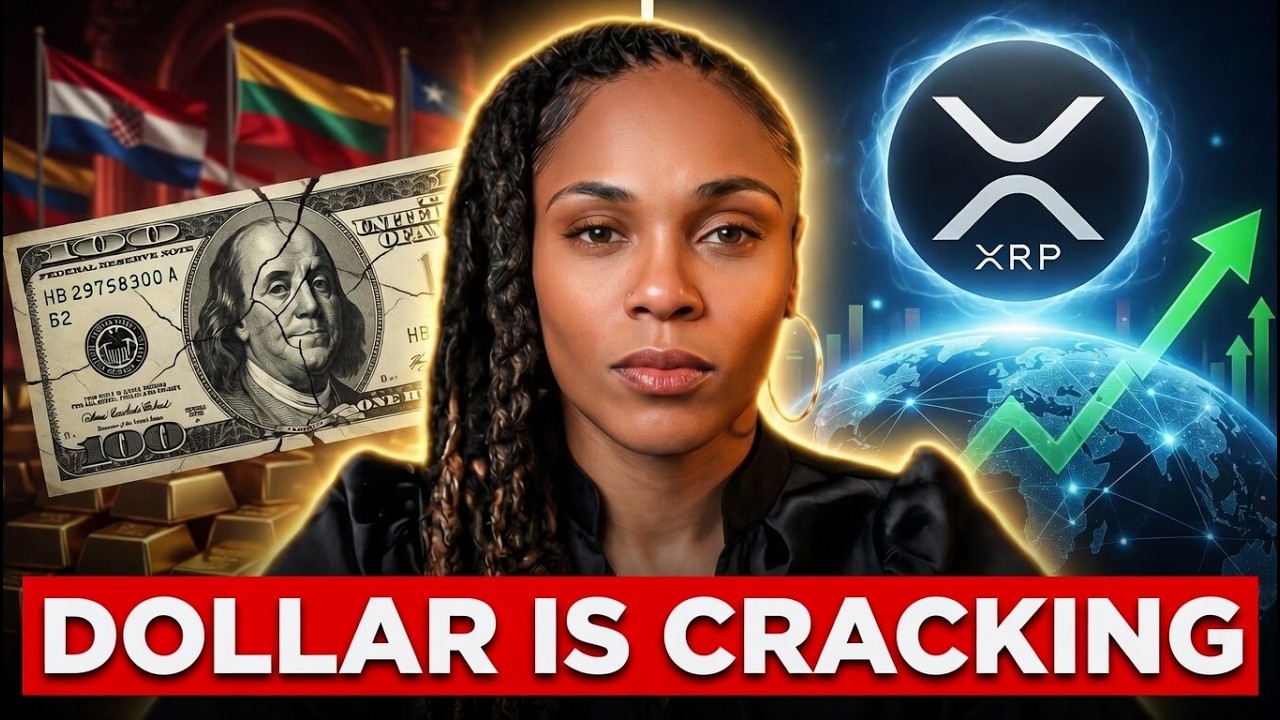
Kamilah Stevenson argues that de-dollarization and coming Fed rate cuts will push trillions into risk assets like XRP, which she sees as positioned to replace the dollar in cross-border settlement. OPEC and BRICS nations are already moving away from dollar-based trades, while central banks buy gold instead.
Chapters
The dollar is losing its grip on global financial systems, and most Americans have no idea what that actually means for their money. While people are watching the daily news cycle, countries around the world are quietly preparing for a future where the US dollar is not the default currency of global trade. That shift is going to reshape what your savings are worth, what your investments are worth, and what your retirement is worth. And the people who understand what is happening before it lands are the ones who will be positioned to protect what they build. At the same time, the Federal Reserve is about to start cutting interest rates aggressively in a way that is going to push trillions of dollars out of cash and into anything that has potential to grow. Both of these forces the dollar losing its grip and the rate cycle changing are arriving in the same window, and they are both pointing toward the same conclusion. The next few years are going to look very different from the last few years, and the assets and structures that you choose right now are going to determine whether you come out ahead or get left behind. So I wanna walk you through what is happening, why it matters, and why XRP sits at the intersection of where the world is headed next. Now, I'm Kamilah Stevenson, and around here we talk wealth. Go ahead and like the video and also subscribe if you have not already so you do not miss what is next. And I want to say this is not financial advice. This is only for educational and entertainment purposes. Do your own research. Now, drop in the comments what you plan to do to make sure that your dollar don't lose purchasing power. Are you investing in gold and silver and precious metals? Or are you investing in XRP? Or are you investing in the stock market? Or do you like real estate? Are you parking your money in property? I'd love to hear what you are doing with your cash flow. All right, let's go ahead and start with this. Let me lay out what is happening so that you can see it clearly. And I'm going to break it down in some of these terms as we go because I know everybody who is watching has not been swimming in this type of language for years. Okay, and I want to get better at this so you can understand what's going on because it matters for you and your money and your financial future. Now, for the last 50 years, the global financial system has been running on something called the petrodollar. The petrodollar is a simple deal that was made back in the 1970s between the United States and Saudi Arabia and the other major oil producers. The deal was this: Oil-producing nations would sell their oil only in US dollars. Every country in the world that needed to buy oil, which is basically every country, had to first get their hands on US dollars to make the purchase. So that created a permanent global demand for dollars, which is what allowed the United States to print money, run massive deficits, and keep the dollar as the dominant currency for half a century. That deal is breaking apart as I speak. Let me walk you through who is doing what, okay? Now, OPEC, that's O-P-E-C, which stands for the Organization of the Petroleum Exporting Countries, is the cartel of oil-producing nations that controls a significant portion of global oil supply. Countries in OPEC include Saudi Arabia, Iran, Iraq, Venezuela, and historically the United Arab Emirates, which everyone calls the UAE for short. Now the UAE has been signaling its move away from OPEC, which is one of the strongest structural signals that the bilateral oil settlement architecture is fragmenting. When one of the largest oil producers in the world signals that they're looking outside of the dollar system, every other country in the deal is going to pay attention to this. Saudi Arabia has openly discussed accepting other currencies for oil sales. China and Russia are settling bilateral trade in yuan and rubles instead of dollars. India is doing similar deals with several countries to bypass dollar settlement. The BRICS nations are working on a shared payment infrastructure that bypasses the dollar entirely. BRICS again is a group of major emerging economies including Brazil, Russia, India, China, and South Africa, and they have been adding new member countries over the last 2 years to expand the bloc. And central banks around the world are doing something even more telling. They are buying gold at the fastest pace in modern history. When a central bank, which is the institution that controls a country's currency and reserves, buy gold instead of US dollars, they are quietly signaling that they want to reduce their dependency on dollar reserves. That is not fear talk. That is real preparation by the most informed financial entities in the world. And so I follow what they're doing. Now, let me be clear about something. This is not anti-American. This is not political. It is structural. Okay, countries around the world are looking at the size of US debt, which is now over $35 trillion. They're looking at the speed at which US prints new money and the risk of being on the wrong side of US sanctions, and they're quietly deciding to build alternatives because of this. So that is what happens when any financial system gets too large, too leveraged, and too one-sided. The market is building around it. So the dollar is not collapsing tomorrow. Let me be clear about that. But the world is quietly preparing for what comes after dollar dominance. And that preparation is happening right now in real time while most people are watching the price of XRP and arguing about whether it will ever move. Okay. There is so many other things that you have to be educated about that is going to play a role in your financial future. And I think it's time to get intelligent about what we watch. Yes, we do want the price to go up, but there are so many other things that you have to look for that's going to affect all of this. And I'm telling you, the economy is showing signals. If you don't see the signals because you wrapped up and just looking at the price, that's going to be on you when the day hits, when all of this unfolds. Now let me help you to understand something about the rate cuts, because that's what makes this moment very unusual. Okay. The world is moving off the dollar at the same time that the Federal Reserve is about to start cutting interest rates aggressively. So let me back up and explain something. The Federal Reserve, which we call the Fed, is the central bank of the United States. The Fed sets the level of interest rates that ripple through the entire economy. When the Fed raises rates, borrowing becomes more expensive and money sits in safer places like savings accounts and bonds. When the Fed cuts rates, borrowing becomes cheaper and money looks for places to grow because cash and bonds stop earning enough to keep up with the inflation. Now, Jerome Powell has been the Fed for the last several years, and today that position exits and it is passed on to Kevin Warsh, and he takes the seat— today. Now, Warsh has signaled that he wants to start cutting rates earlier and deeper than Powell would have. Our president also has been pushing publicly for 1% interest rates. So the rate cut cycle is about to begin in a way that is going to push trillions of dollars out of cash and into what we call risk-on assets. Risk-on assets are anything that has the potential to grow faster than inflation, but also comes with the chance of going down.. So we talking stocks, real estate, gold, crypto, anything that is not just sitting in a bank account waiting. When the Fed cuts rates, money rotates out of safe assets and into risk-on assets because the math no longer works for sitting in cash. This pattern has happened every single time the Fed has cut rates over the last 50 years. The capital flow is very predictable. The size of the move depends on how aggressive the cuts are. And Warsh is signaling aggressive. We'll see what happens. So now hold on to both of these things in your mind at the same time. The world is moving off the dollar as the global settlement layer. Capital is about to flow into risk-on assets because of the cut rates. Both forces are arriving in the same window. Both are pushing in the same direction. Both create demand for new infrastructure that can absorb the flows. Let me say this, it doesn't mean that you can't have pullbacks or drops or anything, right? This is just a structural pattern setup. And sometimes when I say things, maybe people think it's going to happen tomorrow, and so they don't understand how this all works, right? They looking for stuff to happen right away. I'm telling you the structure and the pattern. So we're talking even long term, over the next decade, your dollars are not going to be worth much, and whatever you put into assets are going to be worth a lot more., and the savers are going to just get left behind. Okay, that is the structural setup for the next decade. All right, now short term, we could experience pullbacks or recession or whatever that looks like. So just understand that I am giving you the bigger picture in all of this. And just because I say 10 years also don't mean it take 10 years for upside. That's not what I'm saying either. I am just speaking to you in a way where you understand where you should start thinking about how you position your life, your money, your future, right? It's going to matter. Now let me also share why XRP is positioned at the intersection. Okay, when global trade settlement moves away from the dollar, it has to move toward something. That something cannot just be another national currency like the yuan or euro, because the same problem that pushed the world away from the dollar will eventually apply to any single nation's currency. What the world needs is neutral settlement infrastructure, something that does not belong to any one country, something that is fast, cheap, regulated, and trusted by major institutions. That is exactly what XRP and the XRP Ledger are positioned for. Neutral, fast, cheap, already being used by major banks and corporate treasuries through real partnerships Ripple just received a federal banking license from the OCC, which is the US agency that regulates national banks. Ripple acquired also G-Treasury, which is the cash management software that runs daily operations for Fortune 500 companies, including Subway. RUSD, which is Ripple's own dollar-pegged stablecoin, just crossed a billion dollars in size, and the infrastructure is being built right now in real time for exactly the moment the world is headed into. I continue to repeat this so you can really see what is at play. At the same time, the rate cut cycle is going to drive trillions of dollars of capital into risk-on assets. XRP is one of those assets, not the only one. We got Bitcoin and gold and real estate and stocks. They will also absorb part of the flow, but XRP has a unique position because it sits at the intersection of both forces. It is a risk-on asset that benefits from rate cuts, and it is also the neutral settlement infrastructure that benefits from de-dollarization. Most assets only get one of those tailwinds. XRP gets both at the same time. And that is why I keep telling you that the architecture matters more than the price chart right now. The architecture is being built for a world that is about to arrive. When the world arrives, the assets that are positioned to absorb both the capital flows and the settlement flows are the ones that will be repriced the most aggressively. You do not have to predict when, you only have to be positioned before, right? A lot of people are going to get on board when this is all said and done. I don't know what to tell you. Now, if you do believe in this, if you don't, don't worry about it., right? But if you do believe that both of these forces hit and XRP repositions over the next few years, what percentage of your gains do you actually want to keep when you sell, right? Because the answer to that question depends on a decision that you make before any of this happens and not after. Now, if you do sell, you're going to have to pay taxes. Most XRP are sitting in regular brokerage accounts where everyday dollar of growth becomes a taxable event the moment they touch it. The government calls it capital gains, and they're gonna take their cut before you see yours. There's a different way to hold this asset as an addition to part of your overall plan, and that is inside of a Roth IRA where every dollar of growth stays completely yours. The government never touches it, not when you sell, not when you withdraw in retirement, You keep 100% of what compounds. And that is why I keep a portion of mine inside of a Roth IRA through iTrustCapital. iTrustCapital is the platform I use because they hold real XRP and not paper representation. And they give me the same tax protection on gold, silver, ROLUSD, which now gets a percentage if you hold that, and other digital assets all inside of one structure., and they also have stocks and ETFs being added in the summer. There is a $100 funding bonus when you open up the account. The link for that is in the description. Now here is the harder thing you must think about as well. Where does XRP sit in your overall plan? Where does your cryptocurrency fit in your overall plan? Your precious metals, your real estate, your businesses, your cash flow, your passive income, your taxes, where does it fit? Because the asset is one piece of a wealth strategy, but not the whole strategy. You need a structure around your entities, your trust, your other investments, your timeline, your goals. And that is what I help my private clients to build inside of my clarity calls every week. We sit down, we look at where you are, we map out where you need to be. You walk away with a real plan tailored to your life. Okay? The link is in the description if you want to book that. And also, my coaching community is open if you want ongoing weekly support in a room of people who are building together. And let me tell you, we are doing some amazing things together. And it's more than just money, it's your experience with life. Do you have everything you need to where you are safeguarded against the things that life bring, like inflation, like AI taking over jobs, like taxes, like a shortage in food that could possibly come, or a shortage in supply. Are you protected from all of that? These are things that you need to be thinking about. So those are things that we go over in my community. Both links are in the description below. And I do want to say this because there are a lot of impersonators. This is my page, and there's a lot of other pages that are using my videos and they're capitalizing off of my videos. Do not click on any of those links. My page is @DrKamilahStevenson, and I just want to say that you'll sometimes see me comment from my personal page as well, but be very careful. I will never send you a WhatsApp, a number to call, or anything like that. So be very careful with the scams that are taking place there on everybody's pages, and I am trying to reach out to take care of that. If you see another page that is not mine, @DrKamilahStevenson, please do report them. This is my page. I think at the time of this recording, I have somewhere over 130,000 subscribers. These pages are smaller in count, but they are not me, and I just need you to know that. All right? So aside from that, I do want to say you are not late. You are still early to one of the largest structural shifts of our time. Get positioned before the flow arrives. Not after they hit. That is the wrong place to be. That's where the majority of people will be. So go ahead and drop in the comments which one of the two forces, the dollar losing dominance or the rate cut cycle, do you think will hit XRP first? I want to see what you're paying attention to. Go ahead and like the video if it added value. Subscribe if you have not already. And as always, I want you to stay wise, stay wealthy, and I'll see you in the next video.









