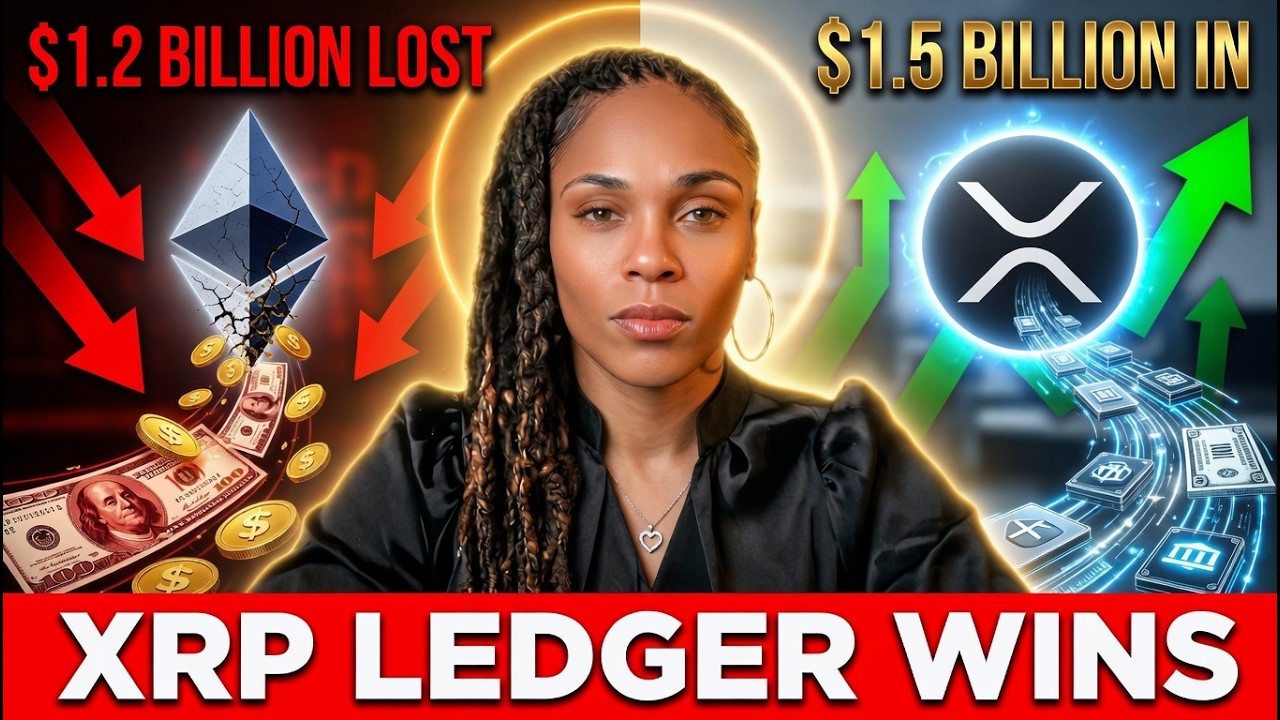
In this solo‑hosted YouTube video, Kamilah Stevenson explains a recent capital migration of tokenized real‑world assets (RWAs) from Ethereum to the XRP Ledger (XRPL). She cites on‑chain flow data showing roughly $1.5 billion net inflow to XRPL versus $1.2 billion net outflow from Ethereum over the past 30 days, and frames this as a shift in where regulated financial paper—US Treasuries, money‑market funds, corporate credit—chooses to settle. Stevenson defines tokenization, outlines the current $32 billion global tokenized RWA market (≈45 % US Treasuries, $14 billion), and lists major institutional issuers (BlackRock BUIDL, Franklin Templeton, Ondo, Guggenheim, etc.). She argues that while Ethereum excels for DeFi due to developer tooling, the XRPL is purpose‑built for fast, deterministic, low‑cost settlement required by regulated assets, leading to a migration of institutional participants (JP Morgan, Mastercard, Ripple, Standard Chartered, Schwab, SoFi, etc.). Stevenson then discusses how XRP holders should position their exposure—suggesting tax‑advantaged structures like a Roth IRA via iTrustCapital—to capture the upside of the rail’s growth. The video also promotes her Wealth Architects Inner Circle coaching program, offers one‑on‑one clarity calls, and includes standard YouTube calls to like, subscribe, and comment. Throughout, she maintains a disclaimer that the content is for education/entertainment, not financial advice, and expresses personal continued buying and staking of Ethereum while emphasizing XRP as the “winning side” of the wealth transfer.
Chapters
I want to share some data that's happening with XRP, and I don't want you to look at it like a crypto popularity contest because you will miss what is actually happening. There is a migration happening of capital, and over the last 30 days, the XRP Ledger took in roughly $1.5 billion of net new real-world asset inflows. Now, in that same window, Ethereum saw approximately $1.2 billion of real-world assets leave the chain. So now I want you to understand what that means for a moment, because the actual tokenized financial paper of the real economy, meaning the tokenized US Treasuries, the tokenized money market funds, the tokenized corporate credit, it's all migrating from one settlement layer to another. And we're seeing this happen. No, this is not about price charts. This is, again, capital migration. Which means the financial paper is voting, uh, about which chain it wants to live on. And, uh, most people are not paying attention to this, so I want to bring it to your attention and let you know what's going on. By the way, I'm Kamilah Stevenson, and around here we talk wealth. I want you to like the video and subscribe if you have not already. And I want you to know this is not financial advice. Everything I share is for educational and entertainment purposes. Drop in the chat what you are hearing about the XRP Ledger and real-world assets. I want to know what you are discovering, what you're finding, what you're researching, or if you feel like I am missing something that you want to add to the conversation, go ahead and drop that for me because I want to see where you all are with this and if you're keeping up with the news. Now, before I go any further, I really want to just take time to explain what real-world asset tokenization means because a lot of people still don't know what it means. And so I don't want to assume that you understand. I like to take my time and help you to map out exactly what's happening. And first, sometimes we just got to hit some of these definitions so you can kind of get a clear picture. So tokenization is the process of taking a traditional financial instrument, something like a US Treasury bond or a money market fund share or a piece of corporate credit, and issuing it digitally on a public blockchain. So with this, the asset still exists in the traditional sense, And the bond still pays interest, the money market fund still holds underlying securities, but the legal ownership and the settlement of that asset moves onto a public network where it can be sent, settled, and verified in seconds instead of 3 to 5 business days. Hey, fellow investors, Kamilah Stevenson here. Quick heads up for all you smart investors watching this. If you're serious about investing and growing a digital asset portfolio that brings you financial freedom and you like how I've been breaking down crypto, but you want more than just free content, I'm putting together something really special. For the first time ever, on June 13th, I'm opening the Wealth Architects Inner Circle, where I'll be working with just 15 investors on a much deeper level. This is for investors who want structure, a deep understanding of crypto beyond what I share on YouTube, and a personalized wealth plan built specifically for for you, not just more random information. So if that sounds like you, click the first link in the description to join the Inner Circle waitlist now. Spots will be limited once enrollment opens, and the waitlist members get first priority. So be sure to check the first link in the description and put your name on it. So the total tokenized real-world asset market across the blockchains currently sits at roughly $32 billion. Tokenized US Treasuries account for approximately 45% of that figure, which is about $14 billion in actual sovereign debt now settling on public chains. The largest single tokenized Treasury product is BlackRock's BUIDL fund, um, which sits at approximately $2.4 billion in assets. Other regulated issuers including Franklin Templeton, Ondo Finance, Guggenheim, Open Eden, and ARCSAC are also live on the chain with their own tokenized products. Now, for years, Ethereum was the default destination for almost all of this activity, and I think a lot of retail investors felt like, uh, it would stay that way forever. But what just happened over the last 30 days or so is that the net flow direction reversed in a way that puts the XRP Ledger as the number 2 destination globally for total tokenized real-world asset holdings and the number one destination globally for recent net inflows. Now that shift is what I want you to focus on because obviously on the surface, you know, it's all boiled down to, oh, which one is winning a popularity contest, but the actual information is about which chain the regulated financial system is choosing to settle real economic activity on. And that decision affects everything downstream. Okay, so now the institutions issuing these tokenized assets are not crypto companies, and I have to say that because some people get confused. These are asset managers and broker-dealers operating under strict fiduciary obligations to their investors. When a firm like BlackRock decides where to issue a tokenized money market fund, the decision gets made based on which chain delivers settlement finality fast enough for institutional use for compliance at the rail level so regulatories can audit transactions, minimal validator concentration risk, and predictable transaction costs even under stressed market conditions. So all of those are very important to have before institutional, uh, capital allocates to a chain. Ethereum was the default in 2022 and 2023 because there was nothing else with the developer tooling, but default is not the same thing as best fit. And the first stage of any new infrastructure layer is always built on whatever rail is available. The second stage migrates to the rail that actually matches the requirements of the application being built on top of it. And that is exactly what we are watching right now. And so this is the piece that a lot of investors get tripped up on because Ethereum still has the most developer activity and the deepest smart contract tooling. And the assumption is that those metrics determine which chain wins for tokenized real-world assets, and they do not. Developer activity and smart contract complexity matter for one thing, and that is decentralized finance applications where users need composable permissionless interaction with each other. Now, those applications and regulated tokenized financial paper are two completely different products with two completely different requirement sets. Tokenized regulated assets need fast deterministic settlement, predictable cost, and compliance built into the rail itself. Ethereum is genuinely excellent at the first set. The XRP Ledger was purpose-built from the ground up for the second set. So what you're seeing on-chain right now is the regulated tokenized asset class, QALY, separating itself from the speculative decentralized finance asset class and choosing the rail that matches its job. And this migration is not happening in isolation. Uh, in the same week the flow data flipped, JP Morgan, Connexus, uh, Mastercard, Ondo Finance, and Ripple executed a live cross-border tokenized US Treasury redemption on the XRPL with settlement finality in approximately 5 seconds. So that was all what happened in the same time frame. And then also Standard Chartered and Nuberger Berman, $200 million credit facility cleared for Ripple's Prime Brokerage. Also remember the Ripple National Trust Bank charter went live, folding, uh, ROUSD inside the federal banking perimeter. And Charles Schwab opened crypto access for 38.9 million accounts. SoFi enabled XRP deposits for 13. 2.7 million customers. And every one of those moves is an institutional checkpoint that supports the same direction that the flow data is pointing in. And I have to mention that because they're all pointing in the same direction. The architecture is being assembled in real time, and the first tens of billions of tokenized assets get to choose the rail, but the next hundreds of trillions are going to live on whichever rail the first tens of billions choose. So that's how infrastructure transitions work. And that is the math underneath what's folding right now. So I want you to understand that the regulated tokenized financial system is migrating onto the XRP Ledger right now. And the asset that the rail itself runs on is XRP. So you have to understand whether you believe the migration is happening. Listen, the data is the data. And so if you do own XRP, then you have to wonder if you own it correctly. And what I mean by this is whether you have XRP position to capture the structural revaluation that comes when the rail wins, or whether you have it sitting in a structure that hands some of that, uh, gain back over. Uh, so you want to now choose, you know, we've, we've gotten beyond, yes, the fact that we hold XRP, but now we got to understand how do we keep what we have? How do we keep the appreciation? Um, and if you're anything like the average retail XRP holder, then you're probably owning the asset that the rails run on, but you're owning it inside a, a structure that is not going to benefit you in the future, right? And so if you hold XRP in the right structure, then you'll hold it in at least a portion of it in an account where when it appreciates, you get to keep most of the gain. Trust me, the institutions that are migrating onto the rails, They're thinking about this, they're thinking about the structures, they're, uh, placing their exposure inside of structures that would protect the growth, the reporting, and the compounding. The asset class is the same, the structure is just not, depending on how you hold it. And the structure where most retail loses 30 to 40% is what you need to think about not doing. So if you are holding XRP, then the closest thing you have to an institutional level type structural position where you protect it against any losses of— meaning when it appreciates, you lose it because you have to give it to the government. That structural protection is there if you want to hold your XRP in a Roth IRA. So iTrustCapital is the platform that lets you hold XRP inside a retirement structure. They also allow you to hold 90+ other digital currencies, gold, and silver. So you have digital commodities and you have physical commodities. I love HBAR and XDC and Quant, and they're all in the same tax advantage account. And so I know whatever moves that are going to be made with that, I'm going to be able to keep every dime of it. They do also offer a $100 funding bonus when you fund the account. The links are in the description for that if you want to take opportunity for that. And they do have ETFs and they have stocks coming in the summertime as well. If you are looking at this and you're wondering how it applies to your personal situation, that is what my one-on-one clarity calls are for. If you're wondering, what do I allocate to, you know, What does my structure look like to protect my assets? What percentage should I give to maybe dividend stocks or real estate or precious metals, maybe silver and gold? Everybody has different questions pertaining to their portfolio and their financial freedom plan. And hopefully you have a plan. We will sit down and we will look at what you have, what you own, where it lives, and what needs to move in what order and get you on a clear path forward. So again, that's what my clarity calls are for. And if you want a community where you can do this together with other like-minded people, um, who have weekly support, live coaching, and just a community that's building wealth together, getting their mindsets together, understanding the holistic viewpoint in all of this, uh, because wealth is beyond just, uh, monetary instruments. There's a lot of other things that are included, and we go through all of that our community. So both links are in the description. And then also drop in the comments, do you hold some Ethereum? Are you long Ethereum? I'm just wondering, um, if you like Ethereum. I personally have been buying Ethereum for years, and I'm honestly still buying Ethereum. I stake Ethereum to make passive income, and so that's where I stand. Uh, no, I don't like it better than XRP. I think you guys know that by now, but I am still loading up on Ethereum as well. All right, can you do me one last favor, and that is like the video and subscribe if you have not already? I'll I'll continue to bring you the updates and continue to educate you on what is happening in this market and in this economy as a whole. And I want you to be prepared and positioned for what is next, because as I continue to say, this is the greatest wealth transfer that will ever exist in your lifetime. And I need you to be on the winning side of this. And as always, I want you to stay wise, stay wealthy, and I'll see you in the next video.