What Happens To XRP If The CLARITY Act DIES?
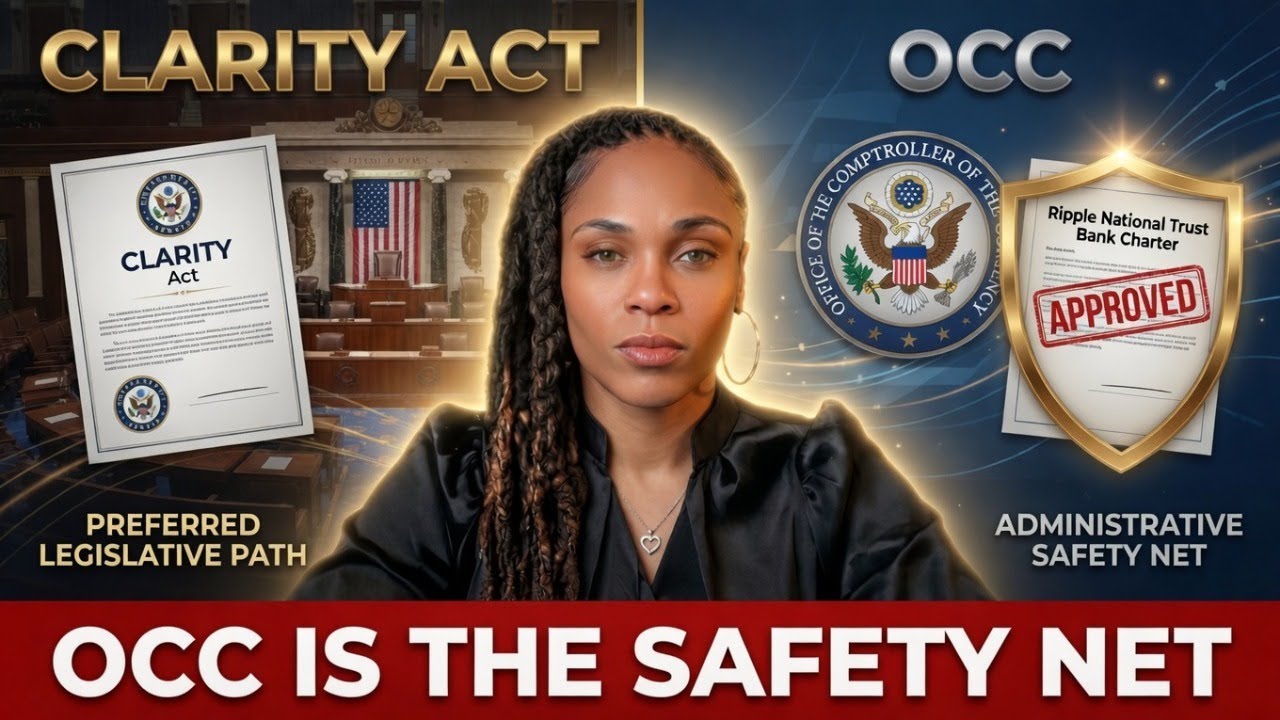
In this extensive YouTube discussion, Kamilah Stevenson examines the future of XRP and the broader crypto ecosystem in the event that the U.S. "Clarity Act"—a proposed federal regulatory framework for digital assets—fails to pass. She begins by outlining why the Clarity Act matters: it would provide legal certainty, unlock institutional capital, and resolve the SEC‑CFTC jurisdictional clash. She then explores worst‑case scenarios, especially a liquidity crisis where institutional adoption stalls, and explains how such a crisis could force the market to adopt existing digital‑asset infrastructure out of necessity. Stevenson shifts focus to the Office of the Comptroller of the Currency (OCC) as an alternative administrative pathway, detailing five specific OCC levers (interpretive letters, trust‑bank charters, Federal Reserve master accounts, capital‑requirement adjustments, and stable‑coin rule clarifications) that can advance crypto integration without congressional action. She highlights Ripple’s conditional national‑bank charter, its stablecoin (RLUSD) plans, and the existing legal precedent that XRP is not a security following the 2022‑2023 court rulings. Throughout, she stresses that while the Clarity Act would accelerate adoption, the underlying architecture and institutional positioning are already in place, so the ultimate destination for XRP remains unchanged. The video also includes community engagement calls (membership, wait‑list, live sessions), personal investment anecdotes, and broader macro‑economic commentary on interest rates, inflation, and systemic risk, all framed as educational entertainment rather than financial advice.
Chapters
Hey, it's Kamilah Stevenson, and around here we talk wealth. And we're going to get into an important topic today, and I want to break down a few things because I've had a lot of people, uh, interested in, uh, the answer to the question of whether or not XRP and other cryptocurrency will survive if there is no Clarity Act. And why am I addressing this? Well, a lot of people have been asking, right? Go ahead and like the video, um, and share it and subscribe if you have not already. And let me know— what's going on, uh, Patrice? Let me know from your standpoint in the comments. Let me know, do you think that this is going to cross the finish line? There's a lot I want to talk about, um, just to kind of give you perspective of where we could end up. And I want you to be considering it because there's not always one direction. Um, there's the direction that we hope for, but we don't know for sure if it, if it finalizes in that direction. Um, I hope so. But let me know if you think— what's going on? Uh, if you think the Clarity Act lives or does it die. What's going on, best friend? What's up? I see you here in the place. Just was cooking like crazy yesterday for her daughter. Um, some good food, by the way. What's going on? XRP doesn't need clarity at it. It does, it already has it. Yeah, I'm going to talk through a few things. Um, yes you do. Benjamin thinks it will go through Stormail. What's going on? All right, so I see a couple of you guys do. I want you to again like the video, subscribe if you have not already. Everything is well, Marcia. I hope it's well with you as well. Um, I want to say this is not financial advice. Everything I share is for educational and entertainment purposes only. Please do your own research. And, uh, @Dream says it will not die, just be dragged out. Um, so yeah, we are, man, we're in a situation, uh, where we are looking to see what will happen, what will become of this. And let me just, uh, say exactly why I am targeting this topic. Um, First of all, there's a lot of stress in, you know, in the crypto family, uh, you know, just over the Clarity Act and just wondering if it's going to pass. Uh, JP Morgan CEO Jamie Dimon publicly came out and talked a little bit about his feelings on it. And, um, you know, the Senate path has been a little slower than what we were hoping for. And I've been getting a lot of questions asking, well, what happens if the Clarity Act does not pass? So I do want to address it. Address this, uh, based on just things that I've been looking into, right? And I think I mentioned this the last time I was on. The legal team— remember when I went to XRP Las Vegas? The legal team did predict, when they did a lightning round of questions, they did predict that it would not happen, okay? Um, that was just their prediction. That does not mean that they'll be right. I am genuinely, um, hopeful that it will, and maybe that's because I'm biased and I want it to pass and I hope it passed. But hope is not a plan, and I do not want anybody, um, to hold their entire wealth strategy on a piece of legislation that may take longer than expected to get through. Okay, so I do want to walk you through the other path and what that looks like, and a path that maybe doesn't depend on Congress, um, and maybe a path that means XRP in the broader digital asset architecture can still win even if there's a shift in timeline. And I do want to read and quote, uh, exactly, um, looking at some of you all's, uh, I do want to, um, such a follower. I'm happy. Hey guys, if you guys didn't see Good Evening Crypto for last Friday, I was with their— I was with them live on Friday. So if you haven't got a chance to see it, go, go back and watch it. It was a really, really good episode and I love them. Um, Jamie Dimon, when asked is he happy with the Clarity Act— just so I can let you know kind of what's going on right now and why so many people are afraid of this. Um, can, can Trump issue executive? No, it has to, it has to go through. Um, it has to follow through the same way any, uh, bill gets passed. Um, so that was Abdul, right? It's You know, they, they gotta— once it gets on his desk, it'll be fine. But okay, when Jamie Dimon was asked about the Clarity Act, he says, uh, when they asked him was he happy with it, he says no, because it allows them to effectively pay interest on deposits, stablecoins, or something like that, um, uh, without protection that— and I was, I was trying to look at what he said— without protection that they should have. Um, so there's basically, he's saying there's no legal protections. And then, and then he also said the Clarity Act doesn't do anything for AML or BSA. So there's no legal protections and the banks, um, will not accept it that, that way. And I think he said if we lose, we lose, we will live, but it, but it will be fought or something. So I was just trying to get in what, what, what he said about this. And, um, so he said there's not enough protections. BSA, he said there's no uh, Bank Secrecy Act. So this is the United States— the, the United States, um, law passed, I think, in 1970. It's a law that requires banks to keep detailed records of, like, customer transactions and file reports and on cash deposits over a certain amount, and also reporting any activity that could, like, look suspicious to the federal government. So, uh, the BSA is the legal foundation that AML runs on. I didn't mention AML. AML stands for anti-money laundering. So these are rules that require financial institutions to monitor, like, customer transactions and again support suspicious activity to the, to the government so that they can prevent criminals, you know, from using the banking system to, like, hide illegal money. So basically what he's saying is that the Clarity Act doesn't require crypto companies to, like, follow the same rules that banks follow when it comes to monitoring, you know, transactions or even identifying customers. And preventing, um, criminal activity. So that was a main complaint, a complaint that he talked about. Okay, again, like the video, subscribe. Nothing I say is financial advice. Let me give you this caveat and say this, that so that you won't, um— thank you so much, I appreciate that— so, so you don't misread what I'm saying, you know. I'm trying to get through the comments also. Um, yeah, like, I, I'm just, I'm I'm not saying I agree with anything he's saying. Y'all know I want the Clarity Act. Get out the way. Okay, uh, but even moderate Dems will vote, uh, to pass cap. Yeah, I mean, to me it's like, I don't think it should be a fight. That's like having a fight over whether or not like the internet protocol is important, like to move data quickly. Like, this is— it shouldn't even be a Democrat, a Republican thing. Let me say this caveat before I get into it, because I'm going to explain to you my thoughts on it and how we could get there. Let's say if there was no Clarity Act or if it got pushed Act. I think the Clarity Act matters. I do, I do think it matters. So I want to say that very clearly before I tell you what else I'm going to tell you, so you don't overstate or over— you— so you don't mix up what I'm saying, okay? So, or misstate what I'm saying, okay? I do think it matters, all right? Um, so I don't want you to walk away thinking that it doesn't necessarily matter. It does. Uh, Clarity would set the federal regulatory framework for digital assets. It'll unlock significant amount of, uh, institutional capital that's sitting on the sidelines, okay? They are waiting. There are some institutions that's waiting. Now I'm gonna give you my other side to this, but I just want to say this first. It can also end this whole SEC-CFTC jurisdiction fight, and it can put the United States in a position to lead the next phase of global financial infrastructure. And that's, that's what the president wants. So I want the clarity to pass. I want it to happen. I believe the country needs it to happen. I'm rooting for it like everybody else who can understand what's at stake. I'm not saying that it can't— I'm gonna get to the other side, but I just want you to understand what happens if it stalls or if it gets delayed in the, in the Senate, uh, because the entire crypto space right now is, is treating the Clarity Act as if it's the only path forward, and I don't know if that's true, okay? Um, so I want to talk about, uh, you know, maybe a worst-case scenario with that. Um, Clarity is preferred. It is to me the preferred path, but there is another safety net, and I want to kind of walk you through that and just give you my thoughts on that. Why? Because I'm pushed to have to do that in a sense, okay? I'm going on with my members after this, and we're going to talk even further about the environment that we're in and what the government is trying to do, the setup for even what's happening with the dollar. I mean, we're just going to go a little bit further. So if you, if you're part of my membership, we rapping today. We gonna, we, we, we gonna get in some, some good information and help you to understand what the plan is. And, um, and I really want you guys to know there's a lot that's— this is not, this is not new. None of what's happening in our environment is new, okay? So I'm going to talk about that, like I said, with my members, and we're gonna get it— we gonna get it in so we can know. The more we know, the more we can position ourselves, okay? So we got to get a little more sophisticated about this, all right? So also, I do have a link for my waitlist because I am opening up— I'm sure some of y'all got, um, the emails. I'm opening up something very new, very fresh, and, um, on June 13th So wait for it. However, if you want to get on the waitlist to know what's going on, I already got people on the waitlist and already in one of my groups. Um, so the link is in the description under that. It should say waitlist and it's in my description. Okay, so, uh, you can click that link and you can join my waitlist and you'll get the information, uh, given to you. All right, so, uh, but, but you'll know once you on the waitlist what's going on. All right, so let me get into this. Okay, let me start by saying, um, uh, for, for the membership of my YouTube, um, I have a weekly, um, I go in live with my members. Okay, so if you're talking about the YouTube, it's $2.99, so that's— it's not even a thought. Okay, it's, it's $2.99 to get in, and, um, that is really a support to the channel, and this is my way of saying thank you. So I often go in with my members every week they get a, a live aside from all of my public lives, and I do some Q&A and I go a little deeper, um, with information that I'm giving. So, and again, that's my way of saying thank you. So you're not paying for the membership technically, you are supporting the channel. I'm on here, you know, adding value, trying to help you guys grow, and that's again my way of saying thank you. And you get access to all the member— like I've talked about being your own bank, making XRP a bank, all of the things that my members asked for. And so I wanted to— now the other membership, again, you got to get on the waiting list to get more information about that. Okay, now somebody said Warren. Yeah, yeah, yeah, Warren. Thank you, I appreciate this, Queen J. Uh, yeah, Warren is, is, is— have a seat. That's all I can tell her to do is have a seat, Warren. Okay, um, you know, she— you know, I'm not even gonna comment on that, but let me say this. Let's transition into hypothetical situations. Let me take you through a journey so you can understand what we're looking for in the event that, let's say, Clarity Act— and unless in the event that Ripple's— remember, Ripple's legal team, they predicted that it would not happen. Let's say they right, okay? Well, let's just say there's one scenario. There's, there's a— there's one scenario that can happen, um, that we all know, and that's a liquidity crisis. Okay, and I've talked about that. It's the liquidity crisis scenario. So this is the scenario where institutional adoption of digital asset infrastructure does not happen because of the legislators finish, uh, writing the rules. It happens because this— the system runs out of, of options, and the risk to not adopt, um, is way bigger than the risk to, um to like ignore it or whatever, right? So, and I'm going to give you the other side where, where it is at an administrative, um, journey. But the liquidity crisis is one, and I'll tell you the second one in a moment. So, uh, that's all right, we just getting started. He said, dang, I'm 10 minutes late. Don't worry. So again, like the video if you coming in. So, okay, so let me tell you a story to explain what that looks like when I say liquidity crisis and when you have options. Um, years ago I had a stepsister who got shot in the face twice, right? She, she— it was a— it's a robbery situation, and she was with a guy, and, uh, they murdered him. And— but they shot her in the face. Um, and like I said, they murdered the guy that was with her. She was dating him at the time. What's up, Megan? And she was left, uh, He got murdered and she was left for dead. So she passed out. Of course, she got shot in the face, she passed out, and he walked up to her back and shot her in the back too. And, um, when she came back to her body, she was laying in a pool of blood with no idea how much time had passed. And in that moment, she had to make a choice that nobody honestly should ever have to make, of course, in that situation. And she didn't know— imagine waking up in, in a pool of blood and you don't know if the man is still there, if they're waiting. So, um, if she moved and he was there, she kind of figured like he would kill her, right? But then if she stayed where she was, she knew she was gonna bleed out and die, right? So I mean, to be honest, you— it's terrifying. Both options are terrifying. Terrifying. Do I, do I stand up and, and then he's here? Am I— and now I'm really dead because he definitely gonna shoot me now because he think I'm dead. Or do I lay in here in my pool of blood and die? Okay, so both of the options, they had a chance of like ending her life. So there was no real good choice in this, okay? Kind of sounds like the economy right now with the interest rates. Anyway, I digress. Um, there, there is only one choice, um, that gave her a chance. And so she just, uh, in that, because she knew I'm gonna just die if I just sit here, so she decided to get up, okay? But because at least getting up is going to offer her like an option to see— I mean, it's, it's what it is. And so what she did was she ran, uh, she, you know, her face was swollen at this point. She thought she was dead. I mean, she thought she was unconscious for only 30 seconds, but it had been like 30 minutes. So she found, she found a house to go to, and she ran up and she rang the doorbell, and she asked them, you know, to call the police or whatever she said. She could barely even talk. And of course they didn't open up the door because you see somebody in front of your house with blood and everything, they didn't open up the door. But they did call the police. Okay, and so, um, long story short, after that event, she did wind up living. She went to a hospital, of course, almost died and everything, but she lived because she chose the option that gave her a chance in a moment where every option was bad. Okay, that to me is the scenario of the global financial system, and, and, and it's starting to face that. Like, there's a few countries right now that's sitting inside of early stages of this kind of choice. And remember We talk about Japan a lot. Japan has been trapped between defending the currency and supporting the bond market, and neither path is really safe. So when a liquidity crisis— if it arrives in a country like that, or it could arrive in any country, United States, as the federal debt continues to compound— the regulators, they stop having the luxury of debating which framework is preferred, and the rules go out the window because we're in an emergency. Do you get what I'm saying? Like, there is no rationale at this point. The choice becomes which bad option keeps the system alive long enough to figure out what comes next. And in that moment, the infrastructure that already exists, the rails that's already operational, the institutions that are already integrated with digital settlement networks, that becomes the path forward. And it's not about the rules at that point being finished because there— but it's really just no other choice. So adoption can accelerate not because everybody agreed or the rules is laid out, but because you ran out of time. And then here's a, you know, here's a, an immediate crisis right before you. And XRP is built for a liquidity crisis, okay? So, um, that is one direction, okay? That, that is the scenario that I want you to— one of the scenarios I want you to understand. Now we've been talking also about another preferred path through the Clarity Act. And that is the— now I will go to the second path, which is the administrative backup path through the OCC. Okay. But yeah, so that's the other side. And so that's the side that I want you to understand. And I want to walk you through a little bit because that path is not talked about as much. And again, we definitely still need the Clarity Act. It's just that we would have to go through different paths and see how that, you know, now, and I will say the OCC can also accelerate the timeline of what we're already prepared for if the Clarity Act goes and then OCC is still doing what they're doing. So let me go by saying this, and I don't see any— I apologize, I actually have to look on my other screen to see some of the comments. I said a smart lady. Listen, uh, speaking of listening, because it stopped, uh, it was, it was kind of stuck on my— okay, there we go. Uh, let me look at the comments and see if I don't, uh, say 13th of July will be bigger than the 4th. We'll, we'll see what the, the 13th of July says, uh, or what happens on the 13th of July. There was a— trying to think, um Or let's, let's— I wonder what will happen on this, the, the 11th of July. I will— I wonder what would happen on 7/11. I gotta write that date down. That date came to my head. Okay, let me start by explaining what the OCC is, because if you, um, have never heard of it, uh, I do want you to understand. So, and I've talked about it a lot, but I know I get new people on here. The Office of the Comptroller of the Currency, it's a federal agency inside the United States Department of Treasury And they're the primary federal regulators for every national bank in the country. So every major bank that you've ever heard of, whether it's JP Morgan Chase, Bank of America, Wells Fargo, Citibank, all of them operate under OCC supervision. So the OCC, what it does is it writes the rules that these banks can follow and they issue federal banking charters and they decide what activities are going to be permissible inside the federal banking perimeter. Okay. So they have authority that comes from their own legal framework, okay? Not from Congress, right? So we're looking for the Clarity Act from them, but they have their own legal framework, which means they can move administratively. Make sure you hear what I'm saying. Not legislative, but like administratively, okay? Without waiting for legislation. Okay, so there's a difference. Now, that last part is the key because the OCC it does not again need Congress to act in order to keep expanding what banks can do with digital assets. So they have their own legal authority and they've been using it methodically over the years. And I'll explain, right? And so I'm making sure I'm not missing any super chats or anything. Okay. So, and I want, I want you all to understand this. So the first major move, um, that they had was back in July, uh, July of 2020. The OCC issued an interpretive letter that stated that national banks were allowed to provide custody services for cryptocurrency on behalf of their customers. Now, again, I'm not saying we don't need the Clarity Act. I'm trying to give you— I'm trying to maneuver through other options just in case. Now, when they sent that letter in July of 2020, it opened up the door for every national bank in America to start building digital asset custody infrastructure And most people don't even have an idea that this is happening, but I'm, I'm leading you up to how Ripple— remember, Ripple has their— have theirs, and the door was open on April 1st. Okay, from that point forward, so from that point back in July of 2020, the legal framework was in place for the largest banks in the country to begin offering crypto services to their customers. Because some of you all may even be confused about, wait, we need the Clarity Act, but it's some banks like, for example, SoFi, and I'll get into that, um, that offer crypto. And how is that? Like, they do them in different ways though, okay? So the infrastructure has been working even with banks like BNY Mellon, State, uh, State Street, uh, US Bank and others. They're building out these custody platforms that institutional capital needs in order to deploy. Then in 2021, so we started in 2020 of July, uh, July 2020, we go to 2021 The OCC went further and they issued another interpretive letter that allowed national banks to participate in independent node verification networks, which means banks could actually run blockchain validator nodes themselves as part of their banking operations. Okay, so that was again a structural expansion that they did. It wasn't just custody anymore. So first it's custody, now it's like We can run blockchain validator nodes. Okay, so basically the OCC, uh, was saying that banks could active— or the banks could be active participants in underlying infrastructure of the blockchain economy. Okay, now let's fast forward to 2024. The OCC issued additional guidance clarifying the rules for banks, um, that wanted to engage in stablecoin. Now we're going into stablecoin and when, when I go on with my members, I'm gonna tell them what the key to stablecoins is. It could be the key to saving the reserve currency, and I'll explain that in my membership, right? Um, so they went into stablecoin activities and, and certain digital asset operations, which created another administrative pathway for institutional integration. Now the most recent one came— here we go, now we're going up to Ripple. Okay, so I had to give you the background so we can come up to Ripple. Is when OCC granted conditional approval to Ripple for a national bank charter— trust, uh, trust bank charter. Um, and that charter was able to fold stablecoin RLUSD inside a federal banking perimeter and gives Ripple the same regulatory standing as a traditional, um, federally chartered bank. It also positions Ripple to eventually access Federal Reserve master accounts, which will let them settle directly with the Fed system the way real banks do, the way traditional banks do. So I know we're waiting again on the Clarity Act in Congress, but the OCC has already approved one of the most important institutional buildouts in the entire digital asset space without needing a new law to be passed for that. Okay, so that's a little level of authority. Now, before I do, um, before I get into— I'm trying to see how I want to swing this. You know what, this is what I'm going to say. This is what I'm gonna walk you through now. I want to walk you through the 5 specific administrative levers. And when I say levers, I'm, I'm calling them almost like powers, okay? Um, so they, the, they have OCC has these powers. Basically, when I say lever, that's a, that's a traditional, uh, word, a finance word. Basically a tool that you can use to make something happen. Okay, so they have these levers. So I want to walk you through the 5 levers, or I call them powers, that they can use to keep the architect moving forward, just to give some, um, thoughts around this. Okay, that's, that's all I'm trying to get you to do is think outside the box in case, um, in case, um, we don't get the Clarity Act. And again, um, I gotta look over here because again, my, um, I don't know, my chats are acting up. So they're not, they're not sending— they're sending, uh, chats through in chunks and not in like— I can't see them happening in real time. Um, so just bear with me as I get this stuff done, all right? As I, as I help you guys to understand this, right? Uh, Okay, so there are 5 different levers or powers that the OCC can use. Okay. And remember the first one, which we talked about, is more the interpretive letters and the updated guidance, which is exactly what they've been doing already. So this has already been used and they continue to add these additional letters that the OCC issues for clarifications of the rules for banks. That can create a little bit more confidence for institutional deployment. So they can continue to update that and create letters that can help banks to get better, clear guidelines for this. Okay, so they can think about it. They can keep issuing as often as they want. So just imagine every letter, okay, every interpretive letter adds on to the last one and it removes another layer of the regulatory friction. Without necessarily requiring new legislation. So I just want you to understand how that works is that they can keep offering letters after letter after letter to help. And I mentioned SOFI. So that's actual proof that OCC has been approving operational pathways for years that maybe we're not considering. SOFI holds— and I don't know if you all, I don't know if any of you all Uh, I see this, I see this. Yes, only 200 likes. Hit that like button for me, hit that like button for me. Um, I appreciate that, by the way. So, uh, I don't know if any of you— I have SoFi and I do hold XRP in SoFi. Now this isn't— this, I can't move it out. This is not like an exchange or cold wallet or anything. I just, you know, invested in it to have, uh, exposure to the price, basically. But one day I was wondering to myself How is SoFi able to— like, how's a bank able to hold— how am I able to do this? So I just asked myself that question because at the time I didn't understand it, right? So I'm like, how they, how they able to, um, how am I able to buy cryptocurrency with a bank right now? And so that's what, that's what made me kind of figure out how this was even possible. So SoFi holds a national bank charter, which means that they operate under direct OCC supervision. So when SoFi offers crypto access to their customers, just so you can understand the difference, they, they do it through a regulated custody partnership model. That means SoFi as the bank doesn't directly hold the crypto on their own balance sheet. Instead, what they do is they partner with a qualified custody provider that holds the crypto on behalf of SoFi customers under a regulated framework. That the OCC has approved. So I want you to know the difference. It's not that they're holding it, they're working with an institutional custody account. So that is the structure that they use. And, and it is helpful to know that because it shows that the OCC has been, again, quietly in the background. Why people may not know, they've been approving multiple operational pathways, okay, for banks again to custody crypto. So there is the direct custody pathway, absolutely, where banks hold crypto on its own books. Which is what the 2020 interpretive letter was authorizing. But then there is the partnership pathway on the other side of the, of, you know, the custody partnership, where a national bank can work with a qualified custody provider, which is what SoFi uses. So you have the ones that can directly own it on their books, and then the ones who can use the custody, work with, in partnership with the custody to use it. Okay.. And then there is the trust bank charter pathway, which is what the OCC granted Ripple on April 1st. So these are 3 different operational structures that's all approved through OCC administrative authority, right? So, and a lot of people don't know that this, this is happening with no legal, with no legislation. Okay, so the infrastructure is, again, it's not waiting to be built. The infrastructure is already operational, but we're, we're, we're, you know, of course the safety net of institutions getting in. Now that was the first layer. Second lever, second power is the more national trust bank charter. So again, that's the one that granted Ripple that we just talked about where, um, other digital asset, uh, companies are reportedly in different stages of the chartering process, which means the OCC could keep approving additional crypto Native institutions inside federal banking perimeter on their own timeline. Okay, if every time they, um, have a new charter being added, that's another bridge between digital asset economy and traditional banking system. So they're trying to bridge the gap. The next one, like I just stated, uh, so the first is the letter, the, the, uh, trust bank charter, the coordination with the Federal Reserve on the master account. A master account if you don't know, is what lets an institution settle transactions directly with Federal Reserve System, which is the foundation of how money moves between banks, if you didn't know that. So if the OCC works alongside the Fed to grant master accounts to digital asset banks, then the entire architecture can start running on the same plumbing as the traditional banks. Okay, that's another one that does not require Congress, and I'm trying to give it to you one by one The things that have already been taking place that doesn't necessarily require Congress. But remember, I told you at the beginning, but we still do need the Clarity Act, and I gave you those reasons. But I want to just give you this other side of what I've been looking into as to, hmm, what could happen? What kind of pathway for crypto forward? And it's good for you to understand this. The fourth way is adjusting capital requirements for banks holding digital assets. So right now, the capital treatment for crypto on a bank balance sheet is extremely heavy, which makes it expensive for banks to hold digital assets. If the OCC works with international regulators to refine those requirements, then it becomes much easier for traditional banks to actually start holding crypto. And, um, they can also custody, uh, tokenize assets and integrate with the broader digital economy. Okay. And then one more layer. Which is the— this is number 5. Okay, so I'm giving you 5 different ways the OCC can compound different things, different avenues, right, that could still maybe push crypto forward. But I'm not saying it's going to be on the same timeline, right? I'm not telling you what the timeline for this is. I'm just telling you what the OCC has the possibility to administratively do outside side of Congress passing the, the Clarity Act. So the fifth power is clarifying the rules around stablecoin issuance, custody, and reserves at, again, the federal banking level. So stablecoins are the bridge asset that connects traditional dollar-based finance to the blockchain economy, and I'll talk about that more in my membership. And the OCC has authority to set the standards for how banks can engage with stablecoin activities. And if those, if those standards can get clearer and clearer, then the institutional flow into blockchain rails can accelerate, possibly regardless of what the Clarity Act is doing and what, what, what Congress is doing. Okay, now if you put all of those 5 things that I just gave you together, then the picture becomes very different from what is possible. When, if, if people are saying like, oh, the Clarity Act has to be passed and there's no other way, and it's just not going to happen without the Clarity Act, I'm just explaining to you the OCC is the regulatory landscape, at least at the federal banking level, and they have been moving things forward for years using the authority that they already have. Okay. So if Clarity Act passes, great. I pray for it. I want it to. It's wonderful. And it would accelerate everything that we just talked about. But if the Clarity Act stalls or it fails or it gets watered down by the Senate or whatever that looks like, then the institutional buildout, it can still continue just through— it might just have to route through administrative channels instead of legislative channels. That, that does— I'm not saying that that doesn't cause risk on the other end and what that looks like, but I am saying there are other channels. And, uh, the other piece I want to mention because I have to, I gotta let y'all know, in 2023, the court case— XRP itself was already legally classified as not a security in its programmable, um, uh, way sales by Judge Torres in July of— was it July of 2022? A lot of stuff happened in July. Wondering what July is going to look like. Uh, you know, as I'm talking, I'm just— I'm considering how much stuff happens in July. Okay, yeah, so the SEC did not get the legal win that they was hoping for when, uh, they tried to make, uh, XRP a security. Um, and XRP has its own form of regulatory clarity in the United States for over 2 years now. So even in the worst case scenario, scenario where Clarity Act doesn't pass, XRP is not starting from zero. XRP is starting from a position that the rest of the industry is really trying to reach, okay? The asset already has legal standing in a sense, so the infrastructure is being built around it through OCC administrative authority. The institutional capital is still positioning anyway. I, I keep— every update I give you, you guys, is really an update on institutional positioning. So maybe At worst case, you do have a timeline shift. You may have longer, okay, because if institutions are on the sidelines, you may have longer to accumulate and to get your position. But I do not believe the destination changes. And, and I have to say that because what if the Clarity Act don't happen? Then what is everybody going to feel like, you know? Oh my goodness, it's not going to happen. No, I don't think that. I think that there's other things that could take place. And that's what I'm trying to show you. So I— and this is a global thing, right? So you do already have other countries that are positioning, that are getting aligned, that are, you know, making moves every single day, every single week. You're looking at the ETF inflows, all of it. There is still positioning happening. And why is it? Well, because they know something already. Why do they know something already? This is not new, y'all. I'll talk a little more in my membership. It's not new. This is not new. Everything that you guys are— it's not new. And you got to understand, smart money, they don't need to position. They will position like— and first of all, in phases. They already— if they're positioning, they know something you don't know. You and I don't know. They know something. They've been in the rooms. They understand something. And they're very early, okay? They're not late to the party, they're early. That means you're still early, right? But there, there's a time that you're going to be priced out. You're still early, and really you need this time to position because you don't have big money, you don't have institutional money. So you're not gonna just— you're not gonna be able to wake up one day and throw, you know, $10 million into cryptocurrency. They can do that technically. You can't. So this is the time to accumulate, or you're gonna miss out. This is what I want you to understand. I think I saw a— okay, I got you, I got you. Thank you so much, Dwayne, for the Super Chat. You are phenomenal. Banks are getting into position at the same time trying to crash the market to improve their position. The US needs crypto or it will be left behind. They are also behind the world and are trying to stay The Financial Leader. And yeah, that, that is so the truth. That's the truth. They are, they're, they're behind, number one. They are trying to get their position, but it's so manipulated. And you know how much— I'm gonna tell y'all how manipulated I think this market is. I'm about to say something that I don't want you to be scared if there's a crash or anything, um, but I know every time I say like where my limit orders are, people get afraid, and I'm not here to make you afraid. Okay, but I so don't trust the market manipulators that I don't put my— I don't— I have limit orders all the way down to 10 cents at this point, and in XRP, not XLM. Y'all know I got XLM low. I don't trust it. If y'all don't want to— if it don't come down, that's cool, but I don't trust it. I think, I think it's not outside of my thinking for them to crash it so low that they want as many people out as they possibly can. Can you imagine if XRP goes— all the fun that we hear right now, can you imagine if XRP drops down to 60 or 70 cents? You know how many people are gonna sell and get out and be afraid? And all I'm trying to tell you is that when you sell, I will be there to pick up the pieces. I will buy your crypto if XRP goes down to 70 cents. I will buy your crypto if it goes to 50 cents, 40 cents, 30 cents, 10 cents. I will buy yours. I don't care if they crash it to 1 penny. I know what is at play, and I know what they want you to do and me to do, and it ain't gonna happen over here. And I've already determined that because I told you guys The decisions I make, I'm making them from the future. I've already been there. I just reverse engineered back, and I'm making decisions from the place of the future. And if you're not making decisions from the place of your future, you're gonna wind up in a cycle. The past rehearsed all over and over again. I keep saying that that's what a cycle is— the past. Wake up, Groundhog Day. Groundhog— you waking up to the same thing every single day like a robot, okay? You got to do something very different. To get out of this rat race. So I don't put it past the powers that be to crash the market, to pull back. Michael— Bitcoin was selling, uh, Michael Saylor is selling some of his Bitcoin for the first time in 4 years. It's under— I think it's underneath the 50 EMA. We may have a pullback, and if Bitcoin pulled back, then the other altcoins will pull back. What I love about XLM taking off is that it moved outside of the sync of Bitcoin, which— see, everything to me is a signal and a sign. The fact that it did that and it's up like over 60%, um, in a, in 7 days— I mean, I think it got as high as like almost 100% move at some point. I can't remember, but I'm looking to see where it's at now. It's back, you know, it's, it's retracing, but it, it doesn't matter. The fact that it moved out of sync with Bitcoin shows me what's possible, that it like decoupled and went on a run outside of Bitcoin. So that's a sign to me, that's a signal. I don't look at that lightly. Even if it retraced back or whatever that looks like, it still moved outside of sync, which means it's possible. And I look at, I look at these because if it happens once, it'll happen again. And if it happens to one, it'll happen to another. So I pay attention to those type of things. Um, I want to make sure that— I thought I saw another— I did. Purple Rain, thank you so much, I appreciate this. We need as much time as we can get. I want to reload my wealth and keep buying up my position in XRP, ZBAC, and more. June fall so July can rise. I love it. Yeah, and it's looking like June might fall and give us some good opportunity, and I'm hoping so. Um, so we gotta, we gotta pay attention to that. And you know, my whole time frame has been like this 2030 kind of time frame. So I'm okay, I'm okay if, if anything happens before my time frame. I'm not complaining, but I do have a longer time horizon than most people. I know some people just antsy and they just waiting, but I can guarantee you if XRP took off right now, you still— you wouldn't— in 10, 10 years, you, you wouldn't end up with much. Why? Because you probably gonna sell right away. Um, you didn't plan for taxes, you don't really have a plan, and you didn't have enough accumulation to really diversify. So it gives you a little bit more time to protect yourself from yourself, and that's the beautiful part. I know where this is going, y'all. I, you know, like Martin Luther King, I've had— I have a dream. I have— I've had dreams, okay? Now you gotta have your own dream that, that, that helps you to, you know, align with what decisions you're making and what, what the future looks like. Um, but just like Martin Luther King when he said, I had a dream, or I have a dream, whichever, whichever way you want. I, I can say it both ways. I've really had dreams and I have a dream, and I know that that dream wasn't placed only by me. I, I don't, I don't believe that. I think that there are higher, um, there's a higher power that's involved in what is going to take place, um, globally and in America, okay? And I know that I know that. All right, so you got to know it for yourself. I come on here to educate you, and I want you to understand— what I want everybody to understand is that even when we're talking about XRP, because I know a lot of people are trying to find 50 million ways to be discouraged, the future of XRP is not actually being decided in a, in a Senate committee vote. It's not. The future of XRP is being decided in a federal banking agency. That has been quietly over the years approving the infrastructure and court rulings that have already given the asset legal clarity and an institutional build-out that is happening regardless of what the political landscape looks like on any given day. I can promise you this clarity would speed things up. We need it because it would make institutions feel safer. They, they do have compliance and they do have rules. They need it. We need it for, for other reasons, um, and the absence of it would slow things down. But the architecture is being assembled either way. And if you understand this, then you won't panic. You will look at every opportunity, uh, or every outcome as an opportunity. All right, you, you, you, you— it don't matter which way they spin it, and that's the way I look at it, you know what I'm saying? Now, if you watching it, all of this, and it is, you know, you maybe you don't have a position, um, that you need to have, I wouldn't be rushing for it to go up, right? I wouldn't be rushing for it to go up. Why? What are you rushing for it to go up if you don't have a strong position in it? You don't really have a plan for your generational wealth, for your freedom. You don't even know what number you need. You don't even know your numbers. You, you don't, you don't know, right? Um, quadrillion a year. The DTCC on the back end, the plumbing on the back end, handles quadrillion. I mean, of— I mean, so much you, you're not even, you're not even gonna be able to comprehend it. And I already talked Saturday about the market cap because that's another, uh, you know. So I'm trying to get through every layer, like, oh, what about the market cap? Oh, they can't go this high. Um, you're, you're analyzing market cap today and, or futuristic market cap with yesterday's traditional system. And wrong. Uh, we need the Clarity Act. Yep, Clarity Act will speed things up and give us like more certainty. Um, but what do you do with a technology that's been, been in the background building for like, and, and been in legal documents for the last 20 years? There's no, there's no reason that it's in the, in documents 20 years ago if it's not going to be used. I don't care if we got to break the whole system and collapse it down to nothing. If there is a solution, a problem will exist. So if we got to bring a problem to fix this, to figure it out, to transition, that's what we gonna do. Okay, so I'm trying to— all of these different like scenarios that people come up with, I don't think it's dead. Um, I don't think it lives and dies by the Clarity Act. I think we need it again, and I think that it happens quicker and we get more certainty and institutional adoption comes quicker, um, because they're now more certain to put all that money on. But I had a statement the other day and I said this, I said, I think— and I, I can't— nothing I say is financial advice, but at some point The system is, is failing. The entire system is just— the trust, it requires so much trust, and confidence is at an all-time low. Okay, that is a signal, everyone. This thing is collapsing before our eyes. Okay, I do believe that there is a whole— there's going to be a holdback if the Clarity Act doesn't happen, and institutions just can't like they, they have to have the guard— they have to have things in place. But I also think that if there's a— I also think there's a part of me that feel like at some point, if we have to go a different route and it becomes more about urgency and collapse or a liquidity crisis or any type of crisis, I think you could see the same way retail FOMO in— I think you can see an institutional FOMO. I, I don't, I don't I believe that. I know because I know that sometimes with institutions, there are the ones that sit on the— in the background and they watch other institutions. And watching other institutions give them more confidence, it's just a different kind of FOMO. Our FOMO is just watching the price and stuff. Their FOMO is watching, or the uncovering of high-end influential organizations that maybe they discover has already had their foot in this from the beginning, right? So their FOMO comes from a different aspect. And I'm just speaking of common sense, y'all. I'm not in these rooms with these people, but let's just turn our thinking caps— let's turn our brain on a little bit. When they find out, when things are uncovered more and they do see like the positioning and stuff, I— there's a place— I'm not saying now It could be 5 years from now, it could be whenever, but I'm saying there's a, you know, institutions can FOMO in also when they find out, oh, the big dogs are, or this part, you know what I mean? Like, so they have their definition of FOMO and retail has their definition of FOMO, but either way, this thing is set in stone, uh, because it was set in stone before any of this, even, even before 2008 came. Along. So imagine that the, the language of the ledger and, and fast settlement, the language has been there for 20-plus years before all of this. So they're just— it's just unfolding to you, you on the back end. This ain't new news, I promise you, I promise you. And it's— none of this is a coincidence, okay? Um, so anyway, I do hope that they crash the market and, uh Right now, banks, uh, make their money lending and investing our fiat deposits for less than 1% interest rates. Would this be the strategy for, for crypto deposits? I'm trying to make sure I understand this. Um, yes, they make money off of lending and investing our money, um, deposits for less than 1% interest. They make a lot money, they give us nothing, basically, in the background. And will— oh, will this be the strategy for crypto deposits? Um, you know, the thing is, crypto, it's going to run by something different. It depends on the bank because like SoFi, for example, it's not on their books. They're just— they're, they're working in partnership through another custody. So it depends on like— I mean, if let's say XRP goes to, um, it's, you know let's, let's say XRP doubles or whatever at some point, or goes to like, you know, $10 or whatever. Um, yeah, they're, they're making money off the fact that your money is invested in their— in the bank, period. They're going to make money either way. But for you as the, as the customer, if I'm holding XRP and XRP goes to double digits at some point, then my upside is greater than just me just holding cash in the bank. So what I believe is that it's going to do better for banks to get the Clarity Act than to not get it, if you ask me. Like, it doesn't make sense that they're even fighting it because I think that they have everything to gain. I just, I don't know if they're looking, I don't know what they're thinking. I don't know if they're looking through the wrong lens. I get the whole regulatory, well, what if somebody is, um, you know, like committing fraud or you know what I'm saying? What if it's criminal activity? I get all of that. Yes, I understand all of that. But also, I don't think they're recognizing how much they can benefit from this, because they— if they, if they work in either partnerships or holding cryptocurrency, then they're going to keep— they're going to bring in more income, they're going to bring in more cash flow, especially with stablecoins. If they can get their own stable— if banks can get their own stablecoins and, uh, and you park money in their stablecoins, like That's a win-win situation for the banks. I, I don't quite understand it. I don't, I don't know if it's something I'm missing when I'm trying to analyze, you know, other than the fact that they got it wrong, like, with what they're pushing back on. Like, they think that they're gonna make less money. And yeah, I, I get that people will go flow over into crypto or stablecoins and get their little yield off of that, but at the same time, y'all missing out. As well. So you gonna make everybody miss out because you're not seeing this the right way? I honestly don't think they understand it. I, I think they need somebody smart. This is what I think. I don't think banks quite— I know they supposed to be banks and they supposed to be smart and all of that, but I think they understand traditional finance. Like, you'll see like people who have like a lot of wealth, a lot of money, and they'll still come and say like, I don't quite understand crypto, I don't quite understand the stablecoin, I think they need to allow some smart people to come into their banks and talk, and talk to like high-end people, CEOs and stuff, and really explain the technology and the opportunity behind it, even from a traditional banking, you know, system. Like, you guys are already operating on it, obviously, because like I said, with transferring wires and stuff, it's getting to other countries really, really quick. So they're already operating, but I don't know if they fully understand it. Like, I don't want to assume that they understand it, just, oh, they banking and they got all this money in there. And, you know, I don't think they get it. And I think somebody need to sit them down. And I, and I want to say that because I think I remember seeing an interview even one time with— I can't remember who it was, but it was somebody who said something and it was, it was very clear they did not understand cryptocurrency or stablecoins. And it was somebody, I don't know if it was over a bank, I just can't remember. But I remember saying to myself, like, they need to hire people to come in who understand the technology and give them a flash, a crash class or something, like a quick lesson or something that can— they can understand it in their language. Um, because I think they're getting in the way of something that can really benefit them, and I don't think they're watching it through the, through the right, um, lens. That's just me. I don't know, like, I don't know everything, but it doesn't make sense to me. Um, if it falls to 70 cents at 1,000 $1,400, you get $14, uh, yep, $1,400. Basically XRP at $1.40, the same 1,000 only gets you $714. I got in at 53 cents. I love that. And mad that I didn't position myself to $10K or $20K at that price. Imagine what position at $5 or $10 to the moon. I love it. First of all, thank you for the Super Chat, you so sweet. Um, yeah, like, I would love it. It's just nothing but opportunity for me if it crashes down at that point. Like, that's the way I see it. And I— it's all about the way you filter this through your lens. Right? I want you guys to get positioned. Like, forget all— I mean, hey, at this point I don't even argue with people that say, oh, it's not going anywhere, it's not doing this and it's not doing that. They have not looked at the documents, they have not studied, they have not followed the liquidity flows. They don't even know who behind it. They, they don't even know who behind it. I promise they don't. And I think if they just get educated, they, they would. And you know, by the way, I— when I say, uh, Uh, I wanted to say this too. That's why I love SoFi, by the way. Um, remember, y'all know I love SoFi, okay? So I think their CEO is, is a, is a common sense guy. I like him. I think he makes sense. And I've told you guys that even as for the company SoFi, I'm long-term invested on SoFi, long term. So of all the things that I've ever, uh, sold, I just have not sold any of my SoFi. I don't care if it comes down. If it comes down, I would love for it to come down. And every time it will come back down, I buy more of it. I think that they have the right outlook on things. And I'm not saying that they're the only bank right now that's connecting with custodian accounts and trying to team with digital assets. But you see them on the cutting edge. You see that? You see that people look up one day. And I kept saying when I was talking about SoFi a year ago, I'm like, they get it. Why do they get it? I don't know how to— like, I can— I see it in their emails. They send emails out and, and they speak the language of the re— they speak, they speak to you. And I don't know how to describe it, but they just do. Their marketing is, is amazing. And I, and I can see that they're innovative and that they may be the online bank that other banks come back to and say, uh, can you help us to do what you're doing? Um, so I wasn't surprised when I looked up and said, oh, they got XRP. Okay, let's do it, let's do it. Like, just, you know, um, to, you know, just— I'm not saying you have to do it through a bank. I'm not saying it's the safest way. I'm not. I got enough in cold wallet and, and Roth IRA and stuff like that to diversify and say, oh, let me buy a little bit just because it's here, like, just for fun. Okay, let's see what happens, right? And so I'm okay, you know, I'm okay with, uh, buying another— you know, I even got— I got investments with SoFi too, like stocks and as well. So, but I just love SoFi, all right? And I love that they are so innovative. Uh, Caveman, I love this. Michelle, thank you. Um, Caveman posted a breakdown of who are the shareholders of Coinbase. Very, very interesting. Oh, I gotta go watch it then. Gotta go watch it. See, it's a lot of stuff happening that we don't know is happening. Thank you for sharing that, by the way, because I'm definitely gonna go in and see it. I'm just making sure I didn't miss any of, uh, yeah, JP Morgan is lobbying. Uh, cold wallet, Tangem, if you're asking for like which cold wallet, uh, Tangem is a cold wallet that you can use. It's very easy, beginner friendly. Um, it doesn't require the like seed phrases. Your cards are your keys. I'm just looking at some of the comments. Say yes, I have a dream. Yeah, I have a dream, I have a dream, and you better have a dream. Because if you don't have a dream, what are you— what do you— what are you envisioning for your life? What are you envisioning for your future? You gotta see it. You gotta see it first. It's not gonna happen if you don't see it, right? Um, that's the first step, is that you got to see it, and you got to do whatever you— you got to work with your mind to convince yourself to not self-sabotage, right? You gotta— you gotta convince yourself to not self-sabotage. And I promise you, systematic teaching and education is the one thing that can strengthen your belief systems when things get hard. A lot of people are not prepared for what's— a lot of people just not prepared for what's— I, I was like, y'all, y'all have no idea what's about to happen. People are living out of their cars, they're living out of like storage units. It's hard. People who have master degrees are saying that they cannot get a job They've put in 400 applications and even put in one, one for McDonald's and Chick-fil-A and still got turned down. Y'all, it's about to go down. The Fed is stuck. I don't know what the Fed is gonna do. If you raise the rates, you break the economy. They're gonna have massive layoffs, massive layoffs. Debt is going to become very expensive. They actually break— they, they increase their debt. They— I mean, they, they're not going to be able to get out of the situation. Then if you look, and inflation is already— you lowered the rates, what, we gonna have eggs at $100? Well, we're gonna, we're gonna be buying eggs for $100. You lower the rates, inflation goes crazy. It's already crazy, right? So the only people who— there's only one group of people who win either way: those who can borrow against their cash life policies and those who have the income and the cash flow to be able to now invest. What is— nobody's gonna— what are they— what are people gonna do? You again, you raise the interest rates, you break the economy. Anybody who got assets and now they can't get a job or whatever They're gonna start selling their assets to try to survive, right? So you wind up in a recession, nobody's gonna have anything. Then you lower it and inflation— we still wind up on the bad side of the fence because, I mean, the money printers— I mean, they turn on the money printers, but inflation just goes all the way away. Maybe the bond market breaks, we don't know. There is no win-win situation. When you— if you lower rates and now food is now twice as much as it is now, I mean, and somebody don't have a job and now the food is going up, gas is going up, insurance is going up, they have nothing. The debt, maybe that can be refinanced, but that still ain't gonna save them, you know, with lowering the rates, meaning that, that you can refinance. I'm telling you, I'm— and I'm using these interchangeably— there is no real stagflation. There's no— there's What do you do? I would love to see what the Fed is going to do. I just need to eat my popcorn and just like, what are you gonna do? You gonna, you gonna lower interest rates when inflation is already high? You, you raise interest rates, hello, massive layoffs. Nobody's getting a job because they're not gonna have the money. Nobody's getting a job, right? So the economy is gonna break. And, um, and inflation is gonna still ride away, you know. So, because I mean, we already in a situation with what happened with what's been going on with oil. So I don't— yeah, we wound up in a recession if they raise rates, probably more than likely. And, um, Matt, like I said, massive layoffs and, um, people can't pay their debt, repo, all— you know what I'm saying? Because Now the interest rates are too high. They get swaddled in debt, swaddled away. Can't they— it like a— like trying to— and it just is sinking sand. There's no win-win. That's all I'm saying, you guys. And, and people still can't find a job. AI is laying— you know what I'm saying? They laying people off. They getting AI agents and stuff. There is no good situation that this ends in. So you better, you better be thinking about this. I heard somebody say like, man, y'all should— people should like live it, move in together. Don't buy another outfit. Don't— whatever clothes you got, use them for the next 2 years. Um, you need to live like you don't have a paycheck coming. But now people still gonna spend, they still gonna spend, they still gonna spend because it's like it's, it's wired in their brain. They still gonna get their nails and toes done like everything is still okay. And then— and don't even have an emergency fund. I'ma just tell you, you don't need to get your toes and nails done if you don't have 3 months worth of an emergency fund. Why wouldn't you put that in your emergency fund? You're still living like you're safe. You still living like somebody gonna save you. Nobody's coming to save you. Do you get what I'm saying? The economy is bursting, just about to break in half. Nobody's coming to save you, and you're still spending money on stuff that don't matter. No more clothes. Whatever clothes you got, wear them for the next 2 years. No more food out. Put it in assets that's going to protect you from what's coming. A tsunami is coming, okay? And you can see it as clear as day, right? And then for the rest of you all, remember, um, that if you are— remember to get your plan together, okay? If you are— if, if assets do— like, if we— if, if they do lower interest rates, assets will take off. Okay, assets will take off, but assets, food, insurance, everything will take off. Okay, so it's going to be hard, especially if people are like working paycheck to paycheck and they don't have anything. So anyway, I say that to say, I'm sure you're gonna like— some people are gonna sell, and there's nothing wrong with that. I'm gonna sell. But make sure you have your game plan together with taxes, because taxes will eat up— it could eat up 30 to 40% of your income. So just don't neglect that. Um, put, you know, open up your Roth. Oh, by the way, and just because I'm about to say this, make sure you're here with me on Wednesday. I have a new live. I'm going to do a live at— I said a new live. Yeah, it will be a new live. Everyone is a new live at 5 PM Central Time. Um, and I will have the CEO of iTrust Capital on to talk about— I'm gonna pick his brain because he's a smart guy. On the Clarity Act and all of that, right? And so, um, he's going to be on— I want to make sure I got that time right. Yeah, uh, yep, 5 PM Central Time. Uh, we'll talk about, you know, um, yeah, the culture, Clarity Act, scams, all of that. Whatever we're going to talk about. He's again a brilliant guy, and I want to bring brilliant people on here to talk through what's happening with the economy. But Uh, if you have questions, you know, iTrust Capital, his— the CEO, he's a great guy, great leader. I've talked to him and he is so humble, and I'm so happy to be able to host him on the show on Wednesday, like I said, at 5 o'clock. So make sure you are here Central Time, that's, uh, 6 PM Eastern Time. So make sure you're here. But also, iTrust Capital is the account that I use, and I put a portion of my crypto in there because it lets you hold XRP along with whatever asset. Y'all know I love HBAR and XLM and Kwan, and I even have exposure to gold and silver. Um, and I think they have over 90 different assets, uh, in a Roth IRA. Roth IRA is one of the only retail structures that lets you get asset— um, assets compound and appreciate, um, without the IRS taking anything on it. Okay, they also do give you a $100 funding bonus when you fund the account. So the link for that is in the description. If you do not have a tax-free account, I don't know what you are doing. Why do you want taxes to eat away at your money? Please get a plan together. They also got a premium account, and I love that account because it's a closed-loop system where hackers cannot get into your crypto. Whether— and I just was, um, I just was on the, uh, when I was on the show with Good Evening Crypto, they was just talking about, I think it was, uh, he was saying that Johnny Crypto had his, uh, account hacked before, but people have their wallets hacked or they make mistakes or whatever. I just feel really safe at night having access to an account where nobody can take— I can't even take it out technically, it would have to be liquidated. But I love that, I love that protection. And, um, that's a long-term account because their accounts just in general are wealth preservation. All right, so, uh, the link is in the description for that. Also, my clarity calls are still in the description. I'm about to close things down because as you guys see, I'm turning over into new things. So make sure you, again, you get on that waitlist Uh, just get on the waitlist so you can at least know. Nobody's gonna— the first people that's gonna know what's going on are the people on my waitlist. So if you get in the waitlist, you'll get some information about what's happening. We put you into a Telegram group and, um, you get the updates and everything. So make sure you join that. Uh, but as of now, I still do, um, have my clarity calls open and I still do have, um, my community open. Uh, but everything will change. So I— and I'm Actually, after my membership with YouTube, I have a meeting with my team tonight to make some, some more changes. So things are changing very, very fast. Um, so I just wanted you all to know that. But, uh, we, we just got off of a coaching call today. It was amazing. Uh, again, for those who want to be in a community of wealth builders doing the same work every single week, um, we have live coaching, weekly support, accountability trainings. It is amazing, uh, what we're doing in that group. So The link is in the description also for that. And remember, I see some people on here, but I don't see enough likes. I'm looking over here. I don't see enough likes. So if you just take a moment and just like the video, that will really, really help the page. And I appreciate you guys so much. Y'all know I'm going to come on here and really help you guys. And I'm going to get to the last of the Super Chats, help you guys to understand what's going on. I hope you got a clear understanding of other pathways that could exist for XRP and digital assets. And again, that does not replace the Clarity Act. Okay, hear me when I say that. Just giving you the real information of how banks are now, um, working, you know, and OCC is pioneering to administratively create guidelines to still allow banks to participate in, uh, the whole connection, the bridge with digital assets. And again, Ripple also working with OCC, um, and having, um, their master account. So, um, things are still moving. Dwayne, what's going on? You are so kind. People are going to wake up and XRP will run to 5, 7, 10, and exchanges are going to be in lock people out. And I know that's the truth. Then all the naysayers will buy at 10. Yep. And be on the way out of position 110. XRP wake up. And I hope you guys are hearing this because it is the truth. People will be exiting out and now people be FOMOing in, buying at the top all the time, buying at the top and selling at the bottom. It's the same thing. Position yourself. If a move is made, the liquidity is so thin on the exchanges, the thinnest has been in years, that you could legitimately see gap-ups. So don't underestimate the moves that these assets can make. We do have to wait and see what's going on with the interest rates. We're still looking at that. Um, are they gonna— I mean, if they raise interest rates there, they're basically going to make their debt more expensive too. I'm just, I, I'm just, I, I, I would not want to be the Fed. Let me just say that. I would not want to be the Fed. Um, and but you want to know what, what could really help is how about we just no more spending money, no more printing any more money, and everybody's debt just get wiped away. Let's start from zero. That would solve the problem, right? Wouldn't that be a good idea? Would everybody like if all debt was clear? Everybody's debt, everybody, even the government, everybody's debt disappeared. No more printing money, right? Let's, let's get some Bretton Woods III. Let's, let's, let's back the dollar with something to make it safe again, okay? Like Nixon took that off the table. Oh, well, they was already— they was already making too much money and, and playing games and didn't have enough gold to back up the dollar. Wouldn't that be great? Anyway, I'm going now with my members to talk about the government's way out. What are they going to do and why they actually need digital assets, right? It's all a part of the plan, y'all. It really is. And so, uh, I'll be on. Give me a few minutes with my members. Go ahead and like the video and subscribe if you have not already, um, so that you do not miss anything that's coming. Listen, the OCC is moving. Check them out. Uh, the architecture is being assembled and the timeline may shift, but the destination does not change. And as always, I want you to stay wise, stay wealthy, and I'll see you guys in the next video. Peace out.









