XRP Just Attracted $1.8 BILLION In Real Assets — And Nobody Is Talking About It
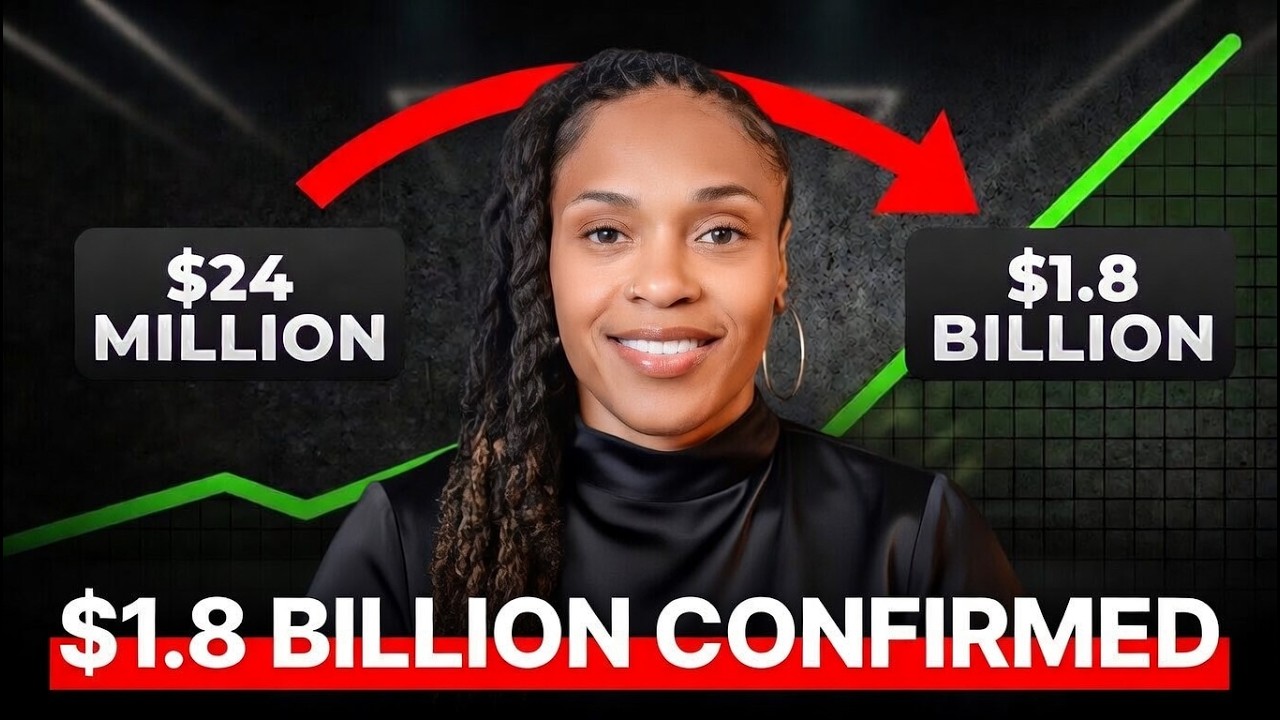
Tokenized real-world assets on the XRP Ledger jumped from $24 million in 2023 to $1.8 billion by 2025-2026. Kamilah Stevenson explains why institutions are moving bonds, real estate, and fund shares onto XRPL: 3-5 second settlement, near-zero fees, and 24/7 markets. Even a 2-3% slice of the projected $5-16 trillion global RWA market would mean $200-300 billion settling on XRPL.
Chapters
Most people watching XRP right now are watching two things: the price and the Clarity Act. And I completely understand why, because both of those things matter. Okay, but while most of the community has been focused there, something else is happening on the XRP Ledger that almost nobody noticed, and the number attached to it is going to change how you think about what you are holding. Real world assets, on the XRP Ledger went from $24 million to $1.8 billion. Not a forecast, not a projection, documented on-chain data showing that institutional money has been quietly moving real financial assets onto this ledger at a scale that most retail investors have never heard explained clearly. Now, I'm Kamilah Stevenson, and around here we do talk wealth. And nothing in this video is financial advice. Do your own research and make your own decisions. Like the video. It adds value. And subscribe if you have not already, because what I'm going to walk you through is one of the most underrated stories in this entire space right now. Also, drop in the comments, have you heard about the real-world assets on the XRP Ledger before this video? Yes or no? Let me know, because I just want to know how many people in the community have seen this data. Let's get into it. First, I want to talk about what real-world assets actually are and why this number is significant. Let me start from the beginning because I have noticed that real-world assets is one of those phrases that get thrown around constantly in the crypto space without anyone really stopping to explain what it means in plain language. And if you do not understand what it is, you cannot understand why the number we just talked about matters as much as it does. A real-world asset is exactly what it sounds like. It is something that exists in the physical or traditional financial world, meaning a government bond, a corporate bond, a real estate property, a private credit instrument, a fund share, or a Treasury bill that has been now converted into a digital token on a blockchain. So the underlying asset is real. The tokenized version of it lives on the chain. And the reason institutions are increasingly interested in doing this comes down to a set of problems with the traditional financial system that most people experience as normal, but are actually enormously inefficient when you look at them clearly. Think about what happens when a large institution buys a bond today. The transaction has to go through multiple intermediaries, custodians, clearinghouses, settlement systems. The actual transfer of ownership does not happen instantly. It takes maybe 2 or 3 business days to settle. Now, during that window, capital is tied up, counterparty risk exists, and every intermediary in the chain takes a fee for doing essentially nothing except being a trusted middle party in a system that requires trusted middle parties because there's no better alternative. Now think about what happens when that same bond is tokenized on the XRP Ledger. The transaction settles in 3 to 5 seconds. There's no intermediaries required because the ledger itself is the settlement layer. The transfer of ownership is recorded permanently and transparently on chain. The cost of the transaction is a fraction of a cent, and the market for that asset operates 24 hours a day, 7 days a week, instead of only during business hours in specific time zones. Now, that is not a marginal improvement. That is a fundamental restructuring of how institutional capital moves. And institutions have spent decades dealing with the friction of the old system, not because they preferred it, but because There was no better alternative, and now there is. So when you see real-world assets on the XRP Ledger go from 24 million to 1.8 billion, that number is telling you something specific about institutional behavior that has nothing to do with retail sentiment or price speculation. It is telling you that the people managing serious institutional capital have evaluated the XRP Ledger as a settlement and custody infrastructure and decided it is ready to hold real financial assets at scale. Let me put that growth in context because I think most people might hear the $1.8 billion and they don't fully process the trajectory behind that. In 2023, total real-world assets on the XRP Ledger was approximately 24 million. That is a small number. It's experimental. These were early adopters doing proof of concept work. By 2024, that number had grown to approximately 568 million as more institutions moved from evaluation to actual deployment. And by 2025 into 2026, the number crossed 1.8 billion, representing a 75 times increase from where it started just a few years ago. Now, here's what makes that trajectory significant beyond just a raw number. The growth is accelerating, not decelerating. The institutions that moved early validated the infrastructure for for the ones that were still watching. Every successful tokenization on the XRP Ledger reduced the perceived risk for the next institution considering the same move. This is how institutional adoption actually works. It doesn't happen all at once. It builds in waves where early movers create the proof of concept that opens the door for the next tier of capital to come in at larger scale. The $1.8 billion is not the destination at all. It is the proof of concept phase completing itself and the next wave beginning. And here's a detail that I want to add to this. Every single one of those real-world asset transactions on the XRP Ledger requires XRP to pay the transaction fee. So every bond tokenized, every fund share issued, every credit instrument settled on-chain, each one of those transactions burns a small amount of XRP permanently. So the RWA growth is not just an adoption story, it's a supply story happening at the same time. More institutional activity on the ledger means more XRP is burned forever. More XRP burned means less supply. Less supply with more institutional demand flowing from multiple directions mean the conversation about this asset's value looks completely different from anything most retail investors are currently modeling.. And so this concept should fundamentally shift how you think about what you are holding. Now there's so many different curves to this, including banking settlement, RWA tokenization, AI agent economy. I talked about this in another video, and there are all of these things that are happening at the same time, and all of these are still in relatively early stages of their full deployment. So think about what these signals mean, right? The total global market for real-world asset tokenization is projected to reach somewhere between $5 and $16 trillion over the next decade, depending on which analyst projection you're looking at. Okay, so there's a wide gap between that, but the XRP Ledger does not need to capture all of that market to fundamentally change the demand equation for XRP. It doesn't even need to capture a large fraction of it. If XRPL captures 2 to 3% of a $10 trillion market, that is $200 to $300 billion in tokenized assets settling on a ledger where every transaction burns XRP permanently. And I'm trying to be conservative with that. So most retail investors are evaluating XRP based on the price they see today relative to the price they hope to see tomorrow. The institutional money that is actually moving into this ledger is not thinking in those terms at all. They are thinking about infrastructure, about settlement efficiency, about what rails their assets will be running on 5 and 10 years from now. And they have already started moving. So the $1.8 billion is not the story. It is the opening chapter of the story and understanding That distinction is what separates someone holding XRP with surface-level conviction from someone holding it with the kind of depth that does not get shaken by a 30% price pullback. Okay, so do not get tripped up in hoping that something is coming to prove your stance, something that you're waiting for to become more obvious to you, right? These signals are showing Adoption is not coming. It is happening right now at a pace that most people are not tracking because they are too busy looking at on-chain data. They are looking at price charts and news headlines. The $1.8 billion in real-world assets on the XRP Ledger didn't appear overnight. It built quietly over several years through thousands of individual institutional decisions that never made the front page of any crypto news site. No single announcement caused it. No viral moment drove it. Institutions evaluated the infrastructure. They decided that it met their requirements and they started moving assets into it. That's how real adoption works at the institutional level. It does not announce itself loudly. It shows up in the data for the people who are paying attention to the right signals. And here's what the trajectory of that data suggests about what comes next. Every major wave of institutional adoption in financial history has followed the same pattern. Early movers validate the infrastructure at small scale. Mid-tier institutions observe the early movers, then they complete their own due diligence, and then they enter at a larger scale. And then the late movers enter when the infrastructure has been proven at scale and the regulatory framework is clear enough that their compliance departments can sign off without significant legal risk. Right now we are in the transition between the early mover phase and the mid-tier institutional phase. The Clarity Act providing regulatory clarity, the SEC commodity determination locking in XRP's legal identity, and partnerships that are happening like Aviva that we didn't talk about are the signals that the mid-tier wave is beginning to form. And the capital that moves in mid-tier wave is not measured in billions, it's measured in tens, and eventually hundreds of billions. Now, the $1.8 billion is the proof of that concept. So what follows it is the scale. And here's a very important thing that I do want to say. Most people are trying to figure out when XRP is going to move based on price targets and timelines that they read on social media. That's the wrong question entirely. The right question is whether the infrastructure being built around What you're holding is real enough and significant enough that the price eventually has to reflect it. The $24 million to $1.8 billion trajectory on chains answers that question without requiring any speculation about timing. The institutions moving real assets onto this ledger are not doing it because they think XRP might go up. They are doing it because the infrastructure solves a real problem at institutional scale. And when infrastructure solves a real problem at institutional scale, the asset that powers that infrastructure does not stay priced at retail speculation levels forever. Now, I do want to connect this to something we covered directly to a decision that most people keep putting off and should not. The institutional money moving on to the ledger right now is not doing it through retail exchanges and taxable accounts. They are structured intentionally. And if the RWA story plus the banking adoption story plus the AI demand curve all pull on this asset simultaneously, the gains that result from holding through all of that are going to be significant enough that your tax structure matters big time. And so iTrustCapital is where I hold some of my XRP and other digital commodities, and it is the structure that I choose specifically because of what I believe is coming. Inside a Roth IRA, every dollar of appreciation is completely tax-free. So when three demand curves hit a deflationary asset all at once, you want to be holding inside a structure where you keep everything and not just most of it. I do also want to add that they have added RLUSD, which is Ripple's own stablecoin, as a holdable asset. So the link is in the description, and there is a $100 funding bonus if you do fund your account and you can take that money and buy more assets. And if you do want to go further, they do have a premium account which is built as a closed-loop system specifically designed for serious long-term holders who want institutional-grade security and want to be positioned for yield products as they come online. And this is not retail exchange. This is infrastructure built for people who understand what they're holding. Again, the link is in the description. $100 funding bonus if you use it. And if you feel like everything that we talked about connected the dots, but you still do not have a clear personal framework for how much to hold, where to hold, and how to think about this across a multi-year timeline, then that is exactly what my community and my clarity calls are designed for. It is not generic advice. It is for your specific situation. And the link is in the description for that. Go ahead and like the video, subscribe, and share it with someone in your circle who wants to know more about XRP purely. And I want to leave you with this. When historians look back at this period in financial history, they're not going to talk about the people who predicted the price. They are going to talk about the people who recognized the infrastructure while it was still being built and understood it clearly enough to hold it while everyone else was distracted by the noise. The $24 million to $1.8 billion happened while most people were not looking. Pay attention. To what happens next. And as always, I want you to stay wise, stay wealthy, and I'll see you in the next video.









